I have been thinking a lot about life in the modern age and how perhaps people were not meant to live in these conditions.
History shows us that disability, sexuality, health and other traits of the human body have always featured difference. Political systems and religions have persecuted some and benefited others since the dawn of time.
But as the world industrialized, we have distanced humanity from the natural rhythms of life.
Humans used to live and sleep by the sun and survive by preparing for each of the seasons. We lived with extended families and protected communities. The amount of labor that needed to be done also meant there were jobs for all, some easy and some hard. Work all contributed toward survival and jobs could be catered to the abilities of each.
We have introduced so many technologies and made our lives much less physical, and our bodies and our mental health pay the price. Perhaps the human machine was not meant to process so many electronic signals, strange lights and live in manufactured environments.
In my own life, well-meaning friends are always telling me to stop over-scheduling myself and to relax more, but I don’t think they understand that I have enough time and energy to do it all— I just can’t settle my thoughts enough to do it without urgency.
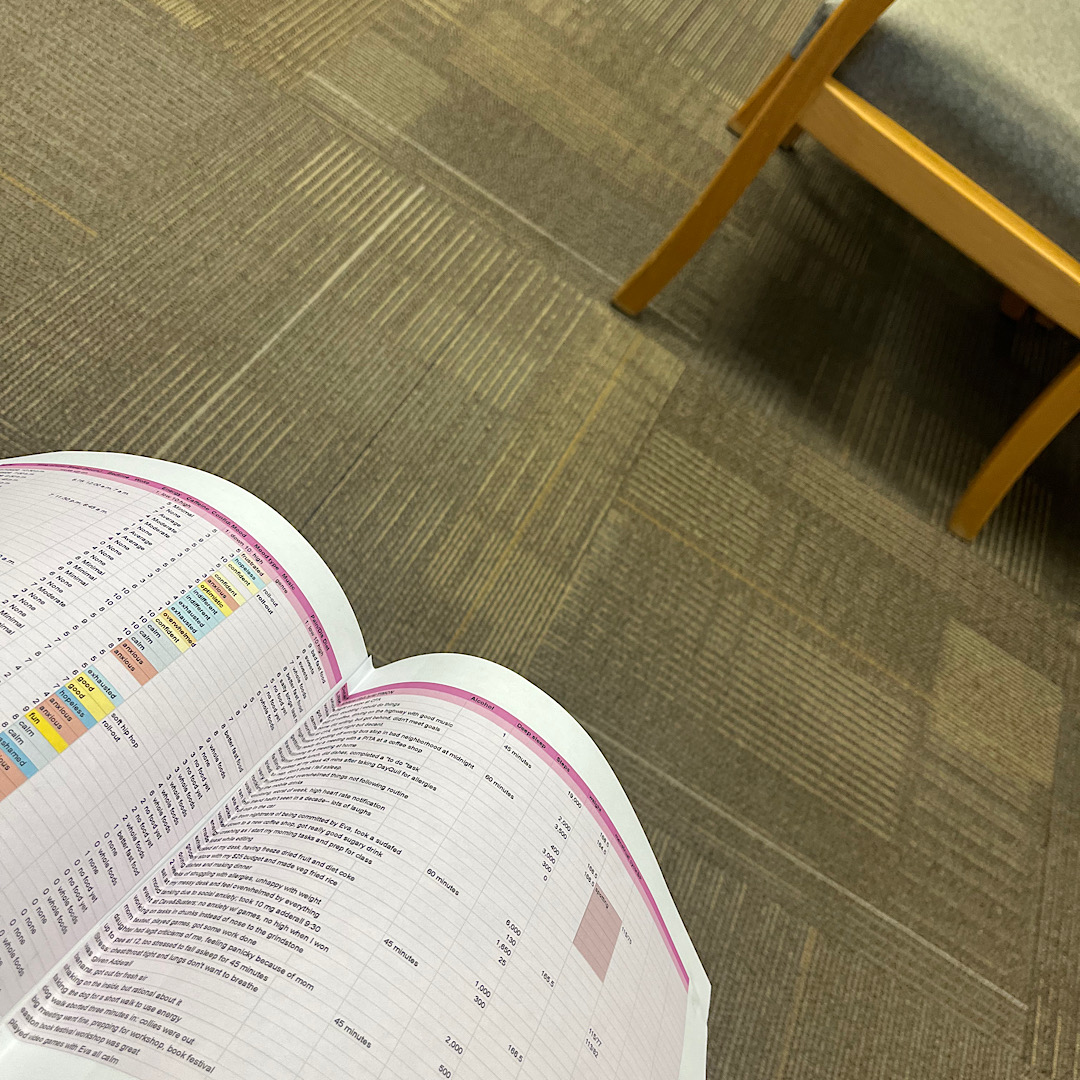
Today I visited my mental health therapist for the purpose of showing him my charts and my data regarding the idea that I may or may not have ADHD or AuDHD. I told him that even though my daughter and I took the same screening, at the same time, and had almost the exact same results, that of course the establishment would offer the teenager a stimulant and a diagnosis of ADHD and me, the fifty-something woman who has always done all the things, an SSRI and question if I have a form of depression.
“They want everybody on an SSRI,” he quipped, “not just you.”
I went to see my therapist because I know returning to my primary care physician’s office Thursday to see the shrink-by-proxy and my actual primary care physician– who has not heard about any of this yet will potentially be emotional, because while I have compiled all this data, the reality is that the most likely outcome will be the one-size-fits-all assessment. And I am not that simple, none of us really are.
My therapist can see how my experiences with Adderall have quieted the fire in my brain, allowing me to end the constant urgency in my everyday tasks, but still thinks my general organization skills dispel the idea of any sort of ADHD, but if there is a touch of Autistic behavior in there… who knows. But that it’s the everyday minutiae that spins me out of control, not a crisis. And we all know that it’s hard for me to adapt in environments of shifting expectations or no communication– that’s when my emotional regulation gets out-of-whack.
But I keep thinking back to the two sensations I have never had before, that I experienced on Adderall:
- I could relax on the couch and just relax, without thinking about what else needed to be done or how to boost my efficiency.
- I could have fun– play video games without feeling threatened, without the high of a win or an emotional landmine when I lost. Fun didn’t feel like a chore.
And these are the things I would like to explore… how to dial down my brain. How to focus on one moment or one item at a time without thinking of all of them.
I shared my spreadsheet with my mental health therapist, and he said he hadn’t even seen anything like the spreadsheet I had prepared. And that’s when I mentioned that the spreadsheet might place me on the Autism sprectrum. And he chuckled. And gave a slight nod.
Data doesn’t lie. It might not have all the answers but it doesn’t lie. Numbers, charts and data bring me solace. Solace amid the chaos of life.
My mental health therapist asked me why my last appointment with the shrink-by-proxy had hit me on an emotional level– and I realized that her responses to me, very standard responses based on the average person, had suggested that she had reached the end of her ability to try and understand me and had made her judgment about who I was.
As a woman with a disability who has always been quirky and outspoken, I don’t get to fade into the background. I will always be noticed, remembered and the person who sees me will have an opinion about who I am and what I stand for. Or what I am capable of. Or what is wrong with me.
So I lean on my team to reassure me that I know what I am doing. And I have always used therapy as a way to organize my thoughts, my priorities and make a plan to improve, and apparently I do that in a way that is much more “buffered” than the standard. My therapist mentioned that today, and I wonder if some of that is the storyteller in me, automatically relaying the tale in a more palatable manner.
But my therapist also pointed out that the psychiatrist’s office’s assessment that I may need to deal with my past trauma more may not be entirely accurate– and he admitted that he is not a trauma therapist so he can’t really say– but that in all the time he’s known me he’s never heard me say that I had a flashback of a traumatic incident, or that it came up during a recent part of my life. This also adds more complexity to who I am.
In the end, I wonder, will my primary care provider prescribe a test run with Adderall if only to allow me a few days to track the results? Because this exploration has done wonders in giving me fresh perspective. What if my intermittent symptoms of depression are actually burn out? What if my “anxiety” is an inability to set one task aside while doing the other?
More to think about. More to understand.