Facing modern Orientalism in Lalla Essaydi photographs at Lafayette College

This is the final week to see Lalla Essaydi’s photographs at the Williams Center for the Arts gallery at Lafayette College.

This seven photograph exhibit takes a journey into contemporary Muslim women’s space while exploring traditional Orientalist beliefs, otherwise known as Western stereotypes of the Muslim/Arab experience.

Immediately, I recognized these themes in Essaydi’s photography. My previous exposure both academically (my interest in post colonial Francophone Africa, how it intersects with the Muslim world, and the impact these topics have on contemporary international politics) and via travel in Africa and the Middle East came rushing into my head like a lost dream you fight to remember upon waking.

This exhibit features five photographs that use white/beige colors, Arabic writing, henna and women in various levels of religious covering and two photographs more steeped in color.
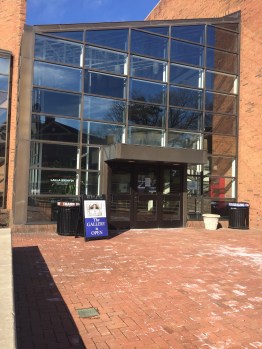
The seven photographs come from three different series: Converging Territories, Harem and Bullets. Just reading those titles should leave a certain taste in the mouth. I have with me an exhibit guide but I haven’t referred to it yet as I prefer to digest the works on my own first.

The first piece one encounters in the exhibit is 2004’s Converging Territories #24, featuring a woman’s face, only eyes showing, with writing on her face and the cloth covering her. The chromogenic print mounted on aluminum divides the woman’s face into four panels, each an almost even display of skin, lettering, and beige fabric.

This one did not attract or impress me. That is not to say it does not present a strong harmonious image. It is certainly a lovely piece of artwork, but artwork often speaks to the viewer in unique ways and this one seemed what one would expect from an exhibit like this.

Next came Harem #2 (2009). Instantly, I noticed the use of the term harem and the mimicry of traditional Orientalist images prevalent in I believe it was 19th century Western paintings capturing a fantasy of what Western/European artists expected the Muslim/Arab lifestyle to be.

The Harem series uses more color, more texture, and repeats the Orientalist themes of a reclining woman in exotic dress. The repetition of these stereotypical themes used by a Muslim female photography made me bristle. But this woman is propped on one arm and seated rather proudly so I sense the challenge to the age-old idea of the Middle Eastern harem.

Next, I found Bullets #3 (2003). The woman  in this photograph has a sassy shoulder turned to the camera. She is covered, but showing more flesh than normally proper throughout the arm. The backdrop is all bullets as if they were tiles on the wall, bullets also adorn her clothes. Another stunning photograph, but frankly I grow tired of the constant obsession of the Muslim identity automatically connecting with terrorism. I’m sure that’s Essaydi’s point, too.

I’m going to skip my favorite piece and turn instead to Harem Revisited #34 (2012). Perhaps this is the most colorful piece presented at Lafayette. It is three years newer than the other, and the woman’s pose in this one is not only more docile and reclined but divided into three panels, an immediate detraction from her humanity. She is reduced to pieces.

But the focal point of the exhibit (and my favorite), if I can proclaim that based on not only the fact that it was in my opinion very prominently displayed, is Converging Territories #30 (2004). [Featured image for this post.] It depicts, with the same beige clothing on beige background covered with writing and people decorated with henna, four females standing side by side in various levels of garb.

The largest woman, whom appears to be the only adult in the group, is completely covered head to toe. I can’t even refer to it as burqa as she doesn’t even have a slit or a screen for her eyes. I see them as a family, and the next one is in more traditional burqa and appears to be an adolescent. The next girl, a sweet looking pre-teen, has her scarf tied under her chin, exposing her whole face but not her hair. The last little girl has no head covering.

What I adore about this photograph is the vivid use of the progression of covering as it follows a woman through various stages of life and suggests not only the typical message of how a woman’s identity is limited by strict forms of covering, but also attaches this idea to the act of mothering and potentially makes it more universal. To me, the suggestion is that all women lose a part of their identity as they transition into a maternal role. This has nothing to do with religion.

If you miss the exhibit at Lafayette, a similar exhibit runs through May at the Trout Gallery of Dickinson College.

About Lalla Essaydi: According to the exhibit guide, she grew up in Morocco, raised her family in Saudi Arabia, and lived in both France and the United States. She received her arts education from prestigious art programs in both France and the United States.

When your writing career carries on without you…


So today I got an unexpected email from the folks at SAGE Academic Publishing. About four years ago, I wanted to write some short encyclopedia entries for them and they said no because I didn’t have a Ph.D. It was one of the things that made me consider graduate school.

They advised me that if I could find someone to co-author who had the necessary credentials, I could write for them.

I enlisted my college era friend Annette Varcoe, a brilliant scholar in American history and Women’s studies who had a freshly-minted Ph.D. after her name. She allowed me the pleasure of helping her edit her final dissertation.

The topic at hand was one of my favorite places in the world, Djibouti, and the article was based on a capstone project for my international affairs degree I had just completed. She knew nothing about Djibouti but her critical eye brought life to my dream and she got hooked on this region of the world and conditions there. Our first article was on poverty in Djibouti. She approached me a few months later and asked if I would consider doing another on security.

We did. Both pieces were submitted fairly close to each other. We probably wrote them both in 2014. The poverty piece was published in July 2015. I got the email that the second has now been published. March 2018. My career looks current even if I have stalled a bit!

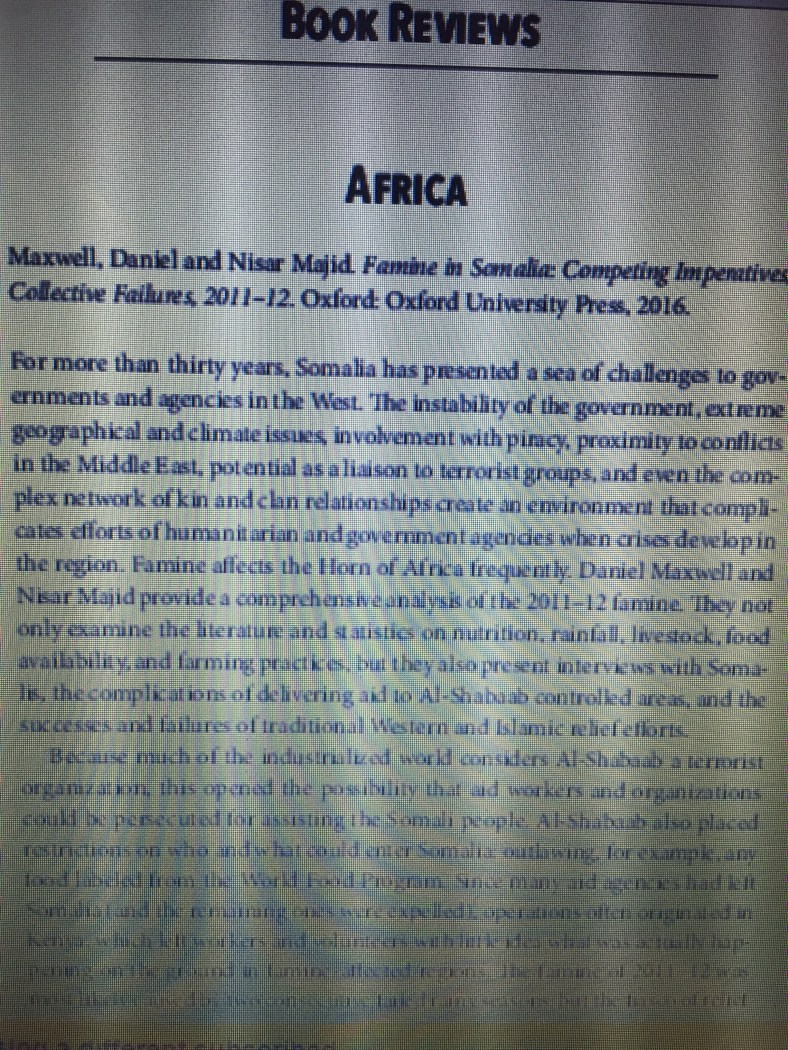
This refreshed my memory that I never actually saw a book review I submitted to Global Studies South. Since my husband is home from work today using up his vacation, I asked him to look me up in the academic databases to which the Lafayette College libraries subscribe.

And here I am!

Parenting, Existential Angst and a Book Review

My semester off from my master’s level work on World History has reached its end… only a few more weeks left until the academic session I skipped comes to a close.

I want my degree. I love African history. I am fascinated by colonialism, Islam, Francophonie and obscure languages. But I am forty-something and my daughter, at almost 13, floats between child and young woman/ angel and royal handful.

So my place is here. At home. I get it. But parenting is a thankless job, even with love and a well-behaved-almost-adult as its reward. Sometimes it gets hard to exist only as the nag, the disciplinarian, the cook, etc.

And sometimes I miss long discussions debating the similarities of the industrial and technological revolutions. 

I have been reading, and enjoying, Philip Gourevitch’s book We Wish to Inform You that Tomorrow we will be Killed with our Families: Stories from Rwanda. It is a sobering book.

More on this later… my daughter is on her way home and I have to sneak a doughnut before she arrives.

Movement in the face of stillness

My mother taught me never to stand still. She wanted to teach me that I should always make my bed and I should never leave the house without doing all the dishes, but I failed in those lessons.

I spent much of my twenties doing exactly what I thought I was supposed to do: I embarked on a career, I bought a new car, I rented an apartment, I got married, I paid off my student loans.

In my thirties, my husband and I focused most of our energy on our daughter. My career as a journalist became more precarious. I went to work part-time as I earned a second bachelor’s in International Affairs.

By my late thirties, I started traveling with a friend. I realized maybe I didn’t want a traditional professional occupation, but I couldn’t label what I did want.

Now I’ve crossed 40. I am working on a master’s degree in world history at West Chester University. I’ve had a few small acceptances with some of my creative writing. I’m contemplating pursuing more paid freelance writing work.

And I also might take a semester off from my master’s work. My daughter is nearing 13 and I never realized how much she’d need me now.

These are the thoughts I was thinking this morning as I held my office hours as a graduate assistant in West Chester’s history department. I stumbled upon one new publication that may be a good fit for me as a journalist wanting to return to the trade and some of my more alternative leanings.

And while I sit quietly, alone, in this office, I ask what will I do with myself this winter with no schoolwork and only my tedious retail job? And I realize this time will be introspective and hopefully give me more stillness so that my true desires come into focus.

While I ponder these thoughts, which are not easy thoughts, I receive an email.

“Thank you for your revisions.” “We’ll contact you with a publication date.”

An essay I submitted to an online literary magazine a few weeks ago seems as if it has accepted my piece. The piece is about weather, Djibouti and broken bones. It’s a quirky publication too so this may be a sign…

I must keep writing.

Seeking perspective: the story behind my travels

This is the rough draft of a presentation I have been asked to give to a class of my graduate school peers at West Chester University next week. My faculty advisor asked me to give a talk about my recent travels in Somalia. We’re all working on master’s degrees in history or genocide/holocaust studies. 

In my case, I’ve recently discovered I’m not the European History MA candidate I thought I was but apparently I’ll be studying World History, with an emphasis with Africa, followed by minor fields in the Middle East and China. 
My true interest is post colonial Francophone Africa, and how the ramifications of European colonialism have an impact on contemporary issues regarding the overlap of Africa, the Middle East, and terrorism. Islam has become the new communism as the dangerous ideology the West must destroy.

Life circumstances have forced me to move away from a successful 15-year career in local print journalism. But my interest in information, sharing information and researching perspectives on the world has led me toward an eventual Ph.D. 

My career in journalism featured a variety of restructurings and lay-offs. When perpetually faced with a shifting marketplace you are forced to face your fears and your complacency. Every small event in life can lead to an unforeseen path. For me, I turned my focus toward my daughter and part-time professional work. A friend steered me toward hosting a French exchange student which led to me enrolling in an undergraduate French class to see if I still had the language I once majored in rolling around in my head.

I did.

That class opened my eyes to my love of academia. It also exposed me to the “Muslim problem” in France. And I made new friends. 

Although I had a bachelor’s degree in English/French from Moravian College, I enrolled for a second bachelor’s in International Affairs from Lafayette College. It would be the perfect way to see if I could balance life, school, work and child. Plus it would give me academic credentials in fields I knew about from my journalism experience: politics and economics. I just never anticipated that I would develop an affinity for history.

Up until this point, I was a total French whore. I visited France for a month in 1995 and fantasized about a return to Paris. It was 2010.

My part-time professional job imploded. I developed severe anemia that left me lying on the living room floor at three in the afternoon until my five-year-old could make a cup of coffee for Mommy. I got a job in retail, because I didn’t have the strength for professional work. I wanted to punch a time clock and go home.

Around this time an old friend from college the first time reconnected with me via Facebook. He offered to take me to Paris. He felt sorry for the rough patch I had hit in life and he had the ability to make my return-to-Paris dream a reality. We went to Paris for the weekend between my orientation for my new job and my first day of training. There were twelve of us in that group at orientation, and we had to introduce ourselves. We were asked to share something random about ourselves. I remember saying, “I’m Angel and I leave for Paris tomorrow.”

M and I had a great time on that trip. I was in a history seminar on 20th Century French Identity and the Muslim problem and religious history in France was a key component. My travels in Paris had included a visit to public Muslim prayer in the streets. I went to ethnically diverse neighborhoods where the European Paris I remembered did not exist. What I found was a multicultural Paris swimming with Africans, Asians, Indians, gypsies and Arabs. I recently had a poem published in StepAway magazine about this revelation.

My studies kept leading me to Algeria, and I became convinced that the complex issue of religion in France should not be one of the French against Islam, but the French addressing their stereotypes of Muslims created during the colonization of Algeria. The no headscarves in schools law and later the anti-niqab law focused on visible Islam, but the issue was French perpetuation of the 19th century prejudice that Muslims were inferior people. These stereotypes came from the Algerian colonial project. This became my honors project.

I am typically afraid of my own shadow. But it was around this time that M suggested a research trip to Algeria. His visa never came through. Mine did. 

  
So we did an immigrant’s journey instead. We started in Paris, fly to Tunis (visited the ancient ruins of Carthage) and finished the voyage with a few days in Marseille soI could see the Arab influence. It opened my eyes. 

I will always have a soft spot in my heart for France, after all I have read the 1905 law on the separation of church and state and the constitution of the Fifth Republic in the original French. But setting foot in North Africa changed me. There was such a crazy blend of European influence and African beauty. From fresh baguettes covered with flies and soup made of lamb sausage and harissa (known as ojja) to the diversity of the architecture… We had arrived in Tunisia on the one-year-anniversary of the abdication of President Ben Ali and the initiation of the Arab Spring. And we had done that by accident. The streets were teaming with people, citizens shot fireworks off balconies, and a random North African guy grabbed my ass.

I had certainly gone beyond my comfort zone. And I started to realize that sometimes the thing that scares you most is the thing you most need to do.

My next academic interest became Djibouti. After the Algerian War for Independence (which ended in 1952, an abrupt and tragic decolonization that led to the more-or-less overnight displacement of a million French people and caused, in my opinion, the psychological issue that has further exploded into the contemporary “Muslim problem” in France), the French moved their primary military presence in Africa to the horn, to the small colony of Djibouti, a strategic point between Eritrea, Ethiopia and Somalia.

France had a conscript army until 1999. This means that when the French left Algeria, a multitude of the next couple generations of men served their military service in Djibouti. M had visited Djibouti just prior to the original trip to Paris he and I took. I begged him to take me to Djibouti. He did. In April 2014. During the beginning of the hot season. When I had a broken right hand in a brace. For a side trip, we did Yemen. Old Sana’a. Where I discovered they love to climb to roofs.

I loved it. We went to Moscow and Siberia in 2015. The Siberia trip was a one day visit for pizza. (Stories about all these trips can be found on this web site.) I have literally walked through what felt like good-block, bad-block, reminiscent of communist era Russia. And ridden some amazing old subways that are more than 100 years old. 

This year we returned to Djibouti. A war has since broke out in Yemen so while the State Department may frown upon my visit there, I am so glad I saw it when I could. (And for the record, I technically did an internship for the State Department. I worked in communications at USAID.)

Somewhere along the line, I said I would visit Somalia. So we did Mogadishu during our January trip. It’s strange to visit places where you become the one who doesn’t speak the language or have no ability to read. It’s surreal to be escorted everywhere by men with machine guns. But it also teaches you how much of the world lives and why knowing what happens around us— knowing our history— is so important.

The plane on which we traveled between Djibouti and Mogadishu was the same exact plane where a suicide bomber killed himself and blew a hole in the plane. That happened less than two weeks after we left. A week after we left there was a hostage situation at Lido Beach, our first destination when we arrived in Mogadishu. 

But look at what’s happened recently in Paris, Turkey, Brussels. A house caught fire in the middle of my block and took out three neighboring homes. The weekend before I left for Africa, I rescued someone from a heroin overdose in my own house. I broke my ankle in August walking down the street to buy a salad. Safety is an illusion. 

M handles the arrangements for our trips. He’s headed to Syria next week and while he invited me to join him, I declined. Safety is one of the reasons, but not the most important to me. I have faith in his research and contacts. He’s been doing this a long time. You can’t be careless, but “adventure tourism” is a real thing. As historians and academics, we have to remember where our perspective comes from and that we can’t rely on the media for our viewpoints. If you aren’t sure of your sources, sometimes you need to tackle it yourself.

Review: A Rainbow in the Night

  This isn’t going to be an elaborate entry but I wanted to mention that I finished Dominique La Pierre’s A Rainbow in the Night: the Tumultuous Birth of South Africa. 

I found the first 150 pages gripping, but as the 20th Century dawned it seemed like a shift happened in La Pierre’s storytelling. I don’t think that is the case, but that is how my brain perceived it.

La Pierre tells his story by choosing significant figures in South African history and using their story to build a national story. The tale seems to build and reflect on apartheid, whereas the title seems broader than the interior content. 

My knowledge is somewhat limited on South Africa and I thought La Pierre’s easy style would give me a quick basic review of key items in South African history, and it did. I guess it brings up the question of how does an author or scholar deal with a topic that is heavily overshadowed by something distasteful or tragic? 

Now I’m on to a book about war in Somalia, the Sudan and Rwanda so I don’t expect anything uplifting soon…

Good surprise, bad surprise

IMG_7516

This hardly getting any sleep and doing a lot of walking and traveling takes a toll. I was so exhausted on the RER into Paris.

Luckily M knows we’re not as young as we used to be so he booked us a hotel room at Mercure-Gare de Nord. We always stay in this neighborhood, but usually in little m0m-and-pop establishments deeper in the side streets. This hotel is across the street from Gare de Nord.

That was a great surprise. I flopped onto the bed and took a nap.

But… speaking of small establishments… the coffee shop where M and I have taken coffee for the five years we have been traveling together has changed hands and it’s now a STARBUCKS. Sigh. So sad.

But… more news… We are here during the January sales! France only has sales twice a year. And I managed to show up during the sales. Went shopping already.

And since I am interested in youth disenfranchisement, immigrant politics in France and French rap, I bought Diam’s two books.

Holiday Upheaval

The events of the last few months have rendered my life unrecognizable, even to me.I have a suspicion that 2016 may come together in ways I never imagined or be the year that leaves me bankrupt, homeless and destitute in more ways than one.

So far I’m leaning toward and working for the former, but the worrier in me can’t help but fear the latter.

Between my broken ankle and the medical bills I incurred (who knew physical therapy was THAT expensive?) and the fact that I paid for graduate school, car repairs and a euphonium on my American Express, I was forced to ponder refinancing the house. The appraiser comes Sunday, but, again, I’m nervous because the appraisers are never generous in my experience. Last time I did this, they wanted to loan me exactly what I need now. So we’ll see. This new mortgage would shorten the length of our current loan, pay off the car and the American Express AND not add to the cost of our monthly payments.

With this and winter and travel looming, I have decided to defer enrollment at West Chester until next semester. I won’t have to commute in the snow. I can get my finances in order and proceed responsibly and not worry about classes interfering with my travel schedule.

Speaking of travel: January 7 I leave for France; I believe it’s January 8 I leave for Djibouti and January 12 I arrive in Mogadishu. Plus a trip to Lebanon may be in the works for spring.

I’m also working on some book reviews in some World War II era memoirs for Hippocampus.

Now the good news…

My poem “This Paris” has been accepted by StepAway magazine. I don’t consider myself a poet, so it’s a tad funny that I’ve placed a poem.

I believe I got an A in my grad school history class and my professor would like to see me continue some of my work, specifically on the Horn of Africa. That’s the topic, not that she wants me to go far, far away.

Publication and acceptance

  
I got an email earlier this week that I was accepted into West Chester’s MA program in history.

Today I received an email with information on how to get temporary access to the article on poverty inDjibouti I co-authored with Annette Varcoe for the Sage Encyclopedia on World Poverty, volume 2.

And my husband and I are finally going to see the new James Bond movie Monday.

This post is short, but full of fun news.

Oops! I think I start grad school next week

  
As a former journalist, I have a passion for research, current events and packaging information. 

When I earned my second bachelors degree, I did it to show my daughter the value of education. I wanted to start grad school, but I didn’t know how feasible that would be with a job, a child, a household and several volunteer commitments. So I committed to a new undergraduate career instead. Cheaper & faster than grad school. A way to test the water. A way to increase my academic credentials to better match my professional experience.

But I do really want my Ph.D. I applied to a prestigious program last year and did not get in. The whole process taught me a lot and when I reviewed it this winter I talked more in depth with my former advisers.

Here’s the thing about advisers: you have to consider their advice within a framework of who they think you will be. I’ve discovered that my former professors have visions for me that don’t necessarily match my goals. Frankly, some of their plans are quite flattering and sometimes overwhelming.

One adviser had suggested the MA program in history at West Chester University. At first I didn’t take him seriously because they don’t have a Ph.D. program.

They sent me an email, coincidentally, advertising a grad school open house. Here’s the kicker… If you attended, they waived your application fee. 

 And then I reviewed their faculty. I noted at least five professors whose interests intersect with mine. The program was flexible, part-time or full-time, affordable and has some scholarship/graduate assistantship available.

At the same time, I was trying to contact another prestigious school about taking a class in their African studies department this fall. They had a professor who might have an interest in East Africa that might suit me.

It took two weeks to get an email that told me to call them or come to one of their “walk-in” events. The email merely asked if the class I wanted to take could be enrolled in as a non-matriculated student. 

Frustrated by the prestigious school, I emailed West Chester. I received a delightful response the next day that encouraged me to contact anyone in the department. I also got an email from the person who would be hosting for the history department at the open house.

And then the open house happened. Wednesday August 12. The graduate coordinator was enthusiastic and portrayed the strengths and weaknesses of her department. She thought I might like a class they were offering this fall, suggesting the professor would be a good fit, and indeed it was one of the people who intrigued me originally.

I came home. Thought. Chatted with friends. Worked. On Monday I entered my name into the system as a potential non-degree student in the history graduate department.

Monday night I received a student number. I also received an invitation to the history meet-and-greet today. I declined. It’s a 90-minute drive one way.

Tuesday morning I initiated my account and went into the registration system to see what I needed to do to gain approval for the class.

Nothing. Just click. So I did.

Turns out classes start next week.

I have gone from floundering to enrolled in a graduate level class in less than a week. Provided this works out, and I suppose paying tuition is the main next step, I will go from undecided about my next step to sitting in class in less than two weeks.

What have I done? Grad school sneaked up and bit me! Gulp.