An Open Letter to American Society

I am home today battling a hand-me-down cold from my daughter. It’s not a bad one so far, but I am doing everything in my power to keep the damage to a minimum. With flu season ravaging everyone out there, I will take my little cold.

I have a part-time job in retail, a job that pays the bills and allows me the flexibility to live my life with the quasi-freedom a writer’s life should have. It is not ideal, but few things are in today’s world. It’s an overpopulated, under-resourceful place, this world, or maybe we waste too much of what we have.

I have traveled enough to understand what “first world problems” really are. I have talked to enough people from cultures more or less the opposite of mine to see how selfish many people have become.

So, today, I write a brief letter to my fellow Americans. This letter is based on things I see everyday. Too often.

  1. Please stop giving babies iPhones and junk food. If your child isn’t old enough to walk or talk, he or she does not need an icee. And I know it’s not easy to drag an infant everywhere you have to go, but believe it or not, they are fairly easily entertained. Giving your baby an electronic device to watch movies or play games while you shop prevents your child from interacting with the world. That’s how they learn. I saw a mother recently apologize for the fact that her child was mesmerized by a toothpaste box. Good for that kid! Good for that mom! Let your child see things, touch things and meet people.
  2. Get off the phone. A lot of people are busy. We get it. But perhaps that also is a sign that you are misusing your life. And it’s not just people on their lunch hour. It’s the elderly who sometimes can’t hang up the phone to go through the check-out line. It’s just rude and it dehumanizes the person helping you. My daughter recently asked me how you could receive calls at a pay phone. I told her it had a number listed on it so if you really wanted to hang out and receive a call, you could. I also reminded her that this was also the time period where you had to answer the phone to find out who it was and before answering machines and voicemail, if you weren’t home or missed the call you would never know…
  3. Stop buying useless stuff. I think the only reason people buy half the things they own is because of an impulse that starts with “this is cute.” We buy too many clothes, too many knick knacks, so many things. Why?
  4. Live within your means. Be careful with your paycheck and try to save those credit cards for emergencies. Buy the car that fits your budget, not your lust. Not everyone needs the big house. Not every family needs more than one car. Consumers in debt are the playthings of big business.
  5. Eat better. You don’t “need” pizzas and burgers and soda. You don’t need fancy sugar-laden coffee drinks. You want them. You need water (lots of it), fruits and vegetables and healthy protein. I’ll spare the full lecture, but the better you treat your body, the better it will perform for you.
  6. Stop acting spoiled. Or entitled. Or privileged. Whatever word you prefer is fine. You want the random stuff and the fancy coffee drink because you feel you deserve it. And that’s fine. But when they run out of your favorite flavor ice cream, or things don’t work out the way you want, remember everyone usually is doing their best and it’s not the end of the world.
  7. Treat each other kindly. Be gentle. The more we share patience and kindness with our families and those we interact with, the more it will spread. I see too many people get nasty to the sweetest people honestly trying to be the best at their job, and when I see truly good souls fighting tears because someone (who probably has their own demons to fight with) decided to be mean, I don’t question why teens are seeing guns as solutions.
  8. Take care of the elderly. I live in a rare neighborhood. We lost our 90-year-old neighbor last week. Several neighbors helped care for her as she became more and more of a shut-in. The children would all visit. I would always help her carry her groceries or send my daughter to help when I saw the opportunity. That woman died very loved. And my daughter learned how to be a neighbor.
  9. Let your children grow up. Let your children solve their own problems. Have their own experiences. It’s hard to let go. I know. Start small. Let them do meal planning and cook dinner. We saw a team of teenagers working on a school project in a store. They were amazed at the cost of laundry soap and a tad befuddled. Remember, parents are training children to be adults.
  10. Appreciate other cultures. The more you value other cultures, the more you learn about yourself. I think Americans are particularly bad at this.

I’m stopping my list here. I just wanted to give you something to think about.

New Adventure: Reviewing Horror Movies with my Teen

It’s probably been a decade since I met William Prystauk at an after-party of sorts when Kaylie Jones came to the Lehigh Valley to promote her memoir Lies My Mother Never Told Me. My attendance at that book signing was itself a convergence of factors, primarily two: my attraction to Paris and my experiences with parents dealing with alcoholism.

The party in question was hosted by a former work colleague then involved in an MFA program as one of Ms. Jones’ students. She invited me to her home after the event and that’s where I met Bill, also in the same MFA program. And we discovered we had similar interests and were practically neighbors so somehow we ended up meeting for coffee.

At some point in the last week or two, Bill suggested my teen daughter write for his web site, Crash Palace Productions, http://crashpalaceproductions.com/, reviewing horror movies. Except, I pointed out, that my daughter doesn’t watch horror movies due to bad memories of The Walking Dead.

That request got me thinking and I proposed doing a joint review. Last night we watched Netflix’s I am the Pretty Thing that Lives in the House. And this morning, I wrote and submitted the review.

My next hope is that my daughter will watch the 90s classic The Craft and examine whether it holds up with today’s generation. I might even consider that a project for today.

Journaling across generations

I started keeping a journal after a writing workshop at University of Pennsylvania that I attended as a high school student. I kept them faithfully for at least a decade, tapered off in my consistency after the birth of my daughter, experimented with forms (most recently adapting a bullet journal style) and renewed my habit in the last few years but still not with the same devotion I once did.

I used to fill a standard cheap journal in a month. Larger, fancier volumes took longer. I color coded a lot of my text. One color for fiction, one color for poetry and another for personal experience. That sort of thing.

The blank ones included sketches. Briefly, I used calligraphy pen and even briefer a fancy fountain pen.

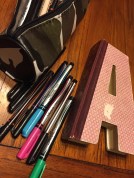
My current fascination is Alphabooks, blank journals in the shape of alphabet letters. I found the A on clearance. My husband had recommended his mother buy me the N for Christmas as it is the second letter of my name, but I fooled them and mentioned if I had the chance I would continue the series with B and write alphabetically.

I also have an affinity for Sharpie pens. I bought a set in August 2016 and they are still going strong.

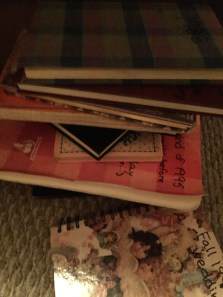
Eventually, my journals ended up in a box in the attic. Or, several boxes, more accurately.

My now 13-year-old daughter has always been captivated by the written word, always written in notebooks, constantly starting projects and ripping out pages (and never finishing). She has started working on her own stories, but journaling hasn’t held her interest.


But she keeps asking to read my journals. I cringe.

I tell her she needs to remember that journals have a lot of angst in them, a lot of unfiltered, unedited thoughts and that what I say in these journals might not always be… well… nice or even what I would say on a different day. And some of my tales might color her opinion of the people she knows, even her own family.

But she keeps asking.
I bought her a nice journal for Christmas. And a HUGE set of Flair pens. She has journaled for 15

days straight. She starts on her journaling journey as I wonder if mine has been worth it. Who wants to read that drivel? There are so many volumes are they worth sifting through? Do I say hateful things?

She asked again. She volunteered to get them from the attic. We sorted through the boxes and at some point I had labeled the cover of the journal with the major events of that time period. I selected a pile of about ten I said she could read.

She started with the journal that included when her father and I got married.

She’s read me excerpts: story ideas I’d forgotten about, adventures and misadventures,

my life as a vegetarian. My favorite thus far has been a poem about my nephew when he was about 3, and a page where he scribbled in my journal. Then my daughter found a journal where she was 2, and I let her scribble in my journal.

So I guess those journals are worth something.

Unlearning Dysfunction

One of the strange parts of growing up in a dysfunctional family, and I resist using that term, is, in my case, you don’t have any other idea of how things should be. My parents struggled with alcoholism, and they were usually functioning alcoholics. But, because they were busy drinking, they surrounded themselves with other people who drank. Most of my extended family drank, too. I didn’t learn until much later that drinking too much alcohol was a problem.

Even though I was the one who had to find my father’s false teeth when he passed out in the car after a binge and lost them. Even though I had to pick the stones and black top from my mother’s back when my father and uncle decided to race their Harleys and my mother fell off. [As we like to tell with a raucous laugh, my dad was almost home before he noticed she wasn’t there.]

Such stuff isn’t funny. But when it’s your “normal” and you’re talking about it years later, it’s not your life any more but more like a movie you saw. And because I have this detached way of looking at it, it seems funny. Until I see the horrified faces of the poor victims of my storytelling.

If your mind is already reeling, grappling with this idea that it’s hard to realize that your normal is someone else’s version of screwed up, let me present a different example. Reality is what we perceive and what we are exposed to.

When I was in middle school, the corn fields in my rural township morphed into housing developments practically overnight. I grew up in a place where bus stops were a mile or more apart and only had one child (unless they were siblings). We never trick-or-treated. There was no where to go. So to suddenly have bus stops with many children, this fascinated me.

The mom of one of these newcomers volunteered to lead our Girl Scout troop. One night we were there for a meeting and the dad came home from work. It was the first time I ever saw a man in a suit. He came home from work in a suit. My dad came home from work in grease-covered brown uniforms.

The locals, we were mechanics, farmers, waitresses, bartenders, truck drivers, quarry laborers, garment factory workers. Some people worked in mythical factories in towns 20 or 30 miles away. I was impressed if someone I knew had a nurse in the family or a teacher. The doctors were all really old white men. We were a blue collar community.

So I remember the day I saw my first white collar worker.

The community I live in now is far more urban and diverse than where I was raised. But my experiences give me the opportunity to empathize with a lot of the different situations I see. And I wonder, for those who grew up in a more traditional home, do you realize how your neighbors or children’s friends view you?

I often think about this. I was raised an only child and my daughter is an only child. I know she loves to experience the chaos of multiple child households. She also likes to come home and be the center of attention. She’s had friends of different religious backgrounds, and some friends with difficult home lives.

Whenever the children are here to play, I wonder, am I showing them something they might be seeing for the first time?

A more contemporary issue of this might be the day I invited a neighbor child to preserve pickles with us. He lost patience with the canning process and didn’t understand why we would go to all the trouble to grow cucumbers and do all this work, when you could simply go to the store and buy pickles.


Parenting, Existential Angst and a Book Review

My semester off from my master’s level work on World History has reached its end… only a few more weeks left until the academic session I skipped comes to a close.

I want my degree. I love African history. I am fascinated by colonialism, Islam, Francophonie and obscure languages. But I am forty-something and my daughter, at almost 13, floats between child and young woman/ angel and royal handful.

So my place is here. At home. I get it. But parenting is a thankless job, even with love and a well-behaved-almost-adult as its reward. Sometimes it gets hard to exist only as the nag, the disciplinarian, the cook, etc.

And sometimes I miss long discussions debating the similarities of the industrial and technological revolutions. 

I have been reading, and enjoying, Philip Gourevitch’s book We Wish to Inform You that Tomorrow we will be Killed with our Families: Stories from Rwanda. It is a sobering book.

More on this later… my daughter is on her way home and I have to sneak a doughnut before she arrives.

Movement in the face of stillness

My mother taught me never to stand still. She wanted to teach me that I should always make my bed and I should never leave the house without doing all the dishes, but I failed in those lessons.

I spent much of my twenties doing exactly what I thought I was supposed to do: I embarked on a career, I bought a new car, I rented an apartment, I got married, I paid off my student loans.

In my thirties, my husband and I focused most of our energy on our daughter. My career as a journalist became more precarious. I went to work part-time as I earned a second bachelor’s in International Affairs.

By my late thirties, I started traveling with a friend. I realized maybe I didn’t want a traditional professional occupation, but I couldn’t label what I did want.

Now I’ve crossed 40. I am working on a master’s degree in world history at West Chester University. I’ve had a few small acceptances with some of my creative writing. I’m contemplating pursuing more paid freelance writing work.

And I also might take a semester off from my master’s work. My daughter is nearing 13 and I never realized how much she’d need me now.

These are the thoughts I was thinking this morning as I held my office hours as a graduate assistant in West Chester’s history department. I stumbled upon one new publication that may be a good fit for me as a journalist wanting to return to the trade and some of my more alternative leanings.

And while I sit quietly, alone, in this office, I ask what will I do with myself this winter with no schoolwork and only my tedious retail job? And I realize this time will be introspective and hopefully give me more stillness so that my true desires come into focus.

While I ponder these thoughts, which are not easy thoughts, I receive an email.

“Thank you for your revisions.” “We’ll contact you with a publication date.”

An essay I submitted to an online literary magazine a few weeks ago seems as if it has accepted my piece. The piece is about weather, Djibouti and broken bones. It’s a quirky publication too so this may be a sign…

I must keep writing.

The iPod saga

My daughter saved her money and asked her relatives for cash for her 12th birthday in June 23. She broke her first one dropping it on the sidewalk (more than once). 

She carried it through Paris, in its brand new puppy protective case I bought her last week. She snapped photos of IM Pei’s pyramids.

Six flights. Two different airlines. Four hotel rooms. Eight days. Multiple continents.

She filmed video of trees in Russia. She recorded herself in airports making silly faces under time lapse.

She played her video games recklessly and typed notes in the Pages app and listened to music.

And as Air France flight 0054 between CDG and IAD landed, I suggested she put it away. I didn’t want her to miss touch down of the huge A380. 

In the car, halfway to DC, she gasps, “Mom, I left my iPod.”

She searches her bag. I search her bag. M searches her bag.

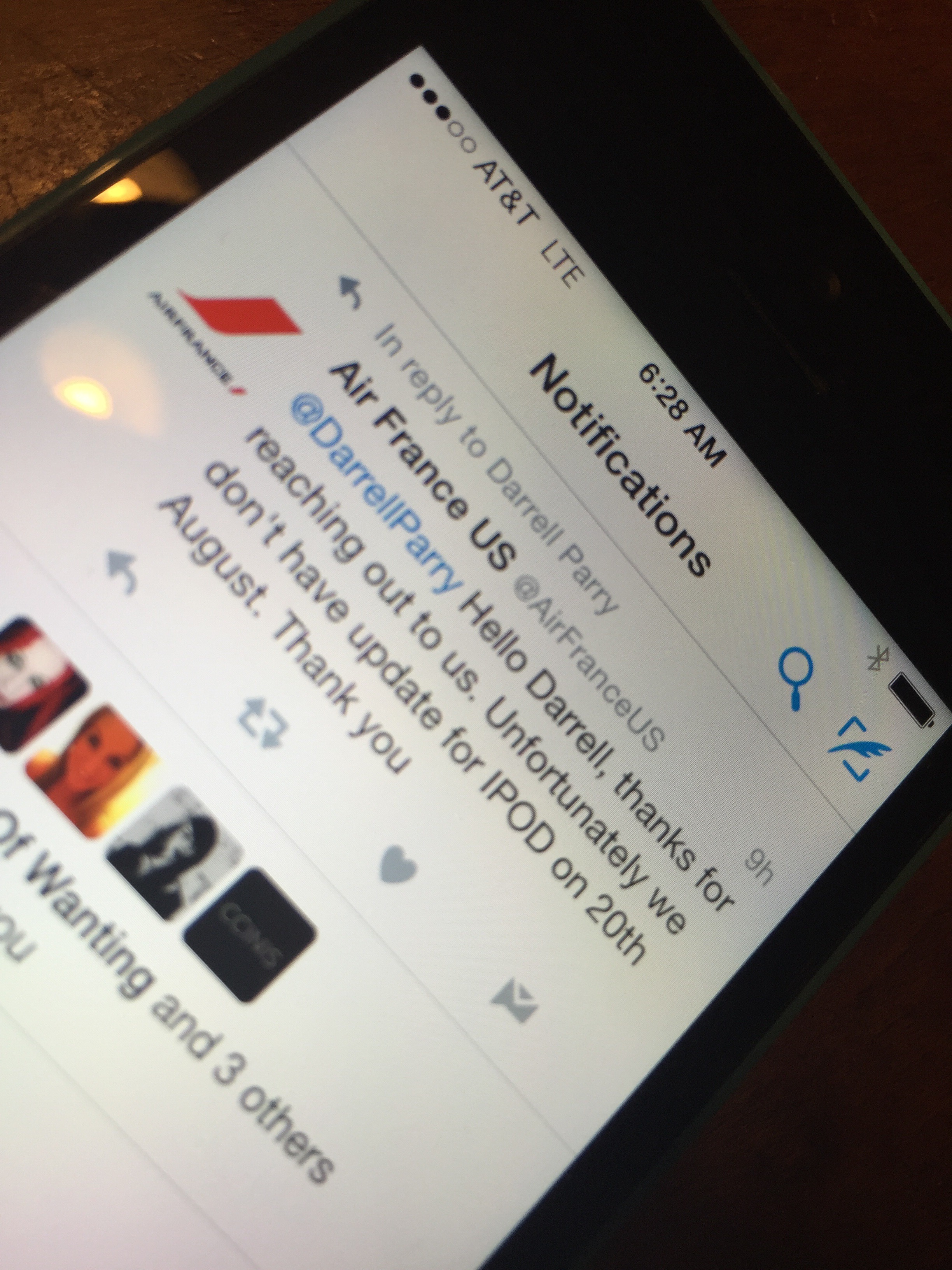
We email Air France’s lost and found. It bounces. We try tweeting to Air France US. “My daughter left her iPod on 0054 between CDG and IAD 8/20. Email to lost and found bounced.”


My husband then tweets her ticket info. We also get the number for Dulles.

We make the child call. The voice menu suggests using the Internet and directs her to a different number if she wants to talk to a person. She doesn’t have a pen ready so she has to call again. 

She gets the number. She calls that. It’s an answering machine. She leaves a flustered message but she can’t remember her phone number. She gives mine rattling it off so quickly I can’t understand her.

I make her repeat it.

It will be a miracle if the iPod returns. But perhaps some good soul will find it. Perhaps someone will restore some of my faith in the human race. 

We found our Moscow joint

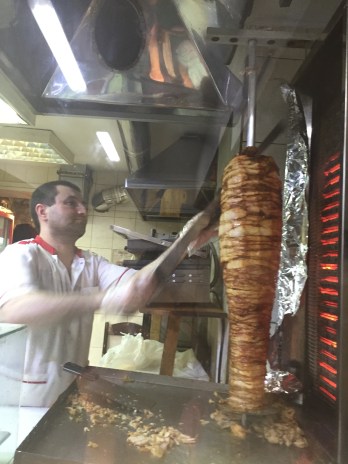
M and I are infamously cheap. We went for our morning constitutional and the weather was warmer then we anticipated. By the second mile, the need for water piqued. Last night we had a delightful dinner of shawarma at a street food vendor near our subway stop, Kunestky Moct. The meal of chicken c0st us about $7 American for all three of us and we were stuffed full.

Best part: A liter of water cost 50 rubles.

The man who served us was very patient with each of us depicting what we wanted on our “sandwiches.” Even scraping off cabbage from child’s sandwich and making sure every stitch was gone. He must have children.

So when we wanted water today in one of the pedestrian tunnels, and they wanted 80 rubles for a 16.9 ounce bottle of water, I said no. And we walked an extra mile for water.

The current exchange rate is 64 rubles per U.S. dollar.

IMG_4355.JPG

“Our Man” by Kunestky Moct

My daughter, the American

I am keenly aware of my quirks as an American. I can be giddy and boisterous. I am erratic and move too quickly. My table manners can be clumsy. My American accent is thick and my language skills, though I try, a jumble of words. Luckily, I’m cute. That rescues me on occasion.

Traveling with my 12-year-old daughter in Moscow has shown me the depth of my  daughter’s Americanisms. 

Some of these things are simply “kid-isms,” I suppose.

1. She has no concept of how loud she is. Ever.

2. Even when she tries, she still stabs her food, can’t properly use a knife and often talks with her mouth full.

3. She talks to strangers even when she doesn’t speak the language. Last night she tried to tell the Russian hostess in a Turkish restaurant in English that her dress was pretty. Poor woman thought we had a problem with the restaurant’s service. We eventually relayed the compliment.

4. My daughter has never dealt with real food. Now my daughter is a duck-in-orange-sauce, fancy meal girl. Not chicken nuggets and French fries. So imagine my surprise when she didn’t have the patience to pull the meat off a real fish or slice around the fat on a healthy portion of duck. Think about that: my daughter, raised as a foodie, has never dealt with real food. Bonus- she now adores fresh juice and real croissant.

5. She does not have the patience to remain at the table for a leisurely meal. She fidgets. She asks for hugs. She tried to put her head down. 

6. She points and screams “LOOK.”

7. In fear of making a mistake, she began this trip reluctant to engage with speakers of other languages and wouldn’t repeat phrases in foreign tongues.

8. She has classic American overconfidence. In our third and final airport of the trip, in Kazan, she tells me adamantly that she can meet us at the gate because she can read her boarding pass. Never mind that we are in a foreign country where she can neither read nor speak the language. Never mind that she is so adept at reading her ticket that she can’t figure out her row and seat on the plane.

9. Space. She’s not too bad with people in her space or how much space she occupies, but man oh man is she a disaster when it comes to realizing where her backpack is in relation to others and where her suitcase rolls behind her. And how to navigate on planes and trains without being a major disruption.

10. Math. She wanted slippers. First she read the wrong tag. Thought it was 800 rubles. It was 2500. I reminded her that the ATM was out of service (really, that isn’t mom code for “I am not your personal back”) and that I had 1100 rubles. So I told her to do the math. I know she has American money with her. And we keep explaining the exchange rate. And pointing out the sign outside the bank that lists the rate for the euro and the U.S. dollar.

I tell her if she wants to calculate the price in dollars she could give me dollars and I would get her rubles. She couldn’t determine the algebraic equation to calculate the cost. I told her to use 70 rubles for ease.
She wanted to divide 70 by 100. I told her that would allow her to figure out the pennies versus rubles rate. She wanted to then multiple that by 2500. I pointed out she was making this too complicated and suggested dividing 250 by 7. 

She didn’t get it. The logic. She could do the math, but not the thinking.

11. Ten minutes into dinner last night, she tried to sneak a game of Minecraft on her iPod under the table. That resulted in confiscation of the iPod (with us as camera and potential language assistant) and a stern, “I did not fly you 6,000 miles from home to sit on a Russian street and play Minecraft.”

“It was two seconds,” the child says.

“Because I caught you,” I retort. “The iPod is for pictures and in the hotel.”

Calm Beauty in Kazan

Kazan has proven gorgeous, calm, and the perfect blend of urban and small town. The mix of religious cultures is not “in your face,” but the orthodox Christian church and the mosque are side by side. I have seen women with beautiful headscarves covering their heads with color and style. (In general, the women are impeccably dressed and very sweet looking.)

English is rare to find, but we have been handed a few English menus. The mosque was lovely, and a good learning experience for my daughter.

I also smoked some hookah for the first time.

We visited the museum of Islamic history and the mosque. It may have been the first time my daughter saw items about 1,000 years old other than a dusty old mummy. I found a lot of the material interesting, various religious texts, holy books in Arabic and Armenian, photos from the 1917 Muslim Women’s Conference, and a chest with a dowry.

When we stopped for a hookah and coffee, and I got my daughter a ham sandwich and myself something with bacon, pineapple and blue cheese. It ended up being a Russian BLT. A delightful and flavorful thing.