Review: With Love From Karen by Marie Killilea

Marie Killilea, mother of Karen Killilea and champion for research and improvement in medical treatment for those with cerebral palsy, wrote two memoirs and a children’s book about her daughter. She also wrote another book— though I don’t know the content of that one.

I’m puzzled by the title of this second memoir, as it refers to Karen’s correspondence with some American service men during the Korean War.

But the book focuses not on Karen, nor that correspondence, but family. The text itself is more beautiful and structured like a novel. Members of the family are cast with richness, though I think sometimes “Big Marie” (the author as her first born daughter is also Marie) gives the various pets in the household more literary attention than Karen.

Marie says she wrote the book in response to the huge volume of mail she received asking what happened next.

The second memoir focuses on all the children growing up, struggling with their futures and leaving home. Well, except for Karen, who, at least until she started showing Newfoundlands in dog shows, just exists in the background doing her physical therapy and for more than a year carries some unknown demon that she is wrestling and the family just lets her sulk. For a year.

The older children get married. A seven year quest for an annulment is chronicled. And elder Marie Killilea’s long-awaited miracle baby is conceived when she is 43. And then she is confined to bed.

Karen’s triumph is learning to put her own shoes and stockings on.

And in the end of the book — Karen reveals the source of her depression and her decision on how to approach her “freedom.”

I’m so disappointed not to know what happened to Karen. Remember Karen? I thought this was a book about Karen, not her damn dogs, the 80-year-old obstetrician, or what a holy Catholic family and their brood looks like.

Disability Pride Month

This is part of a continuing serious about my journey even though I am more than midway through my 40s to understand my disability—cerebral palsy— after a lifetime of pretending it doesn’t exist

Since the teenager subscribed to the family plan of Spotify, my horizons have expanded.

I’ve found so many more podcasts, playlists and music than my 40-something brain can handle. But this allows me to learn new things.

For instance, that July is Disability Pride Month, but not Disability Awareness Month. And there is a Cerebral Palsy Day in October.

Disability Pride month started in 1990 to celebrate the updates to legislation mandating accessibility for those with special needs. And it even has a flag— black with rainbow zig zigs like a child’s depiction of lightning bolts.

How can you be proud of a disability? That sounds like it is anthropomorphizing the disability. Like it has a life. It does something.

I’m not proud of my disability. And I’m not proud to have it. It’s embarrassing and frustrating and, as I mentioned in my review of Netflix’s Special (read it here), when you have a mild disability people can’t see the depth of your struggles.

But I am proud that I get my ass out of bed every morning and do what has to be done.

And for the record, today is a hard day.

And one action I took, although small, I feel is mighty. I added a disability category on this blog and I organized it under the parent category “fitness.”

I started opening old posts and adding the tag, but I had to go get my second Covid shot (Pfizer) and then my neighbor accidentally cut the cable wires so now we have no internet.

And on our phones, the teenager and I share three gigs of cellular data. #singlemom

Anyway, no amount of stretching made my body relax. My back and lower limbs throbbed most of the day. And then after the Covid shot, my arm slowly got heavier and more sore. Now I hate to lift it.

The person who gave me the shot told me to use the arm and drink lots of water. I worked in women’s returns processing at the Stitch Fix Bizzy Hizzy where I opened and hung clothes from more than 100 priority mail envelopes. More than 500 items.

The warehouse was probably 90+ degrees but thankfully not too humid.

When I have these days, I tend to bend by doing lunges (to stretch my body and redistribute my weight), do calf raises in place, stand on one foot, and try to stretch my hips and back as much as possible.

But still the pain level seemed to keep increasing.

So in the car I turned on the heated seat and blasted the air conditioning while drinking some cucumber flavored water.

And took two Tylenol PM to ease the pain enough to sleep.

Funny part is— yeah as if it is funny— I don’t think it’s my cerebral palsy causing the pain. My period is due in four days. I think it’s menstrual cramps.

Everything wrong with my body seems to start in my lower back and hips. Hell, my daughter came into this world through back labor. Is that focus on my back part of the CP?

I used to take a lot of ibuprofen, then Aleve, then meloxicam. After a while, I realized. None of it helped.

I was listening to Dax Shepherd’s Armchair Expert last night and they did a special episode on medical misinformation. They had some pretty rough feelings toward chiropractors. They pointed out that chiropractors can be good or bad, but that the field itself isn’t very regulated or science-based. They turned the conversation to physical therapists. They liked physical therapists.

What about chiropractors who have a physical therapy background? My chiropractor can find muscle tension and stretch out things I didn’t even know I had. And my body seized up from being crooked and she straightens it out.

I guess I have a good one.

Could Poetry Journaling be the new Bullet Journal?

My neighbor Sarah asked me to listen to the episode of Ezra Klein’s podcast featuring Jeff Tweedy of the band Wilco. The journalist and the musician were discussing creativity.

Tweedy talked about writing first thing in the morning before anything else— no news, no email, no thought. Just words on a page.

Ezra said when he tries that all he ends up with are to-do lists.

Their discussion got me thinking about my own regular journaling practice which I started 30 years ago. In recent years much of what I have noted is done bullet style with occasional deep dives into the events of my life.

But what if I phrased anything I put in my journal as poems? Horrible terrible poems but poems.

For instance, instead of writing “Foster cats Khloe and Louise are getting closer to liking each other every day. They now sleep on the same bed at the same time with only a foot or two between them” it could be something like…

The fleet foot one is moody,
The clumsy one timid.
The who among them that starts the throaty snarls varies from time to time.
Slowly, their soft warm bodies
draw closer to each other,
ignoring the other princess drifting to slumber in the soft blankets.
When we find them, these insecure beasts of opposing kingdoms, their paws might almost touch.

To learn more about the Ezra Klein Podcast from the New York Times, click here.

Review: A For Abled Podcast

Another piece in my understanding cerebral palsy series

Technology can offer an opportunity for a great equalizer or perpetuate a divide. In both cases, there is a complexity that arises.

That sounds vague.

But allow me to try and explain.

My friend Nancy, a talented poet and essayist, is blind. She has seen the rise of all sorts of technology from computers, to tablets, to the gambit of “smart” devices. She has experienced that when looking for accessibility, those helping her (whether it be staff at organizations for the blind or everyday customer service employees) view people without what they deem standard technology— smart phones, online banking, PayPal, computers— as lazy, poor or stupid.

I’m thinking about this, in part, because of the podcast A is For Abled. I listened to the debut 2019 episode (recorded on October 6 which the podcaster announced is world cerebral palsy day) at the Stitch Fix Bizzy Hizzy last night.

I am realizing more and more that platforms that YouTube, Spotify, Facebook, etc., provide more and more opportunities to connect with real people so many of the “products” people put out there are amateur. And I am not knocking on that.

But when people talk about there experiences you need to keep in mind that memories are not the best source of fact.

The first episode of A is for Abled discusses the host’s background— Kyle, his sister Cheyenne and his mother have a pretty comprehensive discussion about their family attitude toward Kyle’s cerebral palsy, his upbringing, public vs. private school in regards to disability resources and quality of education, sibling relationships, the various therapy and surgeries Kyle has had and society’s reactions to disabled children and more specifically Kyle’s gait, which they call “swagger.”

Kyle was 32 in 2019, so this makes him more than a decade younger than me. His mother was 19 when she had him and he is the oldest child. They are also African American so they make some comparison/contrast between society’s reaction to the disabled and the reaction to African Americans.

Apparently the show has completed two seasons. And it sounds like Kyle’s condition is very similar to mine.

Between his family, his therapy, his various exercise classes that his mom encouraged him to try (yoga, aqua aerobics, tai chi), private school and surgery, Kyle had a lot of interventions I didn’t have.

Things A for Abled pointed out (I have not fact checked these statements):

  • Like Karen Killilea (if you don’t know who I am referring to I talk about the Karen books here), Kyle had surgery (twice) for his hips to straighten them.
  • People with cerebral palsy often develop arthritis in their thirties.
  • People with cerebral palsy get worse as they age because the muscles and tendons continue to tighten. That’s why physical therapy and stretching is so important.
  • Hot Yoga not only provides the much-needed stretching and flexibility but also the heat automatically loosens the muscles.

To explore A is For Abled, find their website here.

Drunk on Fish

Happy Friday!

It’s a fun, fun day for me as I not only got a good night’s sleep (although I did have a cat jump on my eye in the middle of the night when another cat scared her) but I also got to leave work early as we had voluntary early out.

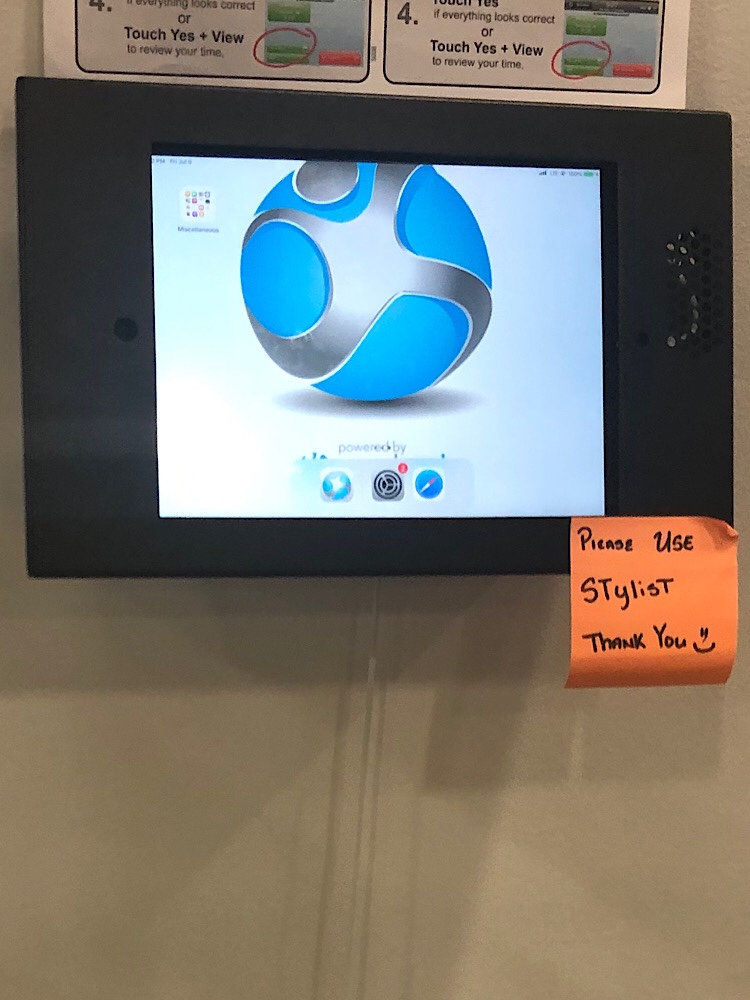
At the Stitch Fix Bizzy Hizzy, I finally got a picture of the “please use stylist” versus the correct word, stylus. I spent my 4-hour shift in women’s returns processing. I was killing my numbers the first hour— my body felt good and for the first time all week I wasn’t so exhausted my limbs wouldn’t move. But, quickly, I found myself slowing down. Could it be the heat in the warehouse?

Regardless, the teenager was working her waitressing gig and I had promised her sushi after I got home. We agreed to try Jasmine Japanese & Thai Cuisine on Sullivan Trail in Forks Township, Pa.

Many people I know have given it rave reviews and encouraged me to try it.

I encouraged my daughter to order anything she wanted— and we promised each other we would have the leftovers for breakfast. Now, I’m not a fish person so I stick to sushi rolls. I cannot even bring myself to try sashimi. The teenager on the other hand loves it all, as I even used to send her to first grade with sushi in her lunch box, preserved on an ice pack.

The cafeteria staff used to tease her that she should tell her mom to pack her normal lunches, so she came home one day convinced that meant she wasn’t allowed to bring sushi to school. But this is the girl who used to request cucumber sandwiches and other oddities for packed lunch.

I wish I knew more about sushi. I wish I could use chopsticks. The teenager did try to give me a lesson (again). You can see the video here.

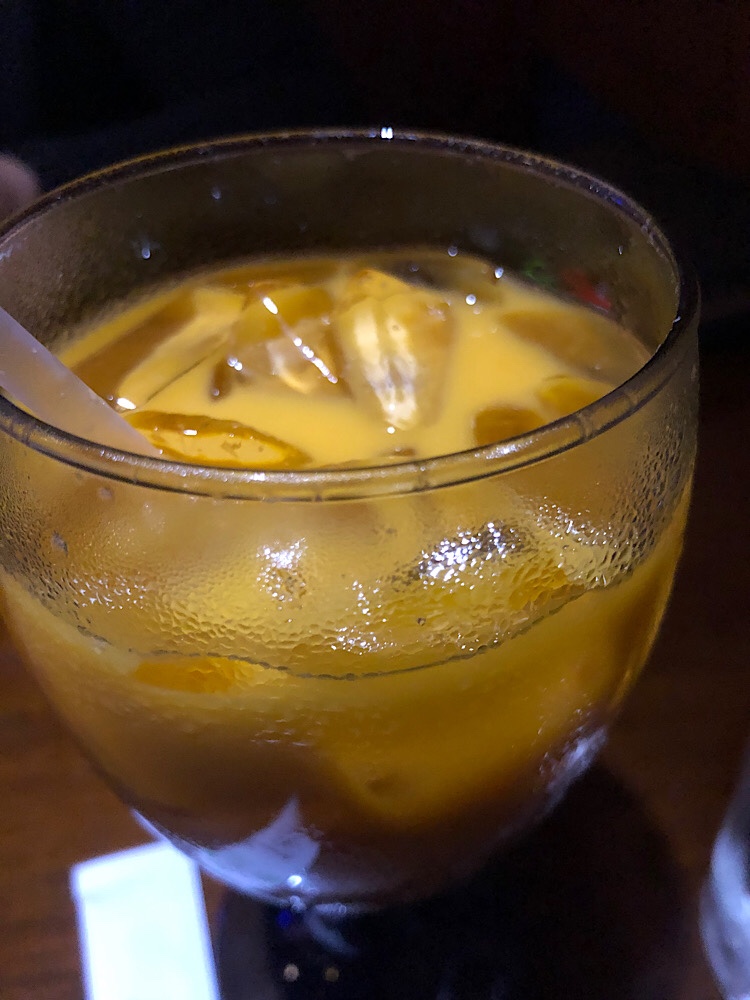
I ordered Thai iced tea for both of us and the “luck bite” appetizer. The Luck Bite featured seaweed and crab artfully arranged on a Pringle potato chip. That itself was amazing enough for me to leave happy.

The teenager was disappointed by her first experience with Miso soup, something I have learned to enjoy. Honestly, we barely touched our salads of iceberg lettuce and a tangy mustard dressing because of the sushi to come.

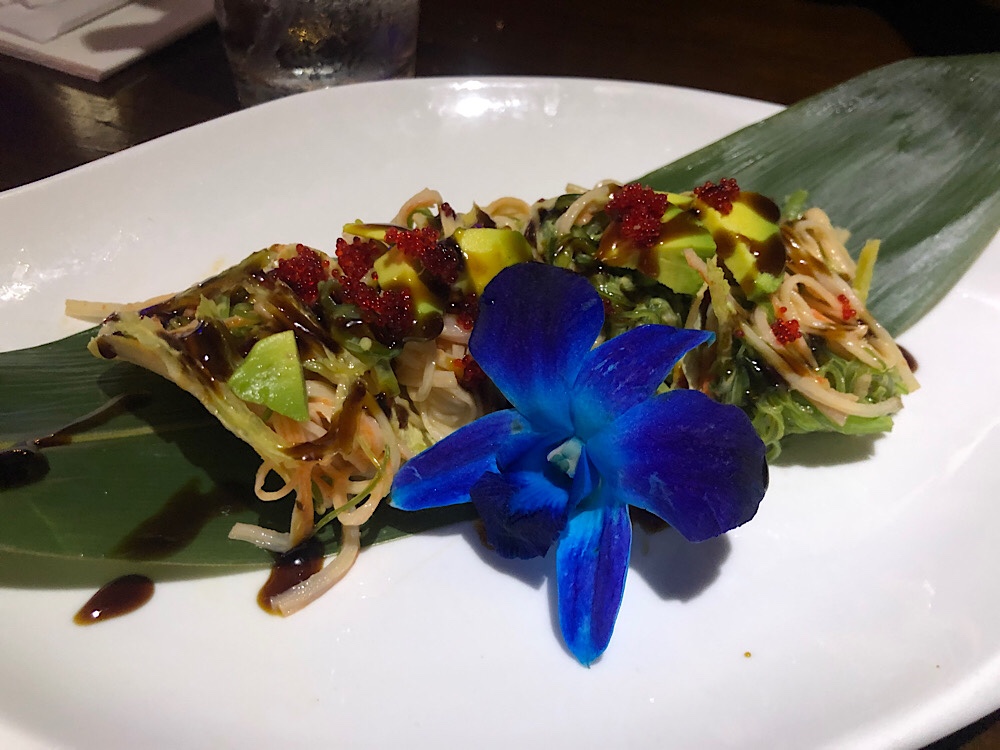
The sashimi combo platter came first— complete with lights and flowers and other adornments. The teenager loved it all but prefers her sashimi on a bed of rice.

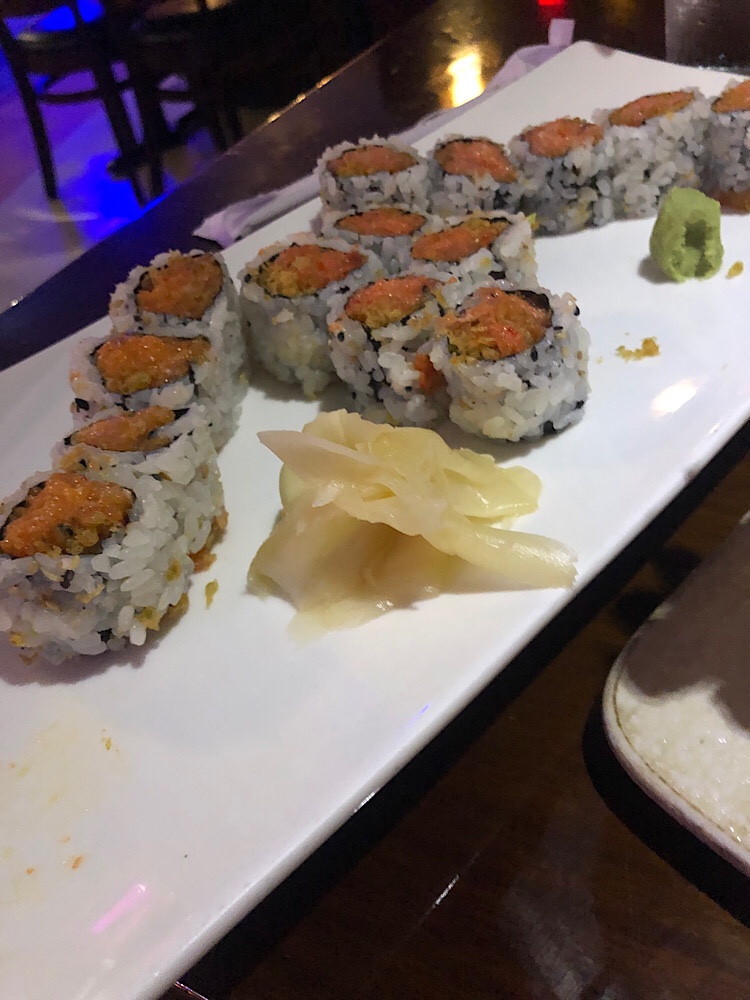
I got the spicy maki roll platter with two specialty rolls, and I honestly don’t recall their names. The one featured eel and avocado and the other mango and crab.

The teenager tried it all. My favorite was the mango. We both enjoyed the maki especially with its crispy bits.

Jasmine truly goes above and beyond with presentation. The sauces and flavor combinations are vibrant without detracting from the star of the show— the sushi.

We spent $92, but we also ordered enough sushi for 4-5 people. The sashimi platter alone was $30. I feel like for sushi, their offerings and dishes were substantial. I think it would be quite easy to select a satisfying meal for 2 for about $40.

More importantly, the teenager and I needed a neutral place where we could unwind together. This was perfect.

We do indeed intend to have the leftovers for breakfast, and I can only wonder what the household and foster cats will do when they smell sashimi.

Bizzy Hizzy update: the donut farewell and the shift differential

Every morning this week I have had some kind of appointment so I’m averaging six hours per sleep a night during a heat wave while anemic.

To say I am fatigued is an understatement.

Took my 2015 Volkswagen Jetta in for its 40,000 mile service even though it’s only got 38,500 miles on it. As this things usually go there was good news and bad news.

Video from the dealer

I don’t know how long this will be active but I think it is super cool.

My friend and publishing partner Gayle picked me up when I dropped the car off and we took her sister to the doctor. She wanted to borrow my hedge trimmer and me, not remembering she was bringing me home, was wandering around the car dealership with a small electric saw.

Gayle packed the three of us a dragon fruit snack and let me read her completed Silk & Sonder planner for June.

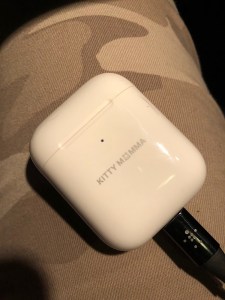
When I got home, my new AirPods we’re waiting on the doorstep.

The teenager took the ones the dog ate.

And I was too stupefied to operate my daughter’s new Keurig mini to make coffee.

And then we got big news for Midnight Society at the Bizzy Hizzy: Stitch Fix is rolling out a $1 per hour shift differential. Their goal is to get second shift to 200-250 people to balance first shift.

Here’s hoping it won’t change the culture and camaraderie.

My friend Barb worked her last shift tonight and one of our leads brought munchkins from Dunkin for Barb to eat or to share. Barb, being the ultimate altruistic soul and team player, gathered everyone on the shift and offered them a donut.

Then at our roster meetings, our supervisors announced VTO— yes VTO— voluntary time off. Anyone who wants a half day tomorrow can have it. Early weekend. We’ve hit all our goals and the work is done.

So now I’m sitting with my foster cats Khloe and Louise as Barb enjoys a glass of celebratory wine at her house.

I made myself at cocktail and texted her a photo.

Baby steps: Attitude and habits to fight anemia

Although my current quest is to understand (after decades of life existence) my cerebral palsy, recent bloodwork has shown that my body continues to flirt with anemia. I see my doctor at the end of the month.

It is time.

The last two years have been stressful— the dissolution of my marriage, a job that threatened my emotional wellness, helping teenager two, raising my own teenager, the pandemic, and the menagerie. This time frame has posed challenges and offered delights.

But the heavy fatigue I feel in my bones is not the change to a second shift schedule nor is it due to working in a warehouse with my disability.

I was diagnosed with anemia circa 2009-2010. My daughter was in kindergarten. I survived a stint in non-profits then, in a position that drove me to panic attacks.

Very similar to my situation today. Hopefully I have learned from my mistakes.

Emotional eating has been a huge part of my existence and unemployment may have also caused my nutritional habits to plummet. And now my body feels the loss.

My largest downfall— not including the impulsive fast food buys and late night junk food binges— is not liking fruit. Not a big fruit person. That brings me to anemia tip #1:

Vitamin C helps the body process iron.

Pair iron-rich foods with fruit or vitamin C laden fruit juice. Example: cream of wheat with fresh strawberries.

Symptoms of anemia, by the way, include mixing up words, not being able to move your body as quickly as you are used to, and fatigue not lifted by caffeine, sleep or sugar. Your nails can pale. Your hair can weaken. I also have increased balance issues.

So I am now recommitted to improving my eating habits. Luckily, a lot of my favorite foods are iron rich. I believe that’s my body saying I need more iron.

But I am not a big carnivore and typically people turn to beef and other meats. I move more toward nettle tea, dark leafy greens, nuts and beans.

I also bought some liverwurst. I’m not a fan of “sausage” or organ meats, but it contains close to 30 percent of your daily iron and lots of coblamin, part of the B-vitamins, which promotes healthy red blood cells.

“Whole Foods” and lots of fresh vegetables provide nutrients your body needs.

I’m a fan of spinach and kale wherever I can add it, and like mentioned above, iron-rich nuts or beans can top many dishes.

And even though it seems impossible to function, it’s important to limit caffeine.

Reducing coffee consumption can allow your body to absorb more iron.

But when you’re in the throes of anemia, coffee becomes an IV fluid. So it’s a double-edged sword.

And it’s important to know your particular symptoms and take supplements if needed— talk with your doctor and find out what supplements will benefit you.

You can often tell by your bowel movements if you are taking too much iron. The more iron in your system, the darker and harder your stool becomes.

Supplements can help, and can increase the body’s stored ferritin. Note that the body will deplete vitamin D before iron, so vitamin D supplements often go hand-in-hand with iron.

Regular blood work, a healthy diet and the right supplements can get your body back on track but it often can take months to fully recover.

And if it’s summer, the heat will sap your remaining energy.

Invisible: At the intersection of disability and childhood trauma

Author’s Note: This is the next in a series I tend to run indefinitely on my quest to understand my mind, body and disability and how they interact as I age.

Also: This post is merely me pondering “out loud” and based on my experience. I might be completely wrong with some of my ideas. That is why I consider this a quest and not something I can answer with a quick internet search or “Hey, Siri” request.

Finally, please understand that I am hesitate to discuss this topic as I don’t want my family members to be hurt or feel responsible. Especially my parents. My parents have some wonderful qualities and their flaws because they are, after all, human beings. My parents experienced their own hardships and traumas and they have both dealt with issues with their own parents, alcoholism, etc. Plus, my childhood encompassed much of the 1980s and they were young adults in the seventies. The world, as they say, was different.

As I have mentioned in early posts, disabled children of my generation and the one prior were the first to escape institutionalization or being kept hidden away at home.

Many parents of disabled children (like Marie Killilea of the Karen books) focused on raising their children to master independence and to “pass” as normal when possible. This can lead to a desire to not call attention to oneself and in many cases avoiding (instead of attempting) activities where our difficulties become obvious.

Instead of talking about our ailment(s), we try to fit in and not be a burden. We want to seem worthy of our place in a society where if the conversation turns to eugenics, we’ll, we’d be the first people edited out of existence.

But add childhood trauma to this mix and I wonder, do disabled people with this type of trauma exponentially feel more of a need to be invisible?

Mommy and Daddy have trouble getting along and sometimes hit each other when Daddy gets home from the bar— I don’t want to be another problem for them.

Am I a victim of sexual misconduct because I was a good kid who would listen to her elders or because I was already broken?

No one wants to see me cry. They get upset when I fall down and cry. Mommy teaches me to laugh when I fall. Does this cheapen the legitimacy of the pain, the bumps and bruises.

None of my childhood trauma happened because I have a disability, but it’s another truth no one wants to talk about.

All good thoughts to ponder.

“Review”: Pick-Your-Own-Bouquet Outing at Terra Fauna Farm

This one brings to mind memories of my mother’s flower gardens during my childhood— her lovingly tending her petunias, impatiens, zinnias and marigolds. I begged for straw flowers, snap dragons and “blue angels.” I thought of my mother’s gifted green thumb while frolicking in these fields.

Last week, knowing my teenager had left me home with no car, my sweet friend Joan had invited me to a pick-your-own-bouquet workshop at Terra Fauna Farm. Joan is a member of their CSA.

For those who don’t know, like the teenager, let me explain the concept of CSA or “Community Supported Agriculture.”

First, some history. Our area (the Lehigh Valley/Slate Belt of Pennsylvania) is traditionally primarily rural, with a few small cities scattered here and there and one of the largest cities in Pennsylvania on the one side (Allentown) and the Poconos on the other. New Jersey lies to the east and more rural areas to the West.

I once served as an advisory board member for the Penn State University Cooperative Extension. I completed six years, many of those as Secretary. I never realized how passionate I was about the area’s agricultural heritage until I had this opportunity. I took it for granted.

I grew up in the rural Slate Belt in the 1980s where most of my neighbors were dairy farmers. One literal neighbor had a green house business. And our school bus route cut through a pig farm. Pig farms smell bad, by the way.

Corn fields. Horses. 4-H. Farm Shows. Future Farmers of America. Horticulture and Agriculture as high school science electives. I took horticulture one and it was an amazing exposure to organic gardening (in 1990 before it became trendy), flower arrangement, and gardening. You haven’t lived until you’ve washed a greenhouse of poinsettias with lye soap to kill the white flies.

At that time your parents were either farmers or blue collar workers. My dad was a diesel mechanic.

During the last two decades, farm land has given way to suburban developments and warehousing.

And to compete with large commercial farm and maintain some smaller farms as viable, farmers have embraced the CSA model.

In a CSA arrangement, when selecting his crops and ordering his seeds, the farmer also contacts those who have expressed interest in supporting the farm. These supporters then purchase a share of the season’s crops by sending money in advance. There’s usually a “full share” customarily enough for a family of four and a “half share” for those who don’t have a family or are timid about how much produce they can use.

The farm typically shares what crops they want to plant and the supporter can usually cater their share to their likes and dislikes.

The farmer uses that money to buy his supplies and pay his bills until the crop is ready. And has a guaranteed market for some of his crop.

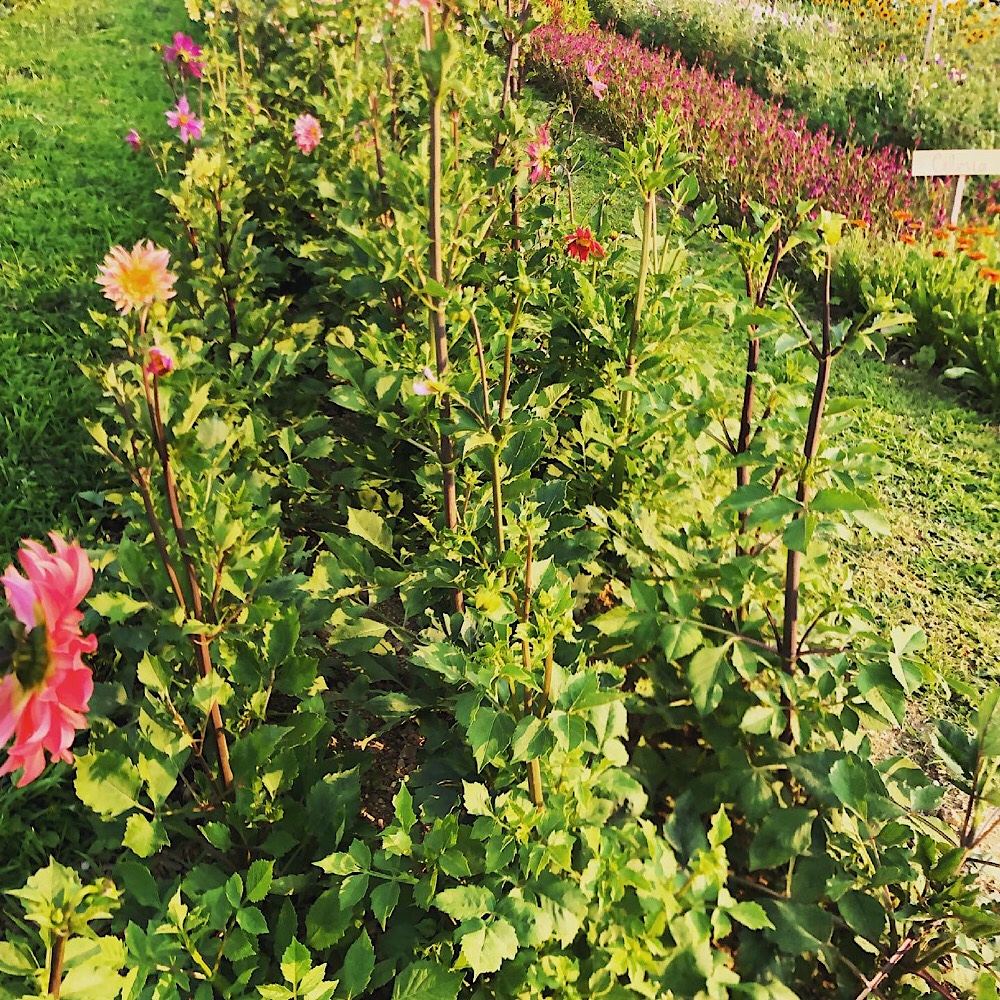
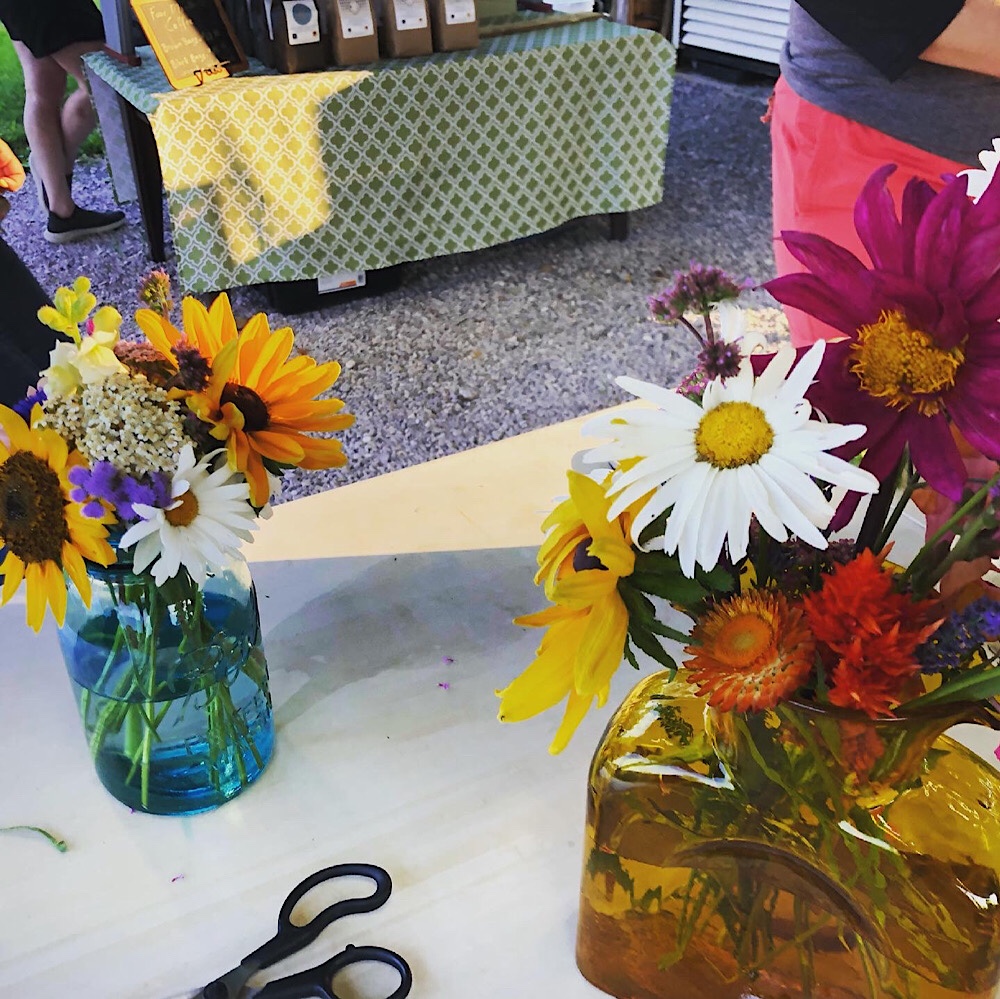
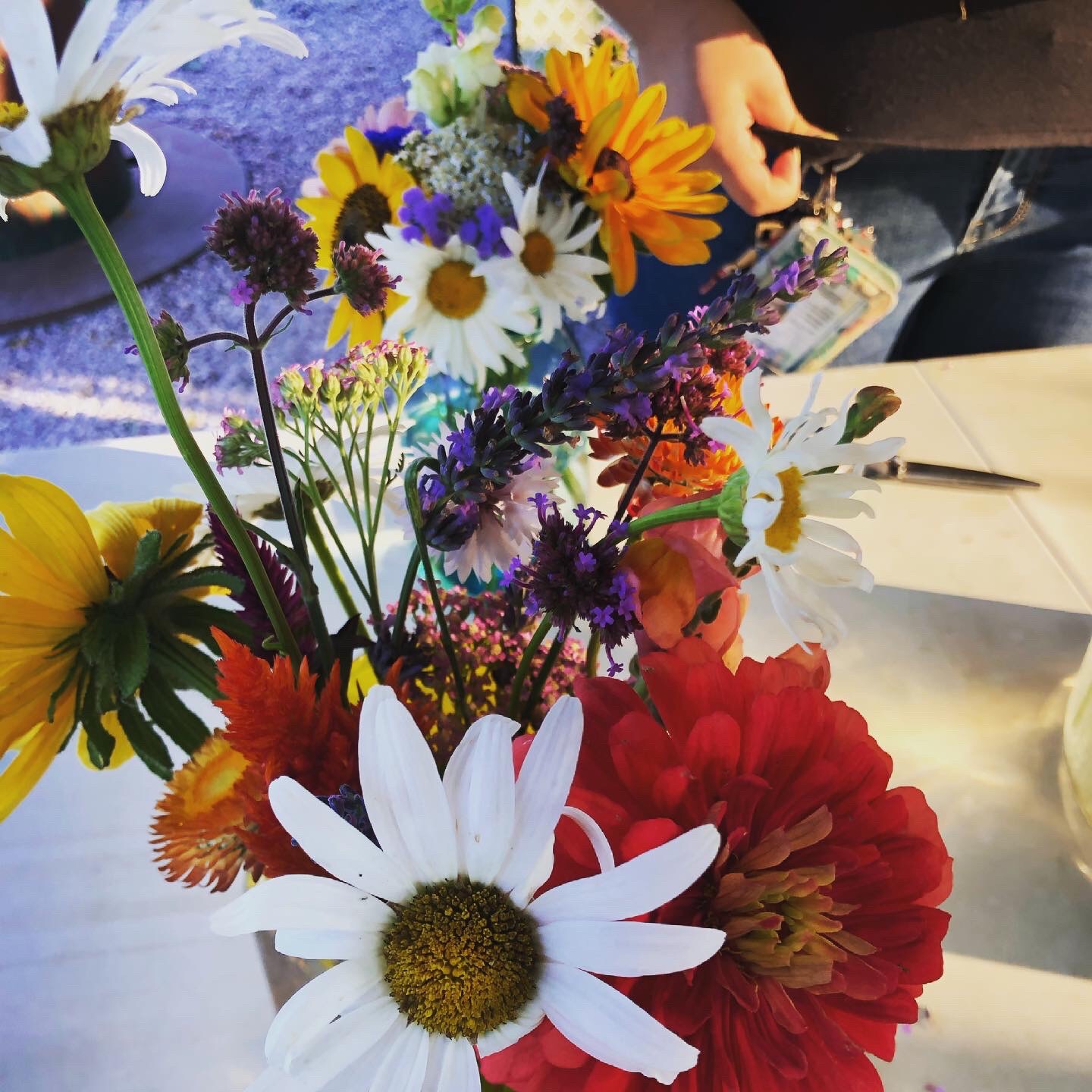
Terra Fauna (located in Northampton, Pa.) planted a flower and herb garden on what I believe they said used to be their cow pasture. For $5, you can pick a bouquet.

As I mentioned, they had planned a workshop for last week but the heat and the threat of thunderstorms made them postpone until July 5.

Joan took photos and the teenager and I indulged our witchy senses and gathered blooms and herbs from the rows.

We spent $26.50 on extras— a farm fresh cucumber, two zucchini, a quart of new potatoes, a pound of local honey harvested this past Saturday, some garden herb cheese spread and a coffee flavored yogurt smoothie which I think tasted like a milkshake.

The teenager came home and spread her cheese spread on some crisp fresh cucumber and for the sandwich effect added “chicken in a biskit” crackers I bought over the weekend. The juxtaposition of ultra-processed and farm fresh was not lost on her.

Perhaps before the end of the summer, Joan and I can “do lunch” at the farm on one of her weekly CSA pick up days. Which, as a country girl, let me tell you this one truth:

The only way to eat sweet corn is fresh off the farm. If you’re buying sweet corn at a local big box grocery store, I’m sad for you.

Summer reading review: Karen and With Love From Karen

These books are directly related to my quest to research cerebral palsy, a disability I have, and chronicle my journey to whole health. With discipline, hopefully I will lose weight, return to strength training and someday pursue my longstanding goals of running a 5K and hobbying as a body builder.

Below please find my original interactions from the first memoir, Karen, by Marie Killilea: Starting the Karen Books.

As I said then, I thought this memoir would be about Karen. And her struggles with cerebral palsy. A condition no one knew anything about at the time.

Now this is not a complaint, but the book is about advocating for a child with cerebral palsy and Marie Killilea’s struggles as a mother— a mother with a history of pregnancy loss, devout Catholicism, children both precocious and sickly.

Karen is merely a two dimensional figure in the background. And the book chronicles many of Karen’s tribulations (limiting fluids to 20 ounces a day to prevent seizures and reduce spasticity, sores and discomfort from what would now be seen as barbaric full-body braces, and despite her keen intellect being banned from school) as well as her developmental triumphs.

The book ends with one such celebratory moment.

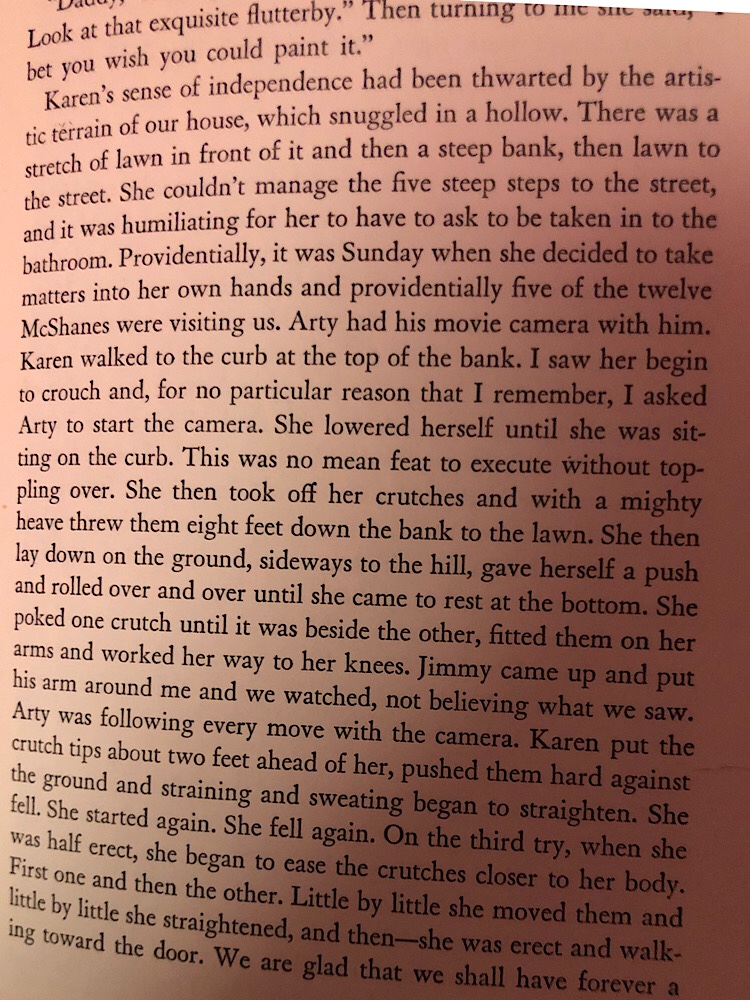
In the passage photographed above, Karen tries to navigate a hill. Mrs. Killilea never quiet explains where she was going— to the house? Away from it? Karen throws her crutches down the hill, rolls, retrieves her crutches, falls several times trying to get up, while her family watches and records it on a neighbor’s home movie camera.

This is one of those moments touted as bastions of independence. But how many times do you want someone fall without at least asking if they want help? And this is solely my opinion and my experience, but I hate seeing myself on video. The camera makes the “wrongness” of the cerebral palsy body more exaggerated and severe. Her parents want to record this moment in their Pride, but, to me, and again this is my opinion, to rewatch such a moment is to buy tickets to the freak show.

This family had inordinate health struggles with all of there children and the work Mrs. Killilea did to benefit cerebral palsy research made the world grow exponentially. And I am grateful.

But as I study the first chapter of Mrs. Killilea’s sequel memoir, With Love From Karen, it leaves me feeling that Karen’s condition has led to a 1952-best-selling book that has eased her family’s burdens, allowing them to buy a big, broken down Victorian house and given them a life line after a decade of medical bills for all their children.

I feel like Karen is exploited. Especially upon hearing that the whole family appeared in Time magazine.

Also I note Mrs. Killilea’s writing style has improved. The sentences flow with more artsy grammar and word choice. The description is more detailed. The verb choice strong.

Does she have an editor working for her now?

Bean, the 50-plus pound mastiff mutt puppy, and I are in the hammock. I hope this book presents Karen as a person, not an accessory.