Why the Disability Struggle Impacts All Humans

It’s Monday morning, and while my red blood count maintains there is nothing wrong, my body shows the signs of anemia, which feel better when I follow a strict regimen of healthy eating, vitamin D and iron supplements… but that is something my primary care physician and I will discuss at my annual physical in September. And he will probably express disappointment that I have regained the ten pounds I lost last year.

It’s true for all of us– when we’re sick or weak or broken, we take care of ourselves (or we try to, I hope) and when we feel better, the routines that help us maintain that wellness fall to the wayside and lean toward repeating the same problems. I know I have a 20-year history of struggling with low ferritin reserves, why don’t I do better to always keep a routine of quasi-regular supplements?

Many disabilities are permanent but not progressive. And most people experience disability at some point in their lifetime– either congenital, temporary or permanent. Any person with a disability or aging person can explain the weight of co-morbidity, that while their various issues alone may not be progressive, when combined with our temporary or new ailments can make life exponentially harder.

My mother struggles to understand how I could be so easygoing and mobile as a kid while experiencing more falls and discomfort now. As my mother, she is no stranger to the aches and pains and limitations of aging, but she didn’t connect that the running and playing and constant activity I had as a child kept my muscles looser and healthy in a way that I can’t match as a fairly sedentary adult. That’s part of the reason why I’ve usually had a part-time job that requires movement and pursued strength training as a hobby.

I know that I need to lose 30 to 40 pounds. As a person aging with cerebral palsy, this would help my cardiovascular system and help take so much stress off my musculoskeletal system. But I have learned, through years of strength training and nutritional counseling that my body reacts strongly to salt and sugar, which means if I wish to lose weight I need to not only increase my activity level, but also cook whole foods, every time. The vicious circle of “I don’t exercise enough because my body hurts/I can’t breath/I’m tired” perpetuates itself because the only way to get past the discomfort is to do it… and survive and persist. (And then there’s the ironic reality that you can overdo it, and hurt yourself trying to do what’s right.)

This is not a disability struggle. It’s a human one.

All people experience a disappointment in and/or failure of their body. It’s a point Johanna Hevda and Julia Watts Belser both point out in their work. They claim that everyone experiences disability within their lifetime, but I extend that same idea to say that all people at some point experience some sort of body dysmorphia. Even if your body works, and is completely normal, people will experience dissatisfaction with it at some point. Maybe you hate your hair, struggle with your weight, identify as trans, wish you were a better athlete. All of these experiences have nothing to do with disability, but stem from the body.
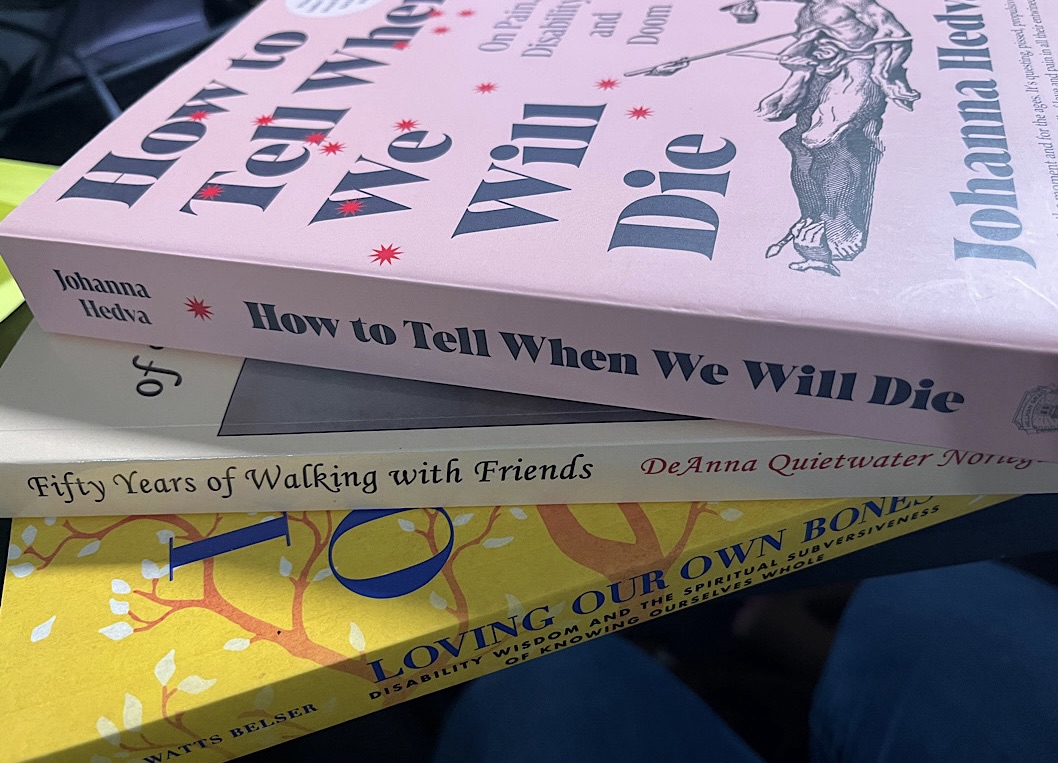
A pile of three disabilty-themed books. The top one, How to Tell When We Will Die: On Pain, Disability and Doom by Johanna Hedva, is pink with red stars. The next on the pile is a beige memoir, FIfty Years of Walking with Friends, by DeAnna Quietwater Noriega. The one on the bottom is vivid yellow, Loving Our Own Bones, by Julia Watts Belser.

Disability Pride Month is celebrated in July because that’s the month when the Americans with Disabilities Act was passed. I didn’t put that together until today, so if you needed that tidbit of knowledge, there you go. I happened to order a whole bunch of disability-themed books in late June because my good friend Nancy Scott told me I should be doing more writing in that space, and she’s right, and she’s tired of hearing me say, “when I write my medical advocacy memoir.”

The four books from the disability space that I read this Disability Pride Month:

  1. How to Tell When We Will Die: On Pain, Disability, and Doom by Johanna Hedva
  2. A Disability History of The United States by Kim E. Nielsen
  3. Fifty Years of Walking with Friends by DeAnna Quietwater Noriega
  4. Loving Our Own Bones: Disability Wisdom and the Spiritual Subversiveness of Knowing Ourselves Whole by Julia Watts Belser

I have been working to expand my collection of books by writers with disabilities. I currently have read books that range from poetry to books with characters on the autism spectrum, though none of these books include my fascination with medical fiction, a realm where Michael Crichton and Frieda McFadden spend some time, and one of my favorite memoirs (An Exact Replica of a Figment of My Imagination) which covers pregnancy and pregnancy loss simultaneously. My Goodreads shelf of “disability” books is visible here.

Poets with disabilities on my read list include Jennifer Bartlett, Larry Eigner, Susan Glass and Nancy Scott. Twentieth-century memoirists on my shelf who explore cerebral palsy include Christy Brown and Marie Killilea, and then there are the people I know, like Tylia Flores (we connected via the Internet) and Peter Altschul (who like DeAnna above is a member of the Behind Our Eyes writing group).

Here’s a very brief review for each of these four books:
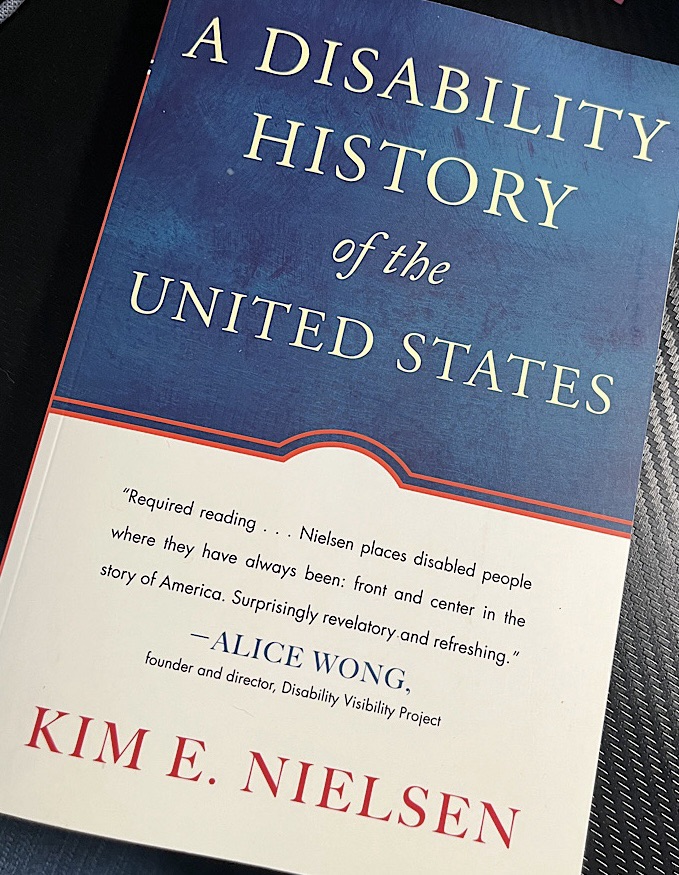
A copy of A Disability History of the United States
  1. On Hedva: I already wrote a long piece about this one, primarily to keep my own notes accessible for future use. You can read that here. Hedva is a queer writer who uses they/them pronouns and has issues with chronic pain and bipolar depression. Their essays are not a cohesive unit, but based on an essay that gained them a publishing contract when it went viral. Their greater thoughts about disability are steeped in personal experience, and often tied to their sexual experiences. But this author challenges us to view the difference between capacity and capability, just because we are capable of something does not mean we have the capacity to do it.
  2. On Neilson: Nielson ended up researching disability as an accident (or serendipity?) as she worked on her history dissertation. Hedva writes philosophically about the capitalist resistance to disabled bodies (as we are worthless if we are not productive to society) and Nielson uses her history background to explore how the capitalist framework has disenfranchised all bodies that are not able-bodied white men, which I found hysterical because one of my publishing company’s initial projects was an anthology, Not an Able-Bodied White Man with Money. See that book here. She weaves together the plights of women, people of color, and people with disabilities into the same historical framework– all of them had bodies deemed inadequate and incapable and inferior by white men.
  3. On Noreiga: This was my first time reading one of Noriega’s books. She’s a self-published author of indigenous heritage who lost her sight as a child. As someone on the waiting list for a service dog, I thought it would be fun to start with her experiences with her (I believe) eight seeing-eye guide dogs. The memoir covered the first decade-ish of Noreiga’s life in autobiography format. The final chapters each provided a summary of her later-in-life seeing-eye guide dogs. While the book did offer insight as to how these dogs perform their complex duties and build relationships with their handlers, the primary focus of the book is Noreiga’s college years and first few years of marriage.
  4. On Watts: Nancy Scott ordered a Braille copy of this from the library at the same time that I ordered the print copy, and that was sheer coincidence. Some of Watts’ ideas are beautiful, like her interpretation of observing the weekly Sabbath as a tribute to not only spirituality but also to her body as an opportunity for rest. Like Heva and Nielson, she laments the push for capitalist societies for valuing bodies only on their capacity to do work– but I think all of these writers need to consider the role of industrialization in all of this. We are no longer in agrarian societies where families live and work together communally and therefore can cater the work to individual strengths and weaknesses. Watts treads a strange line. As a queer rabbi with cerebral palsy and a wheelchair user, she tends to tell us minimal information about herself, yet connect her spiritual journey to her physical one without giving us all the details. In many passages, her affluence shows through, that her financial resources and life situation have provided her with more opportunity that the average disabled person. And she seems to have a fascination with the potential amount of times blindness appears in the Old Testament. As said before, her ideas and themes overlap with Hedva and Nielson, and she focuses on building a relationship with God where you are whole and representative of God in your broken/disabled state. She applies this to beaity standards as well.

I will be revisiting some of these thoughts in my Substack this week,
Thoughts raised by Johanna Hedva

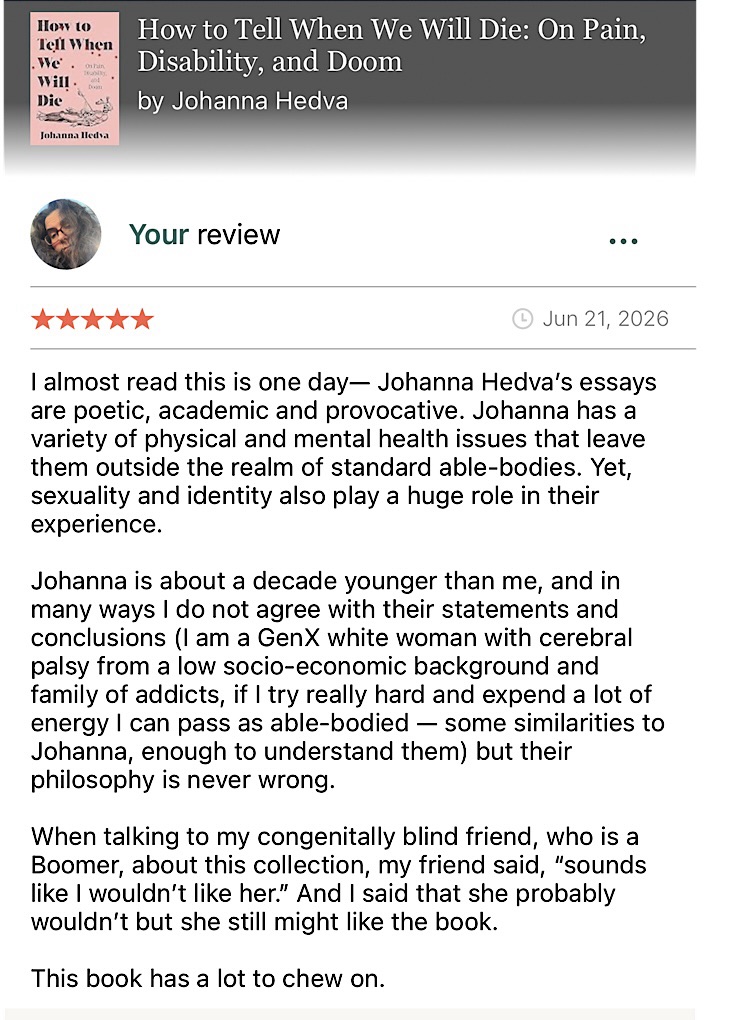
Screenshot of the Goodreads review that is also quoted in the blog piece

I put Johanna Hedva’s How to Tell When We Will Die: On Pain, Disability and Doom on my wish list probably when it was a new release.

The cover design is lovely and the bio of the author is enough to draw interest:

Johanna Hedva (they/them) is a Korean American writer, artist and musician who was raised in Los Angeles by a family of witches and now lives in LA and Berlin…

I guess the first step of my thoughts on the book would be to share my Goodreads review with you.

I gave the book five stars even though the most Generation X parts of my soul wanted to give it four, because despite how much I disagree with some of her points– I can’t stop thinking about them.

My Goodreads Review

I almost read this in one day– Johanna Hedva’s essays are poetic, academic, and provocative. Johanna has a variety of physical and mental health issues that them outside the realm of standard able-bodies. Yet, sexually and identity also play a huge role in their experience.

Johanna is about a decade younger than me, and in many ways I do not agree with their statements and conclusions, (I am a GenX white woman with cerebral palsy from a low socio-economic background and family of addicts, and if I try really hard and expend a lot of energy I can pass as able-bodied– some similarities to Johanna, enough to understand them) but their philosophy is never wrong.

When talking to my congenitally blind friend, who is a Boomer, about this collection, my friend said, “sounds like I wouldn’t like her.” And I said that she probably wouldn’t, but she still might like the book.

This book has a lot to chew on.”

So what are some of their thoughts and my thoughts on their thoughts?

Random comments first.

  1. The title is a shout-out to astrology.
  2. Their book deal for this collection stemmed from the essay Sick Woman Theory which went viral. The attention it garnered made them more of a figurehead and/or activist than they ever intended to be. The essay Sick Woman Theory is not nearly as interesting as her response to that essay, Why It’s Taking So Long.
  3. As a member of GenX, I have some discomfort with how the queer community throws around labels. Johanna identifies as a queer, and not as a woman, which is fine, but I guess I remember the days when people didn’t need to define their identity as concisely as we do now. You didn’t need to label every aspect in which you are weird. It’s okay to just be different.

So let’s look closer at some of their points.

Essay One: “How to Tell When We Will Die”

Opening paragraph:

“Heroes die on the battlefield, never from chronic pain. Diarrhea never makes its way into myth. Tragedies are devoid of menstrual cramps.” Johanna has my full attention. On the second page of the essay, they talk about the representation of disability in early and twentieth century film, and how disabled people become “flattened by some insidious super-cripple myth.” Throughout this first essay, Johanna is tossing around some serious academic critical theory before suddenly turning into memoir…

They speak about not receiving a diagnosis for their ailments until in graduate school (despite later saying that the conditions were inherited from their mother and grandmother, so I think the statement should have been that they could not get a label on the diagnosis– she does state that doctors were “baffled” by her symptoms and “dismissive of their validity.”). And they mention that they stayed on for a second master’s degree to keep their student medical benefits to the tune of $250,000, that led to a career in the arts where they refused any job that did not meet their aesthetic. They chose poverty. They chose art.

I’m wondering why– even if they didn’t want a standard job with employee-sponsored health insurance– they didn’t just buy health insurance or take on medical debt instead of a quarter of a million dollars in student loans.

But then there are gems like “You do not have to be disabled to experience ableism” and “no matter how it arrives, disability will arrive for everyone, sooner or later” (which they repeat in the last essay.) And Johanna points out that the biggest ableist fantasy is that we control our bodies, and we will always be able to control our bodies.

Johanna talks a lot about her mother’s addictions, and the abuse they suffered at their mother’s hands, and of their own mental health issues. Her first suicide attempt happened at age nine, when she took a bottle of sleeping pills, and when she did not die, she carried on with her life.

We are more than 25 pages into the book when we learn that mental health plays a significant role in her disability, which we later (not in this essay) learn includes endometriosis and chronic shingles. I understand that people with disabilities do not owe any sort of explanation of their ailments to anyone, but if you are writing a book about disability, I believe that information should be front and center.

And in this essay she mentions her love of death and doom metal. You can hear some of her music here on YouTube.

Essay Two: “Sick Woman Theory

The essay that started it all. I think it’s really important to understand that they called it “sick woman theory” because regardless of how they identify, the medical establishment and the world consider them a “sick woman” and they are seen as a “sick woman.” They frame their theory that our capitalist world is designed for the existence of “white, straight, healthy, neurotypical, upper- and middle-class, cis- and able-bodied man who makes his home in a wealthy country, has never not had health insurance, and whose importance to society is everywhere recognized and maybe explicit by their society, at the expense of everyone else.” To a certain extent, I want to call out a “Yes, bitch,” (as they toss around this phrase) but at the same token– would the experience be the same in the developping world/Global south.

Essay Three: “The Blast Radius of Disability”

I have to say that I love this concept, “The Blast Radius of Disability.” Disability doesn’t effect one person, one episode, or one place or time. Instead, it impacts everything around it, everyhing that it touches. Johanna speaks of time dvided into before and after sickmess, but I can’t help but wonder how they can divide time in such a way when mental illness entered their life so early they can’t really remember a before, can they?

It is in this essay that Johanna mentions that individuals with disabilities must operate according to “crip time” not clock time, doing things as the body deems itself capable not as the world says we have to do them. On one hand, I understand the point, but that’s not how the world works. I have to believe that there has to be a balance, of not overdoing things in order to conform to the mainstream standard and hurt oneself in the process. And there’s an inference that the entire world runs on the same precision, which isn’t true. There is “island time,” “Latin time,” and “African time.” Each culture has its own realtionship with time, so maybe they need to find a place and a rhythm that works for them.

Essay Four: “In Defense of De-Persons”

A discussion of capitalism and mental illness.

Essay Five: “Get Well Soon”

“Are these my limits, or are these the limits of the world?” Johanna reminds us that disability is part of a dichotomy– the ill being inactive while the healthy take action, the disabled remain still while the rest of the world creates revolutions.

Essay Six: “Notes on Activism (aka Notes on Failure)”

Organizing is exhausting, Johanna begins. Activism, they write, “reminds us how the world actually is, not now how we would like it to be.” Activism often comes off with hypocrisy– like buying your anti-racism books off Amazon.com. Their other question: How can you balance the need as an activism to care for others, yet also take care of yourself?

Essay Seven: “Letter to A Young Doctor”

I didn’t like this one. It seemed to repeat some of other concepts. Johanna tells this doctor all the other things they have already told us and will tell us differently in future essays. The doctor approached Johanna asking for advice.

Essay Eight: “Soft Blues”

Or “The Summer of the 12-inch cock.” The first several essays that are reflections on Johanna’s sexuality. And an in-depth exploration of her experience in a mental hospital for depression that led to her experiencing an entire summer of bipolar mania.

Essay Nine: “Can I Hit You?”

The BDSM essay. Which has the most amazing line: “Pain is the price I must pay to be awake to life.”

Essay Ten: “The Freak”

Another relationship essay. The only highlight I have in the whole essay is when Johanna discusses capability and capacity. They remind us that just because we are capable of something does not mean we have the capacity for it at this time.

Essay Eleven: “Notes on Trash Talk (aka Notes on Community)”

Interesting essay where Johanna gives a view of their obsession with fighting, boxing, wrestling and MMA, and how the way a coach talks to a losing athlete is the type of trash talk we could use more of as disabled people.

The next few essays are all Johanna’s entertainment criticism. I will skip those, even though they do circle around to disability as it all does.

Essay Fifteen: “Notes on Ambition (aka Notes on Survival)

This is a complex one– looking at what we all need, versus what we want, and how many of our ambitions are actually motivating us toward ideals that might not be our own.

Essay Sixteen: “Hedva’s Disability Rider.”

They explore this rider more in a later essay, the one I mention that speaks back to the original “Sick Woman Theory” and presents the repercussions. But here, Hedva gives us the document they send to institutions that invite her to perform. I feel like some of the items on the rider should not be listed as conditions for employment, but instead factors of how much they should charge for their fee. If you know you need a business class airline seat on the aisle, you make sure you only say yes if the organizers give you enough money. Some of the informational items are valid: like allergies. But Johanna also uses the rider as a way to advocate for everyone with disabilities and call attention to how excluded people with disabilities are. They ask for sign language interpreters, live captioning, all-gender restrooms, wheelchair accessibility and audio description.

They say they know they won’t get all of it, but they like to have the conversation and point out how unaccessible and exclusionary the world is.

And this is why hardcore advocacy is exhausting, friends.

While we would like to invite all the people with disabilities to everything, why provide the services if the people aren’t there? I know Nan and I have attended shows at DeSales University where they have one performance with audio description and live captions. These shows are made accessible with grants. Start there.

Essay Seventeen: “Room Day”

Johanna’s partner is Johannes, a German citizen, which is why they now live in Berlin most of the year so they can get better medical care. She does not mention her partner until essay seventeen. The partner to whom the book is dedicated.

Essay Eighteen: “Soft Until It Gets Hard”

How can you not love this title? Another relationship essay.

Essay Nineteen: “Why It’s Taking So Long”

In this essay, Johanna discusses the rider and how when they send the rider to an individual, they would prefer not to see that individual in the context of the institution but as a person with whom they can have a conversation. Teaching moments? Which is exactly what they say later on the page when they discuss they are now part of a “learning experience” that they did not want to be. And here’s another great observation– if an invitation comes in for any event that involves the concept of care in any way and is being organized by solely white women, Johanna won’t do it.

The essay falters between the idea that Johanna never wanted to be an advocate but now that they have the power, they feel a requirement to advocate for everyone.

Here are some great points:

  • Capitalism is so demanding, it makes us all more disabled
  • Even when we are told we “have to,” humans can’t truly do anything alone
  • It’s a fallacy that all you need is will, and the proper manifestation of it
  • Care is often framed as debt
  • You might be winning, but maybe there’s no prize

Essay Twenty: “The Hag in Charge”

A lovely adventure through Greece that offers some recollection of Johanna’s poverty and her spiritual beliefs.

A line that reminded me of Nan, who says this often: some disabled people (Nan and I like to say it’s normally able-bodied people who become disabled) have a fantasy of healing, “and then hate themselves when it fails to arrive for them.”

Some days go off the rails (or weird reasons why I didn’t get my work done)

Whether you’re a small business owner like me or a homemaker or someone who works a corporate 9 to 5 or whatever, it often feels impossible to make a dent in life’s responsibilities.

I think as I get older, and as one friend keeps reminding me I have a significant birthday coming up in May, I realize it doesn’t matter. Stuff eventually gets done or it doesn’t and the important/necessary stuff rises to the top.

Or maybe that’s just because I’m good at prioritizing and fairly awesome at time management.

The last week or so has been exhausting and/or exciting depending on your point of view. I’ve scheduled a storytelling/written word workshop with Larry Sceurman at Hellertown Library at the end of May. I’m strategizing a memoir workshop this summer in the suburbs of Philadelphia. I helped with and sold books at a storytelling event at Bethlehem’s Ice House (hosted by Patchwork Storytelling Guild). I sold books and talked with poets at the third annual Poet Palooza 3 at Book & Puppet Company in downtown Easton.

I received word that Lehigh Valley Community Foundation approved my application for a Pennsylvania Creative Entrepreneurship grant, which I will use for national and local advertising. I performed my duties as president at Greater Lehigh Valley Writers Group and heard a fantastic presentation by Jill Peters.

And book orders have picked up. Still not to the level as last year, but enough to give me hope. I am finishing my local candidate profiles for Armchair Lehigh Valley.

Yesterday I went to the eye doctor and spent more than $500 for exam and glasses (at which point I was told, before being given the price, that they knocked 30% off everything because my insurance was crap). I tried on every pair of Parisian Phoenix pink glasses.

That got me thinking– as everything often does– that with glasses normally being updated every two years I pay about $30/month for eyesight.

And walking home from the eye doctor, I fell. So that sucked. But I’m fine, so yeah!

I received a call from my life insurance company today that I scheduled last week to convert my term life insurance into something more permanent. The bad news is, it’s probably going to cost triple my current policy. But that’s an conversation for me and another agent next week. Sigh. The insurance person kept me on the phone for 45 minutes and we may be continuing the conversation this weekend as she has an idea for a book.

In other news, my blind friend Nan received a print poetry book from a small press recently. We had ordered a braille one, and so I tracked down their email and reached out to see if there had been a mistake. Turns out they made an error so Nan will be getting her book. It felt good to resolve that and get her the book. And I wanted the small press to know there is a real need for these braille books.

Also today I applied for and received a business American Express. I’ve had a personal AmEx for quite some time but now the business is established enough that it can have and should have its own card. No more Ingram bills on my personal card. Yay! (And yes, I do have business banking, but the business account doesn’t always have the assets for large print orders.)

Finally, let me offer you this photo of Eva’s dog wearing Gayle’s sticker from Jury Duty.

Pre-Snowstorm at the Modern Laundromat

Preamble: New Job

So, life got more hectic than usual this week. That’s a large statement on my behalf because my life is normally chaotic, but I promise this is not hyperbole.

I started a very part-time job this week (two days a week, short shifts) and the details of that shall remain for a separate post. But needless to say, the interview, the job offer, my acceptance, and my orientation happened in less than a week.

Winter is a terrible time for retail– and book sales follow retail trends– and my political journalism work won’t resume for another month. With the trials our furnace put us through this autumn and the illness that knocked us out of commission in December, I needed some predictable income even if it does only add $150 a week to the household coffers.

The Flat Tire

On Tuesday, Eva and I had a tight schedule– I had a morning meeting, Eva had some lunch dog walks and a therapy appointment and when she was due to get home, I would head out the door to my gym appointment at St. Luke’s fitness.

But when I got out of my meeting I had a flat tire with a screw sticking out of it. Luckily, a man in the parking lot had a portable air compressor and filled my tire. Then I picked up Eva, drove her to her dad’s to get his car, and then drove to the tire place.

Did I mention it had started snowing?

I had not slept much because of all the goings-on so I opted to cancel my gym appointment.

The Bedroom Reno/Redo

I’ve needed to deep clean my room for a while. I live with a bratty Goffin’s cockatoo and have three cats who live in my bedroom, so it’s always gross. I vacuum and clean cat boxes every other day if not every day but there’s still dust on everything, whether it be plaster dust, dust dust, bird dander or bird seed.

Eva painted my room originally about six years ago in Behr Diva Glam, which later turned out to be a pretty close match for “Parisian Phoenix Pink.” At that time, we painted the trim almond and ripped out the carpets but we never finished the old hardwood floors. Nala, my naughty Goffin’s cockatoo, has been peeling paint off the wall and eating window trim, and when we first painted the room we had an issue where the paint didn’t quite stick.

So, somehow, one thing led to another and the upstairs of our house has been scheduled for a deep clean. But somehow even that deep clean has gotten out-of-hand. Like maybe I should have gotten a bagster or dumpster.

We ripped down everything from curtains to bedding and Eva repainted my room and updated the color scheme. I managed to find the exact color I used to have. Eva also cleaned and updated the electrical outlets and switches. We also have a new ceiling fan to go in there eventually.

Eva decided to go ahead and learn how to refinish the wood floors and she stained them Behr “espresso” water-based poly/stain combo. This room has not had the floors done since we’ve owned it, but we also did not want to wait for the oil to dry or asphyxiate ourselves while doing this in winter.

Today, before the impending snow storm, Eva and I opted to take all of the curtains, bedding and animal beds and stuff to the laundromat.

The Modernity of the Laundromat

So, I haven’t gone to the laundromat in 20+ years– even our apartments either had a laundry room or a washer/dryer hookup. But I have retained the habit of collecting “sacred laundry quarters” for parking, Aldi, tolls, emergencies like a cup of cheap coffee.

I know of at least three laundromats within a half-mile of my house and I googled them. I decided on So Fresh N So Clean for its location across from Wawa and Home Depot and between the former salon where my favorite nail tech used to work and Papa John’s pizza in the old health food store.

I expected, thanks to the web site, that there was wifi and that I could pay for my wash with my quarters or digital options or use the change machine to get more quarters. But I did not anticipate the app. The app attempted to tell me what washers and dryers were free and texted me when my laundry was almost done.

The Rejected Planner Series

The Teenager proposed celebrating Yule this year, and including Christmas as part of that. As we are beyond broke, and participating in Amazon’s Vine Review program we both had no money for or need of stuff.

The season has been full of ups and downs, some lovely moments with the Teen and some interesting kerfuffles because we’re spending a lot of time in the house. It’s been two years since my father died and I can’t help but feel rejected by my family.

But I’m surrounded by good friends and my community at Parisian Phoenix, and I have made strong connections in 2023, even with the loss of my job at Stitch Fix leading to some relationships dissolving there as well.

But over the last few days, inspired by my dear blind friend Nancy Scott, I did a six or seven part series on TikTok exploring the planners and journals I have accumulated with the best intentions for 2024. And today I finished that series and combined them all on YouTube.

If any of you watch all 40-minutes of this, you’re insane.

Please, as always, consider buying books or simply reviewing books by your favorite “small” author. Keep us going– emotionally or financially.

Summer reading review: Karen and With Love From Karen

These books are directly related to my quest to research cerebral palsy, a disability I have, and chronicle my journey to whole health. With discipline, hopefully I will lose weight, return to strength training and someday pursue my longstanding goals of running a 5K and hobbying as a body builder.

Below please find my original interactions from the first memoir, Karen, by Marie Killilea: Starting the Karen Books.

As I said then, I thought this memoir would be about Karen. And her struggles with cerebral palsy. A condition no one knew anything about at the time.

Now this is not a complaint, but the book is about advocating for a child with cerebral palsy and Marie Killilea’s struggles as a mother— a mother with a history of pregnancy loss, devout Catholicism, children both precocious and sickly.

Karen is merely a two dimensional figure in the background. And the book chronicles many of Karen’s tribulations (limiting fluids to 20 ounces a day to prevent seizures and reduce spasticity, sores and discomfort from what would now be seen as barbaric full-body braces, and despite her keen intellect being banned from school) as well as her developmental triumphs.

The book ends with one such celebratory moment.

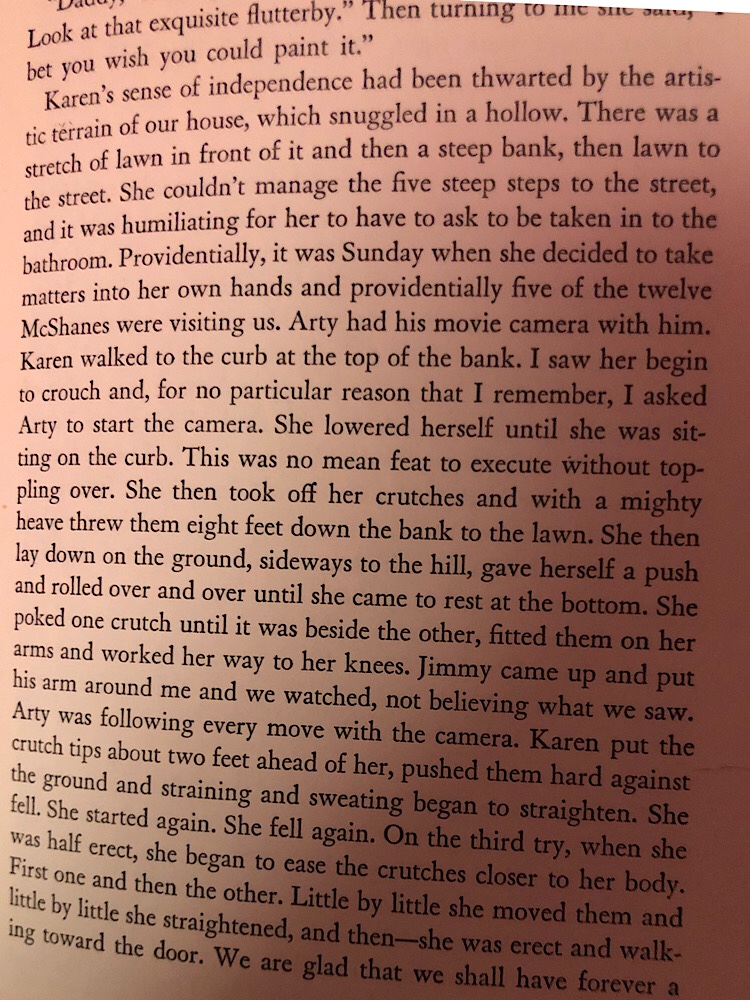
In the passage photographed above, Karen tries to navigate a hill. Mrs. Killilea never quiet explains where she was going— to the house? Away from it? Karen throws her crutches down the hill, rolls, retrieves her crutches, falls several times trying to get up, while her family watches and records it on a neighbor’s home movie camera.

This is one of those moments touted as bastions of independence. But how many times do you want someone fall without at least asking if they want help? And this is solely my opinion and my experience, but I hate seeing myself on video. The camera makes the “wrongness” of the cerebral palsy body more exaggerated and severe. Her parents want to record this moment in their Pride, but, to me, and again this is my opinion, to rewatch such a moment is to buy tickets to the freak show.

This family had inordinate health struggles with all of there children and the work Mrs. Killilea did to benefit cerebral palsy research made the world grow exponentially. And I am grateful.

But as I study the first chapter of Mrs. Killilea’s sequel memoir, With Love From Karen, it leaves me feeling that Karen’s condition has led to a 1952-best-selling book that has eased her family’s burdens, allowing them to buy a big, broken down Victorian house and given them a life line after a decade of medical bills for all their children.

I feel like Karen is exploited. Especially upon hearing that the whole family appeared in Time magazine.

Also I note Mrs. Killilea’s writing style has improved. The sentences flow with more artsy grammar and word choice. The description is more detailed. The verb choice strong.

Does she have an editor working for her now?

Bean, the 50-plus pound mastiff mutt puppy, and I are in the hammock. I hope this book presents Karen as a person, not an accessory.

When your writing career carries on without you…


So today I got an unexpected email from the folks at SAGE Academic Publishing. About four years ago, I wanted to write some short encyclopedia entries for them and they said no because I didn’t have a Ph.D. It was one of the things that made me consider graduate school.

They advised me that if I could find someone to co-author who had the necessary credentials, I could write for them.

I enlisted my college era friend Annette Varcoe, a brilliant scholar in American history and Women’s studies who had a freshly-minted Ph.D. after her name. She allowed me the pleasure of helping her edit her final dissertation.

The topic at hand was one of my favorite places in the world, Djibouti, and the article was based on a capstone project for my international affairs degree I had just completed. She knew nothing about Djibouti but her critical eye brought life to my dream and she got hooked on this region of the world and conditions there. Our first article was on poverty in Djibouti. She approached me a few months later and asked if I would consider doing another on security.

We did. Both pieces were submitted fairly close to each other. We probably wrote them both in 2014. The poverty piece was published in July 2015. I got the email that the second has now been published. March 2018. My career looks current even if I have stalled a bit!

This refreshed my memory that I never actually saw a book review I submitted to Global Studies South. Since my husband is home from work today using up his vacation, I asked him to look me up in the academic databases to which the Lafayette College libraries subscribe.

And here I am!