Thoughts raised by Johanna Hedva

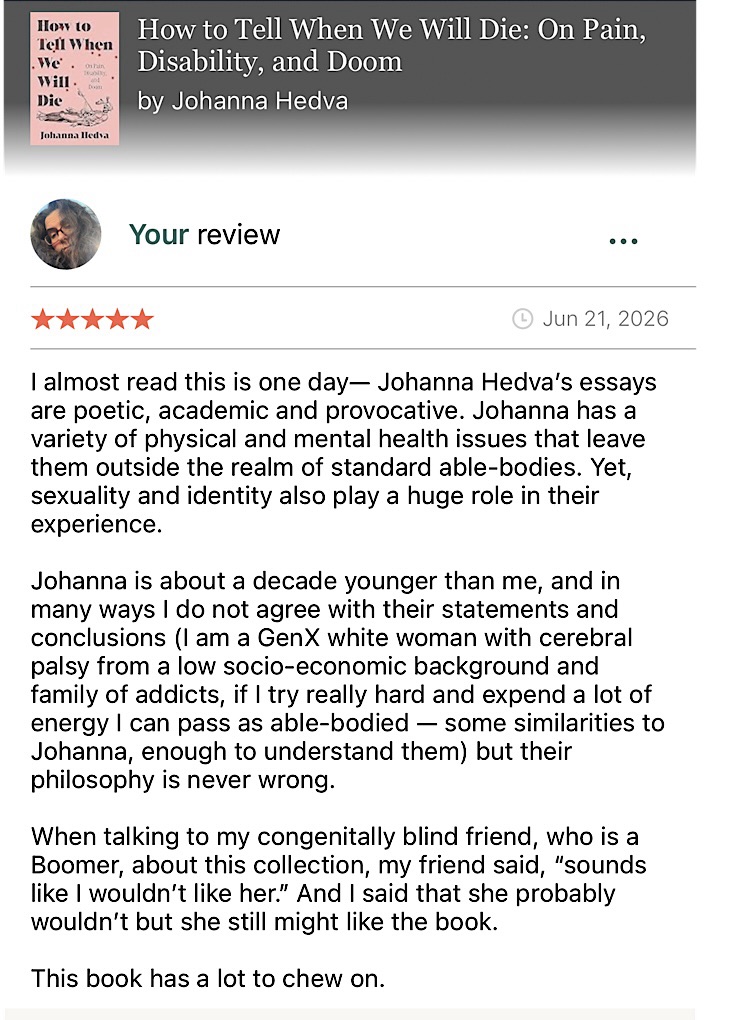
Screenshot of the Goodreads review that is also quoted in the blog piece

I put Johanna Hedva’s How to Tell When We Will Die: On Pain, Disability and Doom on my wish list probably when it was a new release.

The cover design is lovely and the bio of the author is enough to draw interest:

Johanna Hedva (they/them) is a Korean American writer, artist and musician who was raised in Los Angeles by a family of witches and now lives in LA and Berlin…

I guess the first step of my thoughts on the book would be to share my Goodreads review with you.

I gave the book five stars even though the most Generation X parts of my soul wanted to give it four, because despite how much I disagree with some of her points– I can’t stop thinking about them.

My Goodreads Review

I almost read this in one day– Johanna Hedva’s essays are poetic, academic, and provocative. Johanna has a variety of physical and mental health issues that them outside the realm of standard able-bodies. Yet, sexually and identity also play a huge role in their experience.

Johanna is about a decade younger than me, and in many ways I do not agree with their statements and conclusions, (I am a GenX white woman with cerebral palsy from a low socio-economic background and family of addicts, and if I try really hard and expend a lot of energy I can pass as able-bodied– some similarities to Johanna, enough to understand them) but their philosophy is never wrong.

When talking to my congenitally blind friend, who is a Boomer, about this collection, my friend said, “sounds like I wouldn’t like her.” And I said that she probably wouldn’t, but she still might like the book.

This book has a lot to chew on.”

So what are some of their thoughts and my thoughts on their thoughts?

Random comments first.

  1. The title is a shout-out to astrology.
  2. Their book deal for this collection stemmed from the essay Sick Woman Theory which went viral. The attention it garnered made them more of a figurehead and/or activist than they ever intended to be. The essay Sick Woman Theory is not nearly as interesting as her response to that essay, Why It’s Taking So Long.
  3. As a member of GenX, I have some discomfort with how the queer community throws around labels. Johanna identifies as a queer, and not as a woman, which is fine, but I guess I remember the days when people didn’t need to define their identity as concisely as we do now. You didn’t need to label every aspect in which you are weird. It’s okay to just be different.

So let’s look closer at some of their points.

Essay One: “How to Tell When We Will Die”

Opening paragraph:

“Heroes die on the battlefield, never from chronic pain. Diarrhea never makes its way into myth. Tragedies are devoid of menstrual cramps.” Johanna has my full attention. On the second page of the essay, they talk about the representation of disability in early and twentieth century film, and how disabled people become “flattened by some insidious super-cripple myth.” Throughout this first essay, Johanna is tossing around some serious academic critical theory before suddenly turning into memoir…

They speak about not receiving a diagnosis for their ailments until in graduate school (despite later saying that the conditions were inherited from their mother and grandmother, so I think the statement should have been that they could not get a label on the diagnosis– she does state that doctors were “baffled” by her symptoms and “dismissive of their validity.”). And they mention that they stayed on for a second master’s degree to keep their student medical benefits to the tune of $250,000, that led to a career in the arts where they refused any job that did not meet their aesthetic. They chose poverty. They chose art.

I’m wondering why– even if they didn’t want a standard job with employee-sponsored health insurance– they didn’t just buy health insurance or take on medical debt instead of a quarter of a million dollars in student loans.

But then there are gems like “You do not have to be disabled to experience ableism” and “no matter how it arrives, disability will arrive for everyone, sooner or later” (which they repeat in the last essay.) And Johanna points out that the biggest ableist fantasy is that we control our bodies, and we will always be able to control our bodies.

Johanna talks a lot about her mother’s addictions, and the abuse they suffered at their mother’s hands, and of their own mental health issues. Her first suicide attempt happened at age nine, when she took a bottle of sleeping pills, and when she did not die, she carried on with her life.

We are more than 25 pages into the book when we learn that mental health plays a significant role in her disability, which we later (not in this essay) learn includes endometriosis and chronic shingles. I understand that people with disabilities do not owe any sort of explanation of their ailments to anyone, but if you are writing a book about disability, I believe that information should be front and center.

And in this essay she mentions her love of death and doom metal. You can hear some of her music here on YouTube.

Essay Two: “Sick Woman Theory

The essay that started it all. I think it’s really important to understand that they called it “sick woman theory” because regardless of how they identify, the medical establishment and the world consider them a “sick woman” and they are seen as a “sick woman.” They frame their theory that our capitalist world is designed for the existence of “white, straight, healthy, neurotypical, upper- and middle-class, cis- and able-bodied man who makes his home in a wealthy country, has never not had health insurance, and whose importance to society is everywhere recognized and maybe explicit by their society, at the expense of everyone else.” To a certain extent, I want to call out a “Yes, bitch,” (as they toss around this phrase) but at the same token– would the experience be the same in the developping world/Global south.

Essay Three: “The Blast Radius of Disability”

I have to say that I love this concept, “The Blast Radius of Disability.” Disability doesn’t effect one person, one episode, or one place or time. Instead, it impacts everything around it, everyhing that it touches. Johanna speaks of time dvided into before and after sickmess, but I can’t help but wonder how they can divide time in such a way when mental illness entered their life so early they can’t really remember a before, can they?

It is in this essay that Johanna mentions that individuals with disabilities must operate according to “crip time” not clock time, doing things as the body deems itself capable not as the world says we have to do them. On one hand, I understand the point, but that’s not how the world works. I have to believe that there has to be a balance, of not overdoing things in order to conform to the mainstream standard and hurt oneself in the process. And there’s an inference that the entire world runs on the same precision, which isn’t true. There is “island time,” “Latin time,” and “African time.” Each culture has its own realtionship with time, so maybe they need to find a place and a rhythm that works for them.

Essay Four: “In Defense of De-Persons”

A discussion of capitalism and mental illness.

Essay Five: “Get Well Soon”

“Are these my limits, or are these the limits of the world?” Johanna reminds us that disability is part of a dichotomy– the ill being inactive while the healthy take action, the disabled remain still while the rest of the world creates revolutions.

Essay Six: “Notes on Activism (aka Notes on Failure)”

Organizing is exhausting, Johanna begins. Activism, they write, “reminds us how the world actually is, not now how we would like it to be.” Activism often comes off with hypocrisy– like buying your anti-racism books off Amazon.com. Their other question: How can you balance the need as an activism to care for others, yet also take care of yourself?

Essay Seven: “Letter to A Young Doctor”

I didn’t like this one. It seemed to repeat some of other concepts. Johanna tells this doctor all the other things they have already told us and will tell us differently in future essays. The doctor approached Johanna asking for advice.

Essay Eight: “Soft Blues”

Or “The Summer of the 12-inch cock.” The first several essays that are reflections on Johanna’s sexuality. And an in-depth exploration of her experience in a mental hospital for depression that led to her experiencing an entire summer of bipolar mania.

Essay Nine: “Can I Hit You?”

The BDSM essay. Which has the most amazing line: “Pain is the price I must pay to be awake to life.”

Essay Ten: “The Freak”

Another relationship essay. The only highlight I have in the whole essay is when Johanna discusses capability and capacity. They remind us that just because we are capable of something does not mean we have the capacity for it at this time.

Essay Eleven: “Notes on Trash Talk (aka Notes on Community)”

Interesting essay where Johanna gives a view of their obsession with fighting, boxing, wrestling and MMA, and how the way a coach talks to a losing athlete is the type of trash talk we could use more of as disabled people.

The next few essays are all Johanna’s entertainment criticism. I will skip those, even though they do circle around to disability as it all does.

Essay Fifteen: “Notes on Ambition (aka Notes on Survival)

This is a complex one– looking at what we all need, versus what we want, and how many of our ambitions are actually motivating us toward ideals that might not be our own.

Essay Sixteen: “Hedva’s Disability Rider.”

They explore this rider more in a later essay, the one I mention that speaks back to the original “Sick Woman Theory” and presents the repercussions. But here, Hedva gives us the document they send to institutions that invite her to perform. I feel like some of the items on the rider should not be listed as conditions for employment, but instead factors of how much they should charge for their fee. If you know you need a business class airline seat on the aisle, you make sure you only say yes if the organizers give you enough money. Some of the informational items are valid: like allergies. But Johanna also uses the rider as a way to advocate for everyone with disabilities and call attention to how excluded people with disabilities are. They ask for sign language interpreters, live captioning, all-gender restrooms, wheelchair accessibility and audio description.

They say they know they won’t get all of it, but they like to have the conversation and point out how unaccessible and exclusionary the world is.

And this is why hardcore advocacy is exhausting, friends.

While we would like to invite all the people with disabilities to everything, why provide the services if the people aren’t there? I know Nan and I have attended shows at DeSales University where they have one performance with audio description and live captions. These shows are made accessible with grants. Start there.

Essay Seventeen: “Room Day”

Johanna’s partner is Johannes, a German citizen, which is why they now live in Berlin most of the year so they can get better medical care. She does not mention her partner until essay seventeen. The partner to whom the book is dedicated.

Essay Eighteen: “Soft Until It Gets Hard”

How can you not love this title? Another relationship essay.

Essay Nineteen: “Why It’s Taking So Long”

In this essay, Johanna discusses the rider and how when they send the rider to an individual, they would prefer not to see that individual in the context of the institution but as a person with whom they can have a conversation. Teaching moments? Which is exactly what they say later on the page when they discuss they are now part of a “learning experience” that they did not want to be. And here’s another great observation– if an invitation comes in for any event that involves the concept of care in any way and is being organized by solely white women, Johanna won’t do it.

The essay falters between the idea that Johanna never wanted to be an advocate but now that they have the power, they feel a requirement to advocate for everyone.

Here are some great points:

  • Capitalism is so demanding, it makes us all more disabled
  • Even when we are told we “have to,” humans can’t truly do anything alone
  • It’s a fallacy that all you need is will, and the proper manifestation of it
  • Care is often framed as debt
  • You might be winning, but maybe there’s no prize

Essay Twenty: “The Hag in Charge”

A lovely adventure through Greece that offers some recollection of Johanna’s poverty and her spiritual beliefs.

A line that reminded me of Nan, who says this often: some disabled people (Nan and I like to say it’s normally able-bodied people who become disabled) have a fantasy of healing, “and then hate themselves when it fails to arrive for them.”

Disability Lit Review, part one

Let me offer a bit of an author’s note on this one, or perhaps a caveat, that I only got five hours of sleep last night, and my body hurts today. This is the third night this week I got six hours or less of sleep, due to some fairly intense routine change that is kicking my ass. And the pain I am experiencing today is not my standard everyday pain, but similar pain in a more twitchy and unnerving form.

And this may lead to some of my more strident tones. Or perhaps I always feel my opinions with a certain sharpness, but ordinarily I present them after the application of a filter.

I will try to keep my aggressive aggravation to myself, but no promises.

Earlier this month, I drafted a “bird piece” for the Behind Our Eyes anthology, a collection in the works to highlight the members of the Behind Our Eyes email-based writers group for writers with disabilities. I joined the group a couple years ago after participating on the fringes through Nancy Scott, who, in cheap amusement and most things disability, is my partner in crime. I normally lurk in the group, but recently heard they were actively looking for bird stories. The anthology features a variety of sections and one themed block focuses on animals.

I wrote a creative non-ficiton piece about my Goffin’s cockatoo and I navigating disability together, with a present-day, present tense story of Nala plucking her feathers due to her anxiety and me trying to figure out why. The plucking led to her not being able to fly, which gave her a temporary mobility disability. So I used this present-day situation to frame flashbacks exploring why Nala was anxious, but also looking at my mobility disability and the similarities and conditions that made us good for one another. The anthology committee wanted just a bird story, so they’ll be publishing the present-day section of my interactions with Nala.

This was the first of two pieces I wished to submit to disability-associated anthologies. I have drafted the second, but that one is specifically for disabled voices to share what we wished the outside world understood. I revisited my first draft, and tightened it somewhat, and thought the piece sounded like an introductory chapter to my upcoming medical advocacy memoir. That piece has two themes– the beginning talks about how my family had too many problems for me to realize I was “disabled” which seques into the second half, about me finding out my body and assembling an adequate medical team.

Nan has been encouraging me to write more in the disability space, her paraphrased quote being that I could have a real impact there. And in my experience, there are two main types of voices in the world of disability literature. The most mainstream voice is the voice of the writer-first– commonly a writer who experienced illness or disability not from birth, with either some sort of privilege or talent. The second is the disability activist who is not a writer, but congenitally-disabled and fighting for their right and the resources to exist. (And I guess the third would be the hobby disabled memoirist.)

I find myself crossing all these categories. I have the natural writing talent, my background as a professional journalist, my credentials as an academic and historian, and the experience of a congenital disability. Yet, I have the privilege of being a white woman, and if I can borrow the term, I can “pass” as an able-bodied person if I focus really hard and am having a good day. I have the type of cerebral palsy that you might not notice or that might make you stare at my feet and knees.

This morning on social media, I saw a post from a disabled Iraqi/Afghan War veteran stating that he needed to retire his service dog as she had had a seizure. The man said that his career involved much travel and public speaking as an influencer and motivational speaker. I searched the internet for him and found a very basic web site, some YouTube videos and an Instagram, but no information about him or the experiences that lead him to be a motivational speaker.

Now, in everyday life, people with disabilities do not owe information or an explanation to anyone regarding details about their private lives or medical conditions. But if you build a career on your experience coming back from a disability, I think some of that information is owed to prove the validity of that expertise. (And if you are an influencer, a Google search should turn up some information about you.)

What I am about to say next is going to make me sound like an ass, and I mention to not to invalidate the experience of people with disabilities who fit the categories as I am about to describe– but the lived experience of a Cis white heterosexual male in the United States of America who develops a disability after voluntary service with the military is very different from the experience of a person who has never been able to walk, has a limb difference, total blindness or any of the multitude of disabilities that occur at birth.

(Add in family resources, and there’s another layer of complexity.)

Some people have more choices. Some people have more privilege.

ALL people living with ANY TYPE of chronic illness or disability deserve the same respect, but one must understand that they all come from different places. As all humans do.

This has led me into a brief literature review of the disability space, one I have only explored via finding books written by ordinary people on their experience with disability. My list included the third anthology from Behind Our Eyes and a service dog memoir by one of its members, Peter Altschul. I have a collection of books with connections to cerebral palsy: several modern memoirs by Tylia Flores, a pre mid-20th century memoir by Dubliner Christy Brown, and Karen, a parent’s cerebral palsy memoir that takes place about 10 years after Christy Brown, and then poetry and academic work by Jennifer Bartlett. And a highly academic poetry book by blind poet Susan Glass.

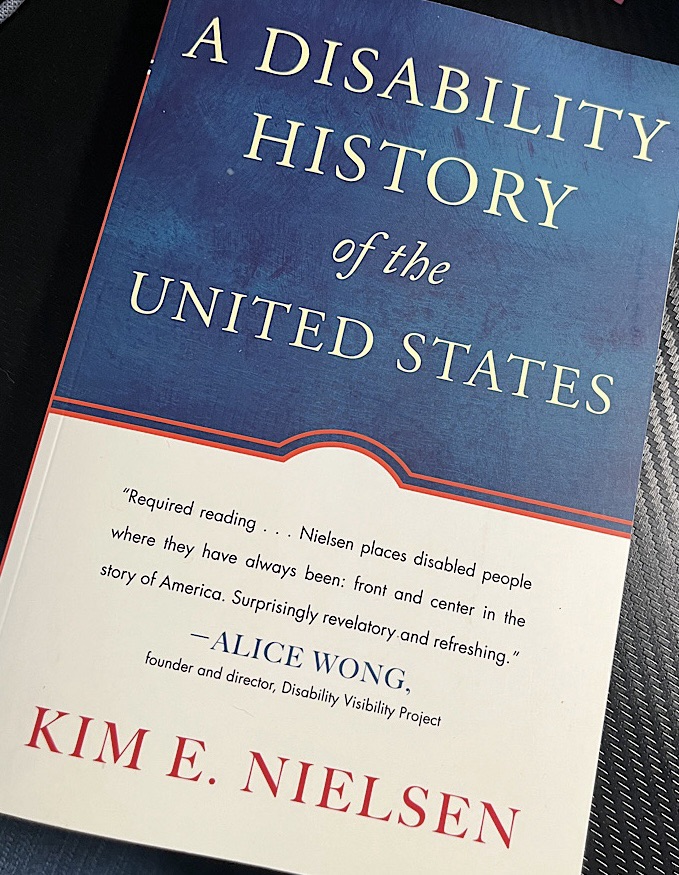
A copy of A Disability History of the United States

I recognized my need to diversify… especially as I start more work on my medical advocacy memoir and consider making more deliberate strides into this space.

Here’s what I ordered:

  • A Disability History of the United States by Kim E. Nielsen. I believe this was Nielsen’s Ph.D. thesis in history. In her introduction, she mentions that she is a white woman of certain privilege, and she ended up in this space by accident, with no connection to disability. Then, shortly after receiving a publishing contract for this book, her teen daughter contracted an illness that made her a wheelchair user and gave her a more personal glimpse of the issues she had talked about.

I finished this book yesterday, and it’s definitely an important work, exploring hundreds of years of attitudes and events about disabled bodies. Nielsen aligns disability rights with other civil rights, for women, for Blacks, for gays. She presents the idea that any body that is not strong, healthy, heterosexual, white and male faces the same discrimination and lack of belonging in the American social structure. And ALL of these bodies are disabled and deemed as unsatisfactory as part of the capitalistic labor machine.

It’s an important work that shows how ideas about disability evolved and how legal status/rights have changed.

Today I started:

  • How to Tell When We Will Die: On Pain, Disability and Doom by Johanna Hedva. This is Johanna’s fourth book, and the bio on the back lists them as a Korean American writer, artist and musician raised in Los Angeles raised by a family of witches.
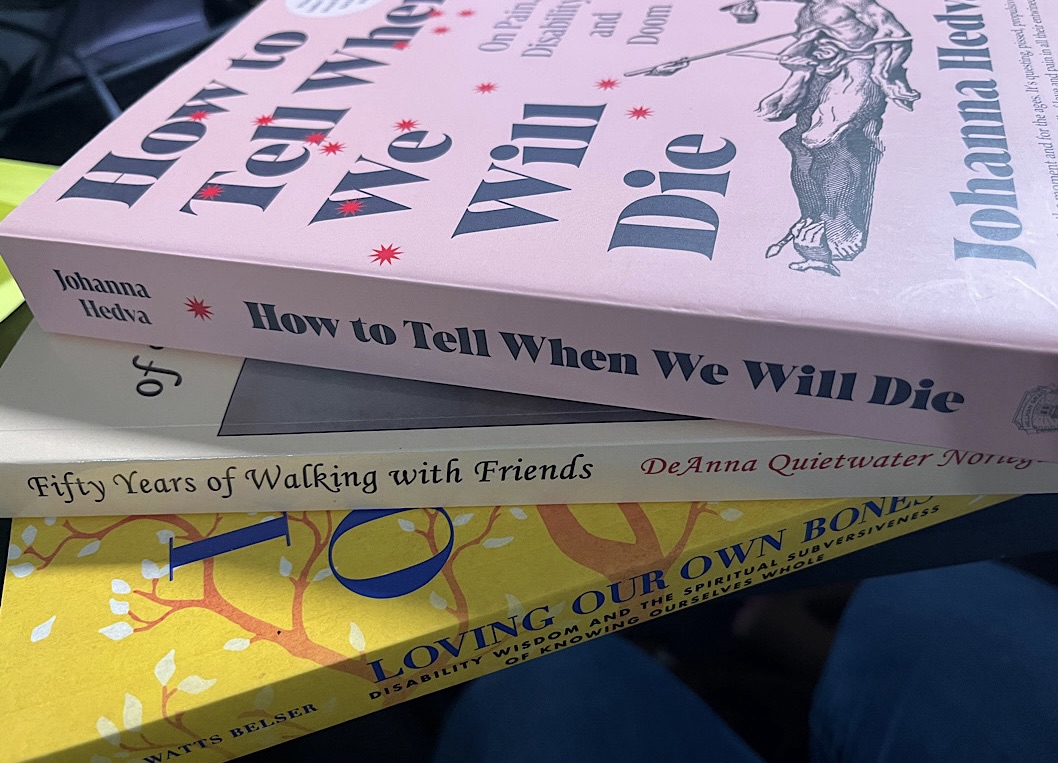
A pile of three disabilty-themed books. The top one, How to Tell When We Will Die: On Pain, Disability and Doom by Johanna Hedva, is pink with red stars. The next on the pile is a beige memoir, FIfty Years of Walking with Friends, by DeAnna Quietwater Noriega. The one on the bottom is vivid yellow, Loving Our Own Bones, by Julia Watts Belser.

Their introduction mirrors a lot of the same concepts about the issues disabled people create for American capitalism. Their experience though is one of disability after chronic illness. I have only reached page 28, and Johanna mentions a decade of chasing a diagnosis, but states that they inherited chronic illness from their mother and grandmother– which leads me to wonder why a diagnosis was such a mystery?

I suspect the reality is that Johanna had trouble finding a doctor to label the diagnosis officially, which is the “doctors are idiots” and the “American healthcare is broken” problem not that Johanna didn’t know what was wrong.

I hope Johanna eventually shares their disability with the reader, but as of yet it has not happened, and again– I know no one is entitled to know the private details of another person’s medical situation, but it is important when one is standing in a public space claiming authority regarding such issues.

The other two books on my new acquisitions are:

  • Fifty Years of Walking with Friends, another guide dog memoir by BOE member DeAnna Quietwater Noriega. I added this one to the list because of Noriega’s Native American heritage.
  • Loving Our Own Bones: Disability Wisdom and the Spiritual Subversiveness of Knowing Ourselves Whole by Julia Bessler Watts. Julia is a queer rabbi. This book was recommended and you had me at queer rabbi.

What makes today a good day might change tomorrow

This week presented many challenges. Monday I was hurting, probably from too much computer work during my 10-hour weekend editing sessions each day. I survived Monday, but barely, only to learn that Tuesday I would be moved to a different station in the Stitch Fix warehouse.

Change is never easy– but in this particular instance, as a person with a documented disability and doctor-derived medical accommodations, I struggle in my normal environment to perform at the same level as an ordinary employee. And that’s my job, to do the work, with a reasonable amount of help.

The main consideration used by management to determine assignments on the warehouse floor is table height. Is the work surface the appropriate height to match the ergonomic needs of the employee? In my case, my performance also relies on which side of the line I am on and who is “on support” that day. I work on “the B side” which does not mean I am not a radio song. It means the conveyance system that moves the fixes to the next stage of the process is on my left side.

I rely on my left side for balance. Therefore, to minimize potential issues with my hip and ensure my balance and stability, I need to work on the side where I turn to the left to put my boxes on the line.

My original table assignment for Tuesday was on the right, or the A side.

Requesting a B-assignment got me moved from line two to line four, which meant I would no longer have my regular support team. (That’s the role of the people who deliver work and supplies to those of us who fold the clothes.) I have been told that it’s my job to remind these folks of my medical needs. And they don’t always like that. So it makes me uncomfortable. Because in my view, it’s not my job to tell someone else how to do their job.

And to make matters more fun, it’s up to the individual to decide how to provide my accommodations. The deviations are small, but the impacts are major. The cart typically arrives with eight fixes on four shelves, with five to eight boxes lying horizontally on top of the cart. Most people move the boxes (I often take them) and pile the work from the bottom of the cart on the top. Some people even put the fixes from the two bottom shelves and place them in boxes on top.

I don’t even ask that pack slips be placed with them. I have myself trained to flip them to match the new order. Which confuses everyone but me.

This particular day, my support person, who I believe is a delight, so this is no reflection of who she is as a person, decided she would place the clothes around the boxes without moving the boxes at all. She tucked them all over the boxes. Which meant if I moved the cart to my station or reached for the boxes, the clothes fell on the floor. How does this help me? Keep in mind– I go through three carts an hour.

I eventually complained to a supervisor and said something like this:

“I know it’s too late now, as we’re closing, but there really should be a system in place where Stitch Fix defines what the accommodation is for the doctor’s orders, because it really shouldn’t rely on individuals who don’t understand the disability. And maybe it’s a violation of privacy, but those of use who need the extra attention should be arranged together so support automatically knows if we’re in that section, we have an accommodation and it would also cut down on people requesting accommodations when they haven’t done the paperwork.”

The supervisor said that was a great idea and lamented that I hadn’t mentioned it earlier. I didn’t mention it because it’s basic logic.

Somehow, I survive, and I make numbers. My body is so twisted I can feel that if I move wrong I’m going to pull a muscle in my lower back. But it’s okay because I have the chiropractor on Wednesday.

And then I get the table from hell on Wednesday. It’s the right height, right side, good support people. But it’s a front-of-the-line table, so I have to keep pushing the boxes toward the end. The fan keeps blowing my pack slips, which means I need to tuck them under my craft paper roll instead of on my laptop keyboard. But I keep forgetting, which means every cart I repeat chasing a paper, and tucking the others under my craft paper roll. My scanner keeps disconnecting from my computer. And if I need to go get a large box, which is common now as we are transitioning into winter clothes, I have to walk to the back of the line to get it.

These things add ten to thirty seconds to every fix. That’s 40 minutes over the course of the day. And I finished at 91% which is bad enough to get me a warning. And so I’m stressing, which tenses my muscles, and since my neurological condition already creates issues with my muscles not relaxing just makes everything worse.

And midday, the leaders got out an inflatable beach ball so every one could bounce it around to each other. That upset me more because I don’t have time to have fun. How dare they think I might be able to survive this and have fun?

Nicole Jensen of Back in Line Chiropractic aligned my lower body and stretched out my legs and I left her able to stand up straight and move my legs without stabbing pain.

This is where the difficult mental part of disability takes over. It’s so much easier to give in, to rest, to eat ice cream and watch TV and be done. But I knew my body needed to stretch and move in order to correct whatever issues had been caused by my misalignment and muscle tightness.

My brain and my muscles don’t have good conversations– so it seems like I can to manually perform a motion for a while to teach my body how to do it, even if that is reminding it how feet go or how a gait is supposed to work. That’s why I go to the gym. Not just so someone forces me to exercise, but also so someone can make sure I am using body parts correctly.

But I have to tell you, I dreaded going to the gym. I had been in pain all day. I wanted to take a hot shower and go to bed.

Andrew texted. He had a situation at work. Maybe the universe thought I needed a break. When Nicole works on me after such bad body pain, I’m often achy the next day.

Then Thursday went fine. Great even. But the pain crept back Friday, not nearly as bad but it took me most of my day to get my metrics at work to solid ground. And Friday night I went to the gym, and despite how I was feeling, I had fun and did well with some heavy weights.

I made some salmon and trendy smashed potatoes with vegan tzaziki sauce for dinner and the Teenager loved it. I fleshed out the writer’s proof for the erotica book. And went to bed feeling like I had been successful.

This morning I got up, discovered I had low blood pressure after I took my beta blocker (oops) and had a light breakfast– coffee with PB2 and cream, PowderVitamin Electrolyte Powder Plus in strawberry cucumber and these breakfast biscuits from Olyra. I thought they’d resemble a Reese’s peanut butter cup or a Tastykake Kandykake.

They were hard, dry and the peanut butter cream was minuscule and didn’t even moisten the cookie. Terrible. And I love their yogurt breakfast biscuits so how could this taste like someone managed to shape chocolate-flavored protein powder into a cookie?

Anyway, the moral of the story is: sometimes what you can achieve one day is much less than what you achieved on a different day.

Return to the gym and other small successes after a week where cerebral palsy gave me hell

It’s a quiet Saturday morning despite absolutely roaring winds and nasty cold outside. The Teenager and I were working out some financial details last night over tequila shooters after upheaval this week (and plans to do taxes tomorrow) in light of the fact that her check engine light popped on last night. Her car has turned out to be an enormous money pit.

I’m drinking Friendly’s Arabica Mint Chocolate Chip Ice Cream flavored coffee. I adore mint in coffee, so I picked this up. It has a light and smooth flavor, so I drink it way too fast (as I am used to my bitter dark roasts) and makes the kitchen smell fantastic, especially considering it comes out of a K-cup. Both the mint flavors I have found since stumbling on the Dunkin white chocolate peppermint, have been branded Friendly’s.

The importance of exercise when you have a disability

Last night I returned to the gym, having warned my fitness and strength coach Andrew of Apex Training that he needed to leave the sadist in him at home because my body is still delicate.

(I know he’s a personal trainer, but that doesn’t seem enough to classify what he does, so I call him my coach. Life coaching has become so en vogue right now and that sort of coaching using combines listening, some psychological training and helping people get their metaphorical shit together. Personal training to me seems very goal oriented, whereas Andrew has to deal with a lot more than that. Training implies, in my mind, sharing knowledge of an activity that relates to form and tricks of the trade. It’s giving intellectual knowledge in combination with experience to help someone develop a skill, or in this case, a habit. But, having dabbled with hobby bodybuilding in the past, I have the knowledge and we’re working with non-textbook medical issues because I don’t have a “normal” body, so I need some extra support. And I love the guys at Apex for all the support they give to me.)

Andrew prepared a lovely full-body workout circuit for me that focuses on quality of movements versus high intensity or heavy weights. He and I have noticed during our now year-long relationship that the second set of an exercise is always better than the first set. And we’ve come to believe that my body– because my brain and the muscles in my lower body can’t communicate like they do in people without neurological conditions– needs to be reminded what to do. It feels like my body needs to be shown basic movements after even the most basic hiatus to break a cycle of malfunctioning, reset, and proceed in a different and better manner.

That circuit reminded my body parts how to work together again and get all those tissues and electrical connections firing. And after a week of sometimes intense pain, emotional and physical stress, and constant discomfort, the exercises allowed me to test my movement and release any sensations of immobility or fear I was clinging to. And Andrew was there to monitor my performance and make sure I didn’t hurt myself.

And let me just add, in case anyone else struggling with a disability like mine that manifests differently in people or that the medical establishment doesn’t fully understand: It is 100% true that you know your body best, but it’s also true that our experiences in bodies that do not do what standard bodies do often blind us to what we can and cannot do. This can bubble to the surface in many ways: 1. We are stubborn and should not do many of the things we attempt to do; 2. We give up too easily; and 3. Because we never see our bodies from an outsider’s perspective so we have a skewed outlook.

These are all important reasons why I have a personal trainer. All of them. I learned this from listening to my daughter talk about my body. She didn’t mention it as a young child, but as she got older she said things like, “Mom, your feet are fucky. Fix them.” She saw me fall so many times that she began to notice the signs of when I might fall. I don’t see that. I don’t see my feet from an outside perspective. And that’s why it’s emotional painful to see photographs of myself with twisted knees. And also why I asked Joan to photograph them for Not an Able-Bodied White Man with Money. And if I’m honest, why I put the photo spread in the back of the book. (See below for Amazon purchasing details or buy from us here.)

In many ways, Andrew knows my physical limitations better than I do. THAT is why I have a personal trainer. If it weren’t for him, I wouldn’t have exercised at all last night. And this is why I get angry when people cite a disability for why they can’t work out– that is specifically why you need to work out. You can’t pound weights like a powerlifter or run marathons, but bodies need to be used and challenged.

Mundane things like food and mail order packages

Rant over… My blood pressure is elevated this morning, but looking at the patterns of the last week and my list of dietary choices, I can see the role salt has had in my numbers. Dinner Thursday night had more salt than I’ve had recently, and dinner last night consisted of a canned black bean, sheep cheese and processed mole sauce lasagne with lentil noodles, laced with that sodium.

screenshot from Goodreads

Add the tequila, of which I did not have much, and the fact that I was licking salt off my hand…

I woke to a truly distressing dream that started as one of those dreams where you need to use the bathroom but can’t find one. I was wrestling a woman in a cheetah print denim dress to beat her to the toilet, and then, in the dream, I could not pee. Despite the pain and urgency of needing to pee. I suppose my mind really wanted me to wake up, because the next part of the dream haunts me even now. I saw a baby, who appeared to be blind (remarkably similar to the early 1980s hardcover, purple dust jacket edition of John Saul’s Comes the Blind Fury. And the baby had a baby. They were side by side, a newborn and a larger infant. Which took a cheese grater to my emotions, because I don’t think they were Irish twins. I had no choice but to get up after that horrific scene.

To bring things back around to happier things… and more references to Parisian Phoenix Publishing… (Please buy books!!!)

I prepared a special mail order package with a signed copy of The Death of Big Butch. I will be headed to the post office today.

What I ate Friday:

  • 4:30 a.m., one cup Friendly’s Peppermint Stick coffee, with half and half
  • 5 a.m., first breakfast, honey nut Chex with Silk protein cashew-almond non-dairy milk
  • 8:30 a.m., second breakfast, salted and roasted pistachios, mango jerky from Solely
  • 11:30 a.m., lunch, vegan tofu spring rolls and cabbage, diet Pepsi
  • 3 p.m., snack, iced coffee with half and half and cinnamon a very berry oatmeal cookie from Panera
  • 7 p.m., dinner, black bean and sheep cheese lasagne with cheddar and mole sauce on green lentil noodles and plantain chips
  • 8 p.m., tequila shooter with pink Himalayan sea salt and a slice of lemon

(and about 60 ounces of water)

How long do I push and how hard do I fight? Questions I have to ask as a warehouse worker with cerebral palsy

The animals are all eating dinner. The Teenager has gone to care for her last client of the day. I am emotionally wiped out from all the events of the day, or the week, or maybe the last couple weeks. My friend from work, a beautiful and sassy Puerto Rican woman whom we shall call Spicy (because of her outspoken Aries nature and her abundance of passion), told me I should go home and drink some tequila.

I’m still waiting for initial contact from the insurance company of the person who hit me Friday night after work. Unfortunately, I did hear from my insurance company about my six-month-bill due next month. It doubled in cost to more than $3,000. I’m just flabbergasted.

I always have a lot on my mind and a lot of responsibility on my shoulders, and I know with my volunteer work, I put a lot of the pressure on myself by saying yes to things.

I visited my chiropractor after work, actually having left early because someone else must have booked my 3:45 appointment. She believes my current issues probably stemmed from the change at work, and started with my back and then effected my hip.

Part of me wants to write this post and submit it to the online social media forum for people with disabilities, The Mighty, because I want a conversation, but I also don’t want to risk exposing myself to issues with my employer.

So, let’s see. Summary: I work in a warehouse folding clothes. I completely disclosed my disability to the person hiring me. This was more than two years ago. In the last year-ish, we’ve had our jobs changed, our shifts changed twice meaning we’ve worked three different schedules in that time, and a recent change (December 2022) in how they measure our performance.

But, you might think, how many ways are there to count how many clothes you fold in a day?

Well, when I was hired, they took the average of how many clothes you folded over the week. If the goal was 100 a day, then if you got 98, 100, 100, 102, 100 you passed the week without incident. I succeeded with this system. I might have several days at 102 or 103 and then a day at 95. And as long as you were consistently about 90 nobody cared. Realistically, my numbers were probably 90, 98, 100, 100, 105.

Now, we work in series of 20-day blocks, and we’re allowed to miss 100 twice in that block. They look at every day independently. I knew I could not reach that expectation. I asked my neurologist to fill out accommodations paperwork. My company has been fantastic working out accommodations for me– but what to do about the days I’m more crippled than usual?

To address this, I applied for intermittent FMLA leave. The company that administers it first granted me six hours every six months. So, I did a new set after talking with my examiner, and despite my listing weekly doctors’ appointments I got the equivalent of one day a month. And because I’ve been experiencing such issues lately, and with my almost cardiac scare last week, and my service dog appointments, I have no paid time off left. I will not have that time replenished for about a month.

That brings me to the present. So, even though I did 100, 100, 110 and 90 last week, I’m already one day down. Then they moved me to a different department Friday, and my body doesn’t handle change well.

Monday I did 86% while in complete discomfort and periodic intense pain. Yesterday I did 93% while in moderate pain. They wrote me up with a first warning today. Apparently each warning comes with a month of focus on an improvement plan, during which they lower expectations. I’m told I only have to hit 90%. Today I think I hit 95%. I can’t say exactly because I had an emergency preparedness training, a safety committee meeting, a sit-down with my boss so he could administer my warning and I left early for a doctor appointment.

When I signed the paperwork, I mentioned that my lack of performance is a direct result of issues stemming from my disability which may or may not have been caused by the change in my working conditions on Friday.

I’m trying to do everything right. But it’s damn hard and I’m damn tired.

Now… the questions I wish to ask and address do not relate specifically to my company or my boss. I think the situation I am facing mimics what we see in the medical industry as well. We no longer live in a society where doctors and bosses have the power to make individual decisions.

In the interest of fairness and preventing discrimination, we have blanket rubrics that determine how every person needs to be treated. My boss knows I work hard, and he knows I will come through in the long haul. His sidekick who interacts with us all on the floor has a disability himself.

And it’s not like I was hired last week. I was hired more than two years ago. And that person who took a chance on me? They got rid of her in well-publicized lay-offs.

Apparently, they have four rounds of warnings before you “separate.” But if I recover from this current cerebral palsy episode of malfunctioning body parts, hit my numbers, and then experience something similar in a couple months, do I get another first warning? Or does it progress to second? Do I care if they “separate” me? They changed the job I was hired to do into one I cannot do, and I can’t do it because of a disability they know I have.

This is when I also mentioned that I only intend to use that leave time for unexpected occurrences. That when appointments are scheduled I will continue to used my paid time, my unpaid time and voluntary time off when offered.

The advice I was given was to have new papers filled out (the third set in as many months) requesting a full week of time off every month. That implied to me that only answer is to call off when I have any sort of discomfort– because if I show up in the building and leave when I’ve already fallen behind that will count toward my misses. But I have no paid time left, and my official leave only covers one day a month.

And sometimes the motion of the day resets my misfiring muscles.

Part of me is done fighting. I love my job. I love the company. I do hate my current schedule. But I like the routine of it all, I like that it leaves my mind free for my own endeavors. If I did give up on striving to meet the standards, I wouldn’t quit. I would still give as much as I could until the end.

But I just keep asking: when do I give up? Will I ever reach the point where I can do my job without hurting myself and will they ever reach the point where they stop upending the process of what we do? I don’t know the answer.

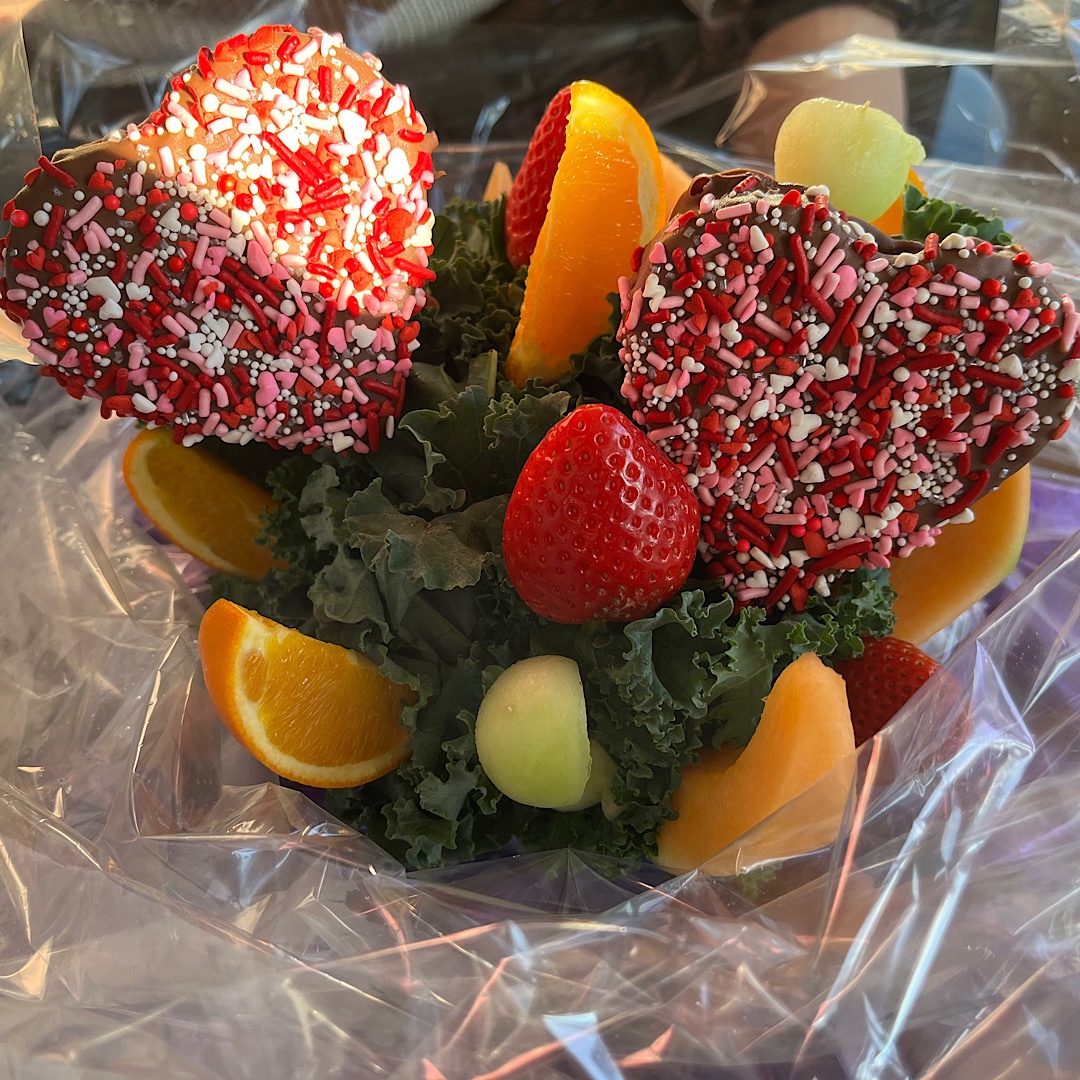
In better news, our neighbor brought us a fresh fruit arrangement. Which the Teenager and I devoured.

In case I forget to say later (it’s only 5:30 p.m. and there will be tequila in my future):

My blood pressure has been damn near perfect.

What I ate today:

  • 4:30 a.m., one cup Suprcoffe coffee, dark roast, with half and half
  • 6 a.m., first breakfast, Kind Breakfast bar, oatmeal peanut butter, banana
  • 8:30 a.m., second breakfast, plantain chips,* peanut butter
  • 11:30 a.m., lunch, stuffed pepper soup, diet pepsi
  • 4 p.m., herbal iced tea (rooibos)
  • 4:30 p.m, four slices cantaloupe, two balls honeydew, one strawberry, one massive pineapple heart covered with milk chocolate and sprinkles
  • 6 p.m., planned dinner, green salad, tequila

(and about 56 ounces of water)

*the plantain chips have some nutrients and are pretty low in sodium

Busy, busy: Taking care of yourself takes time (but we always make time for adventures)

It’s been what, a week?, since I wrote in this forum. I know, I know.

I have been trying to write. I have plans to brainstorm ideas for BookTok, projects to edit, and I decided to make short, very real, unedited videos for BookTube.

But, as I left myself 30 minutes to write this blog entry and “wasted” 15 minutes of that panicking over a medical form (all part of “things that have happened since last week”) I may have to leave you with a list:

  • The Intermittent Leave I submitted to my PCP was illegible once printed out, so I typed a new one over the weekend and sent it to the doctor’s office. I had not heard from them, so I double-checked the email this morning and thought the form I sent them was blank. I panicked, discovered my eyes had misled me, but had already messaged the office so now I probably have high blood pressure and look like an ass.
  • My favorite foster, Khloe the Sassy Princess and Cuddler, went to Chaar in Forks Township in search of a home. I went to visit her before the gym Wednesday and she made me biscuits.
  • My workouts have been brutal… I mean amazing, really I do. I’ve been doing what feels like some great weights and focusing so hard on form.
  • We had a heating oil delivery yesterday and I hadn’t anticipated that for another three weeks. $700. Ouch.
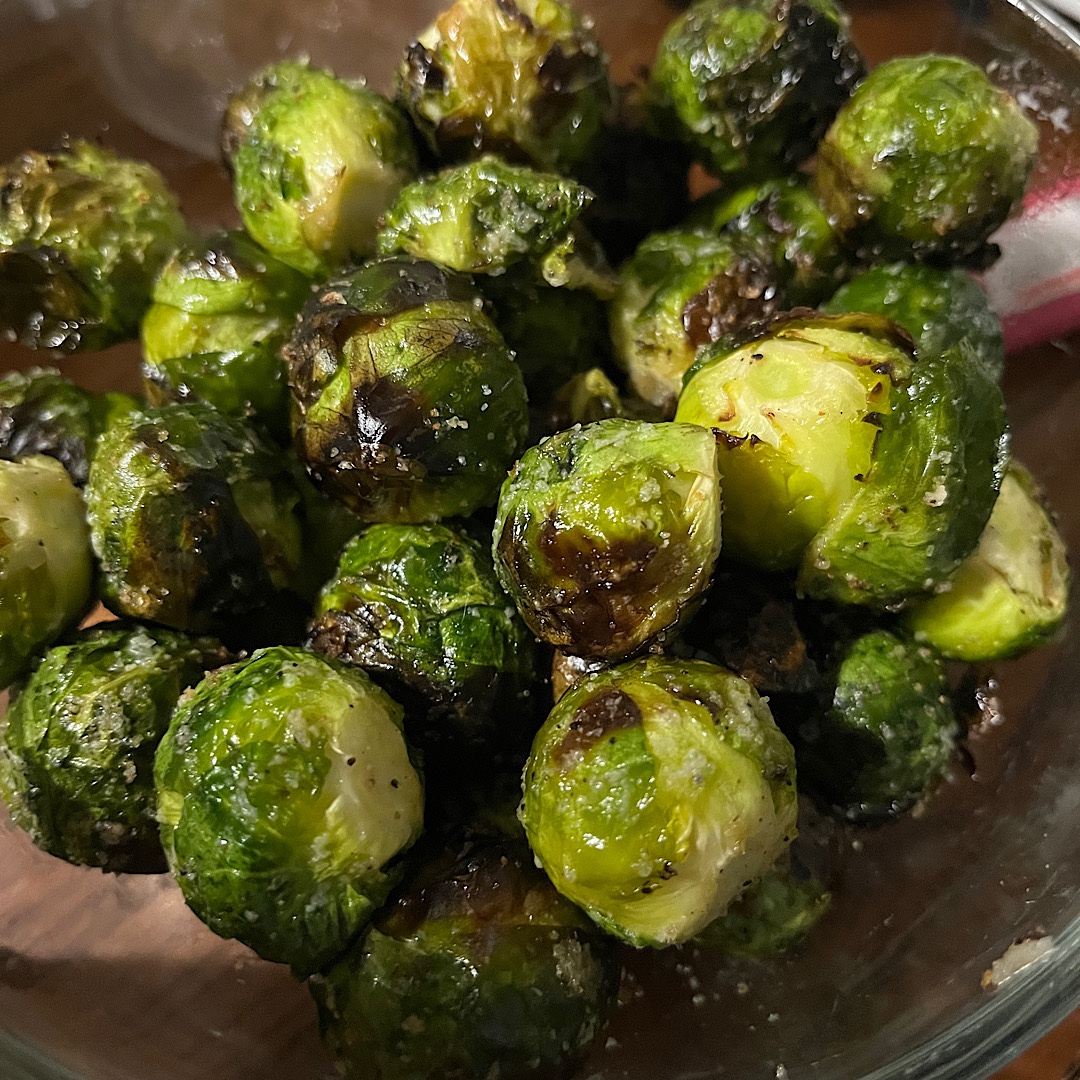
  • I had brussel sprouts three times this week. I do love my brussel sprouts.
  • I saw Nan Tuesday night and we practically made a comedy routine out of reading her junk mail.
  • My creative brain is swimming with ideas. Is that because I have no time?
  • I am soooooo close to fully performing at work. They messed up my accommodations Tuesday. My percentages are 98%, 103%, 103%. Accommodations make a difference.

But here’s my big take away:

Feel free to let me know your opinion.

Regardless of whether you have a disability or not, and that can even be a personal determination, getting older sucks… anyway… Taking care of yourself takes a lot of time. Monitoring your habits (food, sleep, exercise), health and treatments take so much time. Finding and visiting doctors. Physical therapy, training sessions or independent-led exercise. It’s ridiculous. Filling out that intermittent leave paperwork really drove home how much time I spend taking care of myself.

Maybe it is easier to neglect oneself. Maybe it would be so much less stressful to eat what I want, accept my “limitations” and live a more sedentary life. Maybe it is easier to stop fighting and be miserable. Maybe it takes an exhausting amount of energy to take care of oneself.

I’m a doer, a fighter. It’s who I am. So I will never stop trying. But now I think I see why some folks don’t.

A reset? The NaNo Dilemma, a podcast/YouTube interview, and some disability philosophy

I signed up for NaNoWriMo 2022, in part because deadlines and challenges and what feels impossible sometimes motivates me. But between foster cats with diarrhea, work shift changes, health issues and mood in general, I’m losing my focus and drive. I need a reset and an evaluation of my goals more than I need a push.

I have learned in the last five years or so as I’ve “come out” of the disability “closet,” is that when you have a disability or a chronic condition you have a choice: you either withdraw from life or you become tenacious and stubborn and adaptive. I think the majority of those of us with congenital issues, especially when our parents didn’t make our physical difference the center of our existence, tend to be the latter to the point of ridiculousness. We want to do things, whatever they are, and we don’t want our bodies to hinder us.

I think people who came to body differences later in life might be more prone to accept “well I just won’t do that anymore” while younger people with catastrophic injuries have the will to keep on going, and those with issues since birth learn that if they want to experience certain things they have to work harder but in reality we need to work creatively. So the 20-year-old proclaimed paralyzed as the result of a sporting accident will be more motivated to walk again than the 60-year-old who had a car accident.

But these are really complex topics to ponder and very personalized to the emotional and financial resources a person has to support them.

If you read my personal blog, you know I have diplegic spastic cerebral palsy. If you get tired of hearing me day that, I don’t care. I’m 47-years-old and like many Generation Xers out there I’m wondering how the hell that has happened so quickly. But more importantly, and I write this without judgment, I had no real medical treatment between the ages of five and twenty.

I realized– because of my job working in the warehouse at Stitch Fix of all places– that not only do I know nothing about cerebral palsy, but my medical team might not know much either. So no wonder I have a lot of unanswered questions. This week I celebrate my two year anniversary with Stitch Fix and my journey to understand my own body will be forever tied with my warehouse job with them.

Up until December 2021, I had never seen a neurologist. Until that late December visit with a neurologist, I never even had a diagnosis on my file.

And to think, now I have TWO neurologists. I guess I just want to remind everyone, and this is why writing a cerebral palsy memoir will be one of my next projects, that we tend to view our doctors as people in a hierarchy above us and we approach them for answers and with hope of relief. Instead, we need to approach them as peers with education and insight and it’s our responsibility as patients to ferry information between them and do what we can for ourselves.

I had a fall Friday night, after a week long battle with nerve pain in my foot and leg. I agreed to cortisone shots in my foot to see if that would curb the pain in my foot (and it did) but the resulting change in sensation and muscle responsiveness has made this leg (which happens to be my good one) less reliable. Throw in lack of sleep, not enough food and a cocktail and down I went. As someone with cerebral palsy, I need to remember that normal side effects for people who have proper muscle control may manifest differently in me.

So, Saturday morning, I nestled under my new Dad blanket (if you need to hear more detail on any of this about Friday click here) and planned to work on my NaNoWriMo project. Even though I had the time, and the healthy start needed to get a flow going on the project, I didn’t write a word. And I’m wondering if, already having one novel underway and past deadline, if starting another is merely destroying any chance of focus I have.

I have 4,000 words on the NaNo project, which if you don’t know is National Novel Writing Month, and I should be at 12,000 words by now. I had hoped the new project, a new idea which is nothing like anything I’ve ever written, would shake off the bad habits of an editor/publisher debating every word and allow me to write freely. That impetus would revive my ability to write quickly and without overthinking.

And strengthen writing habits.

The jury is out.

I may abandon official NaNo in favor of sticking with a strict writing schedule of rising at 4 a.m. daily before my warehouse shift and writing from 4:15 to 5:15 a.m.

The Teenager has had two overnight clients and I think at last count it had been 16 days since she slept in her own bed. When she arrived home yesterday morning, she looked at me on the couch and her dog lazily dozing and decided we both needed fresh air. So she mentioned key words: “walk,” “ride” and “window.” The dog lost her mind.

The Teenager knows how to bribe both of us.

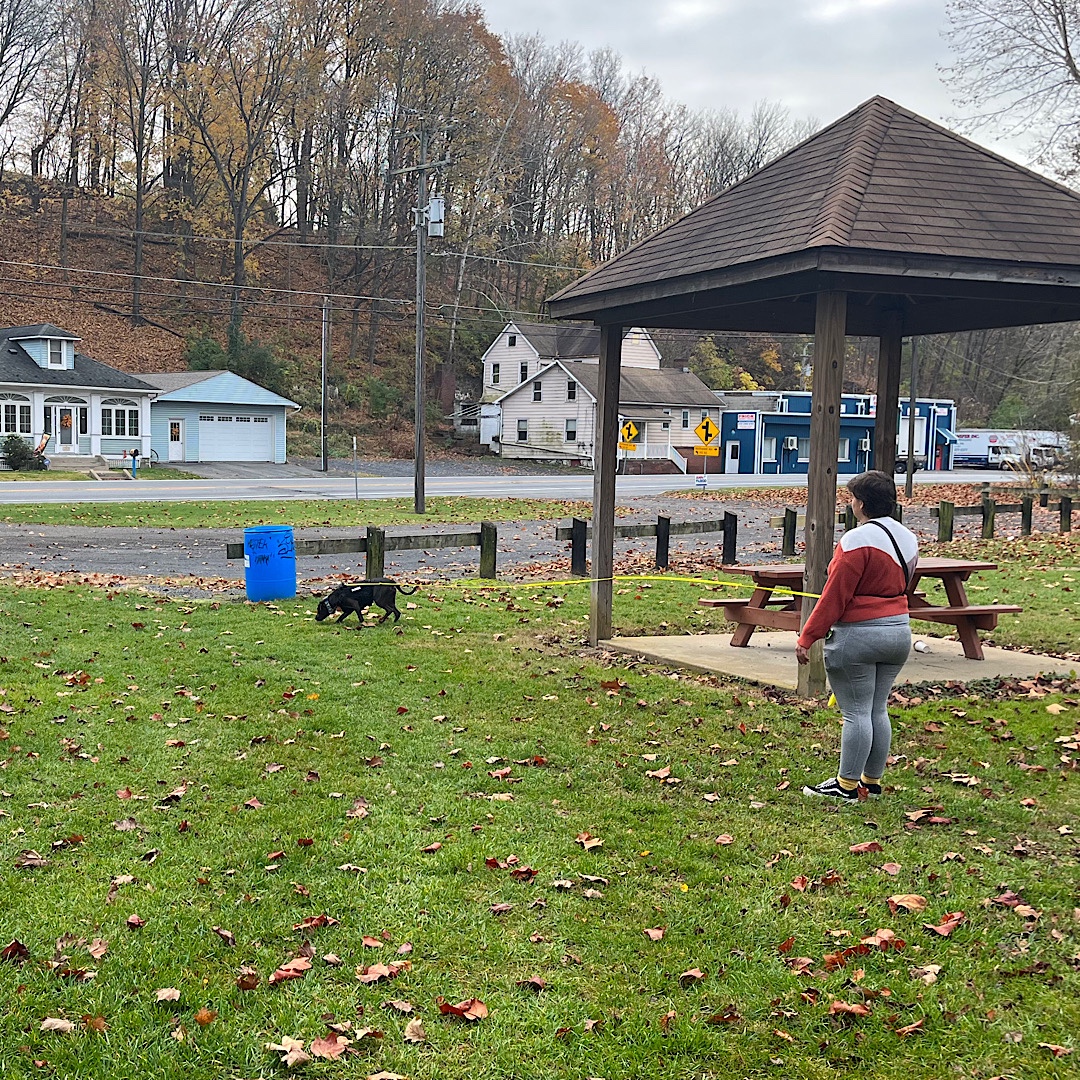
She recently bought a new harness and long line for the dog. So we went to a small park to try it out. The park outlaws tobacco, alcohol, fireworks, drugs and golf. But dogs are okay.

There’s a cute video on YouTube of F. Bean Barker enjoying the outdoors.

And then we went to “the Window.” Which in this case meant Dunkin as it was still early and we sampled their new Cookie Butter offerings, the cold brew and the doughnut. Both were dangerously decadent. The doughnut is 370 calories so I’m hoping it sells out to the extent where I can’t get my hands on it.

I went to the park and the window in my pajamas, because it was a gloomy Saturday and I didn’t see the point of fancying myself just to hang out with the dog.

I spent a good portion of the day doing dishes and laundry and watching “Wheeler Dealer Dream Car” on Motor Trend’s streaming channel. I subscribed to Motor Trend last month so I could binge watch the Dax Shepard redo of “Top Gear America” and I may hang on to the subscription as I enjoy the content. The Teenager finds this perplexing as she knows I have no mechanical aptitude.

She classifies my car knowledge as “it looks pretty” and “it goes fast,” but I suppose my interest is similar to my fascination with haute couture sewing. I have read my haute couture sewing guide cover to cover (and yes there is such a thing) and I can’t sew to save my life.

I suppose I am a true academic. Reading and obsessing over knowledge of things I will never have the skill to do.

Then, the Teenager found “her box” on the doorstep, her third fix from Stitch Fix!!!! So we opened that bad boy.

I think The Teenager is disappointed that her box doesn’t have more flare, but the staples she receives is really improving her day to day look. As a dog walker, I am now seeing her in these Stitch Fix selections as a way that she can maintain comfort and still look put together.

If you watch the YouTube review, you’ll see more of The Teenager in what she calls her new “math teacher sweater.” It’s a keeper. It’s about 16 hours after she received it and she’s still wearing it. Stay tuned to see if I steal her shoes and keep them.

Later in the day, I had an interview with David Figueroa of David’s Cerebral Palsy and Fitness Channel. I have explored his YouTube content and I listen to his podcast. I am working hard to take charge of my aging process and I hope my message of the importance of strength training and my approach to medical advocacy resonate with people.

We talked for an hour and a half. I’ve included a link to his YouTube channel below. Let’s hope the chaos of my house wasn’t too distracting! But one disruption I welcomed was the motorcycle that passed by while I was talking about my father.

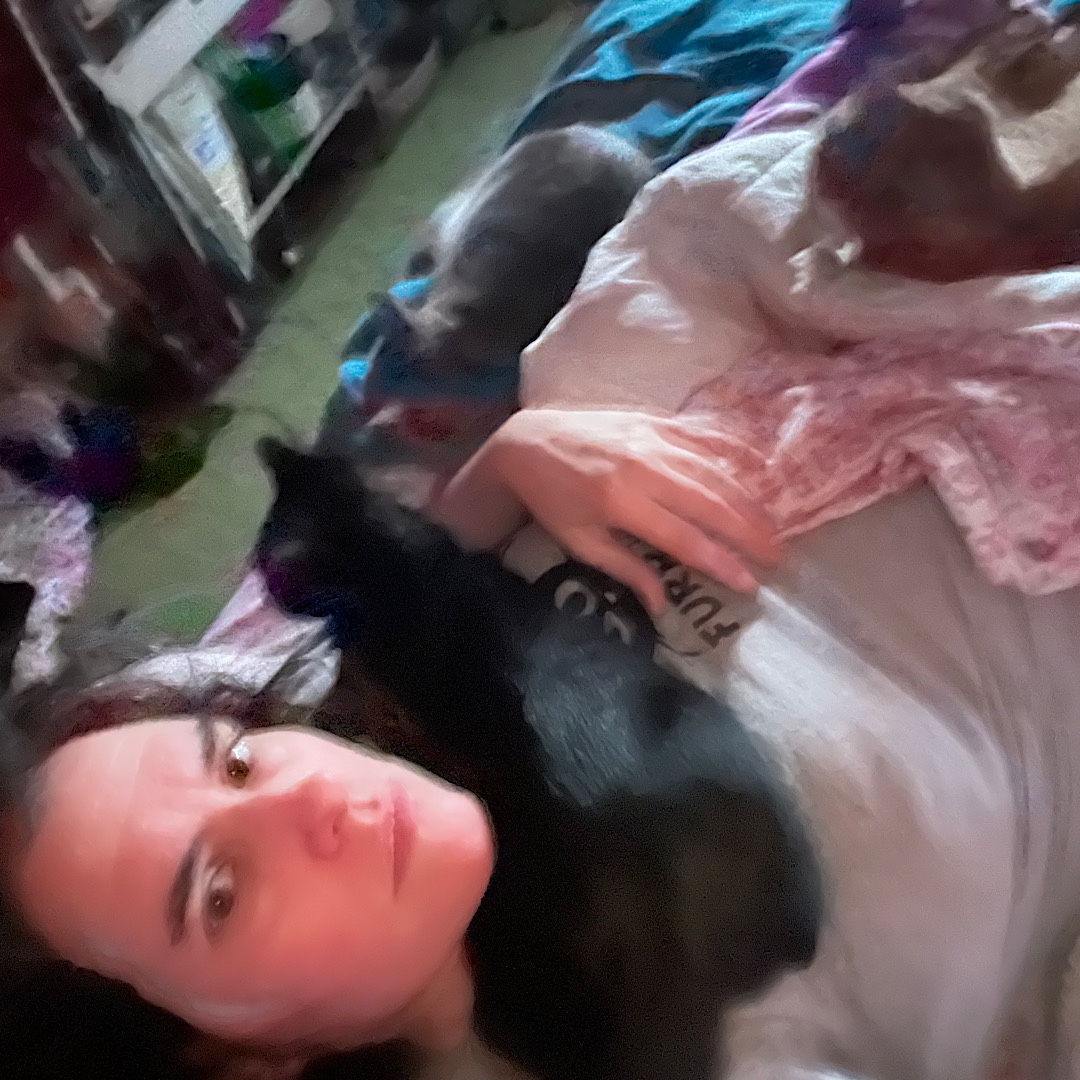
I ended up sleeping more than nine hours last night, and woke up this morning covered in cats. I hope your time-change-hour served you as well as mine did. Here’s a photo of me with the fosters, and it’s blurry because I took it without my glasses.

3/4 of the year: The August medical update and ‘the feels’

Yesterday Nancy (my blind friend, poetry editor and my sassy mentor/ partner in crime) and I were in her bank. The other local branch of this big name bank had had some sort of building emergency. That office was temporarily closed, so the customers were lining up with us. The bank was understaffed (the man in charge had a lovely amiable personality and told us all if we wanted a job he needed two tellers immediately. I turned to Nan and asked if she wanted to apply. She laughed).

We were fourth in line, with a small brown man with an accent in front of us. He overheard me tell Nan something indirectly about my weight (the fact that I had worn jewelry made me jingle and I had on heels so I was unusually tall). And I said something about finally having the mindset to make an effort even if I hadn’t lost any of my stress-induced pandemic weight.

The man in front of us softly said, “you look great” (and when we left I got cat-called so it had to be true, I suppose). A few minutes later the man mentioned that seeing Nancy reminded him of the story of Jesus healing the blind man.

Now, before I continue this story, picture us in the chaos of an old-fashioned bank building, the arched ceilings and the old mega vault. Picture the long line, socially-distanced. Picture awkwardly-gaited me and the little old lady with the white cane on my arm.

I have heard the stories of disabled people dealing with religious folks who want to pray for them or with them. And this man muttered something about blindness being a blessing. And Nan mentioned something about disability teaching lessons to those around us and reminding us to have patience.

“It’s a blessing,” the man said.

Easy for him to say. It reminded me of something I heard on a podcast interview with a martial artist who has cerebral palsy. “I can do anything anyone else can do,” he said.

I mean, it’s the crap we always hear. And we can do anything anyone else can. But we also can’t. There’a footnote to that statement no one ever told me: you can’t expect to do it the same way they do it. You won’t look like them or necessarily achieve the same things in the same order. The able-bodied will never understand how different simple tasks that come easily for others can feel impossible to us. I spent my whole life trying to do what everyone else did, they way I saw them do it. But I didn’t understand that the physics of my body is very different from anyone else’s.

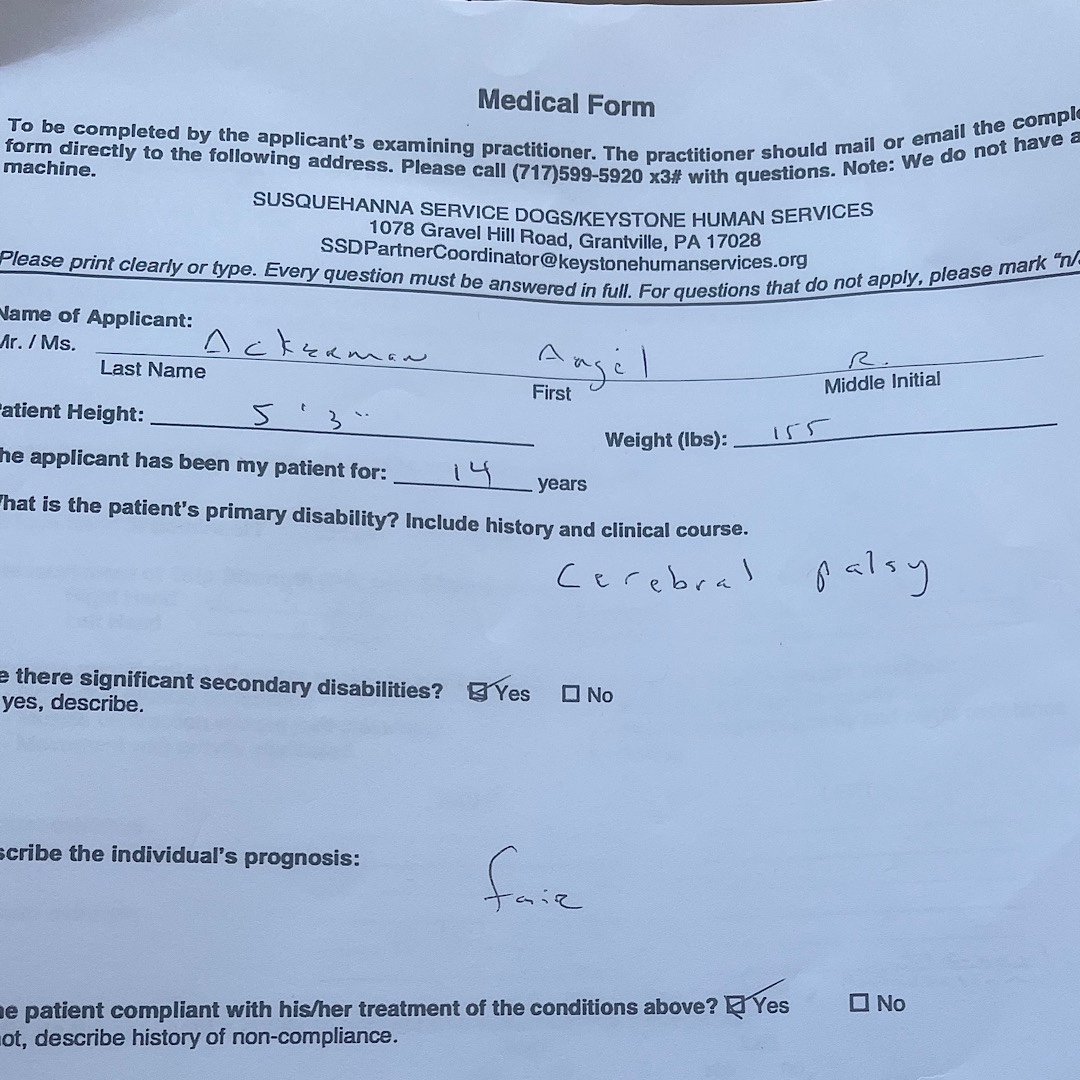
My legs and arms are often covered with brushes and scratches from bumping into things. I stumble and fall. But, I haven’t had a serious fall since August 3. That’s exciting. My average since the mallet finger has been every two weeks. I’ve now made it almost three. Today, I have my follow-up with my doctor, and I had called his office when I started the application process for a mobility dog through Susquehanna Service Dogs.

I’ve blogged about this most recently here. I connected some of my earlier posts about the process and decision here.

I asked his staff if he could fill out the medical form, because if he didn’t think he was the right person I could call my neurology physiatrist. She was/is amazing but I only met her once, two months ago. I have been with my primary care physician for 14 years.

His staff checked with him and they assured me that he not only fill out the form but that he would do it at my already scheduled appointment today. I normally see my doctor twice a year, in winter for my physical and in summer to review bloodwork and health issues that may pop up during the year.

When I ruptured my tendon in April, I visited him because my entire system was thrown off balance with the injury and although the specialist had allowed me to return to work (rightfully so), my hip was in pain and I was falling all the time. He signed me out of work for a short recovery leave of about three weeks, so I could work with Andrew, my strength and fitness coach at Apex Training, my occupational therapists at The Institute for Hand and Upper Extremity Rehab, and my talented chiropractor and physical therapy guru Nicole Jensen of Back in Line Chiropractic and Wellness Center.

I have documented this journey and have started writing my cerebral palsy memoir, Gravity is a Harsh Mistress with clever title by my estranged but still strange husband. Blog posts with connections to cerebral palsy are listed here.

My primary care doctor followed up with me after my specialist visit and allowed me to return to work at the end of May, even though my finger was still in a cast. We made this decision because the effort I gave Andrew had paid off and my hip was no longer bothering me. In addition, I had my first meeting with my physiatrist a few days later and I wanted to see how I felt after a week back-to-work to relay that information to her.

Anyway, point is, I haven’t seen my primary care doctor since May. He hasn’t seen my healed finger. He hasn’t heard about some of my rather dramatically majestic recent falls.

My weight today was 155, which is more than five pounds less than what it was at the gynecologist’s office last week.

I arrived early. I was in my exam room before my appointment time. My friend Gayle was bringing me her laptop so I could work on the cat book edits. I told her to put it in my car as I didn’t have time to run to her house and didn’t know how long my appointment would be. She ended up at the wrong medical practice. There are two similar St. Luke’s affiliated family practices in neighboring buildings.

I was texting her and making notes waiting for the doctor. I noticed my phone buzz again. My mom had sent a photo via text. That’s odd, I thought to myself. Mom hasn’t said much to me since the Teenager and I surprised her companion on Father’s Day. She didn’t even text me when she went to Florida to visit family. So, what was this?

I opened it.

I shouldn’t have. It was my father’s tombstone. My mother, despite having divorced more than 30 years ago, visits my father’s grave regularly. She’s grieving him, as many people are, and she is also grieving two of her brothers who died in the weeks before my father.

I couldn’t hold back tears. I have not visited my father’s grave since the funeral, and even then I did not get out of the car. I don’t see the point. The funeral had alienated me, and I didn’t feel like I “belonged,” and that’s not due to my family. But my father wasn’t there anymore. It was a corpse. And I had no need to see it formally placed in dirt. He was gone. And no ceremony will change that. Even now, I’m crying again.

Several times I regain my composure and several times I lose it, until eventually the doctor knocks on the door. So, I had to explain.

I mean, I suppose I didn’t have to, but it seemed only fair.

That meant we spent the first ten minutes of my appointment talking about boundaries, grief, and therapy. I’ve been with my psychologist even longer than I’ve been a patient of my doctor and the two of them know each other and speak so sweetly and kindly about each other.

We moved on then I think first to my recovered mallet finger. We reviewed my bloodwork. I told him I had to go get more iron, as my previous bottle had run out and I was using a different iron that didn’t seem to be working as I told Nan yesterday that I “almost bought a pair of potato chips.” Now, when you’ve had a history of iron issues and anemia, word confusion is a symptom. And I have been using wrong words in speech for at least a week. So either the iron is dipping or I should be screened for early onset dementia.

I almost bought a pair of potato chips.

I used this opportunities to ask if there were any other adjustments he wanted to make to my vitamin regimen. He suggested sticking with the 2000 ius of Vitamin D3 (which I take with calcium).

Next, we tackled the form for the service dog. Much to my relief, he thought the dog would be extremely helpful for me. And he also commended me for the work I do to take care of myself. In the evaluation for the service dog process, I was telling stories from the gym and mentioned how my ankle finally popped for my chiropractor Wednesday night, and how after my last fall I asked the Teenager to evaluate my walk, then she told Andrew this info at the gym, and he monitored my movement, until the next day I went to the chiropractor and she had to maneuver my hip back where it belonged.

She said I needed to do more single leg muscle stability work, which I then told Andrew, and I relayed to the doctor the horrible exercises Andrew made me do. And my doctor chuckled.

He once told me that he doesn’t worry about me because he knows if he tells me to do something I will do it. And I think Andrew and Chiropractor Nicole see the same commitment in me. My doctor today said this is why I am in better shape than many of his patients, despite my issues.

He handed me the completed form, which is the type of thing the office signs decry “requires 7-10 days” and payment of form fees. I am so grateful for my team, their respect and their guidance.

Meanwhile, while I am setting up my annual physical for February 2023, I see a text from Gayle. Remember Gayle? Apparently, she forgot my current car was a Volkswagen and was wandering in the parking lot looking for a silver Nissan. (My last car was a red Altima.) I didn’t have my Stitch Fix parking permit on my mirror. The car was clean because The Teenager has her own vehicle now. And there were four silver cars– none of the Nissans– in the parking lot.

She meandered around so long that a staff member came out and asked if she was sick or needed help. When I left the building, Gayle was next to my car. I had been with the doctor for an hour.

“You’re still here?” I said.

“I’ve been out here 45 minutes,” she said. “So when you replied to my text I figured I might as well stay and say ‘hi.’ What’s five more?”

Only you, Gayle. Only you.

Body Privilege

Last week, I wrote my piece “A Somber Thought” randomly as a reflection.

Last night, I reworked it and submitted it to The Mighty.com, a social media site for people with disabilities and their caregivers.

They published it instantly, despite having accepted an earlier piece that may have “died on the vine.” The earlier piece was on what to expect at your next doctor’s visit during Covid.

The current piece on the Mighty has been shared to Yahoo News and Zenith News.

Body reliability is a type of privilege. One you don’t appreciate unless you have yours taken aware or you never had it.

The original post on my blog is here: Disability and Reliability.

The Mighty post is here: Let’s talk about body privilege .

Ask the Yahoo post is here: Yahoo: Let’s Talk about Body Privilege