I started my new fitness journal Monday and have been making good choices, tracking my activity and walking the dog everyday.
Each day my number of steps increases by about 500 and today I made it up an extra bend of stairs before I was out of breath– Nan lives on the third floor and I always take the stairs instead of the elevator.
I’ve reduced my caffeine intake, resumed taking my beta blocker and have taken my baclofen regularly. Today was my second try to finish my intake for the Thrive Medical Fitness Program at St. Luke’s Hospital. I even arrived 15 minutes early, used the restroom and sat in the waiting room imagining petting my cat, Fog, and listening to his purr.
They wouldn’t let me finish the intake on Monday because of high blood pressure and heart rate and I was determined to do everything I could to come in on target.
Well.
My heart rate passed.
My blood pressure, despite several attempts by more than one person over a course of 20 minutes, did not. They asked several times if I had any symptoms– and I said no because I didn’t. They asked several times. And the last time my trainer emphasized if you have any symptoms at all I will accompany you to the E.R. right now. They let me go home with a promise that I would call my primary care physician and go talk to them tomorrow. And they instructed me to take my blood pressure as soon as I got home.
My numbers there were: 180/120, 180/117 and 160/110.
I came home and the numbers had fallen: 123/91, then 116/82, and finally 115/71.
I went to the bench outside the hospital and called my primary care physician from there. The office is on the way home from the hospital and it was only 4:30 p.m. so if they had concerns they could have me come immediately to the office or stay at the hospital.
I have an appointment for 8:45 a.m. tomorrow.
And the staff at the fitness center thanked me for being so flexible and understanding, acknowledging that the whole situation must be frustrating, but getting angry about it won’t help me– or my blood pressure.
Honestly, I think my body is just anxious about being in/near the hospital.
So we’ll see what my primary care physician’s office says tomorrow.
I had my intake for the Thrive medical fitness program at St. Luke’s Hospital. I did not finish all of the required testing because my heart rate and blood pressure were too high.
But let’s back up. Perhaps things aren’t as “all or nothing” as I feel right now– I feel like in many areas of my life I am “failing” or “losing” and the reality is that life is more complex than that.
I was soooo excited to join the Thrive Medical Fitness program, and I still am. The staff seems pleasant and supportive.
And I wanted to do stuff.
No doing stuff yet.
I had a 5:30 appointment for the intake, and I was 100% honest on the form about my habits and my medical conditions. After all, it’s a hospital-sponsored program so they have access to at least my medical history anyway. So I told the staff member about my fall history, about my bout of afib, about my orthostatic hypotension, my anemia, and my increase in spasticity.
And I quickly learned that due to all of these conditions, I will not be allowed to workout independently at the facility. I will have to make an appointment and work out with one of their trainers for every workout.
Now, to start, I can see this being prudent, and I hope I will prove I am not a danger to myself and be allowed to drop by and workout. But, if not, my new home gym is almost ready.
So, I accept this. I even try to see the nice staff person’s small gestures to my elbow as I step on and off the fancy scale as kindness. She does not know me, so she has to be cautious. But it would be a delicious story if I fell off a scale. And hurt myself. At the hospital.
Which reminds me of the time I fell down the stairs at the hospital, but that’s another story. You can read that story here.
Then, they took my heart rate and my blood pressure. Both were really high and would not come down.
Part of that might have been because I did not know they were in the basement, and even when I made it to the basement, they were tucked in a corner that had me walking around the whole building for a while. Then I got myself worked up when my anxiety was already doing overtime– I’m thinking a lot about how I’m going to heat the house this winter, what my next strategy will be for maintaining the publishing company’s income, and facing the holidays, a time of year when I typically feel the absence of my family.
So today I started taking my beta blocker again as I initiated my Clever Fox fitness journal. I filled out all the spaces regarding measurements, goals and trackers. Maybe it will force me to be introspective and keep track of my own behavior.
And meanwhile, I have taken Bean Dog for several walks this week. Our first was on last week, and it lasted less than five minutes. We walked halfway up our block and back, just to see how she behaved for me and if she would walk with me and leave Eva behind. The second walk was straight down our street almost 1.5 blocks and straight back, for a total of nine minutes.
Yesterday we walked around the whole block, which took 12 minutes, but about 8 minutes in, Bean spotted our neighbor’s pitty jumping at the fence literally within view of our house and I was afraid to try to get her home. In trying to grab her heel-level handle, I scraped my knuckles on the asphalt and decided to just sit there and wait for Eva to rescue us or for the dog to calm herself.
Today we walked two full blocks (15 minutes) after Eva trained me to use a hands-free leash with a bungee-style lead to absorb some of the force. Eva hooked it to the traditional leash so if she started to react badly I could brace my body weight and use more of my power to balance the dog, and then regain my control by taking the traditional leash back.
We have not had to do that, but it’s good practice and good exercise for both of us.
PS– I return to the medical fitness center tomorrow to resume my intake testing.
I’m energized in a way I haven’t been for a long time. And hopeful.
And once again I find myself greater for a strong, smart medical team that genuinely listens and cares.
It’s been a while since I had a medical update, and part of the reason for that is because of my high deductible medical plan that makes it more expensive to receive care. I am a big proponent of high deductible plans– because with an HSA they can save a lot of money, but I do not have an HSA. My current plan has out-of-pocket costs that are twice that of my previous plan. I’ll be paying $120 a month for the next two years to pay off my MRI from earlier this year.
And you haven’t seen any fitness entries because I haven’t worked out in a very long time. My coach at Apex Training took a hiatus for a family emergency and has not returned, and I no longer have the money. I have a feeling the guys at my gym would offer me some sort of deal– they have always been reasonable people, but life is so uncertain I just didn’t have it in me.
And food has also been an issue. As my food budget is also highly restricted.
These realities, especially for someone proud and stubborn like myself, are a constant reminder that it is not easy to be poor and take care of yourself, even without factoring in a disability. I believe having a mobility disability, which in my case is diplegia spastic cerebral palsy, makes me more away of how important diet and exercise are.
We all hear it all the time– that all of the body’s systems work together and that food, rest, and exercise provide the foundation and potential to fix a lot of problems. And in my case it’s easy to see the impact. It’s been about six months since I stopped working out, and my spasticity has reached a new level of inconvenience. I have spent much of my life in jobs that did not involve sitting behind a desk, and that, coupled with the lack of gym routine, has taught my muscles that we sit. And when my muscles learned something, they remember.
I need to start healthier routines. Eva is remodeling our garage and will move all of our weights, resistance bands and other equipment out there. And I am walking more. I get what I consider reasonable step counts about three times a week. I might even start walking the dog.
But about two weeks ago, I had my second episode of crippling muscle spasms after a day of walking. And I walked with a cane for a day. That also drove the reality home. I have never used a cane before.
In the midst of all of this, once I realized how out-of-shape and out-of-breath I was, I scheduled an appointment with my neurologist/physiatrist. This was a couple months ago and she couldn’t see me until Dec. 31 at 4 p.m. But they put me on a cancellation list and moved me to November 6.
My doctor arrived and immediately called me stylish, not knowing I picked my clothes to keep my weight the lightest possible and when she noticed my red boots, I had to let her know that they were on the floor next to my desk and I didn’t have it in me to look for other shoes. (But later in the visit, she acknowledged how my choice of boots also makes walking easier and the ankle height of the boot gives me more support. All part of why I love boots!)
She also commented about how long my hair has gotten, at which point I had to remind her that we hadn’t seen each other in more than a year. “Really?!?” she said. I nodded. (We set up another appointment for April so that doesn’t happen again.)
She gave me an exam and noted all my muscle tightness and had me walk around the office for her. And we talked about my hopes to improve my habits– because I know my role in my situation accounts for most of my everyday problems.
(And my cardiologist never got back to me about going off my beta blocker, but I did stop taking it. I have seen more incidents of high heart rate, but nothing significant or repeated, and most of it can be explained by diet or exercise. Eat a Little Caesars pizza? End up with a racing heartbeat. Do short stints of rapid walking? Also high heart rate.)
She suggested I resume taking my baclofen regularly and to up the dose to 10 mg if needed, up to 3 times per day. I took it regularly while working in the warehouse and have been taking it now when I feel I “need” to.
As she made a written note of all my lower body muscle issues, she asked if I might be interested in an ambulatory referral to a medical fitness exercise specialist at St. Luke’s Anderson Fitness & Sports Performance Center. “Sure,” I said.
They called me while I was driving home.
And when I learned it was $99 for the three-month fitness program and that insurance might even pay it, I really was glad I decided to go see my doctor. I made an appointment for intake evaluation on Monday and maybe soon I’ll be using my Clever Fox Fitness journal.
This is what the website says:
Medically-based exercise programs for those with a chronic disease and / or disability. Designed to increase exercise tolerance and enhance functional capacity. For all ages. Join us and get ready to THRIVE! $99 three-month fitness memberships are available to all patients and clients referred from St. Luke’s Weight Management, Physical Therapy at St. Luke’s, St. Luke’s Cardiopulmonary Rehabilitation, St. Luke’s Physicians and St. Luke’s Oncology.
Last week, I went to the doctor for my annual physical. The following day I went to the gynecologist for the same.
Between the two appointments, one of the medical professionals listed me as two inches shorter than my average. That led to my status as overweight being upgraded to class one obesity.
I have been struggling for months to resume exercise and return to healthy eating. I go back and forth with losing the same five pounds, based on what I choose to eat.
A lot of my issues with mobility and my heart stem from my extra weight. No doctor has said that to me, but I know based on how I feel and how my body reacts. I need to lose thirty or forty pounds.
About the same time my primary care physician quietly labeled me as obese, murmurings happened on the internet that suggested that the BMI was an imprecise and outdated model of determining health. The suggested replacement is a roundness index, which looks at how much weight people carry around their middles.
If I felt good, I wouldn’t care what they labeled me. But I don’t have the stamina I once did. And that has an impact on my activity which causes more issues.
I think as a society we should promote different body types and multiple standards of beauty, but if I know my weight causes a decrease in my quality of life, it is nothing more than denial to say that weight doesn’t matter.
I don’t know about you, but as I grow older, routines become more and more important to me– because otherwise I simply don’t squeeze all the tasks and items into my day that I think I should. That’s how things I enjoy, like updating this blog, get neglected.
For instance, I never wrote an entry about my single-shot marathon drive from Atlanta home.
But I was working with Nancy yesterday (and she managed to submit something like four poems and an essay while I was with her) and she nudged me in that subtle way. I mentioned that I had gone to the cardiologist the day prior, and that led to a discussion of the fact that most of my current writing time has been dedicated to my medical advocacy/ disability memoir.
“Good,” Nancy said. “I think that’s an important one. Because unlike so many people that write disability books, you’re a normal person.”
I had to pause for a moment and I almost laughed.
“Because so many books by disabled authors come from people with resources?”
While that statement is not 100% true– I know several disabled authors who use the Amazon platform to promote and distribute their fiction– it says something about disability-themed literature and memoir of past generations (I am Generation X and Nan is a Boomer.)
Spending some time in the Barnes & Noble database
For fun, I just searched DISABILITY on the Barnes & Noble website. The search yielded only academic titles. I searched DISABILITY FICTION and got only 22 results, mostly academic books, and one book only available in ebook, published by Draft2Digital, and clicking on the author’s link led me to believe he is an independent author who has published at least twelve titles only in ebook format. The author is also a horror filmmaker, nearing 60-years-old and appears to be white and able-bodied.
When I search DISABILITY MEMOIR, I find twenty results– many of them self-published, several by Boomers (on topics like polio, at least three of those, hey GenZ have you heard of polio? Another on surviving Tuberculosis and living in sanitariums), many on parenting, and many on learning disabilities.
MEDICAL MEMOIRS yielded more results (50 instead of 20) and the boldest words that popped from thumbnails were cancer and survival and the occasional miracle. When I entered my own condition, CEREBRAL PALSY, the search returned more than 130 results– most either children’s picture books or academic books.
Now, I know some of you are thinking, “Why is she looking at Barnes & Noble– everyone knows there are more books on Amazon.”
Barnes & Noble, as the remaining giant big-box book retailer, offers a standard on what can be considered mainstream and the minimum threshold of “wide” versus Amazon-only distribution. And Barnes & Noble has started doing some more gatekeeping as to what self-published or print-on-demand titles can appear on their web site.
Resource #1: Time
Anyone who publishes– even if self-publishing– has a certain amount of financial or support-system resources at their disposal. It might be as simple as the self-published author who solely uses Amazon has a live-in caretaker, which could be a family member or a paid staff person, which allows them the extra time to sit at their computer and write. As a person with a disability, whether that be a mobility issue, a congenital limb difference or vision and other sensory impairment or something else, it takes a lot longer to do basic tasks alone. Ever try to button a shirt alone with a broken arm? It takes longer to bathe, to cook, to eat, to use the toilet. The whole day just takes longer and takes more energy.
And that’s without considering what it takes to monitor and take medications, how often one needs to attend physical therapy appointments or doctor visits, and potential nuisances like arranging accessible transportation, buying supplies like incontinence supplies or feeding tubes, and monitoring one’s health.
Resource #2: Knowledge/connections
There is a profoundly different experience for disabled people based on socio-economic status. There is also a gap between experiences for those people who qualify for public services, those who have private resources and those who fall in the middle.
During the pandemic, I qualified for Medicaid for the first time in my life pretty much because I lost my job at the height of Covid and did not receive any unemployment because only workers displaced by Covid made it into the system. I did eventually receive unemployment, but it literally hit my bank account two days after I started my job at Stitch Fix. Because I had zero income, I qualified for food stamps and Medicaid. My Medicaid kicked in November 1, 2020 and my job at Stitch Fix started one week later and they provided health insurance on day one.
I submitted all my paperwork. My food stamps ended, but Medicaid did not, because of the pandemic. Despite me periodically sending updates reinforcing that I had private insurance, my Medicaid remained. Do you know when they canceled it? When Stitch Fix laid me off. I submitted my application to renew my Medicaid and they denied me because their system hadn’t uploaded my daughter’s prove of being a college student and I didn’t notice. The system didn’t send me a notice that said, “Hey, this item is missing.” Just denied the whole application. So, I have spent the last year as a disabled entrepreneur with a high deductible medical plan which means I recently paid $2,000 out of pocket for an MRI. It also means I am not seeing my specialists as often as I should.
Meanwhile, I know someone who recently not only qualified for Medicaid but also receives government disability payments, also an entrepreneur, who probably makes more money than I do. I have an Office of Vocational Rehab Counselor who has listed me in her highest category of disability, but in the last six months, I have received nothing actionable as support.
Access to social workers, whether professionally in a hospital or even through friends or non-profits can help make sense of what is possible, but without guidance it’s really hard. Another barrier is technology. That one might make a reader bristle, but not all technology makes life easier. Sometimes technology requires practical or financial resources to be useful. Nancy, as a blind person, has struggled with internet access. She has never owned a computer, and she has tried various ways to use the world wide web. Her Fire tablet worked well until the charger failed way too quickly. She has a Blindshell cell phone she uses on wi-fi to check her gmail account, and an Alexa device to handle music, time and reminders.
But recently, NASA discontinued its TV station, guiding viewers to use the NASA Plus app instead. Alexa does not have a skill for NASA Plus. Her Blindshell can’t open links from NASA Plus. And she can occasionally stumble upon a usable link for NASA’s videos on YouTube, but not reliably. She’s now considering a Fire Stick, but she’s considered she won’t be able to easily scroll the thumbnails to find the launches that interest her.
I mention this because the resource of knowledge and connections, many of which we consider technology-dependent, will change the disability experience. The people who will produce memoirs will have more access to knowledge and technology. Even in able-bodied households, not everyone has access to these items.
Resource #3: Money
A lot of the memoirs I have read come from households with financial resources. It could be as simple as having a stay-at-home mom who could be a caretaker. It could be as complex as a disabled person having access to expensive custom schools or having enough savings to take time off work for long treatments or training opportunities. These advantages lead to better education, better adaptability in the world and also empower the person who had these opportunities stories they can share with the world.
Not to mention many disabled authors work with specialty editors or vanity publishers to create their work and that requires cold, hard cash.
Resource #4: Support
Similar to the time resource, support covers the system that helps a person on a day-to-day or as-needed basis. The support of family, friends and caretakers contributes to a person’s time, their skill and their self-worth to lead them to write a book. That could also include a teacher or mentor. Some disabled people might need a typist, or an outside researcher, to help them with their tasks.
For disabled people who use most of their time and energy on survival items, writing a book might not be a possibility. This also covers the emotional support– I would guess that most disabled published authors are people who have been told they have a message worth sharing.
Resource #5: Past Experience
Finally, I consider past experience a resource. This may pertain more to medical memoirs versus disability memoirs, but that is my gut feeling and not fact. Most people want to read “hopeful” stories with happy endings. And therefore I wonder if memoirs that feature “miracles” or “cures” might be more appealing and accepted than chronic illness/lifelong disability books.
If an able-bodied person experiences an illness or an accident and writes a book, he or she will write with their previous experience in mine. The journey present in the story will be “before,” “accident/diagnosis,” “after,” and “end,” whether than end is death, healing, or acceptance. Stories with this framework will inadvertently compare the disability or medical part of the story to the unhindered before time, and the goal will always be to regain what was lost.
For most disabled people, the reality is learning to live with the condition and doing what is needed to prevent a decline in quality of life.
Regardless of what resources or goals a writer has when dealing with their own disability or medical situation, it’s important to remember when we read memoir that everyone’s lives have different challenges and their are many ways to deal with any situation.
Earlier this week, I got a text message from Mr. Accordion.
Mr. Accordion and I were roommates during my tenure at a certain nonprofit that suffered from toxic management. It’s funny though how life leads a person on a meandering path, and we end up gaining things from experiences that hurt us at the time. I have current clients who connected with me because of that job. I ended up at Stitch Fix because of that job. And I published my novel as a distraction when I lost that job. So many of the circumstances that led to the success of Parisian Phoenix Publishing launched from a very stressful and agonizing work environment, where I shared an office with Mr. Accordion.
Mr. Accordion retired, and he has spent the last four years at various part-time jobs and spending time with his family. I have only known him about five years, but in that time he has always had a joke to share, leads on good food, and a genuine care for other people.
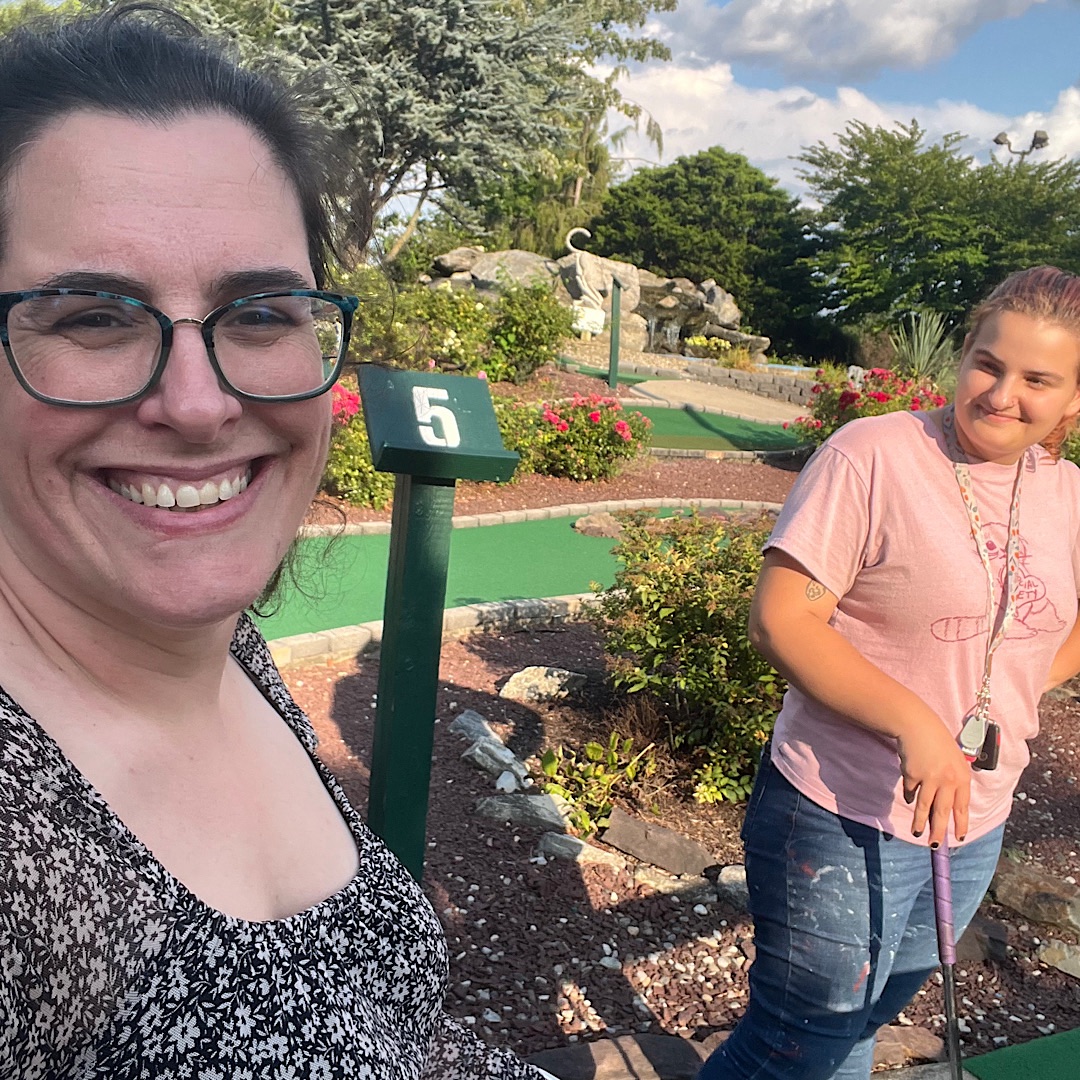
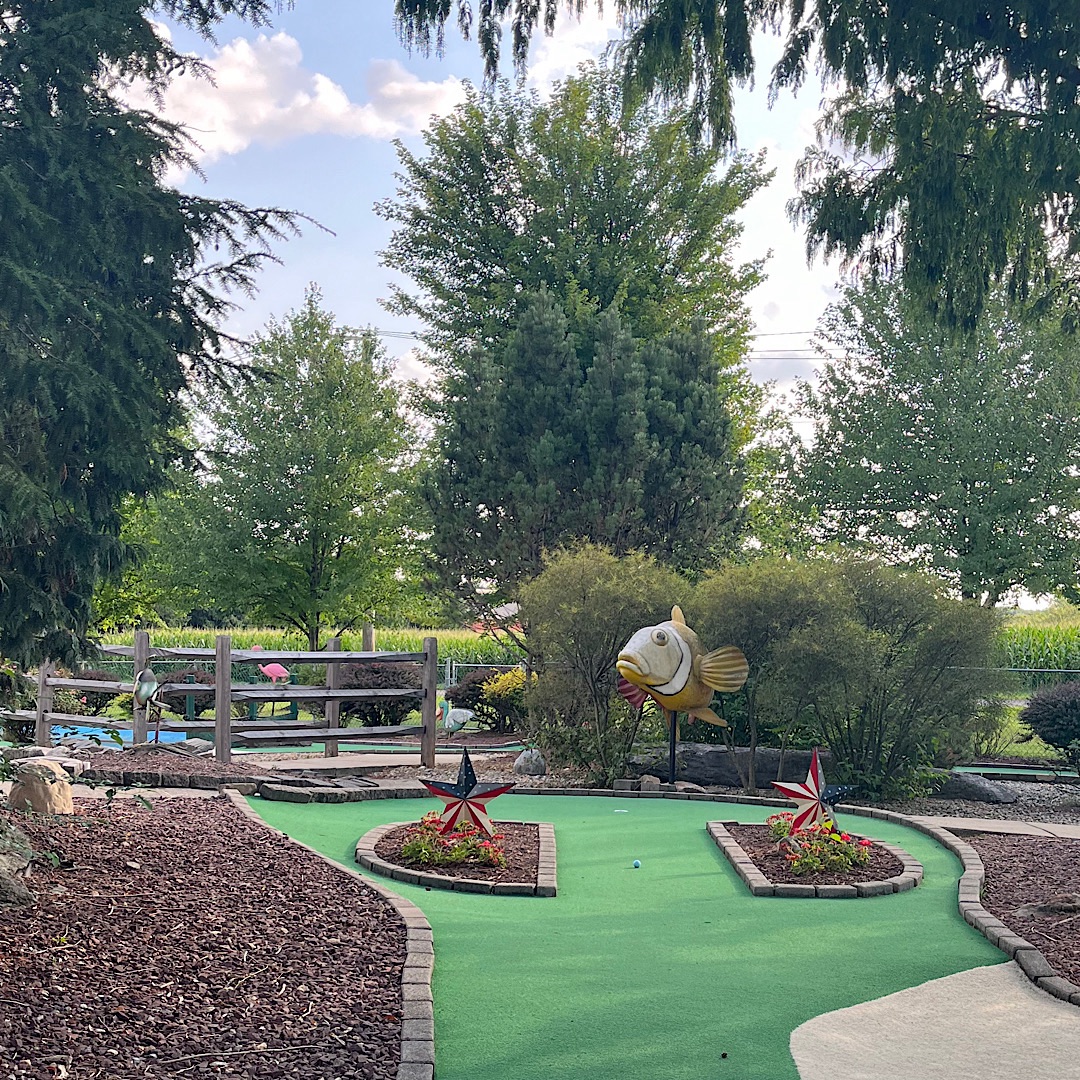
And the other day he invited Eva-the-no-longer-a-teenager and I for pizza and mini-golf. And who am I to say no to pizza and mini-golf? The venue in question was Lucky Strokes mini golf and driving range and Isabella’s Pizza.
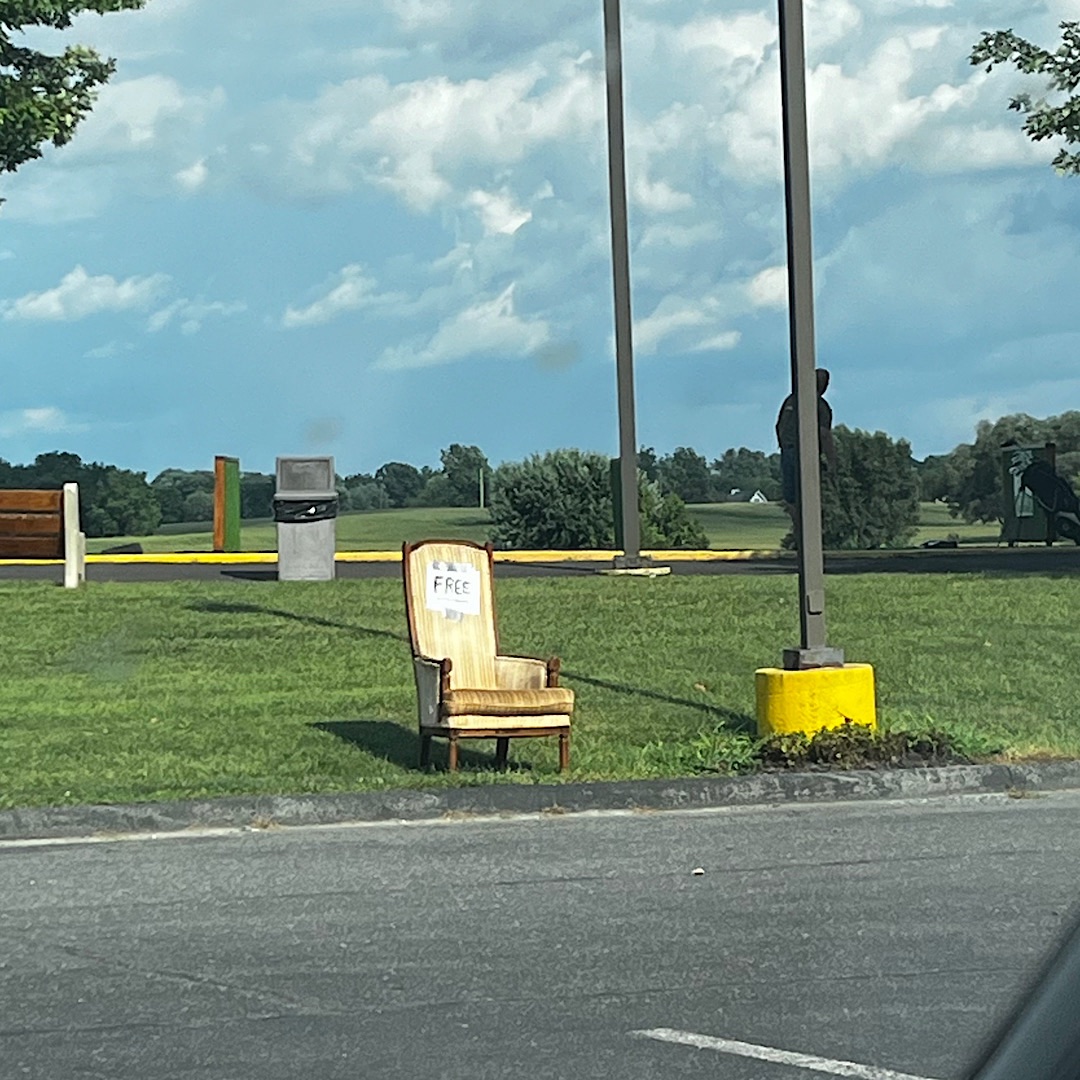
They had a strange, vintage upholstered chair in the parking lot with a “free” sign and a school bus with a giant target painted on it in the back of the driving range, if I saw correctly at 175 yards.
The no-longer-a-teenager and I arrived and ordered a medium pizza with capicola and artichokes.
And after some conversation with Mr. Accordion, Eva and I hit the golf range. Now, I did set my Apple Watch to “golf” (and Omada gave me credit for “sports”). It took us 37 minutes to play all 18 holes. (In part because the people ahead of us where having some intense discussion about his marriage and how his wife wasn’t taking the couples counseling seriously. At least, that’s what Eva heard. How she heard that without her hearing aids, I don’t know.
It looked to me like the worst first date ever. She looked disinterested with her back turned, sipping her soda. He would not shut up about himself or his wife. And every time you looked at them, he was standing over to the side with his putter over his shoulder and his ball on the other side of the green.
Immediately, Eva noticed two things:
I don’t even remotely line up the putter correctly.
I was swarmed by small harmless bee creatures.
And then while following my little pink ball around I fell up an incline and ended up crawling around the artificial turf on my hands and knees. Speaking of my knees, my knees and legs refused enough to let me get the ball out of the hole at each green.
Instead of keeping traditional score, we kept score of who landed each hole first, and who won each hole. We ended up trying, 8 holes each with two ties. None of which would have been possible without Eva’s golfing lessons. And her tendency to sometimes hit the ball so hard I feared she might have landed it on the next green.
And I think I had a hole in one, but now I don’t remember.
On the way home we stopped at The Spot for ice cream. I haven’t been to The Spot since my Stitch Fix days.
Yesterday, my friend Gayle and I embarked on an adventure. I wanted to motivate myself toward more movement and healthier living and Gayle enjoys visiting new towns via self-guided walks designed by local clubs of the American Volkssporting Association. Gayle has wanted to hit the Ephrata, Pa., walk (which is about 90 minutes away from our homes) and I love a day trip. The walk is maintained by the Susquehanna Rovers.
Gayle packed lunch. I packed sunscreen. I even tossed some electrolyte powders packets in my bag, knowing it would be a sunny summer day. I took my muscle relaxers.
Off we went.
The background
Now, as someone with a mobility disability (cerebral palsy, spastic diplegia), I suspected– or perhaps even knew– that this would end with some sort of injury or discomfort. I had hoped that having this walk, a 5K by design, would motivate me to get away from my desk and wander around the neighborhood.
That didn’t happen. I could blame the heat wave, but in reality, I doubt I would have changed my behavior even if the weather were nice.
In the end, I said to myself, “Anyone can walk a 5K.”
And in one respect, I was correct. I did it. On the other hand, it was stupid. And I’m suffering because of it. But that’s getting ahead of myself.
I wanted to use this walk to see how my movement was in a more long-term commitment. I wanted to test my breathing and my heart rate. I suspect a lot of my health issues will not resolve until I lose at least 20, if not 30, or even 35 pounds (at which point I ask myself– how did I gain this much weight so quickly?)
So this walk would help me evaluate my true status and make health-related goals.
That was my logic. Was it a tad reckless? Maybe, maybe not.
The Walk
Ephrata has a lovely main street, historic buildings and apparently monuments– none of which we saw because the 5K was mostly through residential neighborhoods. And we missed a turn somewhere and ended up shaving off about a half mile. Our time for our 2.8 mile 5K was about 31 minutes a mile, and we periodically stopped to enjoy the shade, look at weird buildings, and sometimes cuss about hills.
AVA walks are rated, and this was a 1B which means it was supposed to be easy, with sidewalks and the occasional hill. But if you looked at the “fine print,” the walk was rated “medium” for strollers and “hard” for wheelchairs. I think for the foreseeable future Gayle and I need 1A walks that are easy for wheelchairs.
So here’s my analysis of what we saw in Ephrata on the 5K:
A gnome garden. I like this tiered design of outdoor knick knacks. I’m not sure what sense it makes, but it seems like a concept the no-longer-a-Teenager would embrace.
A neighborhood egg stand, that was closed.
Your going to have to google this for yourself. “Best Kept Secrets Tour.” “Shopping, Food & Fun adventures.”
The strangest “double” homes I’ve ever seen. The walk took us through an entire neighborhood of attached, split-level homes. I own “half a double,” and some neighborhoods in my area are row homes that expand an entire block. But I have never seen neighborhoods like these. I fail to understand the logic. There are two reasons to “attach” homes– one is to lower the cost by sharing a wall, and the second is to squeeze more people into a smaller space.
These homes have the space to be detached. They are on suburban lots. So, if you are going to invest in a suburban home, why would you want (or even accept?) being attached to your neighbor. There were also attached ranch homes, with the same concept, but just without the extra stories. And some had a strange shared doorway in the middle, like a breezeway, so they were both attached and detached.
We did see a lot of great distant views. Mountains in the distance. Clear skies.
One of the first things we encountered was the Anne Brossman Sweigert Charitable Foundation, with a family sculpture out front and a sign engraved on a grave marker. (They also have not updated their website in almost 10 years according to the “grant history” tab.) Why did they place their sign on a grave marker? So it didn’t blow away? Fade?
Around the two-mile mark, we realized we had missed the turn and reached our threshold for the residential tour, and ironically, we ended up taking a street parallel to the main drag back to the hotel where the walk-box is stored.
Interlude: Early in the walk, I noticed my right leg was pulling in toward my left leg. So, minding my fitness and strength coach’s advice, I led with my knees to make sure I wouldn’t end up tripping over my own legs due to my knees facing inward. I tried stretching, to see if I could get my hips and thighs to move more outwardly, but I couldn’t come up with the right movement.
Nothing hurt, but damn everything was tight, and my legs fought me with every step.By the time we climbed the hill and stairs by the hotel, my back was starting to feel the stress. My legs didn’t want to lift. So I made it to the car and popped another muscle relaxer.
Step count: about 8,500
The Ephrata Cloister
We went to Ephrata Cloister, driving down the main drag and wondering why the walk couldn’t have shown us all these lovely local businesses and perhaps led us to a cafe where we could have rested. We had a savory-and-sweet vegan chickpea and carrot salad with a side of grapes for lunch. From there we headed into the gift shop.
At the gift shop, I found an impressive collection of wood crafts, paper folding kits for Moravian Stars, quilted cards, replacement ink for quills, Amish novels and a nice selection of Pennsylvania Dutch nonfiction books.
The no-longer-a-Teenager is mostly Pennsylvania Dutch on her father’s side. One paternal great-grandfather was Welsh, but all of her other paternal great-grandparents were Pennsylvania Dutch. Her paternal grandmother’s father spoke Pennsylvania Dutch (Leroy Buss) as his first language, learning English at the one-room schoolhouse he entered at age five. I would have loved to buy her a Pennsylvania Dutch to English dictionary or Superstitions and Folklore of the Pennsylvania Dutch, but the budget did not allow.
We visited the museum where we learned that the Cloister was a spiritual community with roots in Germany that came to Pennsylvania, just like the Quakers and the Moravians, in the early 18th century for religious freedom.** They had strict beliefs and practices, one of which was celibacy so it became impossible to keep the community alive. (The “householders” later became the German Seventh Day Baptist Church. Householders were the families on neighboring farms who supported the community and their religious beliefs without going all in on the celibacy, vegetarianism, and sleeping on a wooden block disciplines.)
We also saw a really long glass horn.
** 1720. That’s more than FIFTY YEARS before the Revolutionary War.
The tour
Gayle and I like to support local history and nonprofits, and who doesn’t love the story of a good old colonial cult. So, we embarked on the tour.
First, we watched a really information-packed but poorly acted and filmed movie. You can watch it online here. (This was where Gayle thought she lost her phone and I got a text from a client who needed me to do something later that day.) We were told the tour was 45 minutes to an hour long, depending how many questions people had, and that we should be on our way at 3 p.m., 3:15 p.m. at the latest.
Gayle was hoping the tour would send us all over the grounds walking from building to building. I was suddenly starting to hurt and could barely stand. Neither of us voiced what we were thinking to the other.
“You’ll love the tour guide,” the volunteer at the desk said. “He’s really knowledgeable and passionate.”
Our tour guide took ten minutes to get us out the door because already other members of the tour were asking stupid questions covered by the movie we had just watched. We walked out to the middle of the yard, not even a half acre away where the tour guide announced we had reached the village.
We stood outside for a long time, at first talking about architecture, then the idiots with us had to debate how old the trees might be, and whether they were “original.” I was mesmerized the whole time by a man who looked very Mennonite/new order Amish/”Dutchy.” You don’t think the Pennsylvania Dutch have certain genetic “looks,” but they do.
Now, somewhere around this time, it became difficult to know when the tour guide was telling us historical fact, and when he was expounding on his own “theories” (his word). He talked a lot about significance of numbers, how the triangle formed by the Village served as a reminder of our path to God, and the powers of the mystics. This is where I, as a journalist and a historian, started to get annoyed. He provided no proof of the sources of his ideas. (Here are some of the official lectures on the topics.)
We stood in the main living area of what became the Sister’s House. Eventually we ended up in the Meeting Room. We were *locked in* the building, so strangers who had not purchased the tour could not wander in. I know this because the Dutchy man needed to leave and he could not without interrupting the tour.
I faded in and out of the door mentally because my legs were hurting at about an eight. When we left the meeting room and entered the add-on kitchen, I was ready to fight the sweet little old ladies for a space on the small bench. My heartrate had been soaring since we started the tour (130s when standing and 110 when seated) probably in response to the pain. There was room for all of us.
Interior of the Meeting House (saal, meaning “room.”)
At this point, my plan was to sneak out of the tour when he let us out of the building and to tell Gayle to take her time as I would sit outside and read my book. But it turned out the tour was only to this building.
Our tour guide unlocked the door at 3:40 p.m.
The repercussions
By the time I went to bed, my pain levels had reached a nine. They are between a six and seven today and I’m taking it easy. I think my body has forgotten how to walk. As a person who deals with spasticity, which means my muscles in my legs never relax, I have a theory. This is the first long walk I’ve taken probably in years, certainly since I started taking muscle relaxers. It’s the first long walk I’ve taken since I started fitness training with Andrew, and even more certainly, the first I’ve taken since he had to pause our sessions several months ago. And I sit at a desk now, 8-10 hours a day, seven days a week, and walk 3,500 to 5,000 steps a day.
So, sure I overdid it.
But I still maintain that I have never moved the way I moved yesterday. I fried my adductors.
Hard to believe for several months from 2020-2021 I was a picker in the Stitch Fix warehouse where I walked miles and miles and miles every night, five days a week.
For more about this trip and some discussion of books, printing and those arts at the Cloisters, see ParisianPhoenix.com.
If you don’t know, my daughter– The Teenager about to turn 20– works in the pet care industry, primarily doing dog walks and in-home pet care visits. She is also a dog trainer, and spends a lot of time and energy studying dogs, observing dog body language and finding solutions to people’s problems with their dogs.
She is the one who encouraged me to apply for a service dog, and although I grew up with dogs, she has taught me so much about dogs and why they do what they do.
Her dog, F. Bean Barker, who, will be four this summer, can be reactive and territorial. The Teenager has worked very hard to decrease her dog’s reactivity and expose the dog to situations to improve her tolerance. Today, we took her to a dog park. The dog park is less than two miles away from our home and off-the-beaten path so it’s not as well-traveled as some other local places. It has a lot of green area to explore even outside of the dog park. So, if the dog park is occupied, there is other stuff to do.
This dog park has two sides, one for dogs 25 pounds and under, the other for dogs larger than 25 pounds. Each side has a double gate system, so you can enter the first enclosed room and make sure your dog is ready to enter the other side without risking releasing any dogs already in the park. (In this dog park, there is also a gate between the two sides.)
Now, if you do not have a dog or if you have a rural dog who has no need of a dog park, you may not understand that dog parks can be extremely dangerous. You never know how other people’s dogs will react, and you can find that certain dogs have behaviors that can unnerve the most calm and pleasant dog. Owners often don’t keep close enough control over their dogs inside the park, believing the environment is contained and safe. But just like two normally well-behaved children can suddenly behave like cold-hearted killers on a public playground, dogs can change in this unfamiliar and potentially unmonitored environment.
We know Bean is a good dog, well-trained with a recall, but that she often has a hard time with other dogs especially if they aren’t appropriately socialized. Now, even if you think your dog is “good with other dogs” or “well-socialized,” you may not understand dog body language or stress signals to know how well your dog is doing in a new situation.
Knowing this, we brought plenty of our dog’s favorite treats, put her in a harness and on a prong collar and tucked a can of “pet corrector” into our gear. When we arrived at the dog park, one adult and one child had two small dogs running the entire expanse of both sides of the dog park. The Teenager decided not to engage and walked the dog around the human passive recreation trails.
The family soon left, taking their two small dogs off leash through the parking lot and leaving every gate in the dog park open— the two entering the small dog park AND the interior. That means if someone had entered the large dog park, appropriately, the large dog could have run into the small dog side and exited into the busy parking lot. Really?
Needless to say, this dog grandmother went through and checked every gate before Bean and The Teenager entered.
I sat under the pavilion and watched while Bean and The Teenager explored.
I was technically lookout, because The Teenager had removed Bean’s leash and if another dog came The Teenager wanted enough time to leash her dog and make sure Bean was under control, or at least, obedient.
I looked up from my book (Hunter’s Shea’s Manrattan which I am enjoying very much) and there was an unattended mastiff with no leash standing outside the gate. The Teenager already had Bean outside the dog park and releashed. So, we left.
The owner of the mastiff strolled leisurely to the gate, while his unleashed dog just had free reign. Why don’t people have common sense???
Dogs in public should be leashed. It’s a law. I don’t care how well-behaved your dog is– if it is attacked or frightened, it will end up in a fight. Even the best dog in the world would defend itself in a fight, so regardless of how the fight starts, both dogs could be injured or killed.
And, as someone on a wait-list for a service dog, it angers me to see how many people don’t understand why certain laws exist regarding where dogs can go and how they should be handled. A dog masquerading as a service dog in a store for example not only might create a bad example for real service dogs, but if it is not trained properly it could attack or spook another animal (or a person or a service dog). A service dog that encounters poorly-managed and badly trained animals in public could be attacked or spooked in such a way that it might not be able to do its job, creating a financial and practical hardship for the disabled person relying on that dog.
So please, leash and control your dogs as the laws ask you to do.
Yesterday ended up being a strange day. Strange in happy ways, I guess, and I’m afraid I don’t have any photos to accompany this post. But you will see some familiar characters.
I went to visit Nan in the morning. She’s been having some technology failures and is trying to rescue her remaining files from her Braille N Speak. Her current model is dying. So we did some dictation to save some items.
Then, I stopped at CVS. I thought I had $5, $3 and $2 in Extra Bucks with one of them expiring that day, but my phone only showed $3, $2 and $0.04. I went back to the pharmacy window and to pick up my allergy medicine. This spring has been awful for me.
The tech who served me, I had never seen her before, and she saw my $35 tab and suggested I try GoodRX. She found it for $17.24 (which happened to be my house number growing up, see previous post. I like numbers). So she saved me twenty bucks!
I meandered through the store looking for snacks, as my cupboard is bare. I noticed notebooks on clearance for 90 percent off. I texted The Teenager to ask if she could use them or if I brought them home would she just hoard them… She said she would hoard them until the start of next semester.
I got her return text as I was standing near the Nature Valley Granola bars. CVS had a couple varieties on sale for $1.99 a box. I grabbed two boxes of peanut butter biscuits. That and some notebooks (five) at 45 cents each came out to $1.17 after my $3, $2, and $0.04. But at the register, I noticed my $5 off coupon that I couldn’t see on my phone. So I paid, and went back into the store and found my favorite KIND breakfast bars for $2 off. After my $5, that came out to $0.99.
In the afternoon, I visited my neurosurgeon to follow up on my aneurysm. And read the results of my MRA in early May. I got a parking spot right outside the door! At the hospital complex! THAT never happens!
I arrived early, hoping to read more of my nonfiction marketing book that is getting on my nerves. They took me back early. And the doctor showed up early! I was out of the office start to finish in less than 30 minutes, which was only 15 minutes past my original appointment time. And good news– what looked like an aneurysm behind my left eye according to the CT scan did not show up on the MRA.
Then I met Southern Candy at a local park and in the evening, The Teenager, the neighbor and I took Little Dog for ice cream after a dental and having some teeth pulled.
This year’s Greater Lehigh Valley Writers Group THE WRITE STUFF Conference came and went in a flurry of excitement and camaraderie (in the middle of Mercury retrograde to boot). I gave myself Sunday off–and swore I would stay in bed all day watching Grey’s Anatomy, which didn’t happen, in part because I started reading books and talking to my authors and associates at Parisian Phoenix Publishing about the conference.
I attended all three days of the conference, as I am president of the group, and I treated myself to a hotel room at the venue Friday night so I could stay and enjoy the social. My friend William Prystauk and I keep saying we’re going to book a hotel room and sit at our laptops all weekend, so I invited him to join me. I figured we could have a nice dinner between events and catch up.
Yes, you read that correctly. We are writers, after all, so we want to book a hotel room and hide from the world at our keyboards.
Some history… and notes for memoir.
Anyway… last year’s GLVWG conference happened not long after I was released from the hospital after the scariest series of falls in my life. (If you’d like to read more about that, you can read it here. I have to say, I was reviewing it this morning, 13 months later, and my sense of humor amazes me. This was the second fall I had last March, the first of which happened at work on the first day of Cerebral Palsy Awareness Month. That fall is memorialized here.)
(One of the sessions I attended at this year’s conference was Jordan Sonnenblick’s session on memoir writing. I have known Jordan for 20 years and I did not know he wrote memoirs, but it turns out this is a recent turn of events so then I felt better. What I find fascinating about Jordan’s memoirs is that he writes them like his middle-grade fiction, but with his as a protagonist. I bring this up because one of his techniques for recreating his past was to map the scars on his body. I finished The Boy Who Failed Show and Tell last night, and I reviewed it on Goodreads. Some people classified the book as historical fiction and slammed Jordan for “promoting toxic masculinity” — as if in 1978 there was a universe without toxic masculinity.)
Joan & Bill at work
Last year, the conference occurred during the same weekend as The Lehigh Valley Book Festival, where I had volunteered, but I was nervous to attend the event, alone, after so many medical incidents. Joan asked me to be her photography assistant and so I did. This year, Bill ended up working as her assistant since he was in the building anyway. Joan provides author headshots at the event for a $40 charge. It’s a bargain, and the photos have many versatile uses that I don’t think writers consider.
So this year’s conference had not only a great conference line-up, but many of my friends milling about as extras. And I had the naive idea that I might have time to connect with some old friends I hadn’t seen in a while and connect with some new folks. That did not happen.
A hotel with history
Bill left work a little before 5 p.m. to meet me at the hotel. My daughter had stopped by at 4 p.m. at the end of the workshop with Jonathan Maberry to have him sign her battered copy of Rot and Ruin. We are slowly collecting the whole series, as the last books of the series seem to be harder to find. We currently have books one through three of the series, and I have ordered four and five, but I’m not sure I have the Texas bits…
The Teenager with Jonathan Maberry
A bunch of conference attendees and presenters were meeting at the hotel restaurant for a light dinner before the evening events and the social. I encouraged as many as possible to line up in a big, long table that we kept adding squares to the bottom. Bill arrived in time to join us.
Now, here’s where things get very interesting from a writer’s perspective. More than a decade ago, during one of my previous incarnations as the group’s president, we used to flip-flop between the current hotel and the one by the airport. Both were mid-range hotels with plenty of space for a large keynote and enough smaller rooms for break-out sessions. As prices would go up, we would pit the two hotels against each other and the venue that gave us the best deal won.
I’ve been away from the group for almost a dozen years, and a pandemic happened which made the conference virtual only for a while, and now we are building up the GLVWG conference game again, last year with Maria V. Snyder and this year with Maberry.
The hotel though has seen better days, in part because for more than a year now the owner of the land has submitted a proposal to the township to knock down the hotel and build a warehouse. As a consequence, the maintenance on this octopus of a hotel (the floor plan has arms jutting out everywhere) has been minimal.
Jordan Sonnenblick said his wedding used the venue in 1994, and nothing has changed since then. Well, except the name. I think that hotel changes names every other year. The toilets run and/or have low water pressure. Some areas of the hotel smell like “weed and old people” as The Teenager puts it. The restaurant is small. The food is limited. The coffee is terrible. And while the staff is delightful and they keep the place clean and functioning, there were a lot of small but important mishaps probably due to being understaffed. The parking lot is always full of trucks and there’s what appears to be a much nicer Hampton Inn right next door.
But amidst all of this– Bill knew the bartender from earlier in the hotel’s history and apparently she makes good drinks. So after dinner, we stayed for a beverage and heard from a staff member that they have been told the hotel is closing for good in December 2024. We shall see.
The Social
William Prystauk, Marie Lamba, Dianna Sinovic, Jonathan Maberry, & Jordan Sonnenblick
From there, we moved down to the social. Mark Twain was kind enough to visit and I noticed a lot of people in literary cosplay.
I had a lovely time surrounded by friends and some of my favorite writers.
Jonathan Maberry at his table at the keynote luncheon
[I had intended this blog entry to be about my personal life, but I didn’t quite get there. I wanted to at least mention my OVR planning session yesterday. Better luck next time I guess.
PS–I still don’t like Grey’s Anatomy, and with every episode that passes I like Meredith Grey less and less. And I was so excited to get to Derek Shepherd’s death. But man– the whole arc of Meredith disappearing for a year to have another baby. So dumb.
And I cannot believe how you never see the kids, and Meredith never has any paid help, but yet she’s raising three kids as a single mom. And Alex just sells her her house back because it’s important to her to be at home and not in her family house.
Meredith is a spoiled, entitled brat who thanks to her past traumas believes she can behave however she wants and rules don’t apply to her.]







 Angel Ackerman