
Barbells might be my new obsession. Remember my new shirt from the Fitness Tee Company in Michigan?
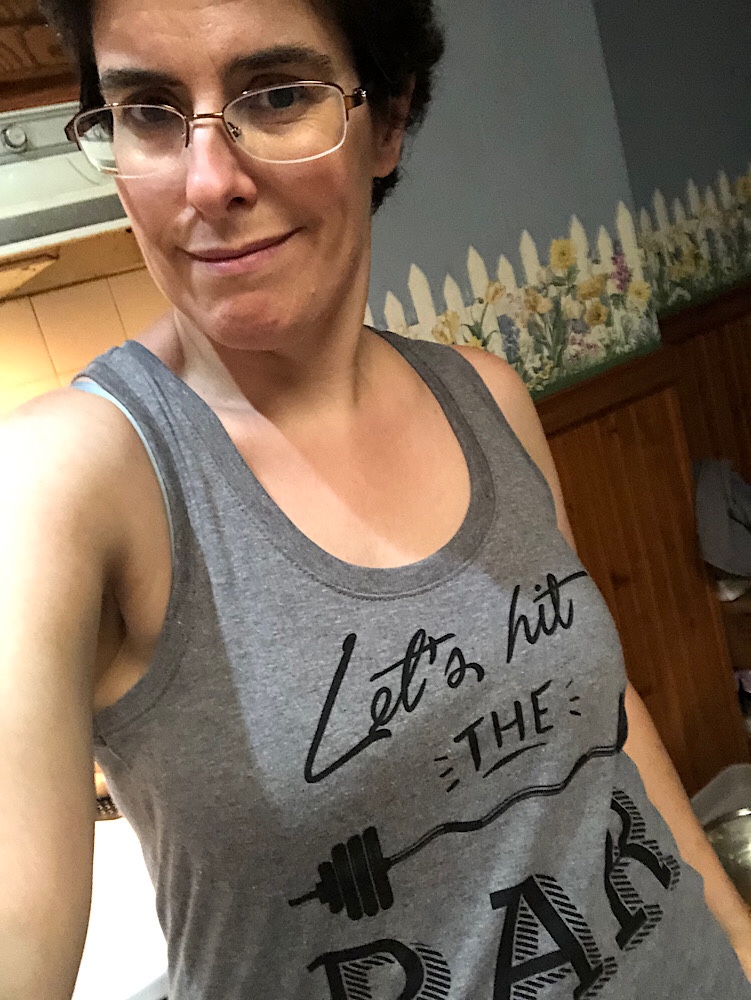
I bought it after my first bench press with the barbell. I have always wanted to lift barbells. I’m fascinated with power lifters, and admire women like Meg Squats. She recently had a baby, but to stay on topic, here is one of her lifting videos: 5 things I wish I knew before I started lifting.
So when my trainer first put me on the bench with a barbell, it was in part to evaluate me. What he didn’t know was my secret burning desire to do it. And it did not disappoint.
Those first couple lifts I learned so much— about form, about using “power zones” in the body, and how a simple bench press uses most of your muscle groups. Fascinating. To see other people do it hints at the complexity, but to do it yourself is a true lightbulb moment to the depth of the interactive mechanics of the human body.
Today I did my first one plate barbell deadlift. Pretty much because my trainer said, “You could totally lift that,” and pointed to the barbell on the floor.
And I said, “I’ve always wanted to.”
You could totally lift that.
Dan, my personal trainer at Apex
So he let me deadlift the one-plate (on each side) barbell. I mimicked his form, which appeared to be underhand and it was a totally different kind of effort from the dumbbell deadlifts I previously completed. Those seemed very concentrated in the butt and legs, these included more of the body in a fluid way.
I did three in that first set and returned to my dumbbell circuit— 10 lb dumbbells in a swing style motion up to a press, 10 reps, followed by 10 bicep curls— before back to the bar. This was my cool down set of the day. And I did 3 more additional sets at the barbell— a set of five, another circuit with the dumbbells, then eight at Dan’s urging, another circuit, and he asked for another eight, but I tapped out after five.
I determined that I prefer underhand grip. Overhand grip puts too much stress on my lower back. Mixed grip is awesome, too, but I think that may require some work before I can up my weight. Mixed grip forces a certain instability and requires more focus on balance, which as a balance exercise would be stellar.
But what does any of this have to do with athletes and disability— the idea I propose in the title?
I have no athletic talent what so ever. My coordination is awful. I tend to walk “all done f*cky” when my health is poor or I am fatigued. I also deal with a myriad of aches and pains from walking crooked and associated issues with my S1 joint.
But my trainer often comments on my form, well, once he reminds me to point my toes for a squat or perfect that lean for a row. He’s even commented that I’m “built for that” while we do certain exercises. That once I correct manually what my brain can’t make my body do automatically, that I use a very deliberate form.
As I’ve mentioned before my weight training is very meditative for me because I am counting (something my trainer and the teenager were discussing because she said even with a decade of band she can’t count) and my trainer said I was good at keeping count, but that many of his clients needed assistance. I am also thinking about control in every motion of the exercise— from each body movement, to pace and control.
And on top of that, I try to note feeling and body function. Though that is touchy. In a “leg day” session a week or two ago, Dan said he noticed something strained about the lift I was doing. He wanted to know if it were legs or back bothering me.
I had to do an extra rep of the exercise to answer him. Because I hadn’t noticed.
“Ankles,” I answered. “My ankles are stiff and shaky today.”
All of this makes me think, and question, how those of us will a mild physical disability like cerebral palsy might be better athletes because we don’t have talent or physical advantages. But we know our bodies and we are accustomed to acknowledging the details of our bodies and their functions.
Does the fact that I am required to concentrate on every motion make me more prone to perform that motion closer to perfection than someone who can breeze through it without thinking about it?
Compelling idea.

 Angel Ackerman