
Why the Disability Struggle Impacts All Humans

It’s Monday morning, and while my red blood count maintains there is nothing wrong, my body shows the signs of anemia, which feel better when I follow a strict regimen of healthy eating, vitamin D and iron supplements… but that is something my primary care physician and I will discuss at my annual physical in September. And he will probably express disappointment that I have regained the ten pounds I lost last year.

It’s true for all of us– when we’re sick or weak or broken, we take care of ourselves (or we try to, I hope) and when we feel better, the routines that help us maintain that wellness fall to the wayside and lean toward repeating the same problems. I know I have a 20-year history of struggling with low ferritin reserves, why don’t I do better to always keep a routine of quasi-regular supplements?

Many disabilities are permanent but not progressive. And most people experience disability at some point in their lifetime– either congenital, temporary or permanent. Any person with a disability or aging person can explain the weight of co-morbidity, that while their various issues alone may not be progressive, when combined with our temporary or new ailments can make life exponentially harder.

My mother struggles to understand how I could be so easygoing and mobile as a kid while experiencing more falls and discomfort now. As my mother, she is no stranger to the aches and pains and limitations of aging, but she didn’t connect that the running and playing and constant activity I had as a child kept my muscles looser and healthy in a way that I can’t match as a fairly sedentary adult. That’s part of the reason why I’ve usually had a part-time job that requires movement and pursued strength training as a hobby.

I know that I need to lose 30 to 40 pounds. As a person aging with cerebral palsy, this would help my cardiovascular system and help take so much stress off my musculoskeletal system. But I have learned, through years of strength training and nutritional counseling that my body reacts strongly to salt and sugar, which means if I wish to lose weight I need to not only increase my activity level, but also cook whole foods, every time. The vicious circle of “I don’t exercise enough because my body hurts/I can’t breath/I’m tired” perpetuates itself because the only way to get past the discomfort is to do it… and survive and persist. (And then there’s the ironic reality that you can overdo it, and hurt yourself trying to do what’s right.)

This is not a disability struggle. It’s a human one.

All people experience a disappointment in and/or failure of their body. It’s a point Johanna Hevda and Julia Watts Belser both point out in their work. They claim that everyone experiences disability within their lifetime, but I extend that same idea to say that all people at some point experience some sort of body dysmorphia. Even if your body works, and is completely normal, people will experience dissatisfaction with it at some point. Maybe you hate your hair, struggle with your weight, identify as trans, wish you were a better athlete. All of these experiences have nothing to do with disability, but stem from the body.
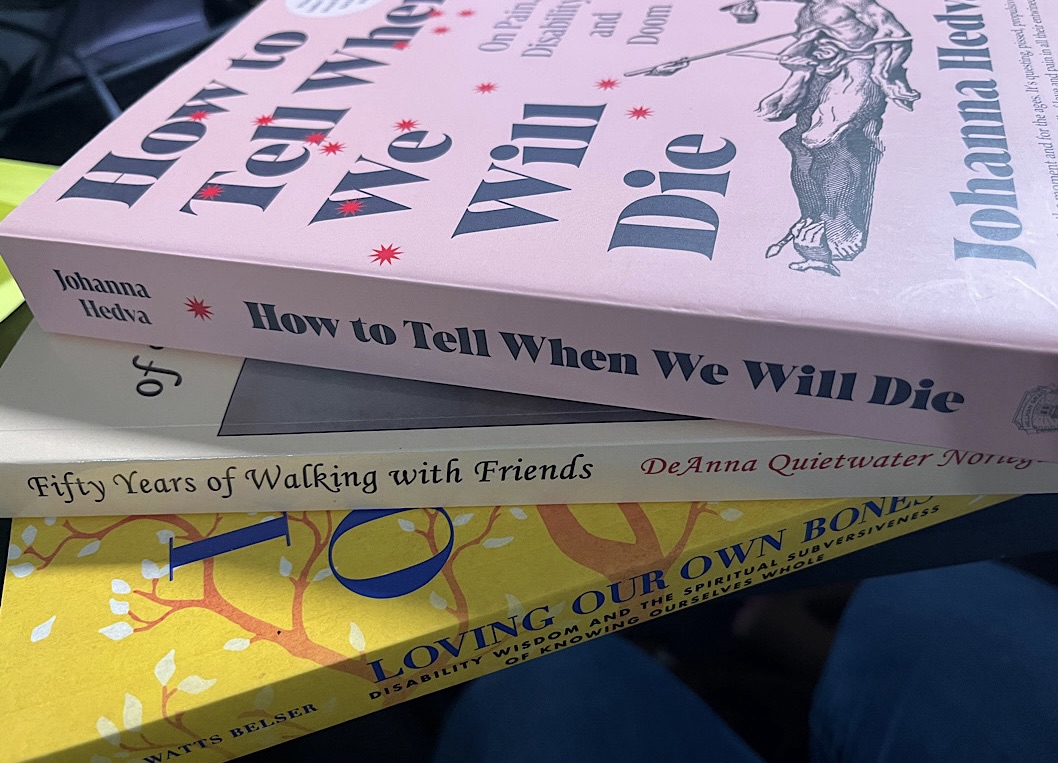
A pile of three disabilty-themed books. The top one, How to Tell When We Will Die: On Pain, Disability and Doom by Johanna Hedva, is pink with red stars. The next on the pile is a beige memoir, FIfty Years of Walking with Friends, by DeAnna Quietwater Noriega. The one on the bottom is vivid yellow, Loving Our Own Bones, by Julia Watts Belser.

Disability Pride Month is celebrated in July because that’s the month when the Americans with Disabilities Act was passed. I didn’t put that together until today, so if you needed that tidbit of knowledge, there you go. I happened to order a whole bunch of disability-themed books in late June because my good friend Nancy Scott told me I should be doing more writing in that space, and she’s right, and she’s tired of hearing me say, “when I write my medical advocacy memoir.”

The four books from the disability space that I read this Disability Pride Month:

  1. How to Tell When We Will Die: On Pain, Disability, and Doom by Johanna Hedva
  2. A Disability History of The United States by Kim E. Nielsen
  3. Fifty Years of Walking with Friends by DeAnna Quietwater Noriega
  4. Loving Our Own Bones: Disability Wisdom and the Spiritual Subversiveness of Knowing Ourselves Whole by Julia Watts Belser

I have been working to expand my collection of books by writers with disabilities. I currently have read books that range from poetry to books with characters on the autism spectrum, though none of these books include my fascination with medical fiction, a realm where Michael Crichton and Frieda McFadden spend some time, and one of my favorite memoirs (An Exact Replica of a Figment of My Imagination) which covers pregnancy and pregnancy loss simultaneously. My Goodreads shelf of “disability” books is visible here.

Poets with disabilities on my read list include Jennifer Bartlett, Larry Eigner, Susan Glass and Nancy Scott. Twentieth-century memoirists on my shelf who explore cerebral palsy include Christy Brown and Marie Killilea, and then there are the people I know, like Tylia Flores (we connected via the Internet) and Peter Altschul (who like DeAnna above is a member of the Behind Our Eyes writing group).

Here’s a very brief review for each of these four books:
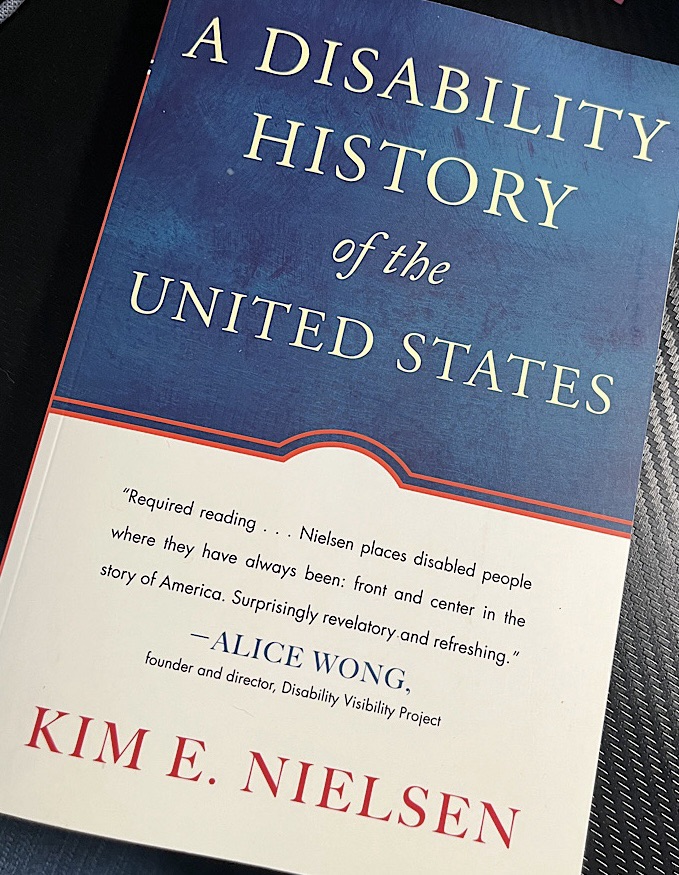
A copy of A Disability History of the United States
  1. On Hedva: I already wrote a long piece about this one, primarily to keep my own notes accessible for future use. You can read that here. Hedva is a queer writer who uses they/them pronouns and has issues with chronic pain and bipolar depression. Their essays are not a cohesive unit, but based on an essay that gained them a publishing contract when it went viral. Their greater thoughts about disability are steeped in personal experience, and often tied to their sexual experiences. But this author challenges us to view the difference between capacity and capability, just because we are capable of something does not mean we have the capacity to do it.
  2. On Neilson: Nielson ended up researching disability as an accident (or serendipity?) as she worked on her history dissertation. Hedva writes philosophically about the capitalist resistance to disabled bodies (as we are worthless if we are not productive to society) and Nielson uses her history background to explore how the capitalist framework has disenfranchised all bodies that are not able-bodied white men, which I found hysterical because one of my publishing company’s initial projects was an anthology, Not an Able-Bodied White Man with Money. See that book here. She weaves together the plights of women, people of color, and people with disabilities into the same historical framework– all of them had bodies deemed inadequate and incapable and inferior by white men.
  3. On Noreiga: This was my first time reading one of Noriega’s books. She’s a self-published author of indigenous heritage who lost her sight as a child. As someone on the waiting list for a service dog, I thought it would be fun to start with her experiences with her (I believe) eight seeing-eye guide dogs. The memoir covered the first decade-ish of Noreiga’s life in autobiography format. The final chapters each provided a summary of her later-in-life seeing-eye guide dogs. While the book did offer insight as to how these dogs perform their complex duties and build relationships with their handlers, the primary focus of the book is Noreiga’s college years and first few years of marriage.
  4. On Watts: Nancy Scott ordered a Braille copy of this from the library at the same time that I ordered the print copy, and that was sheer coincidence. Some of Watts’ ideas are beautiful, like her interpretation of observing the weekly Sabbath as a tribute to not only spirituality but also to her body as an opportunity for rest. Like Heva and Nielson, she laments the push for capitalist societies for valuing bodies only on their capacity to do work– but I think all of these writers need to consider the role of industrialization in all of this. We are no longer in agrarian societies where families live and work together communally and therefore can cater the work to individual strengths and weaknesses. Watts treads a strange line. As a queer rabbi with cerebral palsy and a wheelchair user, she tends to tell us minimal information about herself, yet connect her spiritual journey to her physical one without giving us all the details. In many passages, her affluence shows through, that her financial resources and life situation have provided her with more opportunity that the average disabled person. And she seems to have a fascination with the potential amount of times blindness appears in the Old Testament. As said before, her ideas and themes overlap with Hedva and Nielson, and she focuses on building a relationship with God where you are whole and representative of God in your broken/disabled state. She applies this to beaity standards as well.

I will be revisiting some of these thoughts in my Substack this week,
Thoughts raised by Johanna Hedva

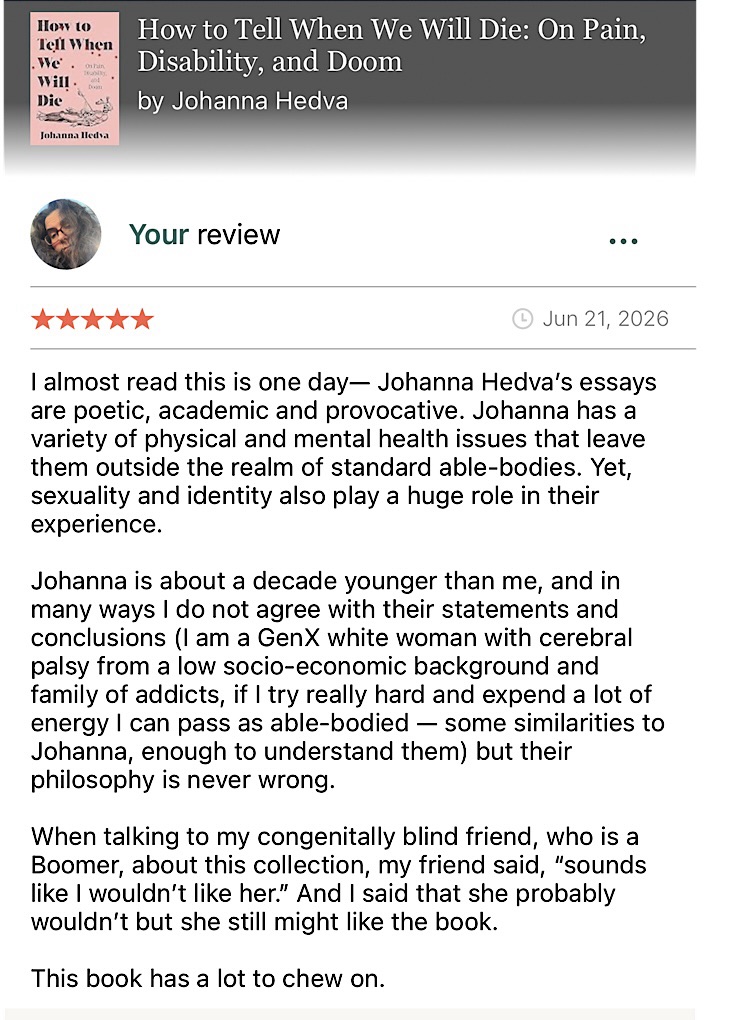
Screenshot of the Goodreads review that is also quoted in the blog piece

I put Johanna Hedva’s How to Tell When We Will Die: On Pain, Disability and Doom on my wish list probably when it was a new release.

The cover design is lovely and the bio of the author is enough to draw interest:

Johanna Hedva (they/them) is a Korean American writer, artist and musician who was raised in Los Angeles by a family of witches and now lives in LA and Berlin…

I guess the first step of my thoughts on the book would be to share my Goodreads review with you.

I gave the book five stars even though the most Generation X parts of my soul wanted to give it four, because despite how much I disagree with some of her points– I can’t stop thinking about them.

My Goodreads Review

I almost read this in one day– Johanna Hedva’s essays are poetic, academic, and provocative. Johanna has a variety of physical and mental health issues that them outside the realm of standard able-bodies. Yet, sexually and identity also play a huge role in their experience.

Johanna is about a decade younger than me, and in many ways I do not agree with their statements and conclusions, (I am a GenX white woman with cerebral palsy from a low socio-economic background and family of addicts, and if I try really hard and expend a lot of energy I can pass as able-bodied– some similarities to Johanna, enough to understand them) but their philosophy is never wrong.

When talking to my congenitally blind friend, who is a Boomer, about this collection, my friend said, “sounds like I wouldn’t like her.” And I said that she probably wouldn’t, but she still might like the book.

This book has a lot to chew on.”

So what are some of their thoughts and my thoughts on their thoughts?

Random comments first.

  1. The title is a shout-out to astrology.
  2. Their book deal for this collection stemmed from the essay Sick Woman Theory which went viral. The attention it garnered made them more of a figurehead and/or activist than they ever intended to be. The essay Sick Woman Theory is not nearly as interesting as her response to that essay, Why It’s Taking So Long.
  3. As a member of GenX, I have some discomfort with how the queer community throws around labels. Johanna identifies as a queer, and not as a woman, which is fine, but I guess I remember the days when people didn’t need to define their identity as concisely as we do now. You didn’t need to label every aspect in which you are weird. It’s okay to just be different.

So let’s look closer at some of their points.

Essay One: “How to Tell When We Will Die”

Opening paragraph:

“Heroes die on the battlefield, never from chronic pain. Diarrhea never makes its way into myth. Tragedies are devoid of menstrual cramps.” Johanna has my full attention. On the second page of the essay, they talk about the representation of disability in early and twentieth century film, and how disabled people become “flattened by some insidious super-cripple myth.” Throughout this first essay, Johanna is tossing around some serious academic critical theory before suddenly turning into memoir…

They speak about not receiving a diagnosis for their ailments until in graduate school (despite later saying that the conditions were inherited from their mother and grandmother, so I think the statement should have been that they could not get a label on the diagnosis– she does state that doctors were “baffled” by her symptoms and “dismissive of their validity.”). And they mention that they stayed on for a second master’s degree to keep their student medical benefits to the tune of $250,000, that led to a career in the arts where they refused any job that did not meet their aesthetic. They chose poverty. They chose art.

I’m wondering why– even if they didn’t want a standard job with employee-sponsored health insurance– they didn’t just buy health insurance or take on medical debt instead of a quarter of a million dollars in student loans.

But then there are gems like “You do not have to be disabled to experience ableism” and “no matter how it arrives, disability will arrive for everyone, sooner or later” (which they repeat in the last essay.) And Johanna points out that the biggest ableist fantasy is that we control our bodies, and we will always be able to control our bodies.

Johanna talks a lot about her mother’s addictions, and the abuse they suffered at their mother’s hands, and of their own mental health issues. Her first suicide attempt happened at age nine, when she took a bottle of sleeping pills, and when she did not die, she carried on with her life.

We are more than 25 pages into the book when we learn that mental health plays a significant role in her disability, which we later (not in this essay) learn includes endometriosis and chronic shingles. I understand that people with disabilities do not owe any sort of explanation of their ailments to anyone, but if you are writing a book about disability, I believe that information should be front and center.

And in this essay she mentions her love of death and doom metal. You can hear some of her music here on YouTube.

Essay Two: “Sick Woman Theory

The essay that started it all. I think it’s really important to understand that they called it “sick woman theory” because regardless of how they identify, the medical establishment and the world consider them a “sick woman” and they are seen as a “sick woman.” They frame their theory that our capitalist world is designed for the existence of “white, straight, healthy, neurotypical, upper- and middle-class, cis- and able-bodied man who makes his home in a wealthy country, has never not had health insurance, and whose importance to society is everywhere recognized and maybe explicit by their society, at the expense of everyone else.” To a certain extent, I want to call out a “Yes, bitch,” (as they toss around this phrase) but at the same token– would the experience be the same in the developping world/Global south.

Essay Three: “The Blast Radius of Disability”

I have to say that I love this concept, “The Blast Radius of Disability.” Disability doesn’t effect one person, one episode, or one place or time. Instead, it impacts everything around it, everyhing that it touches. Johanna speaks of time dvided into before and after sickmess, but I can’t help but wonder how they can divide time in such a way when mental illness entered their life so early they can’t really remember a before, can they?

It is in this essay that Johanna mentions that individuals with disabilities must operate according to “crip time” not clock time, doing things as the body deems itself capable not as the world says we have to do them. On one hand, I understand the point, but that’s not how the world works. I have to believe that there has to be a balance, of not overdoing things in order to conform to the mainstream standard and hurt oneself in the process. And there’s an inference that the entire world runs on the same precision, which isn’t true. There is “island time,” “Latin time,” and “African time.” Each culture has its own realtionship with time, so maybe they need to find a place and a rhythm that works for them.

Essay Four: “In Defense of De-Persons”

A discussion of capitalism and mental illness.

Essay Five: “Get Well Soon”

“Are these my limits, or are these the limits of the world?” Johanna reminds us that disability is part of a dichotomy– the ill being inactive while the healthy take action, the disabled remain still while the rest of the world creates revolutions.

Essay Six: “Notes on Activism (aka Notes on Failure)”

Organizing is exhausting, Johanna begins. Activism, they write, “reminds us how the world actually is, not now how we would like it to be.” Activism often comes off with hypocrisy– like buying your anti-racism books off Amazon.com. Their other question: How can you balance the need as an activism to care for others, yet also take care of yourself?

Essay Seven: “Letter to A Young Doctor”

I didn’t like this one. It seemed to repeat some of other concepts. Johanna tells this doctor all the other things they have already told us and will tell us differently in future essays. The doctor approached Johanna asking for advice.

Essay Eight: “Soft Blues”

Or “The Summer of the 12-inch cock.” The first several essays that are reflections on Johanna’s sexuality. And an in-depth exploration of her experience in a mental hospital for depression that led to her experiencing an entire summer of bipolar mania.

Essay Nine: “Can I Hit You?”

The BDSM essay. Which has the most amazing line: “Pain is the price I must pay to be awake to life.”

Essay Ten: “The Freak”

Another relationship essay. The only highlight I have in the whole essay is when Johanna discusses capability and capacity. They remind us that just because we are capable of something does not mean we have the capacity for it at this time.

Essay Eleven: “Notes on Trash Talk (aka Notes on Community)”

Interesting essay where Johanna gives a view of their obsession with fighting, boxing, wrestling and MMA, and how the way a coach talks to a losing athlete is the type of trash talk we could use more of as disabled people.

The next few essays are all Johanna’s entertainment criticism. I will skip those, even though they do circle around to disability as it all does.

Essay Fifteen: “Notes on Ambition (aka Notes on Survival)

This is a complex one– looking at what we all need, versus what we want, and how many of our ambitions are actually motivating us toward ideals that might not be our own.

Essay Sixteen: “Hedva’s Disability Rider.”

They explore this rider more in a later essay, the one I mention that speaks back to the original “Sick Woman Theory” and presents the repercussions. But here, Hedva gives us the document they send to institutions that invite her to perform. I feel like some of the items on the rider should not be listed as conditions for employment, but instead factors of how much they should charge for their fee. If you know you need a business class airline seat on the aisle, you make sure you only say yes if the organizers give you enough money. Some of the informational items are valid: like allergies. But Johanna also uses the rider as a way to advocate for everyone with disabilities and call attention to how excluded people with disabilities are. They ask for sign language interpreters, live captioning, all-gender restrooms, wheelchair accessibility and audio description.

They say they know they won’t get all of it, but they like to have the conversation and point out how unaccessible and exclusionary the world is.

And this is why hardcore advocacy is exhausting, friends.

While we would like to invite all the people with disabilities to everything, why provide the services if the people aren’t there? I know Nan and I have attended shows at DeSales University where they have one performance with audio description and live captions. These shows are made accessible with grants. Start there.

Essay Seventeen: “Room Day”

Johanna’s partner is Johannes, a German citizen, which is why they now live in Berlin most of the year so they can get better medical care. She does not mention her partner until essay seventeen. The partner to whom the book is dedicated.

Essay Eighteen: “Soft Until It Gets Hard”

How can you not love this title? Another relationship essay.

Essay Nineteen: “Why It’s Taking So Long”

In this essay, Johanna discusses the rider and how when they send the rider to an individual, they would prefer not to see that individual in the context of the institution but as a person with whom they can have a conversation. Teaching moments? Which is exactly what they say later on the page when they discuss they are now part of a “learning experience” that they did not want to be. And here’s another great observation– if an invitation comes in for any event that involves the concept of care in any way and is being organized by solely white women, Johanna won’t do it.

The essay falters between the idea that Johanna never wanted to be an advocate but now that they have the power, they feel a requirement to advocate for everyone.

Here are some great points:

  • Capitalism is so demanding, it makes us all more disabled
  • Even when we are told we “have to,” humans can’t truly do anything alone
  • It’s a fallacy that all you need is will, and the proper manifestation of it
  • Care is often framed as debt
  • You might be winning, but maybe there’s no prize

Essay Twenty: “The Hag in Charge”

A lovely adventure through Greece that offers some recollection of Johanna’s poverty and her spiritual beliefs.

A line that reminded me of Nan, who says this often: some disabled people (Nan and I like to say it’s normally able-bodied people who become disabled) have a fantasy of healing, “and then hate themselves when it fails to arrive for them.”

Disability Lit Review, part one

Let me offer a bit of an author’s note on this one, or perhaps a caveat, that I only got five hours of sleep last night, and my body hurts today. This is the third night this week I got six hours or less of sleep, due to some fairly intense routine change that is kicking my ass. And the pain I am experiencing today is not my standard everyday pain, but similar pain in a more twitchy and unnerving form.

And this may lead to some of my more strident tones. Or perhaps I always feel my opinions with a certain sharpness, but ordinarily I present them after the application of a filter.

I will try to keep my aggressive aggravation to myself, but no promises.

Earlier this month, I drafted a “bird piece” for the Behind Our Eyes anthology, a collection in the works to highlight the members of the Behind Our Eyes email-based writers group for writers with disabilities. I joined the group a couple years ago after participating on the fringes through Nancy Scott, who, in cheap amusement and most things disability, is my partner in crime. I normally lurk in the group, but recently heard they were actively looking for bird stories. The anthology features a variety of sections and one themed block focuses on animals.

I wrote a creative non-ficiton piece about my Goffin’s cockatoo and I navigating disability together, with a present-day, present tense story of Nala plucking her feathers due to her anxiety and me trying to figure out why. The plucking led to her not being able to fly, which gave her a temporary mobility disability. So I used this present-day situation to frame flashbacks exploring why Nala was anxious, but also looking at my mobility disability and the similarities and conditions that made us good for one another. The anthology committee wanted just a bird story, so they’ll be publishing the present-day section of my interactions with Nala.

This was the first of two pieces I wished to submit to disability-associated anthologies. I have drafted the second, but that one is specifically for disabled voices to share what we wished the outside world understood. I revisited my first draft, and tightened it somewhat, and thought the piece sounded like an introductory chapter to my upcoming medical advocacy memoir. That piece has two themes– the beginning talks about how my family had too many problems for me to realize I was “disabled” which seques into the second half, about me finding out my body and assembling an adequate medical team.

Nan has been encouraging me to write more in the disability space, her paraphrased quote being that I could have a real impact there. And in my experience, there are two main types of voices in the world of disability literature. The most mainstream voice is the voice of the writer-first– commonly a writer who experienced illness or disability not from birth, with either some sort of privilege or talent. The second is the disability activist who is not a writer, but congenitally-disabled and fighting for their right and the resources to exist. (And I guess the third would be the hobby disabled memoirist.)

I find myself crossing all these categories. I have the natural writing talent, my background as a professional journalist, my credentials as an academic and historian, and the experience of a congenital disability. Yet, I have the privilege of being a white woman, and if I can borrow the term, I can “pass” as an able-bodied person if I focus really hard and am having a good day. I have the type of cerebral palsy that you might not notice or that might make you stare at my feet and knees.

This morning on social media, I saw a post from a disabled Iraqi/Afghan War veteran stating that he needed to retire his service dog as she had had a seizure. The man said that his career involved much travel and public speaking as an influencer and motivational speaker. I searched the internet for him and found a very basic web site, some YouTube videos and an Instagram, but no information about him or the experiences that lead him to be a motivational speaker.

Now, in everyday life, people with disabilities do not owe information or an explanation to anyone regarding details about their private lives or medical conditions. But if you build a career on your experience coming back from a disability, I think some of that information is owed to prove the validity of that expertise. (And if you are an influencer, a Google search should turn up some information about you.)

What I am about to say next is going to make me sound like an ass, and I mention to not to invalidate the experience of people with disabilities who fit the categories as I am about to describe– but the lived experience of a Cis white heterosexual male in the United States of America who develops a disability after voluntary service with the military is very different from the experience of a person who has never been able to walk, has a limb difference, total blindness or any of the multitude of disabilities that occur at birth.

(Add in family resources, and there’s another layer of complexity.)

Some people have more choices. Some people have more privilege.

ALL people living with ANY TYPE of chronic illness or disability deserve the same respect, but one must understand that they all come from different places. As all humans do.

This has led me into a brief literature review of the disability space, one I have only explored via finding books written by ordinary people on their experience with disability. My list included the third anthology from Behind Our Eyes and a service dog memoir by one of its members, Peter Altschul. I have a collection of books with connections to cerebral palsy: several modern memoirs by Tylia Flores, a pre mid-20th century memoir by Dubliner Christy Brown, and Karen, a parent’s cerebral palsy memoir that takes place about 10 years after Christy Brown, and then poetry and academic work by Jennifer Bartlett. And a highly academic poetry book by blind poet Susan Glass.

A copy of A Disability History of the United States

I recognized my need to diversify… especially as I start more work on my medical advocacy memoir and consider making more deliberate strides into this space.

Here’s what I ordered:

  • A Disability History of the United States by Kim E. Nielsen. I believe this was Nielsen’s Ph.D. thesis in history. In her introduction, she mentions that she is a white woman of certain privilege, and she ended up in this space by accident, with no connection to disability. Then, shortly after receiving a publishing contract for this book, her teen daughter contracted an illness that made her a wheelchair user and gave her a more personal glimpse of the issues she had talked about.

I finished this book yesterday, and it’s definitely an important work, exploring hundreds of years of attitudes and events about disabled bodies. Nielsen aligns disability rights with other civil rights, for women, for Blacks, for gays. She presents the idea that any body that is not strong, healthy, heterosexual, white and male faces the same discrimination and lack of belonging in the American social structure. And ALL of these bodies are disabled and deemed as unsatisfactory as part of the capitalistic labor machine.

It’s an important work that shows how ideas about disability evolved and how legal status/rights have changed.

Today I started:

  • How to Tell When We Will Die: On Pain, Disability and Doom by Johanna Hedva. This is Johanna’s fourth book, and the bio on the back lists them as a Korean American writer, artist and musician raised in Los Angeles raised by a family of witches.
A pile of three disabilty-themed books. The top one, How to Tell When We Will Die: On Pain, Disability and Doom by Johanna Hedva, is pink with red stars. The next on the pile is a beige memoir, FIfty Years of Walking with Friends, by DeAnna Quietwater Noriega. The one on the bottom is vivid yellow, Loving Our Own Bones, by Julia Watts Belser.

Their introduction mirrors a lot of the same concepts about the issues disabled people create for American capitalism. Their experience though is one of disability after chronic illness. I have only reached page 28, and Johanna mentions a decade of chasing a diagnosis, but states that they inherited chronic illness from their mother and grandmother– which leads me to wonder why a diagnosis was such a mystery?

I suspect the reality is that Johanna had trouble finding a doctor to label the diagnosis officially, which is the “doctors are idiots” and the “American healthcare is broken” problem not that Johanna didn’t know what was wrong.

I hope Johanna eventually shares their disability with the reader, but as of yet it has not happened, and again– I know no one is entitled to know the private details of another person’s medical situation, but it is important when one is standing in a public space claiming authority regarding such issues.

The other two books on my new acquisitions are:

  • Fifty Years of Walking with Friends, another guide dog memoir by BOE member DeAnna Quietwater Noriega. I added this one to the list because of Noriega’s Native American heritage.
  • Loving Our Own Bones: Disability Wisdom and the Spiritual Subversiveness of Knowing Ourselves Whole by Julia Bessler Watts. Julia is a queer rabbi. This book was recommended and you had me at queer rabbi.