Balance Assessment at Susquehanna Service Dogs

About three years ago, Eva– my daughter, in the beginning of her career as a pet caregiver and dog trainer– said she wanted to train me a service dog. She wanted something to babysit me once she left home or when I was home alone.

She showed me some videos and I did some research and thought she had a point. When she leaves home, I will be a 50-something woman living alone with a history of falls and accidents. The presence of a dog in my life would keep me active and prevent spasticity issues, improve my gait as a dog’s gait never falters, and perform small tasks like bringing me my phone or picking items off the floor.

I have no doubt that with the right puppy and the time, Eva could train a service dog. But I suggested that for our first experience in the realm of service dogs, we should apply to an official service dog program.

Working with a program would teach us how the dogs are trained, give us support, guarantee good breeding and the physical fitness of the dog, and have some added legitimacy should people question my dog’s work.

Now there are no rules that prevent individuals from training their own service dogs. I think this is why one can encounter a variety of “fake” service dogs doing public access work. [I saw two service animals in the same restaurant this week. One looked like a well-trained Labradoodle with a handler who wasn’t cognizant of her surroundings. The Labradoodle was lying across the main floor area of the restaurant and not tucked under a table. The second was a small dog, perhaps some sort of schnauzer who barked and begged and whined and scratched at its owner’s leg for food the entire time. So, either that handler was having a medical emergency and the dog’s alerts were being ignored or the dog was not properly trained. A working dog should not make noise in public and it should not be distracted by food.]

I understand that training a dog with an agency or a professional trainer is expensive, but people who insist on using dogs for public access that are not properly trained make life harder for those people who have working dogs that don’t misbehave. Improperly trained dogs with public access are the dogs more prone to cause an incident with another dog.

And once I pay for my dog– which will take ALL of my savings– if that dog is attacked or threatened while working in public, that could impact its ability to do its job in the future. My dog might become afraid and unable to focus on its job. So I will have invested all of my money in a dog that won’t leave the house.

In the United States, there are no rules or governing agencies that regulate service dogs. There are, however, rules about what people can ask to a handler of a service dog– Does this dog do work that mitigates your disability? What tasks does the dog do? That’s it.

I have chronicled my service dog adventures on this blog. Here are most of the entries. (I am also working on a disability memoir.) There’s a lot to the process. My dog will be a light mobility dog.

They say the average placement takes four years start-to-finish. We filled out the application with Susquehanna Service Dogs in Summer 2022. I went to their facility and had an interview, fill out a survey of my life and health every six months, did an assessment while working with a dog where they recorded me, brought Eva with me to do public access work in a mall, passed a home visit, collaborated with a case worker to develop a plan of what my dog would actually need to do, and now yesterday, I went back to the facility with Eva for a balance assessment.

They had a mobility professional join us– I believe she was a physical therapist– and I worked with the dog and showed them how I get up off the floor and answered questions about my life and recent fall history. I love when Eva can come because she can tell them her insights. Apparently, she was annoyed because physically I was having a good day yesterday.

I worked with Captain. What we learned was that my dog will need to walk on my right. The dogs are trained to walk on the left, but when the dog is on my left I struggle to walk in a straight line. When the dog is on my right, my posture and ambulation is much more natural.

We also decided that my dog will be guided by a leash, versus a strap or a mobility harness. A mobility harness is rigid and has the most feedback between human and dog. In the photos, I am using a red strap on the far right. The strap was okay, and it’s an intermediary step between the harness and the leash, but it didn’t feel natural. (And the benefit of using leash only is that it gives the dog more freedom and space to get out of the way when I fall. Some dogs are trained to do things when a handler starts to fall, but I want my dog out of the way.)

It also seems like I’m at the proper place in the timeline. The next step: When they have a group of dogs that are flexible enough to work on the right and the right size to work with me, I will get to meet them. It might take a few meetings to find the right dog. Once the right dog is selected and assigned, I believe they will do any specialized training while boarding on site and then I go to their facility for a three-week training session.

The dog itself has to be two-years-old and fully grown and cleared by a veterinarian before entering the work force. Moibility dogs have some of the hardest and most physical jobs out there for service dogs.

People and Dogs: Come on, where’s the common sense?

If you don’t know, my daughter– The Teenager about to turn 20– works in the pet care industry, primarily doing dog walks and in-home pet care visits. She is also a dog trainer, and spends a lot of time and energy studying dogs, observing dog body language and finding solutions to people’s problems with their dogs.

She is the one who encouraged me to apply for a service dog, and although I grew up with dogs, she has taught me so much about dogs and why they do what they do.

Her dog, F. Bean Barker, who, will be four this summer, can be reactive and territorial. The Teenager has worked very hard to decrease her dog’s reactivity and expose the dog to situations to improve her tolerance. Today, we took her to a dog park. The dog park is less than two miles away from our home and off-the-beaten path so it’s not as well-traveled as some other local places. It has a lot of green area to explore even outside of the dog park. So, if the dog park is occupied, there is other stuff to do.

This dog park has two sides, one for dogs 25 pounds and under, the other for dogs larger than 25 pounds. Each side has a double gate system, so you can enter the first enclosed room and make sure your dog is ready to enter the other side without risking releasing any dogs already in the park. (In this dog park, there is also a gate between the two sides.)

Now, if you do not have a dog or if you have a rural dog who has no need of a dog park, you may not understand that dog parks can be extremely dangerous. You never know how other people’s dogs will react, and you can find that certain dogs have behaviors that can unnerve the most calm and pleasant dog. Owners often don’t keep close enough control over their dogs inside the park, believing the environment is contained and safe. But just like two normally well-behaved children can suddenly behave like cold-hearted killers on a public playground, dogs can change in this unfamiliar and potentially unmonitored environment.

We know Bean is a good dog, well-trained with a recall, but that she often has a hard time with other dogs especially if they aren’t appropriately socialized. Now, even if you think your dog is “good with other dogs” or “well-socialized,” you may not understand dog body language or stress signals to know how well your dog is doing in a new situation.

Knowing this, we brought plenty of our dog’s favorite treats, put her in a harness and on a prong collar and tucked a can of “pet corrector” into our gear. When we arrived at the dog park, one adult and one child had two small dogs running the entire expanse of both sides of the dog park. The Teenager decided not to engage and walked the dog around the human passive recreation trails.

The family soon left, taking their two small dogs off leash through the parking lot and leaving every gate in the dog park open— the two entering the small dog park AND the interior. That means if someone had entered the large dog park, appropriately, the large dog could have run into the small dog side and exited into the busy parking lot. Really?

Needless to say, this dog grandmother went through and checked every gate before Bean and The Teenager entered.

I sat under the pavilion and watched while Bean and The Teenager explored.

I was technically lookout, because The Teenager had removed Bean’s leash and if another dog came The Teenager wanted enough time to leash her dog and make sure Bean was under control, or at least, obedient.

I looked up from my book (Hunter’s Shea’s Manrattan which I am enjoying very much) and there was an unattended mastiff with no leash standing outside the gate. The Teenager already had Bean outside the dog park and releashed. So, we left.

The owner of the mastiff strolled leisurely to the gate, while his unleashed dog just had free reign. Why don’t people have common sense???

Dogs in public should be leashed. It’s a law. I don’t care how well-behaved your dog is– if it is attacked or frightened, it will end up in a fight. Even the best dog in the world would defend itself in a fight, so regardless of how the fight starts, both dogs could be injured or killed.

And, as someone on a wait-list for a service dog, it angers me to see how many people don’t understand why certain laws exist regarding where dogs can go and how they should be handled. A dog masquerading as a service dog in a store for example not only might create a bad example for real service dogs, but if it is not trained properly it could attack or spook another animal (or a person or a service dog). A service dog that encounters poorly-managed and badly trained animals in public could be attacked or spooked in such a way that it might not be able to do its job, creating a financial and practical hardship for the disabled person relying on that dog.

So please, leash and control your dogs as the laws ask you to do.

All things fitness, mobility and service dog

The last week or so I feel like my strength in the gym (Apex Training) has been dead on– the lifts have come easily and even as my feet/lower body doesn’t cooperate, I seem to get the job done without compromising my other body parts. Andrew, my fitness trainer and strength coach, has been a wonderful support and motivator as life has gotten dramatic and hectic for both of us.

Today I lifted a new PR on bench press– I am up to 80 pounds! As for flexibility and core strength, from my angle it fluctuates every day but Andrew points out a lot of his observations which suggest I am improving more than I might realize. I have noticed that I stumble less, even as my toes drag and my balance falters, knock on wood I have not fallen since Sept. 30.

I have gained back all of the weight I lost, between gin sours and peanut m&m’s and all sorts of chips from the Dollar Tree. And too much pizza! Even with The Teenager home after having her wisdom teeth plus a back molar removed, I’m still eating too much junk– milkshakes, cheese curds, the Wawa chicken fingers and french fries, Macs received for free with minimum purchase of a Diet Coke for me and a Sprite for the Teen all in the name of surgery recovery.

Meanwhile, I can see my muscles gain definition so I know if I’d stop putting junk in my body ALL THE TIME, I could really lean out and have great tone. But the immediate satisfaction of treats and savory, salty foods steals my discipline and knowledge every time.

As if that alone weren’t enough to kick my ass back where it needs to be, I’m starting to believe that the occasional out-of-breath episodes I’m having are symptoms of exercise-induced asthma. My allergies have been bad. The weight doesn’t help. And I noticed more and more that it comes on all of a sudden, even when I’m walking on a flat surface setting my own pace and not with anyone else, and I cannot get air into my lungs until I repeatedly take breaths through my nose and get a breath deep into my chest.

Today, it happened at the gym. I have never had anything like this happen at the gym. I was doing sets of 25 crunches on the exercise ball and really had trouble catching my breath at the end of the set. And I love those crunches! I normally knock them out like a beast!

Light Mobility Service Dog Update

Yesterday I was scheduled to meet with my caseworker at Susquehanna Service Dogs on Zoom. She asked if we could please reschedule for today and as I kept the end of the week open not knowing how the Teen would do with surgery, it worked out fine.

Today the Teen, myself and the caseworker met to discuss what my dog might be trained to do as a task for me, any concerns I might have, and some more updates about my lifestyle. The number one goal I have for this endeavor is to be able to go on walks by myself without fear. I miss my days of going for a 4-mile walk in the morning. I want that piece of mind. The other tasks that I asked for are help retrieving things from the ground when I can’t bend, carrying items I might have in my hand if I find myself struggling for balance, and getting a first aid kit if I need one.

The Reunion Dilemma

Tonight is my 30th High School Reunion, scheduled in the casual and amazing environment of Richmond Brewing. Our classmates own the establishment and have agreed to let us assemble and celebrate without a lot of formal to-do.

But I don’t know if I’m going to go.

I was on the reunion committee. I love the food and the beer at Richmond Brewing. It should be fun.

But I’m stressed and if I’m honest, I’m scared. And I think this is probably the first time I really wished my service dog was already here. Because having that dog would relieve some of the physical barriers to attending, which might help my emotional issues.

I’m already showered and dressed and ready to mingle. But I’m struggling with my own mobility today– which if you aren’t a regular reader I have diplegic spastic cerebral palsy which means I have issues controlling my legs. Last weekend I took a medium fall. I didn’t do any permanent damage, though I did damage my expensive glasses, probably delayed healing of my sprained right pinky, and got myself some nasty bruises and bumps on the head.

But today I fell again. This is is going to sound ridiculous (my trainer Andrew can probably vouch for me here, I think he’s seen it happen) but I can’t pick up my feet today. Primarily my right one. It’s dragging. It got caught in the cracks between the sidewalk and down I went. No damage, my Apple Watch didn’t even alert.

Which is probably a good thing as I’ve been enrolled in the Women’s Heart Health and Mobility Study at Brigham & Women’s Hospital in Massachusetts and when I fall and my watch registers it, they call to check on me. I talked with them for a half hour on Monday.

I fell on the way to the gym, and my workout went fine, although at the same time, I struggled with some muscle control.

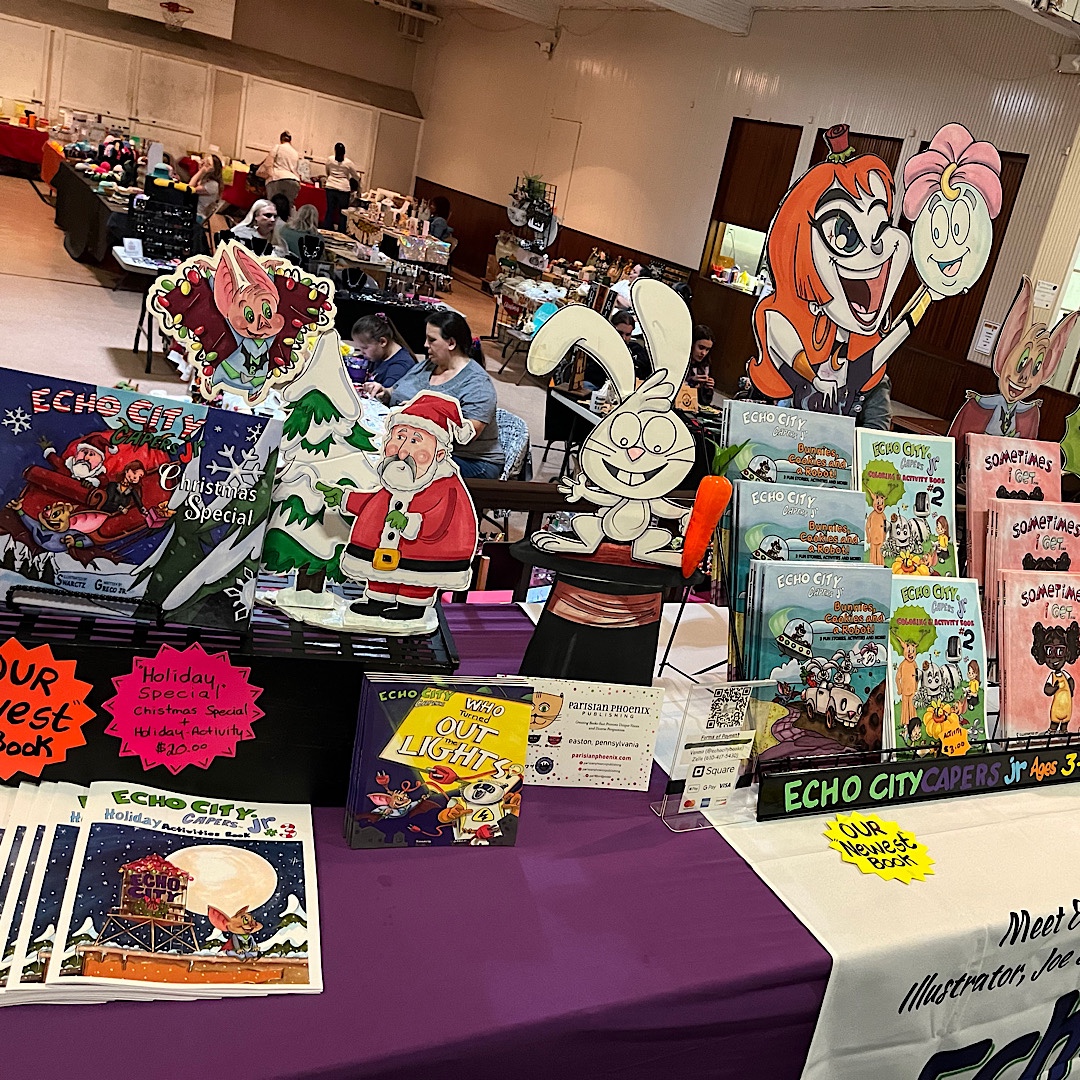
I went over to the Christ United Methodist Church for their craft and vendor fair where Joe Swarctz, our fearless illustrator and the creator of Echo City Capers, was selling the latest in children’s books. I didn’t fall, but every bump on the sidewalk or imperfection in the floor challenged my balance.

The Teenager has to work tonight, so I’ll be on my own for the reunion tonight. And I’m scared. It’s about 30 minutes up there, and with my recent layoff gas money is tight, plus I won’t be able to have a beer. And it would have been my father’s 75th birthday today, if he were still with us, so that has me in a horrible, dejected mood.

If I had my service dog, I would feel safer. I would at least feel more secure about my ability to navigate walking. And I would know that I would have another living thing there that could help me if something did happen. I know that all of my classmates at the Reunion would be helpful, but there’s a certain comfort from those who already know what you need and how to help. Because it’s a dreadful feeling when you have an accident in public, and people want to help and no one quite knows what to do or they do too much or the wrong thing.

I’m not sure what to do, but I know the choice is stressing me out.

But if my balance is already significantly compromised, I don’t know if traipsing around an old barn is a good idea.

Do I want a (mobility) dog?

A while ago, the teenager suggested that I needed a mobility dog and someday she would train me one.

Well, with all the mishaps and falls I’ve had since April (mallet finger, smashing into a brick wall, almost breaking my glasses falling literally on my face, falling into the bathtub and whacking my head on the ceramic tile wall and my personal favorite falling through the screen door), I did some research and thought the beautiful, dog-loving teenager might be right.

I had previously blogged about why I thought a dog would help me and I also thought a first dog should come trained and the teen, approaching young adult, could learn from this one. Just like I would.

My previous post on service dogs

I requested an application from two organizations. The closest to me was Susquehanna Service Dogs near Harrisburg. They sent me an application today. I have three months to fill it out.

The flow chart of initial steps for a service dog

The application requires my demographic, medical and lifestyle information, plus the financial statement saying that I will pay the $5,000 necessary if I get into the program. I need two letters of support— they need to come from people who support me having a dog and promise to support me and the dog together for the life of the dog.

I also need three references.

And a statement from my doctor.

I just thought I’d document my thought process and journey here. Because I’m hopeful, and doubtful, excited and afraid.

Do I want a dog? Can I handle the commitment? Am I the right kind of disabled to benefit from a dog? Can a dog help me be safe? Can I maintain an active lifestyle? Will they see how a dog would protect my independence?