Resources and their impact on disability memoir

I don’t know about you, but as I grow older, routines become more and more important to me– because otherwise I simply don’t squeeze all the tasks and items into my day that I think I should. That’s how things I enjoy, like updating this blog, get neglected.

For instance, I never wrote an entry about my single-shot marathon drive from Atlanta home.

But I was working with Nancy yesterday (and she managed to submit something like four poems and an essay while I was with her) and she nudged me in that subtle way. I mentioned that I had gone to the cardiologist the day prior, and that led to a discussion of the fact that most of my current writing time has been dedicated to my medical advocacy/ disability memoir.

“Good,” Nancy said. “I think that’s an important one. Because unlike so many people that write disability books, you’re a normal person.”

I had to pause for a moment and I almost laughed.

“Because so many books by disabled authors come from people with resources?”

While that statement is not 100% true– I know several disabled authors who use the Amazon platform to promote and distribute their fiction– it says something about disability-themed literature and memoir of past generations (I am Generation X and Nan is a Boomer.)

Spending some time in the Barnes & Noble database

For fun, I just searched DISABILITY on the Barnes & Noble website. The search yielded only academic titles. I searched DISABILITY FICTION and got only 22 results, mostly academic books, and one book only available in ebook, published by Draft2Digital, and clicking on the author’s link led me to believe he is an independent author who has published at least twelve titles only in ebook format. The author is also a horror filmmaker, nearing 60-years-old and appears to be white and able-bodied.

When I search DISABILITY MEMOIR, I find twenty results– many of them self-published, several by Boomers (on topics like polio, at least three of those, hey GenZ have you heard of polio? Another on surviving Tuberculosis and living in sanitariums), many on parenting, and many on learning disabilities.

MEDICAL MEMOIRS yielded more results (50 instead of 20) and the boldest words that popped from thumbnails were cancer and survival and the occasional miracle. When I entered my own condition, CEREBRAL PALSY, the search returned more than 130 results– most either children’s picture books or academic books.

Now, I know some of you are thinking, “Why is she looking at Barnes & Noble– everyone knows there are more books on Amazon.”

Barnes & Noble, as the remaining giant big-box book retailer, offers a standard on what can be considered mainstream and the minimum threshold of “wide” versus Amazon-only distribution. And Barnes & Noble has started doing some more gatekeeping as to what self-published or print-on-demand titles can appear on their web site.

Resource #1: Time

Anyone who publishes– even if self-publishing– has a certain amount of financial or support-system resources at their disposal. It might be as simple as the self-published author who solely uses Amazon has a live-in caretaker, which could be a family member or a paid staff person, which allows them the extra time to sit at their computer and write. As a person with a disability, whether that be a mobility issue, a congenital limb difference or vision and other sensory impairment or something else, it takes a lot longer to do basic tasks alone. Ever try to button a shirt alone with a broken arm? It takes longer to bathe, to cook, to eat, to use the toilet. The whole day just takes longer and takes more energy.

And that’s without considering what it takes to monitor and take medications, how often one needs to attend physical therapy appointments or doctor visits, and potential nuisances like arranging accessible transportation, buying supplies like incontinence supplies or feeding tubes, and monitoring one’s health.

Resource #2: Knowledge/connections

There is a profoundly different experience for disabled people based on socio-economic status. There is also a gap between experiences for those people who qualify for public services, those who have private resources and those who fall in the middle.

During the pandemic, I qualified for Medicaid for the first time in my life pretty much because I lost my job at the height of Covid and did not receive any unemployment because only workers displaced by Covid made it into the system. I did eventually receive unemployment, but it literally hit my bank account two days after I started my job at Stitch Fix. Because I had zero income, I qualified for food stamps and Medicaid. My Medicaid kicked in November 1, 2020 and my job at Stitch Fix started one week later and they provided health insurance on day one.

I submitted all my paperwork. My food stamps ended, but Medicaid did not, because of the pandemic. Despite me periodically sending updates reinforcing that I had private insurance, my Medicaid remained. Do you know when they canceled it? When Stitch Fix laid me off. I submitted my application to renew my Medicaid and they denied me because their system hadn’t uploaded my daughter’s prove of being a college student and I didn’t notice. The system didn’t send me a notice that said, “Hey, this item is missing.” Just denied the whole application. So, I have spent the last year as a disabled entrepreneur with a high deductible medical plan which means I recently paid $2,000 out of pocket for an MRI. It also means I am not seeing my specialists as often as I should.

Meanwhile, I know someone who recently not only qualified for Medicaid but also receives government disability payments, also an entrepreneur, who probably makes more money than I do. I have an Office of Vocational Rehab Counselor who has listed me in her highest category of disability, but in the last six months, I have received nothing actionable as support.

Access to social workers, whether professionally in a hospital or even through friends or non-profits can help make sense of what is possible, but without guidance it’s really hard. Another barrier is technology. That one might make a reader bristle, but not all technology makes life easier. Sometimes technology requires practical or financial resources to be useful. Nancy, as a blind person, has struggled with internet access. She has never owned a computer, and she has tried various ways to use the world wide web. Her Fire tablet worked well until the charger failed way too quickly. She has a Blindshell cell phone she uses on wi-fi to check her gmail account, and an Alexa device to handle music, time and reminders.

But recently, NASA discontinued its TV station, guiding viewers to use the NASA Plus app instead. Alexa does not have a skill for NASA Plus. Her Blindshell can’t open links from NASA Plus. And she can occasionally stumble upon a usable link for NASA’s videos on YouTube, but not reliably. She’s now considering a Fire Stick, but she’s considered she won’t be able to easily scroll the thumbnails to find the launches that interest her.

I mention this because the resource of knowledge and connections, many of which we consider technology-dependent, will change the disability experience. The people who will produce memoirs will have more access to knowledge and technology. Even in able-bodied households, not everyone has access to these items.

Resource #3: Money

A lot of the memoirs I have read come from households with financial resources. It could be as simple as having a stay-at-home mom who could be a caretaker. It could be as complex as a disabled person having access to expensive custom schools or having enough savings to take time off work for long treatments or training opportunities. These advantages lead to better education, better adaptability in the world and also empower the person who had these opportunities stories they can share with the world.

Not to mention many disabled authors work with specialty editors or vanity publishers to create their work and that requires cold, hard cash.

Resource #4: Support

Similar to the time resource, support covers the system that helps a person on a day-to-day or as-needed basis. The support of family, friends and caretakers contributes to a person’s time, their skill and their self-worth to lead them to write a book. That could also include a teacher or mentor. Some disabled people might need a typist, or an outside researcher, to help them with their tasks.

For disabled people who use most of their time and energy on survival items, writing a book might not be a possibility. This also covers the emotional support– I would guess that most disabled published authors are people who have been told they have a message worth sharing.

Resource #5: Past Experience

Finally, I consider past experience a resource. This may pertain more to medical memoirs versus disability memoirs, but that is my gut feeling and not fact. Most people want to read “hopeful” stories with happy endings. And therefore I wonder if memoirs that feature “miracles” or “cures” might be more appealing and accepted than chronic illness/lifelong disability books.

If an able-bodied person experiences an illness or an accident and writes a book, he or she will write with their previous experience in mine. The journey present in the story will be “before,” “accident/diagnosis,” “after,” and “end,” whether than end is death, healing, or acceptance. Stories with this framework will inadvertently compare the disability or medical part of the story to the unhindered before time, and the goal will always be to regain what was lost.

For most disabled people, the reality is learning to live with the condition and doing what is needed to prevent a decline in quality of life.

Regardless of what resources or goals a writer has when dealing with their own disability or medical situation, it’s important to remember when we read memoir that everyone’s lives have different challenges and their are many ways to deal with any situation.

Almost like a vacation

This year’s Greater Lehigh Valley Writers Group THE WRITE STUFF Conference came and went in a flurry of excitement and camaraderie (in the middle of Mercury retrograde to boot). I gave myself Sunday off–and swore I would stay in bed all day watching Grey’s Anatomy, which didn’t happen, in part because I started reading books and talking to my authors and associates at Parisian Phoenix Publishing about the conference.

I attended all three days of the conference, as I am president of the group, and I treated myself to a hotel room at the venue Friday night so I could stay and enjoy the social. My friend William Prystauk and I keep saying we’re going to book a hotel room and sit at our laptops all weekend, so I invited him to join me. I figured we could have a nice dinner between events and catch up.

Yes, you read that correctly. We are writers, after all, so we want to book a hotel room and hide from the world at our keyboards.

Some history… and notes for memoir.

Anyway… last year’s GLVWG conference happened not long after I was released from the hospital after the scariest series of falls in my life. (If you’d like to read more about that, you can read it here. I have to say, I was reviewing it this morning, 13 months later, and my sense of humor amazes me. This was the second fall I had last March, the first of which happened at work on the first day of Cerebral Palsy Awareness Month. That fall is memorialized here.)

(One of the sessions I attended at this year’s conference was Jordan Sonnenblick’s session on memoir writing. I have known Jordan for 20 years and I did not know he wrote memoirs, but it turns out this is a recent turn of events so then I felt better. What I find fascinating about Jordan’s memoirs is that he writes them like his middle-grade fiction, but with his as a protagonist. I bring this up because one of his techniques for recreating his past was to map the scars on his body. I finished The Boy Who Failed Show and Tell last night, and I reviewed it on Goodreads. Some people classified the book as historical fiction and slammed Jordan for “promoting toxic masculinity” — as if in 1978 there was a universe without toxic masculinity.)

Joan & Bill at work

Last year, the conference occurred during the same weekend as The Lehigh Valley Book Festival, where I had volunteered, but I was nervous to attend the event, alone, after so many medical incidents. Joan asked me to be her photography assistant and so I did. This year, Bill ended up working as her assistant since he was in the building anyway. Joan provides author headshots at the event for a $40 charge. It’s a bargain, and the photos have many versatile uses that I don’t think writers consider.

So this year’s conference had not only a great conference line-up, but many of my friends milling about as extras. And I had the naive idea that I might have time to connect with some old friends I hadn’t seen in a while and connect with some new folks. That did not happen.

A hotel with history

Bill left work a little before 5 p.m. to meet me at the hotel. My daughter had stopped by at 4 p.m. at the end of the workshop with Jonathan Maberry to have him sign her battered copy of Rot and Ruin. We are slowly collecting the whole series, as the last books of the series seem to be harder to find. We currently have books one through three of the series, and I have ordered four and five, but I’m not sure I have the Texas bits…

The Teenager with Jonathan Maberry

A bunch of conference attendees and presenters were meeting at the hotel restaurant for a light dinner before the evening events and the social. I encouraged as many as possible to line up in a big, long table that we kept adding squares to the bottom. Bill arrived in time to join us.

Now, here’s where things get very interesting from a writer’s perspective. More than a decade ago, during one of my previous incarnations as the group’s president, we used to flip-flop between the current hotel and the one by the airport. Both were mid-range hotels with plenty of space for a large keynote and enough smaller rooms for break-out sessions. As prices would go up, we would pit the two hotels against each other and the venue that gave us the best deal won.

I’ve been away from the group for almost a dozen years, and a pandemic happened which made the conference virtual only for a while, and now we are building up the GLVWG conference game again, last year with Maria V. Snyder and this year with Maberry.

The hotel though has seen better days, in part because for more than a year now the owner of the land has submitted a proposal to the township to knock down the hotel and build a warehouse. As a consequence, the maintenance on this octopus of a hotel (the floor plan has arms jutting out everywhere) has been minimal.

Jordan Sonnenblick said his wedding used the venue in 1994, and nothing has changed since then. Well, except the name. I think that hotel changes names every other year. The toilets run and/or have low water pressure. Some areas of the hotel smell like “weed and old people” as The Teenager puts it. The restaurant is small. The food is limited. The coffee is terrible. And while the staff is delightful and they keep the place clean and functioning, there were a lot of small but important mishaps probably due to being understaffed. The parking lot is always full of trucks and there’s what appears to be a much nicer Hampton Inn right next door.

But amidst all of this– Bill knew the bartender from earlier in the hotel’s history and apparently she makes good drinks. So after dinner, we stayed for a beverage and heard from a staff member that they have been told the hotel is closing for good in December 2024. We shall see.

The Social

William Prystauk, Marie Lamba, Dianna Sinovic, Jonathan Maberry, & Jordan Sonnenblick

From there, we moved down to the social. Mark Twain was kind enough to visit and I noticed a lot of people in literary cosplay.

I had a lovely time surrounded by friends and some of my favorite writers.

Jonathan Maberry at his table at the keynote luncheon

[I had intended this blog entry to be about my personal life, but I didn’t quite get there. I wanted to at least mention my OVR planning session yesterday. Better luck next time I guess.

PS–I still don’t like Grey’s Anatomy, and with every episode that passes I like Meredith Grey less and less. And I was so excited to get to Derek Shepherd’s death. But man– the whole arc of Meredith disappearing for a year to have another baby. So dumb.

And I cannot believe how you never see the kids, and Meredith never has any paid help, but yet she’s raising three kids as a single mom. And Alex just sells her her house back because it’s important to her to be at home and not in her family house.

Meredith is a spoiled, entitled brat who thanks to her past traumas believes she can behave however she wants and rules don’t apply to her.]

Summer Reading Review: Karamo, My Story of Embracing Purpose, Healing & Hope

My daughter and I used to binge-watch the reboot of Queer Eye on Netflix— she loved the home makeovers, Bobby’s energy and style; we both loved Antoni and the food. Tan was adorable. And Jonathon is just a lovable force. And then there was Karamo, orchestrating something not quite identifiable as “culture expert.”

When his memoir, Karamo: My Story of Embracing Purpose, Healing & Hope came out (pun?) in 2019, Karamo Brown visited Lafayette College. The teenager’s father had him autograph a book for her and we excitedly attended a public lecture he gave on campus that night.

Almost two full years later, I finally finished the book.

I have recently resumed reading in general so the fault does not lie with Karamo.

The book is light, simple in phrase, and mimics Karamo’s speech.

It’s a coming of age story. It’s the experience of a Black gay man, son of immigrant parents, struggling to find himself, share his voice and help people.

He has handled so many situations others know well— issues of addiction, relationships, family, sex, parenting. He spent so long yearning to reach out into the world that he nearly self-destructed in the process.

He’s very respectful of other people, only talking about himself— not violating the privacy of his kids, his extended family or fiancé. He doesn’t share glorifying tales of his wild boy days, focusing instead of why he was behaving that way and what he learned.

He structures the chapters not chronologically but thematically which makes it easy to understand the building blocks of who he is and how he came to be.

And even before George Floyd and #BlackLivesMatter, he begged us as a society to listen to each other and be kind.

Review: With Love From Karen by Marie Killilea

Marie Killilea, mother of Karen Killilea and champion for research and improvement in medical treatment for those with cerebral palsy, wrote two memoirs and a children’s book about her daughter. She also wrote another book— though I don’t know the content of that one.

I’m puzzled by the title of this second memoir, as it refers to Karen’s correspondence with some American service men during the Korean War.

But the book focuses not on Karen, nor that correspondence, but family. The text itself is more beautiful and structured like a novel. Members of the family are cast with richness, though I think sometimes “Big Marie” (the author as her first born daughter is also Marie) gives the various pets in the household more literary attention than Karen.

Marie says she wrote the book in response to the huge volume of mail she received asking what happened next.

The second memoir focuses on all the children growing up, struggling with their futures and leaving home. Well, except for Karen, who, at least until she started showing Newfoundlands in dog shows, just exists in the background doing her physical therapy and for more than a year carries some unknown demon that she is wrestling and the family just lets her sulk. For a year.

The older children get married. A seven year quest for an annulment is chronicled. And elder Marie Killilea’s long-awaited miracle baby is conceived when she is 43. And then she is confined to bed.

Karen’s triumph is learning to put her own shoes and stockings on.

And in the end of the book — Karen reveals the source of her depression and her decision on how to approach her “freedom.”

I’m so disappointed not to know what happened to Karen. Remember Karen? I thought this was a book about Karen, not her damn dogs, the 80-year-old obstetrician, or what a holy Catholic family and their brood looks like.

Summer reading review: Karen and With Love From Karen

These books are directly related to my quest to research cerebral palsy, a disability I have, and chronicle my journey to whole health. With discipline, hopefully I will lose weight, return to strength training and someday pursue my longstanding goals of running a 5K and hobbying as a body builder.

Below please find my original interactions from the first memoir, Karen, by Marie Killilea: Starting the Karen Books.

As I said then, I thought this memoir would be about Karen. And her struggles with cerebral palsy. A condition no one knew anything about at the time.

Now this is not a complaint, but the book is about advocating for a child with cerebral palsy and Marie Killilea’s struggles as a mother— a mother with a history of pregnancy loss, devout Catholicism, children both precocious and sickly.

Karen is merely a two dimensional figure in the background. And the book chronicles many of Karen’s tribulations (limiting fluids to 20 ounces a day to prevent seizures and reduce spasticity, sores and discomfort from what would now be seen as barbaric full-body braces, and despite her keen intellect being banned from school) as well as her developmental triumphs.

The book ends with one such celebratory moment.

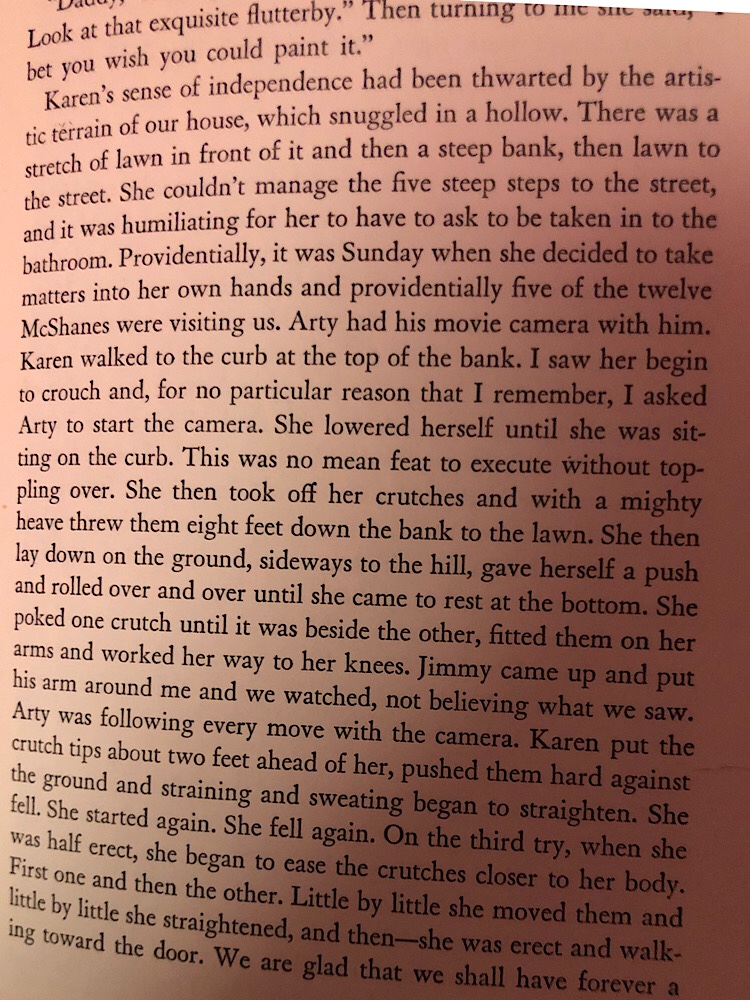
In the passage photographed above, Karen tries to navigate a hill. Mrs. Killilea never quiet explains where she was going— to the house? Away from it? Karen throws her crutches down the hill, rolls, retrieves her crutches, falls several times trying to get up, while her family watches and records it on a neighbor’s home movie camera.

This is one of those moments touted as bastions of independence. But how many times do you want someone fall without at least asking if they want help? And this is solely my opinion and my experience, but I hate seeing myself on video. The camera makes the “wrongness” of the cerebral palsy body more exaggerated and severe. Her parents want to record this moment in their Pride, but, to me, and again this is my opinion, to rewatch such a moment is to buy tickets to the freak show.

This family had inordinate health struggles with all of there children and the work Mrs. Killilea did to benefit cerebral palsy research made the world grow exponentially. And I am grateful.

But as I study the first chapter of Mrs. Killilea’s sequel memoir, With Love From Karen, it leaves me feeling that Karen’s condition has led to a 1952-best-selling book that has eased her family’s burdens, allowing them to buy a big, broken down Victorian house and given them a life line after a decade of medical bills for all their children.

I feel like Karen is exploited. Especially upon hearing that the whole family appeared in Time magazine.

Also I note Mrs. Killilea’s writing style has improved. The sentences flow with more artsy grammar and word choice. The description is more detailed. The verb choice strong.

Does she have an editor working for her now?

Bean, the 50-plus pound mastiff mutt puppy, and I are in the hammock. I hope this book presents Karen as a person, not an accessory.