Not looking for a mental health diagnosis, I’m seeking understanding and relief.

In many common injuries, and with certain illnesses and diseases, clear trajectories and treatments exist/are followed. I think in reality, nothing is ever that simple due to all the quirks that make us all the people we are.

Last year, I asked every practitioner on my care team how they felt about Valium.

Even on my beta blockers and other blood pressure medication, my heart would have these periods of elevated heart rate, even as my blood pressure was under control. And when physical circumstances coincided with these events, such as muscle pain and discomfort from too many hours at the restaurant, I would find myself taking triple my normal recommended dose of baclofen. And it didn’t relieve any of it.

So, I wondered if a low dose of valium could be a breakthrough med to relax my muscles and my heart rate. But no one on my team was comfortable with an experiment like that. I got on a list to speak to a psychiatrist. A year later I am still on that list.

A recent experiment with a dose of Adderall showed that I may respond to stimulants and/or that I have a touch of ADHD. I set up appointments with my therapist and my doctor to discuss. I got a referral to a new in-office case manager who can work with patients and report to the psychiatrist so family medicine can prescribe medication.

Earlier this week, the case manager who works for my primary care p behavioral health matters called me. She said she would talk to the psychiatrist whom she works with on my behalf, but already in that initial conversation, some of my complexities popped up.

She called me back Wednesday morning and asked if I could come in that same day or Thursday as she had time scheduled with the psychiatrist Friday. The psychiatrist recommended some screenings to give us some more information and a letter from my current therapist — whom I have been with for the last 15 years.

That in itself is hard to believe.

So God Bless him, he wrote me a letter and emailed it to me. With minimal notice.

I walked into my primary care physician’s office and, because this case manager is a new addition to the staff, they have her tucked in this odd, closet-like room in the back corner of the practice. Which had no windows. And she lit with a tiny desk lamp. Which might make some people feel cozy, but I kept thinking, “We are in a closet. In the dark.”

I screened higher than I would on the depression screening. (Which today I would do significantly better on because my good mood and hope is back– so of course that led to a mood disorder screening, which suggested I might exhibit some bipolar symptoms.) I scored “high” on the anxiety screening. And I do show symptoms of ADHD but not enough for formal diagnosis and no clear childhood presentation.

Remember– I didn’t receive medical treatment between ages 5 and 21. Except for physicals and immunizations required by law for public school and those were administered by a semi-retired doctor around the corner who only accepted cash. And this was in the 1980s: things were different.

“Did your teachers or counselors notice anything?”

Ummm… schools for GenX did not have counselors. Remember all those memes that circulate around January 28: They put a teacher on the space shuttle, shot her toward the moon, and every school age child in America watched her blow up LIVE on television. Then, they shuffled us back to our classrooms (because at my school we watched it as a group in the multi-purpose room like an assembly) and pretended it didn’t happen. I was in fifth-grade. I was almost 11-years-old.

I think every GenX (and Boomer child) understood that we were expected to sit still, do our work, get good grades, and if we didn’t the school and/or our parents would punish us– and the school could even hit us if necessary. My parents never hit me, but my mother was/is the queen of silent disappointment and perpetually pointing out individual flaws. My mother dropped out of high school, but she never hesitated to make her first statement about my report card to be about the lowest grade.

“Why did you get a B+?”

A B+.

Couple that with the childhood trauma I lived with at home– slight food insecurity, sporadic but frequent domestic violence events or risky behavior from my parents, alcohol abuse, etc.– school was my safe place. My teachers nurtured me, educated me, (sometimes even fed me and protected me) and listened to me. I would have done anything to make sure my teachers would not be disappointed in me.

So I was the perfect student. But I talked. And I often spoke inappropriately. And despite my good grades, I struggled with studying. Repetition and lots of notes are still the only way I can learn new things.

And the organization issue? Developing systems not to forget or overlook things? I had a very unpredictable household. I had to keep myself together. And my mother loves everything clean and in its place– if I left something out of place in the common areas of the house, my mother would pile it on the stairs for me to take to my room. And if I didn’t take it up, she would nag me. And if I still didn’t take it up, she would. And when she did it, she would often clean and reorganize my room while I was in school.

And if we’re looking at my borderline results for ADHD and comparing them to other brain issues, we have to consider how symptoms of depression and anxiety overlap with ADHD. And how especially adult women get treated for a mental health condition when the issue stems from neurodivergence. So am I manic– or am I hyperactive/hyperfocused? Am I depressed– or am I in a burn-out phase? (And I would add how do these correspond with hormonal cycles. When I was traditionally ‘fertile,’ I had great mood and energy, when I am approaching menstruation, I crash.)

And fatigue is also a symptom of everything. I have a history of anemia, which causes fatigue. I have a chaotic sleep schedule, which interrupts my routines and causes fatigue. I eat primarily vegetarian vegan and my B12 is on the low side of normal, is that causing fatigue? I perpetually overschedule myself. This causes fatigue. I think if depression were causing my fatigue, I would be more prone to not get out of bed. I always drag myself out of bed on time.

So, in the end, it sounds like this case manager wants a mental health history of my biological father to be the determining factor on the ADHD issue. Problem is he’s been dead for like twenty years. His ex-wife whom I knew for all of the time I knew him, also dead. My biological half-brother, I’ve never spoken with them. The few people who friended me on Facebook who share his last name and said we are family– I’m not even sure who they are.

And then there’s the issue of trauma.

I have experienced a lot of different types of trauma from the unstable environment of my childhood, a period sexual abuse by my grandfather that could have escalated had I not made the decision to avoid him, and multiple experiences in hostile work environments. (One boss who randomly fired me after recuiting me for the job to hire a friend, One boss who threw things at me. Another who made me constantly fix her personal failings. And the final one: she was an all-out tyrant.)

I even mentioned to the case manager that I had spoken with my therapist on one point about why I ended up in so many of this situations: Was it me? And the case manager rephrased some stuff I have probably heard before, but didn’t really make sense until now: You will be more prone to ignore or not notice red flags. And that made total sense. That‘s how people end up repeating cycles. You can’t recognize the subtle signs and once you are knee-deep, you rationalize, as in “the devil you know.” Or, in the case of some family cycles, the child of a drug addict might think some overconsumption of alcohol and behavior related to that is okay, because it’s “just beer.”

Note that none of this addressed the fact that I also live with a mobility disability. And my medical issues– which I am considered prediabetic now and had gestational diabetes. I have always had a strong reaction to sugar and less reaction to caffeine and alcohol. And I also react to certain chemical flavors. (I would love to find out if I react to Red 40.)

As a woman with a mobility disability, I will be extremely hesitant about any SSRI that list side effects as weight gain– I have worked really hard to lose 12 pounds and need to lose at least 20 more. This is not due to vanity. This is due to risk of Type II diabetes AND the fact that more weight will put more stress on my body that already struggles to move.

Anyway, the case manager is meeting with the psychiatrist today to discuss my case notes. If I had to guess what they will suggest, I would say they will probably try to treat my anxiety with an SSRI and refer me to a trauma therapist to explore PTSD. And I suspect they may hint at depression, or even bipolar, expecting to treat it with whatever SSRI they pick.
But I think the constant interplay of some behaviors being driven by rumination or compulsion (“I must do the dishes if the bin is full”) and my avoidance of minor, personal tasks (I struggle to put my laundry away, every time, and I’ve never developed a system) and so many other things like:

  • focusing on projects I like to the extent that I won’t stop until I’m done
  • struggling to start projects I don’t like and giving in to every distraction
  • doing several things at a time and sometimes leaving some half-finished (moving into my office)
  • lacking proper mood regulation
  • obsessing over procedure, routine, documentation and details on items I deem important
  • missing details or skipping steps on things I cannot get emotionally invested in
  • writing down tasks in 5-6 different formats while doing them as to not forget and to not worry about forgetting
  • sharing and writing down important or “pretty” numbers
  • food issues: aversion to textures, difficulty motivating myself to eat or eating too much
  • inability to recalibrate when faced with unexpected change
  • must redo entire household financial plan 30 to 60 days out every time a purchase more than $100 is made or if receiving income in that range
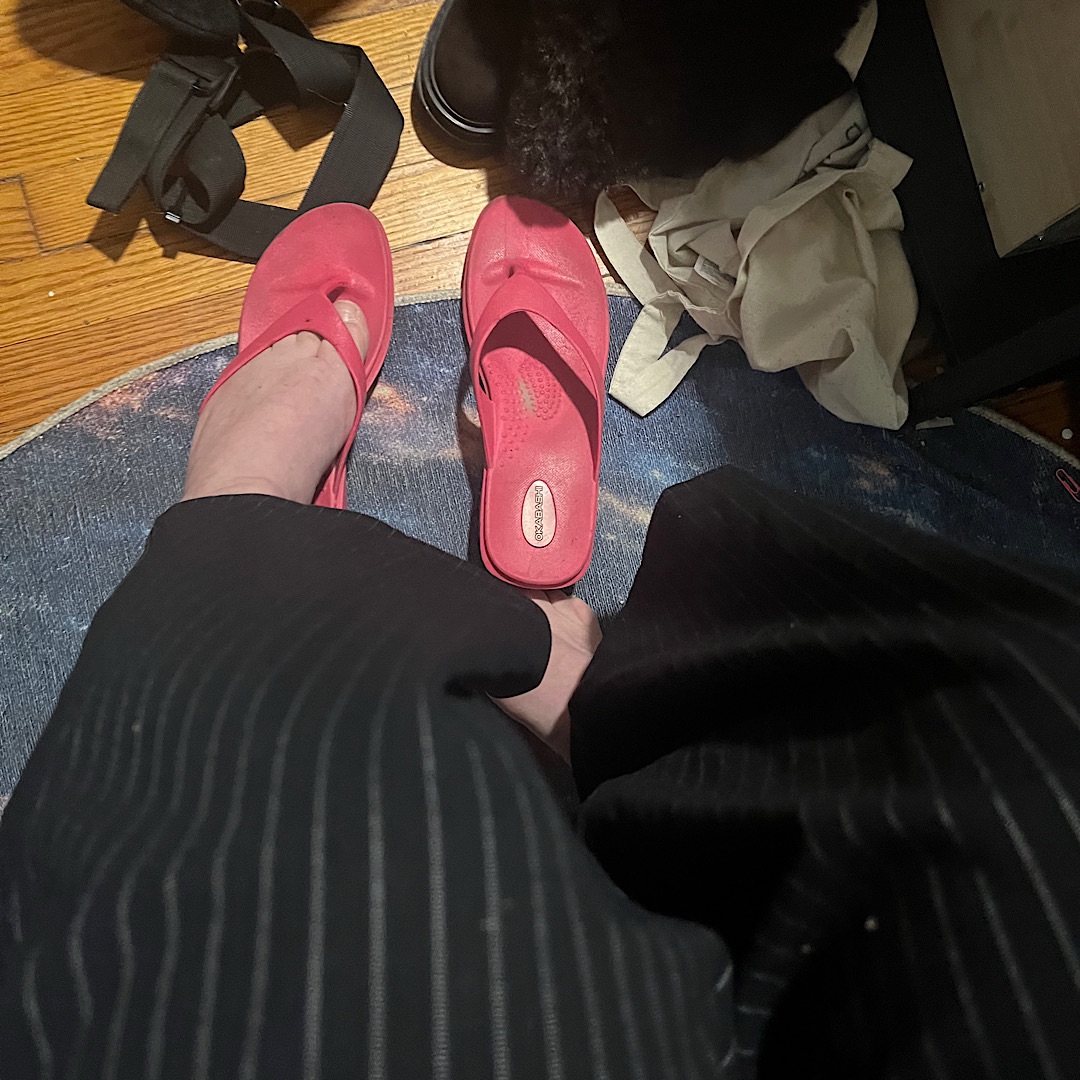
  • pausing in the middle of simple tasks to complete a more appealing task (I picked up my phone today while putting on flip flops and left my foot half-inserted into the shoe. A flip flop!)
  • monitoring medical information more than necessary (Blood pressure: sometimes once a week, sometimes three-times a day; Weight: at least twice a day.)
  • unable to ask for help and will instead take on large projects and complete them alone
  • feeling worthless when I do not meet my goals, no matter how big or small
  • high level of rejection sensitivity
  • always making decisions based on my “gut.”

These make life/diagnosis complicated.

I have spent about two hours on this post. It is 12:30 p.m. I have not eaten yet today. I need to pee. Because of the SEVEN medical appointments I had in the last two weeks, I am behind on some projects due Oct. 10.

And tomorrow I have a business road trip.

And Sunday, I am meeting new friends for tea.

So I need to get shit done…
Am I Alice? The White Rabbit? Or the Mad Hatter? Or the Queen of Hearts?

Who doesn’t love a good mystery?

Anyone who deals with serious medical issues has experienced a sense of Wonderland. Is your regular life Wonderland? Or is the medical system Wonderland? Who is Alice? Who is the White Rabbit leading Alice down the rabbit hole?

We all have a lifetime of experiences. Some good, some bad. Some of us got “good” bodies, some of us have bodies we hate. Some of us have learned to accept our bodies. Some of us work really hard to change our bodies.

Some of us want to understand. Some of us want only to survive.

All of those things are okay.

We all have Alice in Wonderland moments.

It’s been a couple of weeks since my daughter, who has ADHD, floated the idea that she inherited the ADHD from me. It’s been one week, almost to the minute, since I took 10 mg of extended-release Adderall to test her theory, at least to give us data on if the drug brought me up or down. And the answer was down, pointing toward something not neurotypical.

And as you will see later in this entry, one of the stumbling blocks to determining what exactly my brain needs– whether that is treatment for ADHD, anxiety, depression or nothing– is, as my daughter would put it, I mask so hard even I don’t see the problems.

I have always been extremely organized, and I forgot nothing. And yesterday, at my second doctor appointment of the day, the clinician got out the standard short ADHD screening and asked the questions related to inattention. I don’t have a problem there. But I am realizing more and more, I write everything down multiple times. I write in my journal, on my paper calendar, on post-it notes, on my electronic calendar, in this blog. I write down when I take my medicine. My blood pressure.

And this morning– I went to blow my nose. Allergies are hitting in full force and Eva has an ear infection. In the middle of blowing my nose, I put the tissue down so I could take a Zyrtec before I forgot. I do not remember if I took the Zyrtec. I did not log it in my phone. The cap is off my water bottle, but did I take the pill?

Could my “obsessive” habits, like checking my bank balance several times a day, be not a form of soothing my own anxiety but something I do to prevent myself from missing something?

And even right now, as I write this, Eva has interrupted me and the entire train of thought for what I was writing completely disappeared. I had to reread the whole paragraph and reconstruct what I was trying to say. Is that normal? I’m honestly asking. So before I get too much more ahead of myself, let’s talk about yesterday.

Yesterday, I met with my longtime mental health therapist. I wrote a quick entry yesterday about that visit, posted it, somehow managed with a same day appointment with the practice who handles my everyday care, realized that the post was worse than I thought it was, and so I took it down with the intent to do a better job with new information.

And here we are.

Some observations from that appointment with the therapist who started treating me for anxiety more than 15 years ago. (That seems crazy. It can’t be that long. It just can’t.)

  • My individual complexity may prevent a simple diagnosis/solution. My history of childhood trauma and neglect, my family history of addiction, substance abuse and domestic violence. My physical disability (to which he adds “never discussed nor treated). So my brain could be doing anything for any reason. I believe this is why I’ve developed many of the habits I have that are masking how I feel on the inside. Whether we attribute this to ADHD or anxiety, that is part of the mystery.
  • Even looking back, with my history of doing and achieving all the things and doing them pretty well, it would be difficult for a clinician to trace this back to my childhood. Childhood presentation is one of the required elements for an ADHD diagnosis. (But, again, I was dealing with a lot of things, things I didn’t understand… from my body and my environment.)
  • My therapist theorized that if I have ADHD, I may have inherited it from my biological father. And that was a lightbulb moment for me. The first time I met him, I was

(I picked up my phone while typing this. I have no idea why. Got lost scrolling Instagram. Put the phone down. Realized I was in the middle of the sentence. And don’t remember what I was saying. So I distracted myself?)

  • … impressed by the breadth of his creativity and the projects he undertook. But I also remember that he had decided to remodel the bathroom and had never finished the one wall. It was still primarily the framing. Functional. But no real wall on the inside of the room. And when he and my mother split up, he went with his dog and lived in a cave in the woods until it got cold. Then it built a shelter. And when he and his wife split up, he left in his pickup truck, with his dog and a duffel bag and moved to the midwest. Where he got a job at Russell Stover chocolates.
  • My therapist can provide a letter of support to my primary care provider, and he reminded me that it didn’t matter the diagnosis if we could find a treatment that could bring relief. (And my therapist and doctor know each other so that helps.)

Now, I know “euphoria” is one reason people who don’t have ADHD take Adderall. And I’ve taken other types of medication: Lexapro for work stress and then depression (which helped in that “take the edge off” kind of way); beta blockers to control my heart rate (which failed); and Ativan for panic attacks (great, as long as I just wanted to come down and not do anything for the rest of the day). When I took Adderall, it wasn’t euphoria– it was the sensation of being able to let go of the adrenaline, the sense of doom and the constant muscle tension and being able to effectively regulate my emotions because normally my emotions also stress me out because I can’t do anything to work through them. I could on Adderall. If anything, that is what I want. I want that.

I asked my therapist: What would you recommend as my next steps? Since I have not been able to get past the waitlist for a psychiatrist, should I make an appointment with my family doctor?

I went home and called the office.

(Right now I am sitting here, forcing myself to finish this because it’s important. I need to pee. I’m very hungry. It’s 9:22 a.m. and my daughter and I are leaving for Susaquehanna Service Dogs which is sooooo exciting and stressful and… but if I don’t do this now I will not do as good of a job if I do it later and I don’t want to forget a single detail because the details can mean the difference between finding answers and getting the run-around from the medical establishment. This is how my brain works.)

I was offered an appointment with my regular provider October 13 or I could see another doctor in a couple hours. I took the appointment in a couple hours. I knew nothing would get resolved quickly, but wanted to position myself “in the system” to get the process working. That’s the hardest part of the medical system. Positioning yourself to get access to physicians and presenting the case with evidence, not anecdotal experiences.

That was why I started with my therapist. While he’s the most expensive provider on my list of medical professionals, he was the most qualified to give an opinion. Offering his opinion, based on our experience of 15 years, will hopefully show this is a legitimate possibility and not just a drug-seeking behavior. I specifically work with this therapist because he is a Ph.D. psychologist– I wanted someone who could help me grow as a person, not just medicate my brain. I have done a lot of worth in those 15 years, but recent years have shown me how much I fight myself and that I could have a chance at actually slowing down and enjoying more of my life, not just frantically surviving it and celebrating sporadic moments. Because in my brain, nothing is ever safe, or enough, or helps me overcome the doubt and doom.

(Okay, I need to get up and pee now. I’ve had 10 ounces of coffee and like 24 ounces of water… Be right back.)

(Hi, me again, I stopped to look in my protein bar basket. I should eat something. My belly hurts I’m so hungry. I have these blueberry breakfast biscuits that taste nice but don’t have any real protein. I also have a cookie dough protein energy bar from Aldi that is high in protein but full of chemicals, sugar and preservatives… I can’t decide. I have them both on my desk. I really want a piece of toast, but then I need to find and decide on bread, wait for it to toast. I should make an egg sandwich, but that is a whole undertaking of cooking. I guess I’ll open the breakfast biscuits… The taste bad. They usually don’t taste bad. And they smell weird. Are they spoiled. “Best if used by August 2025.” Did I mention I tend not to eat food I like because I might want it more another day? And then I panic that it’s not the best day to eat it? And now I’m sad that I let them spoil. Like really said. But honestly– they were Dollar Tree biscuits. So now I feel bad that I feel bad. I don’t need to beat myself up that much.

Now, do I eat the protein bar? Because I do not want to eat now. I threw out the biscuits. But I put them in my office garbage can. And the dog often gets in that can. Maybe I should empty it. Yes, let me do that quick. BRB. Again.)

So the doctor. She’s a great doctor. I mention that my daughter, and I both use the practice and my daughter does have ADHD. I tell her that I know we won’t have answers today, and I don’t expect that but I would like to start investigating this. She listens attentively and we explore the classic short ADHD. I have the anxiety-laden portion of hyperactivity impulsivity but not much else– and I ask her– I probably do fidget, but I have a spastic muscle disorder that means my legs cannot move. So how do we know? And I have similar I don’t know answers to some of the other questions. The test is inconclusive. She mentions other SSRIs. And that Wellbrutin has shown to improve symptoms of ADHD that coexist with symptoms of depression but it makes anxiety worse. And then she adds, “so that would be a bad idea for you.” And she wonders if I should try other SSRIs.

Her plan becomes three-fold:

  1. Get the letter from my therapist.
  2. Book an appointment with my regular doctor ASAP because he’s a busy guy. (Did not expect that.)
  3. She gave me a referral for a behavioral health case manager. This professional should be reaching out to me to prepare my case for review by a psychiatrist. It sounds like she does the evaluation, makes notes and gives them to the doctor so I can get medication through primary care… or through that psychiatrist. It’s a program designed for people like me who don’t have dangerous behaviors or immediate needs. And reduces the waitlist problem. That people never get off the list.

(I don’t want to write this anymore. I am forcing myself to do it. Just so you know.)

I leave the office. Hear from Eva that she got antibiotics for her ear infection. I email my therapist but then decide a phone call is more expedient and professional, so I call. He leaves me a voicemail a little later that we will get the letter together. And then the funny part– my actual primary care doctor comes to the restaurant, drives up to me in the drive-through, and chuckles when I ask what name to put on his order. He knows nothing of what I have gone through this week, or maybe he does, but I don’t think the other doctor finished her notes yet.

And that’s where all that stands.

Now if you’ll excuse me, it’s cold this morning and I am debating making a can of Spaghetti-O’s for breakfast.

The ADHD rabbit hole

My daughter, now in her senior year at Lafayette College as a psychology major, has been armchair diagnosing our friends and family since her early high school days when she would read the DSM-V for fun. It’s fascinating for me as a parent to hear my child talk academically about topics and use language outside my understanding. And I do enjoy it.

If you know me, or you’ve read this blog for any significant time, you may know that I have struggled with my mental health. I exhibit symptoms of anxiety and depression from time to time, love routine yet challenge rules, obsess over numbers and patterns, overschedule myself and never relax. And the funniest part of that– I have gotten better about these things.

Through casual observations, it seems obvious that ADHD runs in my husband’s family.

But my daughter continued to study people– and me– and one by one she made her diagnoses. “Your dad had a type,” she said to me once. “His wives were all narcissists.” Or she’d suggest a medication to a friend looking for relief. And I have never seen her be wrong.

She has recently declared that her father is “autistic as all shit,” (which my mental health therapist had suggested might be the case more than a decade ago) and that she thought that she “inherited her ADHD” from me.

I protested. “My executive function is fine.”

“Is it, Mom?”

Her words make me recall a conversation I had with a friend of mine before I left for Ireland in the spring. I don’t even remember details of what we said, but it was a business call, and I remember listening to this woman I respect and adore the creative work of, a woman who had ADHD, and thinking “that sounds a lot like me.”

At Eva’s urging, and her constant reminder that traditional medical research applies to 40-year-old white men, I looked at the symptoms. And when I google information, I always evaluate the source. I look for articles from medical centers, government agencies, professional organizations and publications like Psychology Today. (It may reduce everything to layman’s terms but it does have a responsibility to be accurate.)

These are symptoms of hyperactive impulsive ADHD in adult women that spoke to me:

  • racing thoughts
  • subtle fidgeting
  • excessive talking
  • overcommitting
  • burnout
  • rejection sensitivity
  • hiding internal struggles to appear calm and organized
  • burn out
  • signs of anxiety
  • signs of depression

Let those last couple sink in. Women with ADHD are commonly misdiagnosed and treated for anxiety and depression.

I wonder if I would be more restless and move more if I didn’t have spastic cerebral palsy that prevents my legs from doing things. The more I pay attention, the more I see how my daughter’s ADHD habits totally mimic my own. And I never noticed.

And I know people with ADHD often self-medicate with caffeine and sugar. I never experienced a cup of coffee calming my thoughts, but I do know I can drink a lot of caffeine with minimal reaction but I get a sugar high really easily.

I am also prone to hyperfixation. And taking on hobbies with gusto and then suddenly never doing them again. It’s like one of my existing hobbies will suddenly explode and become all I do and then, one day, I never wanted to do it again. When Eva was born, I made something like 18 scrapbooks in her first three years of life. Since she turned 4, I did not have a photograph printed. (I blame the iPhone. Not my brain.)

As a well-behaved patient should, I called my mental health therapist/psychologist to see if we can explore this idea. He will see me Thursday. And it might be wishful thinking, but he sounded like the concept might have triggered a “lightbulb” moment for him– because I know he has grappled to find “what I need.” His formal diagnosis has stated that I exhibit occasional symptons of generalized depression and anxiety.

Any good theory deserves an experiment. So, after a few online surveys, I took a trial dose of Adderall. I was terrified to do so. I have issues with high heart rate. I was fairly confident I would be very uncomfortable.

And then, in a conversation with my daughter about 20-30 minutes in, my brain felt soft. And then about 40 minutes in, my hands started tingling. All my fingertips felt weird.

“Mom?” my daughter said. “Is something happening? How do you feel?”

“My brain feels like goo,” I told her. “And something’s wrong with my hands.”

She took my hands and looked at them. “What’s wrong?”

“They’re tingly.”

“Mom,” she said. “They’re warm. That’s all. You have circulation. Your hands are not cold.”

My hands and feet are never warm. My body temperature is usually around 96 degrees. I had first-wave COVID, and my “fever” was a body temp of 99 degrees. And even on the hottest summer day, my hands are usually chilly when other people touch them.

And in that moment, I knew I had slowed down. It was like someone just took the energy that was “me” and turned down the flame a couple notches. I read my tarot cards; they felt it. I went to the grocery store and casually looked at the options and didn’t run from one aisle to the next. I wrote a Substack newsletter. Because I wanted a record to see if my writing had changed. (You can read that here.)

All the stuff I normally worried about and used all my energy to “do,” it didn’t feel urgent. I laughed easier. Moved slower.

I remember the day my daughter first took her ADHD medication. She was standing at the table in her grandparents’ kitchen, animatedly telling a story. As I listened, I realized that she had stopped vibrating.

I had stopped vibrating.

“It’s like your aura has changed,” my daughter said.

“I’m calm,” I replied.

“I never understood what you meant when you said that I ‘stopped vibrating,'” she said. “I get it now.”

I had stopped vibrating.

The thought that I really could stop vibrating made me want to cry– from relief, because of the new understanding, in fear that I would never feel this way again, hope that I could.

I slept like a baby that night. And the next few days I went back to being me. The me I know. My heart rate and blood pressure hadn’t been impacted.

We opted to do the next trial dose yesterday. I was meeting a good friend and wanted to see if she saw a difference. I was scheduled at the restaurant. I wanted to see how it felt in a different environment.

I took the medicine. Went to Panera for my writing date. I drank herbal tea to be safe. At 9 a.m. I caved. I had 12 ounces of coffee. And then about 6 more. It did not disrupt my zen. I did my writing. I was less talkative.

I came home, did more work on my personal project because I wanted to, and I didn’t fret about all the things I “should” do. I knew I would do the things I should, but I didn’t stress over doing them right now. Then, I watched TV for a while. And I didn’t feel guilty about it. My daughter came home from school and her 3:30 dog walk canceled so we didn’t have to rush out the door. I sat on the couch and chatted. I didn’t try to do more.

Now, the medicine should have worn off by the time I went to work at the restaurant. But I don’t think it did. I sat in the lobby watching everyone. It made me happy to sit and watch them. I thought they were moving slowly. That maybe the restaurant wasn’t the busy place I thought it was. I am often stressed by the fact that the kids I work with don’t think anything is urgent. Maybe they are right. My heart was not racing in anticipation of my shift.

I was not thinking about all the stressful things that could happen.

But as the medicine started to wear off, the restaurant got busier. But even as my heartrate and workload increased, I didn’t feel the “panic” I would normally feel. I didn’t feel the need to analyse and make a plan every two seconds. And then I thought of the perfect way to phrase it– because I got moved to a work center that stresses me out– even though the medicine was wearing off and I could feel the stress in my body, my brain and my behavior were not motivated by a sense of impending doom and disaster. I know that sounds dramatic, but every piece of stress I feel it my body feels like if I don’t keep up with the moment/the environment/the task, I will face a disaster.

Remember the television show LOST? There was a button on the island that someone had to push. I believe it was every twenty minutes. No one knew what the button did, but they all believed that if they didn’t push the button, something terrible would happen.

My brain is pushing that button all the time.

But on the show, I believe something bad did happen when they did not push the button.

And I feel like even when I did not have the full effect of the medication in play, my sense of doom dissipated. And that was amazing.

When I took this medication, I felt like I could relax. I have been wishing for decades that I could find a way to relax. I thought I needed a hobby, not amphetamines.

And today my daughter tells me that cerebral palsy is also lumped into the neurodivergant classification… More to think about.

**I cannot find much information on this, but my anecdotal experience on medication suggests that although it should not, my mobility and spasticity improves when I take Adderall. My experience feels like I no longer hold as much stress and tension in mu muscles. Which is why I wanted the small dose of Valium. Maybe I need the opposite?

Do I need to put on clothes today?

Tonight I have a long-for-me shift at the fast food restaurant. 4 p.m. to 10 p.m.

Tomorrow I have a very busy day– gynecologist appointment at 7:30 a.m., helping Nan with her stuff around 9:15 a.m., teaching in the afternoon.

Thursday, we are recording our radio program at WDVR. Then, selling chicken from 4 p.m. to 9 p.m.

So, today I wanted to send out our acceptance letters for the Greater Lehigh Valley Writers Group The Write Stuff conference, March 11-13, 2027 at the Homewood Suites by Hilton in Center Valley, Pa. And I almost sent one so far. It’s ten minutes from noon.

Did I do things? Yes. Were they important? Yes.

Just not what I intended.

One of the items I have needed to do is grab a few groceries. I have been very careful with my diet lately (which has led to a new number today, one I haven’t seen in more than a year if not since the pandemic when I started rapidly gaining weight). And my daughter made me get dressed and go to Aldi.

Why Aldi? I wanted chicken salad and shelled endamame.

They didn’t have chicken salad and only had whole edamame. I didn’t want whole. I also wanted a salad and all their greens and pre-bagged salad mixes looked past their prime. So I came home with baby carrots (which I don’t eat, and I was hoping to make carrot pickles but I didn’t get the vinegar…), plain greek yogurt (because the flavors have too much sugar, but I probably won’t eat the plain), half and half (but I did not get coffee), crab cakes, and cheese. And bologna. Cheap cheap bologna because despite my primarily vegan tendencies I just really needed a bologna and cheese sandwich.

And two boxes of protein bars since I didn’t buy much food.

I did not want to get dressed. Until later.

Yesterday, I had my annual physical with my primary care physician. It was the first appointment of the day, and he spent 45 minutes with me. I had told myself that I did not intend to bring anything up. That I wanted to get in and out, continue my own experiments into diet, exercise and sleep, and ask for follow-up bloodwork.

He went through my late June bloodwork I did for him and the mid-August bloodwork I did for the life insurance company, with me, and requested I do another A1C and some vitamin D and some stored Ferritin… He was surprised to see– that as I told him– my “bad” cholesterol and my weight change very quickly according to what I eat. It’s how I gained almost 15 pounds this winter and lost it since July.

I still think I am among a rare amount of people who really pay attention to their bodies and try to understand and improve. He also asked how long I’ve been off my blood pressure meds– and I said– “about a year,” and then I reminded him that my cardiologist knows, or at least I told her I would probably stop taking them.

“Your blood pressure is great,” he said.

“The pills didn’t help,” I replied. I was prescribed the beta blocker because of my single incidence of afib. I stayed on it because I hoped it would help my anxiety– specifically the way my heart will sometimes race for hours for no reason. But the medicine never stopped that. If anything (and I have yet to prove this, my evidence so far is purely anecdotal, it’s food. I think the right blend of high sodium and refined white carbohydrates makes my heart want to explode.)

And my blood pressure has maintained itself in a healthy zone the entire time I have been unmedicated.

But then my doctor found out, I have been having stress dreams, disrupted sleep routines and general poor sleep since incorporating more “easy food” and less of my “outside aisles of the grocery store” home cooking. And now he’s worried about sleep apnea, my tendency to display symptoms of mild clinical depression, and my inability to relax (or have fun). He offered me a temporary antidepressant, and I declined.

And then today I remembered… I have been on the waitlist for a psychiatrist appointment for almost a year. During my routine physicals last fall I talked with my entire care team (primary care, cardiologist, mental health therapist, and neurologist) about the prospect of trying a low dose of valium as a breakthrough medication.

According to my research, doctors often give valium to children with cerebral palsy to calm spasticity and help them sleep. I asked my team about it. No one has experience with that sort of thing so they referred me to psych. So I reminded my doctor of this is an email. I told him that on bad days I often take 60 mg of baclofen– so could we try a small dose of valium in a small amount of pills to see if I took 2 mg of valium instead of all the baclofen if that would calm my muscles, alleviate my twitching hamstring, settle my heart, reduce my spasticity, and allow me to (1) stretch everything, (2) sleep better and therefore (3) recover better.

Remember– my leg muscles are unable to relax. I can’t even describe what it feels like. Sometimes it feels like my calves are so tight they burn. Sometimes my thighs feel like bricks. So if my doctor thinks I might benefit from a little something… this might be the something.

And on my one tangent for today: I have been binge-watching Nurse Jackie. I never liked Jackie, found her repulsive as a person but the older I get the more I recognize the accuracy of the depiction of people in addiction. And my daughter brought up something vital to consider:

Is Nurse Jackie an unreliable narrator?

My daughter votes yes, because there’s no way that an addict taking as much shit as she does (especially as a nurse) could appear to have her shit together as well as she does.

Interesting thought.

I have reached the midpoint in the series, and I’ve never watched this much before. And she has entered rehab and thrown her husband out of the house. And I’m thinking about it.

Meanwhile, my daughter has been tracing ADHD and autism in her family tree. My daughter– from a young age– has been super keyed in to people’s minds, patterns and habits. And just like she’s freakishly good at seeing every ripple in a dog’s body language, she’s damn accurate with her psychiatric diagnoses. And she’s finishing her bachelor’s in psych at Lafayette, she’s also developed some ideas about medication (so I asked her to do one of her recent psychopharmacology assignments on valium). She’s wondering if I might have ADHD.

My response is typically that it doesn’t matter.

I have a disability. One that stems from lack of oxygen at birth. One known to affect GABA in the body.

I score fairly high on the ACE scale for childhood trauma.

My parents were alcoholics.

Did I inherit generational trauma? Probably. Do I exhibit everything from OCD to depression to anxiety? Yes. Because my brain never learned how to feel safe and/or let its guard down. I never relax. The last time I felt truly relaxed was during some good adult physical activities that I don’t get nearly enough of. And do you know how much I need to trust my partner to let that happen?

My daughter believes something interesting about this whole ADHD hypothesis. She basically said I have not allowed myself to fail enough to recognize the truth it what she’s said. AND that because of that no clinician could ever diagnose me.

Strange food for thought.

Disability Lit Review, part one

Let me offer a bit of an author’s note on this one, or perhaps a caveat, that I only got five hours of sleep last night, and my body hurts today. This is the third night this week I got six hours or less of sleep, due to some fairly intense routine change that is kicking my ass. And the pain I am experiencing today is not my standard everyday pain, but similar pain in a more twitchy and unnerving form.

And this may lead to some of my more strident tones. Or perhaps I always feel my opinions with a certain sharpness, but ordinarily I present them after the application of a filter.

I will try to keep my aggressive aggravation to myself, but no promises.

Earlier this month, I drafted a “bird piece” for the Behind Our Eyes anthology, a collection in the works to highlight the members of the Behind Our Eyes email-based writers group for writers with disabilities. I joined the group a couple years ago after participating on the fringes through Nancy Scott, who, in cheap amusement and most things disability, is my partner in crime. I normally lurk in the group, but recently heard they were actively looking for bird stories. The anthology features a variety of sections and one themed block focuses on animals.

I wrote a creative non-ficiton piece about my Goffin’s cockatoo and I navigating disability together, with a present-day, present tense story of Nala plucking her feathers due to her anxiety and me trying to figure out why. The plucking led to her not being able to fly, which gave her a temporary mobility disability. So I used this present-day situation to frame flashbacks exploring why Nala was anxious, but also looking at my mobility disability and the similarities and conditions that made us good for one another. The anthology committee wanted just a bird story, so they’ll be publishing the present-day section of my interactions with Nala.

This was the first of two pieces I wished to submit to disability-associated anthologies. I have drafted the second, but that one is specifically for disabled voices to share what we wished the outside world understood. I revisited my first draft, and tightened it somewhat, and thought the piece sounded like an introductory chapter to my upcoming medical advocacy memoir. That piece has two themes– the beginning talks about how my family had too many problems for me to realize I was “disabled” which seques into the second half, about me finding out my body and assembling an adequate medical team.

Nan has been encouraging me to write more in the disability space, her paraphrased quote being that I could have a real impact there. And in my experience, there are two main types of voices in the world of disability literature. The most mainstream voice is the voice of the writer-first– commonly a writer who experienced illness or disability not from birth, with either some sort of privilege or talent. The second is the disability activist who is not a writer, but congenitally-disabled and fighting for their right and the resources to exist. (And I guess the third would be the hobby disabled memoirist.)

I find myself crossing all these categories. I have the natural writing talent, my background as a professional journalist, my credentials as an academic and historian, and the experience of a congenital disability. Yet, I have the privilege of being a white woman, and if I can borrow the term, I can “pass” as an able-bodied person if I focus really hard and am having a good day. I have the type of cerebral palsy that you might not notice or that might make you stare at my feet and knees.

This morning on social media, I saw a post from a disabled Iraqi/Afghan War veteran stating that he needed to retire his service dog as she had had a seizure. The man said that his career involved much travel and public speaking as an influencer and motivational speaker. I searched the internet for him and found a very basic web site, some YouTube videos and an Instagram, but no information about him or the experiences that lead him to be a motivational speaker.

Now, in everyday life, people with disabilities do not owe information or an explanation to anyone regarding details about their private lives or medical conditions. But if you build a career on your experience coming back from a disability, I think some of that information is owed to prove the validity of that expertise. (And if you are an influencer, a Google search should turn up some information about you.)

What I am about to say next is going to make me sound like an ass, and I mention to not to invalidate the experience of people with disabilities who fit the categories as I am about to describe– but the lived experience of a Cis white heterosexual male in the United States of America who develops a disability after voluntary service with the military is very different from the experience of a person who has never been able to walk, has a limb difference, total blindness or any of the multitude of disabilities that occur at birth.

(Add in family resources, and there’s another layer of complexity.)

Some people have more choices. Some people have more privilege.

ALL people living with ANY TYPE of chronic illness or disability deserve the same respect, but one must understand that they all come from different places. As all humans do.

This has led me into a brief literature review of the disability space, one I have only explored via finding books written by ordinary people on their experience with disability. My list included the third anthology from Behind Our Eyes and a service dog memoir by one of its members, Peter Altschul. I have a collection of books with connections to cerebral palsy: several modern memoirs by Tylia Flores, a pre mid-20th century memoir by Dubliner Christy Brown, and Karen, a parent’s cerebral palsy memoir that takes place about 10 years after Christy Brown, and then poetry and academic work by Jennifer Bartlett. And a highly academic poetry book by blind poet Susan Glass.

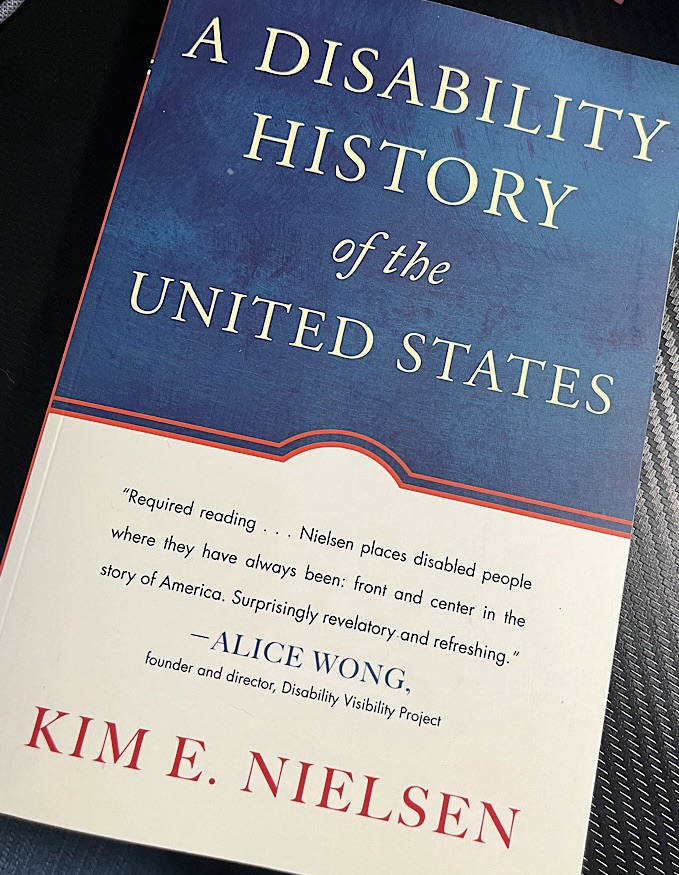
A copy of A Disability History of the United States

I recognized my need to diversify… especially as I start more work on my medical advocacy memoir and consider making more deliberate strides into this space.

Here’s what I ordered:

  • A Disability History of the United States by Kim E. Nielsen. I believe this was Nielsen’s Ph.D. thesis in history. In her introduction, she mentions that she is a white woman of certain privilege, and she ended up in this space by accident, with no connection to disability. Then, shortly after receiving a publishing contract for this book, her teen daughter contracted an illness that made her a wheelchair user and gave her a more personal glimpse of the issues she had talked about.

I finished this book yesterday, and it’s definitely an important work, exploring hundreds of years of attitudes and events about disabled bodies. Nielsen aligns disability rights with other civil rights, for women, for Blacks, for gays. She presents the idea that any body that is not strong, healthy, heterosexual, white and male faces the same discrimination and lack of belonging in the American social structure. And ALL of these bodies are disabled and deemed as unsatisfactory as part of the capitalistic labor machine.

It’s an important work that shows how ideas about disability evolved and how legal status/rights have changed.

Today I started:

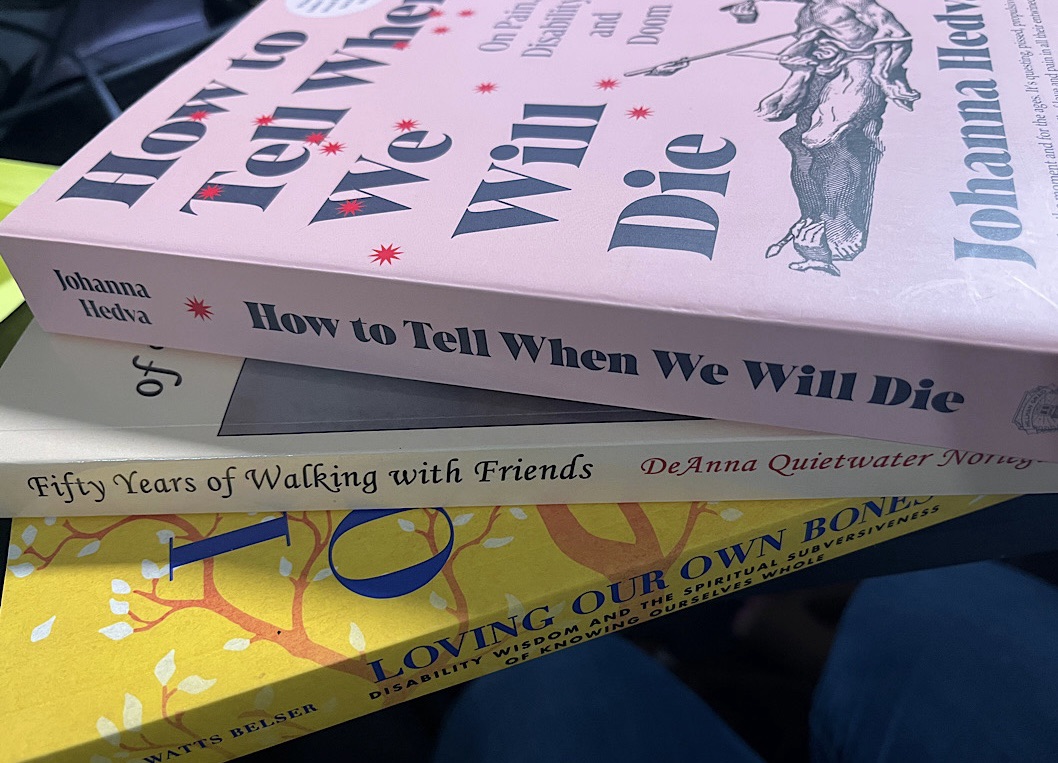
  • How to Tell When We Will Die: On Pain, Disability and Doom by Johanna Hedva. This is Johanna’s fourth book, and the bio on the back lists them as a Korean American writer, artist and musician raised in Los Angeles raised by a family of witches.
A pile of three disabilty-themed books. The top one, How to Tell When We Will Die: On Pain, Disability and Doom by Johanna Hedva, is pink with red stars. The next on the pile is a beige memoir, FIfty Years of Walking with Friends, by DeAnna Quietwater Noriega. The one on the bottom is vivid yellow, Loving Our Own Bones, by Julia Watts Belser.

Their introduction mirrors a lot of the same concepts about the issues disabled people create for American capitalism. Their experience though is one of disability after chronic illness. I have only reached page 28, and Johanna mentions a decade of chasing a diagnosis, but states that they inherited chronic illness from their mother and grandmother– which leads me to wonder why a diagnosis was such a mystery?

I suspect the reality is that Johanna had trouble finding a doctor to label the diagnosis officially, which is the “doctors are idiots” and the “American healthcare is broken” problem not that Johanna didn’t know what was wrong.

I hope Johanna eventually shares their disability with the reader, but as of yet it has not happened, and again– I know no one is entitled to know the private details of another person’s medical situation, but it is important when one is standing in a public space claiming authority regarding such issues.

The other two books on my new acquisitions are:

  • Fifty Years of Walking with Friends, another guide dog memoir by BOE member DeAnna Quietwater Noriega. I added this one to the list because of Noriega’s Native American heritage.
  • Loving Our Own Bones: Disability Wisdom and the Spiritual Subversiveness of Knowing Ourselves Whole by Julia Bessler Watts. Julia is a queer rabbi. This book was recommended and you had me at queer rabbi.

On writing, living and working (with a disability)

I pride myself on being able to write just about anything at any time with no fear of writers block.

But lately, I haven’t been keeping this blog up-to-date. I think it’s because I’m doing so much that I don’t have enough stillness to think, reflect and write. I still have the thoughts, but I don’t have the time to germinate themes and record them and so I lose the moment.

Last night, I was a guest speaker at the Behind Our Eyes writing group for writers with disabilities. Nan has been a part of that group probably for most of its 19+ year existence, but I am a relative newcomer. I joined because I read Nan’s email and work so closely with her as a writer that I already knew most of the members in the creepy troll way.

Nan pointed out to the group that I was a gifted cook and bargain hunter, and that she hopes I commit more time to my disability memoir because I have some insights that the world needs to hear. And maybe they are things I also need to remember.

I overdid it last week. The last few weeks have been insane. I haven’t been eating right, or sleeping well, or giving myself any breathing room. I saw my cardiologist last week, and I mentioned to her that I don’t know if my blood pressure medications are the most efficient way to stabilize my heart rate.

The backstory

So, in March 2023, I had two bad falls down stairs in close proximity– 2 weeks apart. Neither were traditional mechanical falls of the type I am used to, those from lack of proper muscle control due to cerebral palsy. The first occurred as I was hurriedly leaving work to go to the chiropractor. I dove down the cement stairs and ended up severely spraining my pinky. Most dumb injury ever, and my pinky is still bent.

I didn’t know it at the time, but my eating habits had flooded my system with salt when I misbehaved, and then when I suddenly returned to my normal diet and drank the massive amounts of water I had always consumed, well, I washed all the sodium from my body, causing low blood pressure and dizziness (orthostatic hypotension).

With cerebral palsy impacting my gait, and allergies/congestion also challenging my balance, a sudden drop in blood pressure may have caused the fall. (I suggest this because I did almost pass out in the moments after the incident.)

Almost two weeks later, I was carrying a cup of tea upstairs when I had a nothing fall triggered by my head and not my legs. My daughter watched it happen. I plummeted out and down and into an air conditioner that was on the floor. I split open my chin directly under my lip. I definitely needed stitches so we headed to the emergency room.

I told the doctor that I knew mechanical falls and these weren’t from my legs, and he gave me some options:

  1. He could stitch me up and send me home in a matter of minutes.
  2. He could order every test and I’d be there all night.

I asked if there was an option in the middle, and he suggested starting with some bloodwork. But they also noticed my blood pressure hadn’t come down so they put me on a heart monitor and very quickly noticed that I was in Afib with OVR.

So it looked like I would be there all night anyway.

They eventually labeled the whole incident as idiopathic and put me on a low-dose beta blocker to make sure I stayed in rhythm. I invested in an AppleWatch to try and get information about what my heart was doing.

Fast forward to present-day

I have had no incidents of Afib since that initial one. But each fall, my blood pressure has risen in the autumn. Is it allergies causing stress on my body? Is it the stress of the end of the year and all the obligations of adulthood like taxes and paying for fuel oil? Is it just the looming presence of Christmas? Or is it the change in the seasons and the shorter days? Or a figment of my imagination?

In the autumn, I struggle more with anxiety. My primary care physician has talked with me several times about the impact of stress and anxiety on heart health. I have been in and out of psychotherapy for 15 years showing symptoms of depression and generalized anxiety disorder.

So I asked my primary care doctor, my cardiologist, and my psychologist if I might need an anti-anxiety med instead of the combination of other meds for high blood pressure. Because typically my diastolic pressure is typically good, and high in response to stress, but it’s not uncommon for my systolic pressure to stay high even when my heart is at rest, sometimes elevated for days even with a now higher dose of the beta blocker.

I take a muscle relaxer for spasticity several times a day and some anti-anxiety meds can also treat this, allowing me to reduce the amount of medications I am taking. A standard low-dose beta blocker and muscle relaxer for maintenance and on days that I am anxious, an anti-anxiety med instead. So now I’m on the hunt for a psychiatrist to get an evaluation.

Which brings me back to last week

Last week was brutal. I was booked every day from 8 a.m. to at least 10 p.m. And Saturday I attended Collingswood Book Festival as an author with Pennwriters Area 6. I met with clients everyday, taught my college class, went to WDIY to talk about advertising my business (and hopefully make some new friends)…

And I still worked part-time. I don’t talk much about the job I have in a local fast-food restaurant, a job I took last January because after a year of relying on Parisian Phoenix Publishing for my income, the realities of first quarter in the business world were making me nervous. And since royalties pay out three months after sales, I know how much money is coming and when.

And 90% of the time, the evening fast food job suits me perfectly and feeds me. The general manager was an English teacher until this year and understands my business and my frequent time off requests.

But last week I had two long shifts back to back where I was assigned jobs that were physically challenging for me. And I haven’t been in that much pain and discomfort in a long time.

And so even though I still have more work than time, and business can be as stressful as it is rewarding, I will try to go easier on myself. I only have two fast food shifts this week, and they are both on the longer side… but my days aren’t packed nearly as tight.

Soothing my wounds with healthy food

After my doctor appointment yesterday, Nan and I went to Grocery Outlet. Advocating for yourself, even in a safe, familiar environment drains a person emotionally.

My work in the kitchen not only provides the nutrients for my recovery from my mallet finger, but also helps me continue my fitness journey with Apex Fitness.

Maybe I’ll finally commit to losing weight.

Last night for dinner I had leftover pancakes, almond butter and apple slices with a can of blueberry elderflower sparkling water.

And this morning, Louise insisted I get up at 4:15 a.m. And it’s only Saturday not even a work day.

I cuddled her for a while, tried to go back to sleep, and finally just got up at 5:45ish.

Someone adopt this love so I can sleep instead of cuddle the cat all night

I came downstairs, had my coffee and started cooking my treasures. I sautéed kale (reduced for quick sale) in extra virgin olive oil, garlic, salt pepper and lemon juice. I made shredded potatoes in the frying pan with peppers. I prepared quinoa and midnight grains.

I fried an egg and mixed some of everything together with some apple, some of my homemade roasted red pepper hummus and pumpkin seeds.

Truly delectable.

And then right before the gym I had two medjool dates.

And I also prepped some plain lentils just to have on hand. I’m taking Nan some of the different ingredients.

Now for lunch I toasted some Ozery multigrain thin and made no-nitrate smoked turkey sandwiches (the free protein of the week from Hungryroot) topped with Brie, roasted red pepper, spinach, butter lettuce (reduced as well) and chipotle mayonnaise also from Hungryroot.

And I fell again today. At the gym today. Andrew my trainer seems to be concerned that I won’t make as much progress with upper body during my injury (but I did bench press today, but I inadvertently favored the right pretty heavily). But I’m okay with that — a body has to stay active and exercise, alcohol and excessive caffeine are the only way I can get my left hand warm. Well, unless I curl into bed under a heat blanket.

That’s two falls this week that lead to not serious but definitely painful bruises and scrapes.

Marvel review: Ant-Man & the Wasp and the final two Avengers movies

The latest three in our series of Marvel movies— Ant Man and The Wasp and Avengers Infinity War and Avengers End Game— brought some fun moments into my experience of the Marvel Comics Universe.

The teenager brought home generic takis from the Dollar Tree and I had some of those and Cabot Cottage cheese for supper.

I still think the length of the Avengers movies is unnecessarily long— fight scenes and excessive fancy CGI does not attract me. The contrast between Infinity War and Endgame is strong. The former clearly is conflict driven while the later seeks resolution to the past as its plot. So whereas Infinity War offers the fighting of villains vs heroes, Endgame offers a chance to solve a puzzle.

Ant-Man, as in his previous film, blends pure silliness with the everyday experience of the Everyman and the Ant-Man & The Wasp storyline puts Scott slang, as the Everyman, in a unique position to miss the events of the Infinity War and have a worldview that gives him the strange understanding of quantum physics that he doesn’t really “get” but has lived. He has the knowledge potentially to revive the world.

I love the dynamic paths of Hawkeye— I’m drawing a blank on Clint’s full name— and Tony Stark. And Thor’s deterioration from a god to an overweight alcoholic is a beautiful tribute to the toll trauma takes on any hero.

We still have an hour to go on Endgame, so perhaps my opinions will grow. But for now, here it is.

Roller coaster

What an insane week it’s been.

Monday we had a paid day off for President’s Day and, as I have mentioned, my primary care physician called and scheduled an appointment for me with a physiatrist they recommended.

You may recall this made me very happy.

Nan and I even went out for coffee to celebrate.

But yesterday, as I did what I do folding clothes at the Bizzy Hizzy, I got a call from the physiatrist that they didn’t think they could help me as they specialized in orthopedic care and I probably needed neuromuscular care.

The very kind staff person asked me questions and said she would talk to the doctor on my behalf but that they might cancel my appointment.

I literally started to cry.

And I emailed my psychologist.

Because the difficulty I am having finding medical care seems a tad ridiculous— and every hurdle I cross makes me feel like less of a person.

Or perhaps just less valuable.

When I returned from my first break, the powers-that-be at our Hizzy transferred me to the returns department. Now I love women’s returns processing, but it hurts my body. It must be unloading and swinging the packages around. But I can’t figure it out.

By the end of the day, I wasn’t too horribly in pain, but I definitely felt out-of-whack. I had “vague-booked” on Facebook that seeking medical care should not make one cry.

One of my friends, whom I have known for probably five years now, replied that he might be able to help research doctors. We’ll call him the punk Viking.

Meanwhile my neurologist finally returned my email from several weeks ago recommending another physiatrist.

I called the Punk Viking on the way home from work. He has social work experience and is recuperating from a significant medical intervention. He and I have made a pact of sorts to support each other through our health journeys and try to bring a little more levity to each other’s lives.

And then I woke up at 3 a.m. keenly aware of the fact that my hip had shifted. And I was uncomfortable.

And I went to work uncomfortable.

A bunch of us were scheduled to work women’s inbound processing— which is about 700 steps from the main breakroom for my short legs, the far end of the warehouse.

At 8:50 a.m., we trekked to the breakroom for first break. On the way, my chiropractor’s office called and asked to move my Friday appointment because of the anticipated winter weather. They are calling for snow. I fought tears. They wanted to move my appointment to Monday— but I’m already uncomfortable.

(According to the iPhone my walking was asymmetrical today. It looks like once a week my walk is getting measurably off.)

So, I take an appointment for 5 p.m. Monday. And put in a last minute request to leave early Monday.

We returned to our stations at 9:05 and at 9:15 we had a team meeting back in the breakroom.

During that meeting, the physiatrist’s office called. I can’t answer. So I can only assume they are canceling.

But instead I discovered they have agreed to do an assessment.

I get back to my station at 9:38, and I have a second interview for my application to the safety team at 10. It’s on the complete opposite side of the building— about 1300 steps. When I arrive, I find out the location has been moved to a different room. One, get this, just beyond the breakroom in women’s inbound.

You know, where I started.

The interview went great.

And I had more than 8,000 steps today.

I came home, talked to the Viking, and did some cleaning with the teenager. I’m exhausted. Achy. Stiff.

But if all goes as I hope it will— I should be able to get my business bank account for Parisian Phoenix tomorrow. My LLC came in today!!!!!

A day in the life— medical update, meal plans, sunshine, animals and publishing

I make a lot of lists.

Sometimes my journals are nothing but to do lists and shopping lists. But I like lists— even if I never refer to them again, the act of making a list allows me to stop thinking about things.

If I want to refer to it later, I know where to look, but I no longer have to worry about forgetting as if I want to remember or revisit items from an earlier day I can but I am not staring at a list focusing on what needs to be addressed versus what I actually did.

Many people make lists to receive the satisfaction of checking off the things that are done. I don’t do that. Sometimes I do, but now it’s more like I am acknowledging the list versus trying to conquer it.

I used to finish my list every day or stress over the things I didn’t get to, and on top of that— the list never made me feel better or more in control.

It just exhausted me.

Trapped and the Cover for the Anthology Arrive

Parisian Phoenix’s first contemporary romance has arrived and it looks great. Read more about that here.

But I also received the cover for Not An Able-Bodied White Man with Money, which I will be blogging about on the Parisian Phoenix site this weekend.

And I have a 4 p.m. meeting today with another author who I have been hoping would join our family.

Now if only I could finalize some of our business documents to really move the projects forward.

Yesterday (Voluntary Time Off) and evaluating my health

Life at Stitch Fix’s Bizzy Hizzy has been odd lately. We’re shipping something like 8,000 fixes a day and having the opportunity for voluntary time off.

Last week, I performed at pretty damn close to 100% without pain or significant mobility issues. This week, issues started mildly during my Sunday shift and deteriorated Monday & Tuesday, leaving me at 80% and crying myself to sleep. I talked about this here.

I’m very much wondering if my menstrual cycle has something to do with it, as the Mirena IUD has done miracles for my pain and issues in that department but has made my cycle irregular. I think my body is trying to menstruate later than usual.

I was taking inventory of my recent balance, mobility and functioning issues as today I had my annual “wellness visit” that the office rescheduled from last week.

I took VTO yesterday to allow myself some rest and some time as life (and grief from my father’s death two months ago) has gotten chaotic and overwhelming.

And I made the teenager and I grilled cheese as I had promised to do, and the child acted like I had prepared filet mignon for her.

I have a feeling I will be repeating that after school today.

We also watched Miranda Sings Live on Netflix. The teenager went through a time when she watched the show, so that was weird. It always amazes me how much talent it takes to perform badly.

The doctor today

I have spent more than a decade assembling a talented and caring medical team, so now I can confidently say any issues with my medical treatment stem from the system and not from my doctors.

The doctor and his resident agreed with my assessment that it’s time for me to get into the physiatrist and that their office will advocate for me on that as well, and that my instincts and approaches are correct.

I learned that women more so than men tend to favor one side when they move or stand. As women age, this tendency can create problems. That means this is a problem normal people have and not just a result of cerebral palsy.

And most interestingly… I learned that women more so than men tend to favor one side when they move or stand. As women age, this tendency to let’s say ‘lean’ can create problems, just like what I am experiencing now with my right hip and right leg/foot. That means this is a problem normal people have and not just a result of cerebral palsy.

I reiterated to them that I do know I need to lose 20 pounds, but that we have some issues to address before that.

The psychology of emotional and physical pain

When I was turning 40, I embarked on a journey to lose five pounds and gain muscle. I inadvertently lost 30 lbs and ended up a skeleton and regained some weight to look like this:

That was about 30 pounds ago. I have no need to be that lean again, but I’d really like to see 135 lbs again— which means I need to lose 20 lbs.

I told my doctor and his resident— I know I can’t eat an entire bag of cheese puffs or Wawa bowl of mac and cheese and brisket after dinner. But I’m struggling with depression from my body pain and my father’s unexpected death.

I’m grateful I haven’t turned to alcohol like many in my family, but I have “given in” to food as a psychological crutch.

I pay almost $300 a month for a personal trainer, but I can’t work as hard as I want to because I hurt and I feel like I need answers as to how to move my body so it doesn’t hurt. Because if I could exercise more and move more, I wouldn’t sabotage myself by eating garbage (or if I did, I would be active enough to balance it).

But right now, when I come home from a ten-hour shift with my body twisted and aching badly, and wishing I could call my dad so he could make me laugh and tell me how much it sucks to get old, I grab junk food because it’s the last pleasure I have.

I can’t move without pain so if I’m going to be forced to get fat and lazy I might as well enjoy the process.

These are ugly thoughts and I know that, but I’m being honest.

The fun stuff: errands with Nan

After leaving my primary care doctor, I called Nan as we were scheduled to do some errands together. We stopped at Wawa for some hot caffeinated beverages (cafe con leche for me and vanilla chai for Nan).

Among other stops we visited Park Avenue Market and Deli, one of our favorite haunts known for its deli, salads and meats.

Although I am once again contemplating more of a vegan diet, which will make the teenaged carnivore wince, I am not ready to commit until I feel better. We must achieve discipline before we enact change.

I never got around to meal planning yesterday so I didn’t have a list. I ended up spending $36.89 and I think the results will work.

I purchased: two packs of beef jerky, one small box of minute rice for the teen, three or four teeny tiny bags of Wise snacks from popcorn to potato chips, meatballs, the biggest damn carrot I’ve ever seen, frozen vegetable medley with potatoes and garlic herb sauce, sweet potato crinkle cut fries, pork roll, Lebanon bologna, liverwurst, turkey, olive salad, a store-baked pig ear for the dog and something called “hot pepper shooters”— round hot peppers stuffed with prosciutto and provolone.

Rough meal plan

My rough meal plan for the next week or so is:

  • Sandwiches
  • Meatballs and green peppers, either as a sandwich or in pasta
  • vegetable lasagna still in the freezer from last week
  • Burgers and fries, using ground beef from the freezer and the sweet potato fries
  • Cold tortellini salad with roasted carrot, olive salad and seasoned broccoli (broccoli is in the freezer)
  • Pork roll and egg sandwiches
  • Chicken and the frozen vegetables and rice or other grain

PS— we also welcomed a new foster into the house. Her name is Babs. Meet her in this video. I need to make her a page.