When I was in college at what is now Moravian University, we had to take several religion classes to fulfill our liberal arts requirements. We had to take one on the Bible, and I took Old Testament. For one of my world culture religious requirements, I took Religions of China and Japan, where I learned about Confucianism, Taosim and Zen Buddhism.
My daughter, now at Lafayette College, also a liberal arts institution, has taken several religion classes because it seems to be the only department with courses open when her class year registers. And unlike her parents– she has no interest in English classes. She also can’t take classes at lunch time because of her dog walk clients, and she would prefer not to take any more classes with labs.
This semester, she has two religion classes, an astronomy class (space math) and a class in her major department on psychiatric diagnoses. Her two religion classes are Religion in World Cultures and Anthropology of Religion. For her world cultures class, she has to visit a religious site/service and write a reflection paper.
Some members of her class are visiting the local mosque. Not us. During the summer, I had seen a video or some social media post about BAPS Swaminarayan Akshardham North America. I was pretty sure the TikTok algorithm suggested it. I showed it to Eva because I thought then it would make a fun road trip– simply because of the architecture.
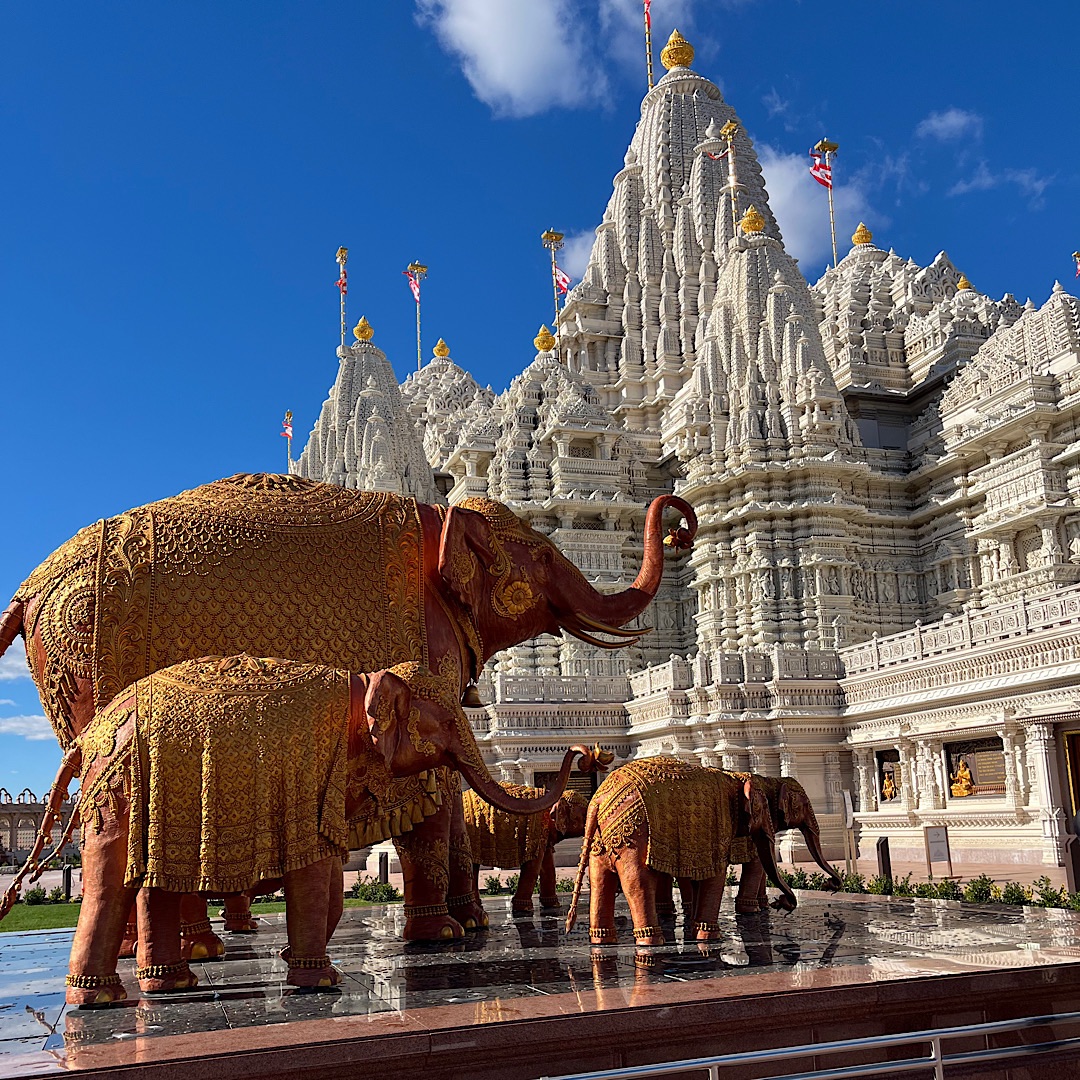
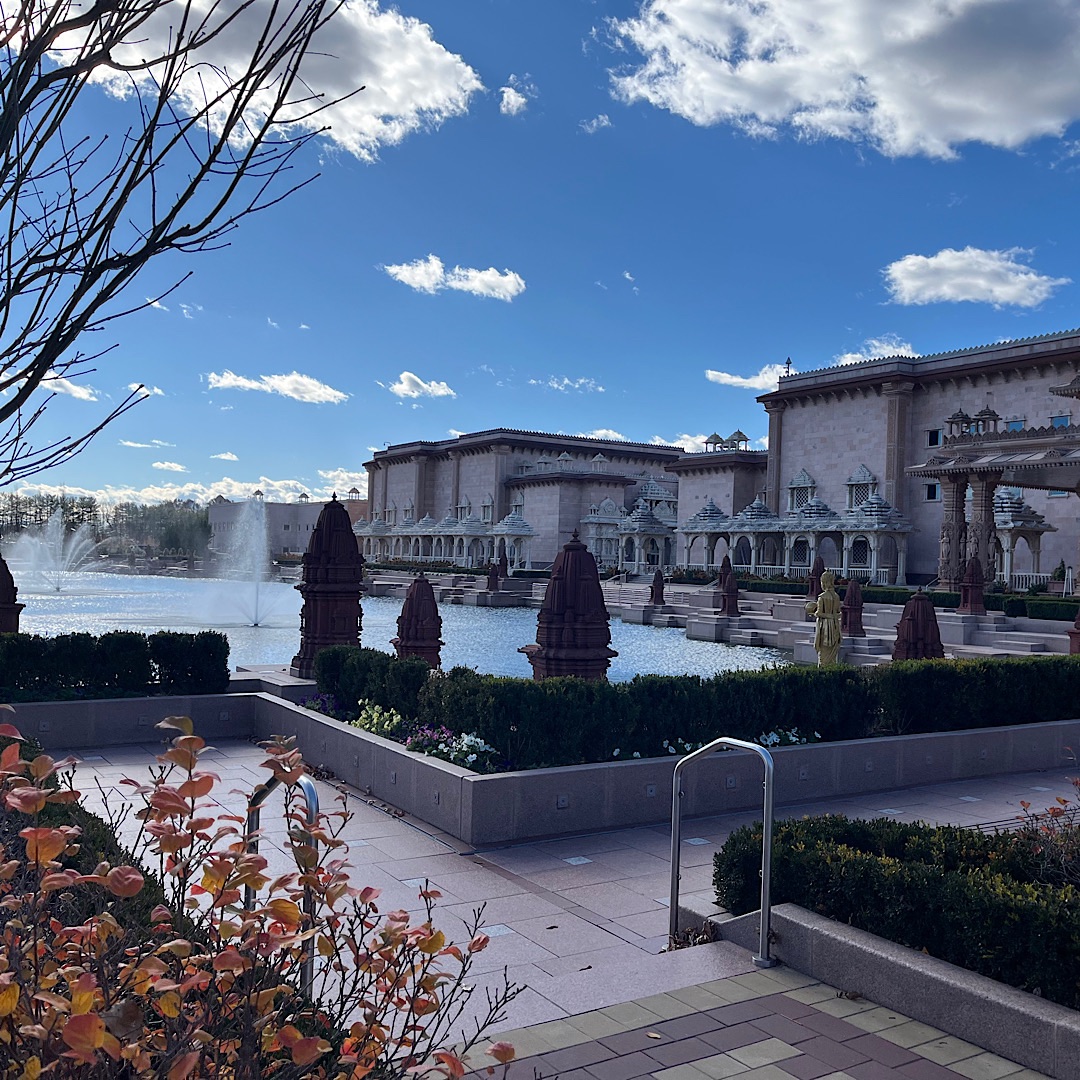
We watched the orientation video that discussed the basics of their beliefs and the construction of the campus– which began around 2011 on 185 acres, took 12,500 volunteers and was more or less completed in 2023. The limestone was carved in India and shipped to the United States where it was reassembled “like a giant jigsaw puzzle.”
Even without reflecting on the spiritual spaces on the campus, their design includes so many statues, people, animals, and even hands and feet (as a sacred connection to the divine).
Our first stop was the mandir where we joined a prayer ceremony. Shoes off and divided into men and women, we sat on the heated marble floor in silence. The chants and prayers were familiar to the Hindus in the audience who joined in with strong voices and rhythmic claps as the leaders (monks? swamis?) in orange performed gestures before the (shrines?).
This was my first time experiencing anything Hindu, and I apologize for mixing up the words regarding the leaders, the representations of the Holy, and whatever instruments they used for the prayer ceremony we attended. I do understand and appreciate that touring the campus is an exercise in personal spirituality and a journey into the divine.
Swaminarayan refers to the type of Hindu faith and Akshardham means large temple.
And the architecture of the Akshardham in New Jersey follows the guidelines from Hindu scriptures, including an 80-foot spire that reminds those viewing it of the search for higher truth and the divine.
Let me repeat that I know nothing about Hinduism, but I did buy some books today: Hindu Vegetarianism, Hindu FAQs and Hindu Funeral Rites. So, hopefully this will spark a journey. I marveled at the expansive statues in the Akshardham and compared them to Christian stained glass window, as a way to share with the illiterate population the tenets of the faith. (And I loved the reminder that feet connect to the ground and the spiritual.)
The campus itself was beautifully landscaped and organized and moved people from place to place, maintaining order yet allowing everyone freedom to explore. Everything– from the statues to the levels of the water feature in the front of the grounds (symbolizing purity and the sacred rivers of India)– had symbolic meaning.
After we perused the grounds, the buildings, and even the construction timeline, we visited the food shop. And we bought a bunch of snacks to bring home (mango cookies, cashew fudge among them).
Then, we hit the food court. I wish we had a paper menu I could share with you. Eva had a saucy cheese street dish (Pav Bhaji) with toasted rolls, a mango lassi, a fruit drink AND a cup of hot masala chai. I had the cauliflower (Gobi Manchurian) and a odd little cookie coated with saffron (Kesar Vati).
We spent $20 in the gift shop, $20 in the snack shop and $40 on lunch.
The scents of incense, tastes of good vegetarian Indian street food, warm floors beneath our feet, exquisite art surrounding us, welcoming staff and volunteers, beautiful chants and prayers, and the deep spiritual vibe made the day an enlightening adventure.
Yesterday, my friend Gayle and I embarked on an adventure. I wanted to motivate myself toward more movement and healthier living and Gayle enjoys visiting new towns via self-guided walks designed by local clubs of the American Volkssporting Association. Gayle has wanted to hit the Ephrata, Pa., walk (which is about 90 minutes away from our homes) and I love a day trip. The walk is maintained by the Susquehanna Rovers.
Gayle packed lunch. I packed sunscreen. I even tossed some electrolyte powders packets in my bag, knowing it would be a sunny summer day. I took my muscle relaxers.
Off we went.
The background
Now, as someone with a mobility disability (cerebral palsy, spastic diplegia), I suspected– or perhaps even knew– that this would end with some sort of injury or discomfort. I had hoped that having this walk, a 5K by design, would motivate me to get away from my desk and wander around the neighborhood.
That didn’t happen. I could blame the heat wave, but in reality, I doubt I would have changed my behavior even if the weather were nice.
In the end, I said to myself, “Anyone can walk a 5K.”
And in one respect, I was correct. I did it. On the other hand, it was stupid. And I’m suffering because of it. But that’s getting ahead of myself.
I wanted to use this walk to see how my movement was in a more long-term commitment. I wanted to test my breathing and my heart rate. I suspect a lot of my health issues will not resolve until I lose at least 20, if not 30, or even 35 pounds (at which point I ask myself– how did I gain this much weight so quickly?)
So this walk would help me evaluate my true status and make health-related goals.
That was my logic. Was it a tad reckless? Maybe, maybe not.
The Walk
Ephrata has a lovely main street, historic buildings and apparently monuments– none of which we saw because the 5K was mostly through residential neighborhoods. And we missed a turn somewhere and ended up shaving off about a half mile. Our time for our 2.8 mile 5K was about 31 minutes a mile, and we periodically stopped to enjoy the shade, look at weird buildings, and sometimes cuss about hills.
AVA walks are rated, and this was a 1B which means it was supposed to be easy, with sidewalks and the occasional hill. But if you looked at the “fine print,” the walk was rated “medium” for strollers and “hard” for wheelchairs. I think for the foreseeable future Gayle and I need 1A walks that are easy for wheelchairs.
So here’s my analysis of what we saw in Ephrata on the 5K:
A gnome garden. I like this tiered design of outdoor knick knacks. I’m not sure what sense it makes, but it seems like a concept the no-longer-a-Teenager would embrace.
A neighborhood egg stand, that was closed.
Your going to have to google this for yourself. “Best Kept Secrets Tour.” “Shopping, Food & Fun adventures.”
The strangest “double” homes I’ve ever seen. The walk took us through an entire neighborhood of attached, split-level homes. I own “half a double,” and some neighborhoods in my area are row homes that expand an entire block. But I have never seen neighborhoods like these. I fail to understand the logic. There are two reasons to “attach” homes– one is to lower the cost by sharing a wall, and the second is to squeeze more people into a smaller space.
These homes have the space to be detached. They are on suburban lots. So, if you are going to invest in a suburban home, why would you want (or even accept?) being attached to your neighbor. There were also attached ranch homes, with the same concept, but just without the extra stories. And some had a strange shared doorway in the middle, like a breezeway, so they were both attached and detached.
We did see a lot of great distant views. Mountains in the distance. Clear skies.
One of the first things we encountered was the Anne Brossman Sweigert Charitable Foundation, with a family sculpture out front and a sign engraved on a grave marker. (They also have not updated their website in almost 10 years according to the “grant history” tab.) Why did they place their sign on a grave marker? So it didn’t blow away? Fade?
Around the two-mile mark, we realized we had missed the turn and reached our threshold for the residential tour, and ironically, we ended up taking a street parallel to the main drag back to the hotel where the walk-box is stored.
Interlude: Early in the walk, I noticed my right leg was pulling in toward my left leg. So, minding my fitness and strength coach’s advice, I led with my knees to make sure I wouldn’t end up tripping over my own legs due to my knees facing inward. I tried stretching, to see if I could get my hips and thighs to move more outwardly, but I couldn’t come up with the right movement.
Nothing hurt, but damn everything was tight, and my legs fought me with every step.By the time we climbed the hill and stairs by the hotel, my back was starting to feel the stress. My legs didn’t want to lift. So I made it to the car and popped another muscle relaxer.
Step count: about 8,500
The Ephrata Cloister
We went to Ephrata Cloister, driving down the main drag and wondering why the walk couldn’t have shown us all these lovely local businesses and perhaps led us to a cafe where we could have rested. We had a savory-and-sweet vegan chickpea and carrot salad with a side of grapes for lunch. From there we headed into the gift shop.
At the gift shop, I found an impressive collection of wood crafts, paper folding kits for Moravian Stars, quilted cards, replacement ink for quills, Amish novels and a nice selection of Pennsylvania Dutch nonfiction books.
The no-longer-a-Teenager is mostly Pennsylvania Dutch on her father’s side. One paternal great-grandfather was Welsh, but all of her other paternal great-grandparents were Pennsylvania Dutch. Her paternal grandmother’s father spoke Pennsylvania Dutch (Leroy Buss) as his first language, learning English at the one-room schoolhouse he entered at age five. I would have loved to buy her a Pennsylvania Dutch to English dictionary or Superstitions and Folklore of the Pennsylvania Dutch, but the budget did not allow.
We visited the museum where we learned that the Cloister was a spiritual community with roots in Germany that came to Pennsylvania, just like the Quakers and the Moravians, in the early 18th century for religious freedom.** They had strict beliefs and practices, one of which was celibacy so it became impossible to keep the community alive. (The “householders” later became the German Seventh Day Baptist Church. Householders were the families on neighboring farms who supported the community and their religious beliefs without going all in on the celibacy, vegetarianism, and sleeping on a wooden block disciplines.)
We also saw a really long glass horn.
** 1720. That’s more than FIFTY YEARS before the Revolutionary War.
The tour
Gayle and I like to support local history and nonprofits, and who doesn’t love the story of a good old colonial cult. So, we embarked on the tour.
First, we watched a really information-packed but poorly acted and filmed movie. You can watch it online here. (This was where Gayle thought she lost her phone and I got a text from a client who needed me to do something later that day.) We were told the tour was 45 minutes to an hour long, depending how many questions people had, and that we should be on our way at 3 p.m., 3:15 p.m. at the latest.
Gayle was hoping the tour would send us all over the grounds walking from building to building. I was suddenly starting to hurt and could barely stand. Neither of us voiced what we were thinking to the other.
“You’ll love the tour guide,” the volunteer at the desk said. “He’s really knowledgeable and passionate.”
Our tour guide took ten minutes to get us out the door because already other members of the tour were asking stupid questions covered by the movie we had just watched. We walked out to the middle of the yard, not even a half acre away where the tour guide announced we had reached the village.
We stood outside for a long time, at first talking about architecture, then the idiots with us had to debate how old the trees might be, and whether they were “original.” I was mesmerized the whole time by a man who looked very Mennonite/new order Amish/”Dutchy.” You don’t think the Pennsylvania Dutch have certain genetic “looks,” but they do.
Now, somewhere around this time, it became difficult to know when the tour guide was telling us historical fact, and when he was expounding on his own “theories” (his word). He talked a lot about significance of numbers, how the triangle formed by the Village served as a reminder of our path to God, and the powers of the mystics. This is where I, as a journalist and a historian, started to get annoyed. He provided no proof of the sources of his ideas. (Here are some of the official lectures on the topics.)
We stood in the main living area of what became the Sister’s House. Eventually we ended up in the Meeting Room. We were *locked in* the building, so strangers who had not purchased the tour could not wander in. I know this because the Dutchy man needed to leave and he could not without interrupting the tour.
I faded in and out of the door mentally because my legs were hurting at about an eight. When we left the meeting room and entered the add-on kitchen, I was ready to fight the sweet little old ladies for a space on the small bench. My heartrate had been soaring since we started the tour (130s when standing and 110 when seated) probably in response to the pain. There was room for all of us.
Interior of the Meeting House (saal, meaning “room.”)
At this point, my plan was to sneak out of the tour when he let us out of the building and to tell Gayle to take her time as I would sit outside and read my book. But it turned out the tour was only to this building.
Our tour guide unlocked the door at 3:40 p.m.
The repercussions
By the time I went to bed, my pain levels had reached a nine. They are between a six and seven today and I’m taking it easy. I think my body has forgotten how to walk. As a person who deals with spasticity, which means my muscles in my legs never relax, I have a theory. This is the first long walk I’ve taken probably in years, certainly since I started taking muscle relaxers. It’s the first long walk I’ve taken since I started fitness training with Andrew, and even more certainly, the first I’ve taken since he had to pause our sessions several months ago. And I sit at a desk now, 8-10 hours a day, seven days a week, and walk 3,500 to 5,000 steps a day.
So, sure I overdid it.
But I still maintain that I have never moved the way I moved yesterday. I fried my adductors.
Hard to believe for several months from 2020-2021 I was a picker in the Stitch Fix warehouse where I walked miles and miles and miles every night, five days a week.
For more about this trip and some discussion of books, printing and those arts at the Cloisters, see ParisianPhoenix.com.
In my recent discussions of spirituality and witchcraft, a comment from one of my followers (Olivia) pointed out that it makes sense that items that are on an altar should be very personal.
That got me thinking about what makes a symbol powerful.
Items on an altar are symbols of the energies we wish to attract.
So, sure there are certain traditional masculine symbols if you wish to attract that type of energy: phallic symbols and the sun for example. Just like the bowls and the moon are traditionally female.
Those symbols are based on associations most people understand and to which they can relate.
Other symbols retain their power because people imbue them with collective thoughts. Think of the cross; it’s a powerful icon because a massive amount of people having agreed on its meaning for centuries.
For some, the cross inspires hope and love and a promise. Others might associate it with guilt and bigotry.
But most people on this planet know it.
The American flag also evokes such strong associations.
That’s why, when considering what you believe and what symbols hold power, and what that power is, the most important part of the equation is what you hold most dear in your heart.
This is the final week to see Lalla Essaydi’s photographs at the Williams Center for the Arts gallery at Lafayette College.
This seven photograph exhibit takes a journey into contemporary Muslim women’s space while exploring traditional Orientalist beliefs, otherwise known as Western stereotypes of the Muslim/Arab experience.
Immediately, I recognized these themes in Essaydi’s photography. My previous exposure both academically (my interest in post colonial Francophone Africa, how it intersects with the Muslim world, and the impact these topics have on contemporary international politics) and via travel in Africa and the Middle East came rushing into my head like a lost dream you fight to remember upon waking.
This exhibit features five photographs that use white/beige colors, Arabic writing, henna and women in various levels of religious covering and two photographs more steeped in color.
The seven photographs come from three different series: Converging Territories, Harem and Bullets. Just reading those titles should leave a certain taste in the mouth. I have with me an exhibit guide but I haven’t referred to it yet as I prefer to digest the works on my own first.
The first piece one encounters in the exhibit is 2004’s Converging Territories #24, featuring a woman’s face, only eyes showing, with writing on her face and the cloth covering her. The chromogenic print mounted on aluminum divides the woman’s face into four panels, each an almost even display of skin, lettering, and beige fabric.
This one did not attract or impress me. That is not to say it does not present a strong harmonious image. It is certainly a lovely piece of artwork, but artwork often speaks to the viewer in unique ways and this one seemed what one would expect from an exhibit like this.
Next came Harem #2 (2009). Instantly, I noticed the use of the term harem and the mimicry of traditional Orientalist images prevalent in I believe it was 19th century Western paintings capturing a fantasy of what Western/European artists expected the Muslim/Arab lifestyle to be.
The Harem series uses more color, more texture, and repeats the Orientalist themes of a reclining woman in exotic dress. The repetition of these stereotypical themes used by a Muslim female photography made me bristle. But this woman is propped on one arm and seated rather proudly so I sense the challenge to the age-old idea of the Middle Eastern harem.
Next, I found Bullets #3 (2003).The woman in this photograph has a sassy shoulder turned to the camera. She is covered, but showing more flesh than normally proper throughout the arm. The backdrop is all bullets as if they were tiles on the wall, bullets also adorn her clothes. Another stunning photograph, but frankly I grow tired of the constant obsession of the Muslim identity automatically connecting with terrorism. I’m sure that’s Essaydi’s point, too.
I’m going to skip my favorite piece and turn instead to Harem Revisited #34 (2012). Perhaps this is the most colorful piece presented at Lafayette. It is three years newer than the other, and the woman’s pose in this one is not only more docile and reclined but divided into three panels, an immediate detraction from her humanity. She is reduced to pieces.
But the focal point of the exhibit (and my favorite), if I can proclaim that based on not only the fact that it was in my opinion very prominently displayed, is Converging Territories #30 (2004). [Featured image for this post.] It depicts, with the same beige clothing on beige background covered with writing and people decorated with henna, four females standing side by side in various levels of garb.
The largest woman, whom appears to be the only adult in the group, is completely covered head to toe. I can’t even refer to it as burqa as she doesn’t even have a slit or a screen for her eyes. I see them as a family, and the next one is in more traditional burqa and appears to be an adolescent. The next girl, a sweet looking pre-teen, has her scarf tied under her chin, exposing her whole face but not her hair. The last little girl has no head covering.
What I adore about this photograph is the vivid use of the progression of covering as it follows a woman through various stages of life and suggests not only the typical message of how a woman’s identity is limited by strict forms of covering, but also attaches this idea to the act of mothering and potentially makes it more universal. To me, the suggestion is that all women lose a part of their identity as they transition into a maternal role. This has nothing to do with religion.
If you miss the exhibit at Lafayette, a similar exhibit runs through May at the Trout Gallery of Dickinson College.
About Lalla Essaydi: According to the exhibit guide, she grew up in Morocco, raised her family in Saudi Arabia, and lived in both France and the United States. She received her arts education from prestigious art programs in both France and the United States.



 Angel Ackerman