I put Johanna Hedva’s How to Tell When We Will Die: On Pain, Disability and Doom on my wish list probably when it was a new release.
The cover design is lovely and the bio of the author is enough to draw interest:
Johanna Hedva (they/them) is a Korean American writer, artist and musician who was raised in Los Angeles by a family of witches and now lives in LA and Berlin…
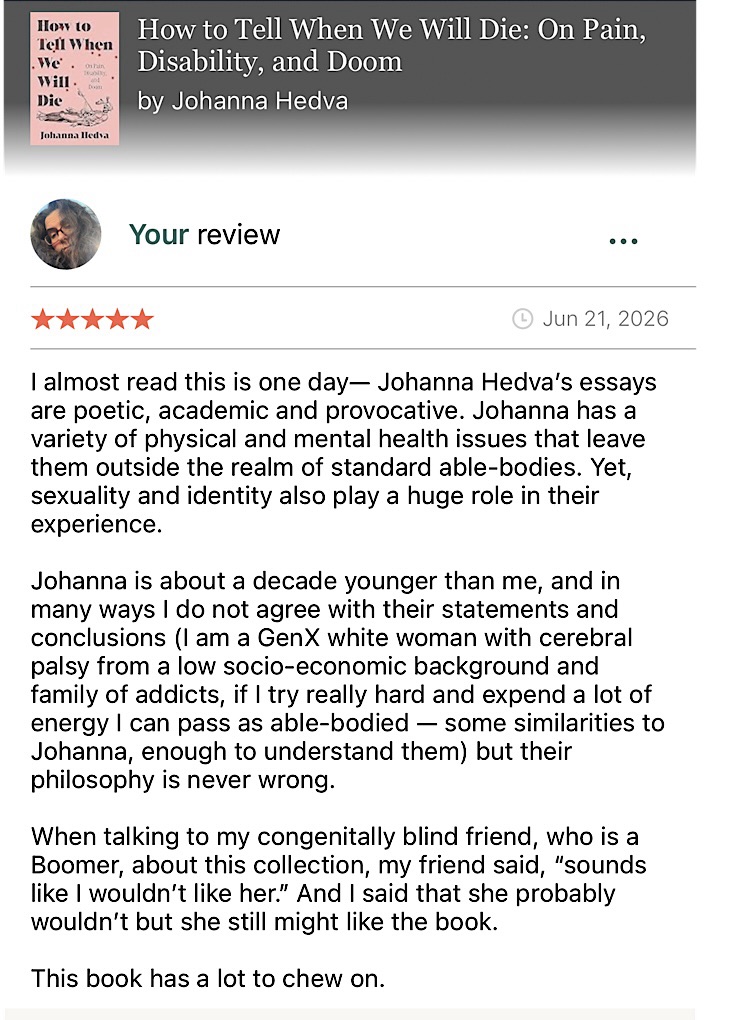
I guess the first step of my thoughts on the book would be to share my Goodreads review with you.
I gave the book five stars even though the most Generation X parts of my soul wanted to give it four, because despite how much I disagree with some of her points– I can’t stop thinking about them.
My Goodreads Review
“I almost read this in one day– Johanna Hedva’s essays are poetic, academic, and provocative. Johanna has a variety of physical and mental health issues that them outside the realm of standard able-bodies. Yet, sexually and identity also play a huge role in their experience.
Johanna is about a decade younger than me, and in many ways I do not agree with their statements and conclusions, (I am a GenX white woman with cerebral palsy from a low socio-economic background and family of addicts, and if I try really hard and expend a lot of energy I can pass as able-bodied– some similarities to Johanna, enough to understand them) but their philosophy is never wrong.
When talking to my congenitally blind friend, who is a Boomer, about this collection, my friend said, “sounds like I wouldn’t like her.” And I said that she probably wouldn’t, but she still might like the book.
This book has a lot to chew on.”
So what are some of their thoughts and my thoughts on their thoughts?
Random comments first.
- The title is a shout-out to astrology.
- Their book deal for this collection stemmed from the essay Sick Woman Theory which went viral. The attention it garnered made them more of a figurehead and/or activist than they ever intended to be. The essay Sick Woman Theory is not nearly as interesting as her response to that essay, Why It’s Taking So Long.
- As a member of GenX, I have some discomfort with how the queer community throws around labels. Johanna identifies as a queer, and not as a woman, which is fine, but I guess I remember the days when people didn’t need to define their identity as concisely as we do now. You didn’t need to label every aspect in which you are weird. It’s okay to just be different.
So let’s look closer at some of their points.
Essay One: “How to Tell When We Will Die”
Opening paragraph:
“Heroes die on the battlefield, never from chronic pain. Diarrhea never makes its way into myth. Tragedies are devoid of menstrual cramps.” Johanna has my full attention. On the second page of the essay, they talk about the representation of disability in early and twentieth century film, and how disabled people become “flattened by some insidious super-cripple myth.” Throughout this first essay, Johanna is tossing around some serious academic critical theory before suddenly turning into memoir…
They speak about not receiving a diagnosis for their ailments until in graduate school (despite later saying that the conditions were inherited from their mother and grandmother, so I think the statement should have been that they could not get a label on the diagnosis– she does state that doctors were “baffled” by her symptoms and “dismissive of their validity.”). And they mention that they stayed on for a second master’s degree to keep their student medical benefits to the tune of $250,000, that led to a career in the arts where they refused any job that did not meet their aesthetic. They chose poverty. They chose art.
I’m wondering why– even if they didn’t want a standard job with employee-sponsored health insurance– they didn’t just buy health insurance or take on medical debt instead of a quarter of a million dollars in student loans.
But then there are gems like “You do not have to be disabled to experience ableism” and “no matter how it arrives, disability will arrive for everyone, sooner or later” (which they repeat in the last essay.) And Johanna points out that the biggest ableist fantasy is that we control our bodies, and we will always be able to control our bodies.
Johanna talks a lot about her mother’s addictions, and the abuse they suffered at their mother’s hands, and of their own mental health issues. Her first suicide attempt happened at age nine, when she took a bottle of sleeping pills, and when she did not die, she carried on with her life.
We are more than 25 pages into the book when we learn that mental health plays a significant role in her disability, which we later (not in this essay) learn includes endometriosis and chronic shingles. I understand that people with disabilities do not owe any sort of explanation of their ailments to anyone, but if you are writing a book about disability, I believe that information should be front and center.
And in this essay she mentions her love of death and doom metal. You can hear some of her music here on YouTube.
Essay Two: “Sick Woman Theory“
The essay that started it all. I think it’s really important to understand that they called it “sick woman theory” because regardless of how they identify, the medical establishment and the world consider them a “sick woman” and they are seen as a “sick woman.” They frame their theory that our capitalist world is designed for the existence of “white, straight, healthy, neurotypical, upper- and middle-class, cis- and able-bodied man who makes his home in a wealthy country, has never not had health insurance, and whose importance to society is everywhere recognized and maybe explicit by their society, at the expense of everyone else.” To a certain extent, I want to call out a “Yes, bitch,” (as they toss around this phrase) but at the same token– would the experience be the same in the developping world/Global south.
Essay Three: “The Blast Radius of Disability”
I have to say that I love this concept, “The Blast Radius of Disability.” Disability doesn’t effect one person, one episode, or one place or time. Instead, it impacts everything around it, everyhing that it touches. Johanna speaks of time dvided into before and after sickmess, but I can’t help but wonder how they can divide time in such a way when mental illness entered their life so early they can’t really remember a before, can they?
It is in this essay that Johanna mentions that individuals with disabilities must operate according to “crip time” not clock time, doing things as the body deems itself capable not as the world says we have to do them. On one hand, I understand the point, but that’s not how the world works. I have to believe that there has to be a balance, of not overdoing things in order to conform to the mainstream standard and hurt oneself in the process. And there’s an inference that the entire world runs on the same precision, which isn’t true. There is “island time,” “Latin time,” and “African time.” Each culture has its own realtionship with time, so maybe they need to find a place and a rhythm that works for them.
Essay Four: “In Defense of De-Persons”
A discussion of capitalism and mental illness.
Essay Five: “Get Well Soon”
“Are these my limits, or are these the limits of the world?” Johanna reminds us that disability is part of a dichotomy– the ill being inactive while the healthy take action, the disabled remain still while the rest of the world creates revolutions.
Essay Six: “Notes on Activism (aka Notes on Failure)”
Organizing is exhausting, Johanna begins. Activism, they write, “reminds us how the world actually is, not now how we would like it to be.” Activism often comes off with hypocrisy– like buying your anti-racism books off Amazon.com. Their other question: How can you balance the need as an activism to care for others, yet also take care of yourself?
Essay Seven: “Letter to A Young Doctor”
I didn’t like this one. It seemed to repeat some of other concepts. Johanna tells this doctor all the other things they have already told us and will tell us differently in future essays. The doctor approached Johanna asking for advice.
Essay Eight: “Soft Blues”
Or “The Summer of the 12-inch cock.” The first several essays that are reflections on Johanna’s sexuality. And an in-depth exploration of her experience in a mental hospital for depression that led to her experiencing an entire summer of bipolar mania.
Essay Nine: “Can I Hit You?”
The BDSM essay. Which has the most amazing line: “Pain is the price I must pay to be awake to life.”
Essay Ten: “The Freak”
Another relationship essay. The only highlight I have in the whole essay is when Johanna discusses capability and capacity. They remind us that just because we are capable of something does not mean we have the capacity for it at this time.
Essay Eleven: “Notes on Trash Talk (aka Notes on Community)”
Interesting essay where Johanna gives a view of their obsession with fighting, boxing, wrestling and MMA, and how the way a coach talks to a losing athlete is the type of trash talk we could use more of as disabled people.
The next few essays are all Johanna’s entertainment criticism. I will skip those, even though they do circle around to disability as it all does.
Essay Fifteen: “Notes on Ambition (aka Notes on Survival)“
This is a complex one– looking at what we all need, versus what we want, and how many of our ambitions are actually motivating us toward ideals that might not be our own.
Essay Sixteen: “Hedva’s Disability Rider.”
They explore this rider more in a later essay, the one I mention that speaks back to the original “Sick Woman Theory” and presents the repercussions. But here, Hedva gives us the document they send to institutions that invite her to perform. I feel like some of the items on the rider should not be listed as conditions for employment, but instead factors of how much they should charge for their fee. If you know you need a business class airline seat on the aisle, you make sure you only say yes if the organizers give you enough money. Some of the informational items are valid: like allergies. But Johanna also uses the rider as a way to advocate for everyone with disabilities and call attention to how excluded people with disabilities are. They ask for sign language interpreters, live captioning, all-gender restrooms, wheelchair accessibility and audio description.
They say they know they won’t get all of it, but they like to have the conversation and point out how unaccessible and exclusionary the world is.
And this is why hardcore advocacy is exhausting, friends.
While we would like to invite all the people with disabilities to everything, why provide the services if the people aren’t there? I know Nan and I have attended shows at DeSales University where they have one performance with audio description and live captions. These shows are made accessible with grants. Start there.
Essay Seventeen: “Room Day”
Johanna’s partner is Johannes, a German citizen, which is why they now live in Berlin most of the year so they can get better medical care. She does not mention her partner until essay seventeen. The partner to whom the book is dedicated.
Essay Eighteen: “Soft Until It Gets Hard”
How can you not love this title? Another relationship essay.
Essay Nineteen: “Why It’s Taking So Long”
In this essay, Johanna discusses the rider and how when they send the rider to an individual, they would prefer not to see that individual in the context of the institution but as a person with whom they can have a conversation. Teaching moments? Which is exactly what they say later on the page when they discuss they are now part of a “learning experience” that they did not want to be. And here’s another great observation– if an invitation comes in for any event that involves the concept of care in any way and is being organized by solely white women, Johanna won’t do it.
The essay falters between the idea that Johanna never wanted to be an advocate but now that they have the power, they feel a requirement to advocate for everyone.
Here are some great points:
- Capitalism is so demanding, it makes us all more disabled
- Even when we are told we “have to,” humans can’t truly do anything alone
- It’s a fallacy that all you need is will, and the proper manifestation of it
- Care is often framed as debt
- You might be winning, but maybe there’s no prize
Essay Twenty: “The Hag in Charge”
A lovely adventure through Greece that offers some recollection of Johanna’s poverty and her spiritual beliefs.
A line that reminded me of Nan, who says this often: some disabled people (Nan and I like to say it’s normally able-bodied people who become disabled) have a fantasy of healing, “and then hate themselves when it fails to arrive for them.”
 Angel Ackerman