This Christmas (2024)

If I’ve said it once, I’ve said it multiple times this year. 2024 has brought with it profound hopes and joys, and also some challenges and disappointments. I hate when people say “it’s been a good year” or even a “bad year” because our measures of time are such arbitrary concepts.

I would like to take stock of my life not in calendar years but more in marks of what I have achieved in my various stages and ages.

I believe after November’s blood pressure scare we have that under control. I have an appointment to return to the medical fitness program Friday, and have in the last four months successfully lost 4-5 pounds. Considering my affinity for stress eating, the low level of weight loss is not surprising.

Food certainly plays an important role in my heart health as my blood pressure and weight respond clearly and drastically based on my sugar and salt consumption.

Eva had a double ear infection, sore throat, laryngitis and vertigo three-ish weeks ago, and she is still recovering from that– and she has shared with me whatever gunk started her troubles. I had a small fever last Tuesday night and struggled with an excess of clear phlegm and a cough for the last week. I have coughed more and more at night for the last few days, hours each night according to my AppleWatch, and finally expelled some pale yellow mucus and blood from my nose at 5 a.m. this morning. With luck and dreams I can hope that was the “infection,” and perhaps I can start to mend.

Eva and I haven’t fully embraced Christmas in recent years, especially since my father’s death three years ago and the increasingly-distanced behavior of my parental family. But at the same time, despite my health challenging me, trying to grow my business and watching my financial security evaporate, and in general surrendering a lot of items and ideals that were important if not central to me, I find myself closer to peace than I have been in a long time.

I meet people every day who, in some cases, inspire me, and in other cases, remind me who I don’t want to be. I still spend too much time mourning the past and not enough celebrating the future.

I had coffee with an impressive woman last week– Lenore Kantor– at Plants & Coffee.

Let me share with you these holiday-themed photos I took there.

When one is battling health problems or illness, especially at the holidays, it offers so much time to think undistracted by the work we just don’t have the mental or physical energy to do.

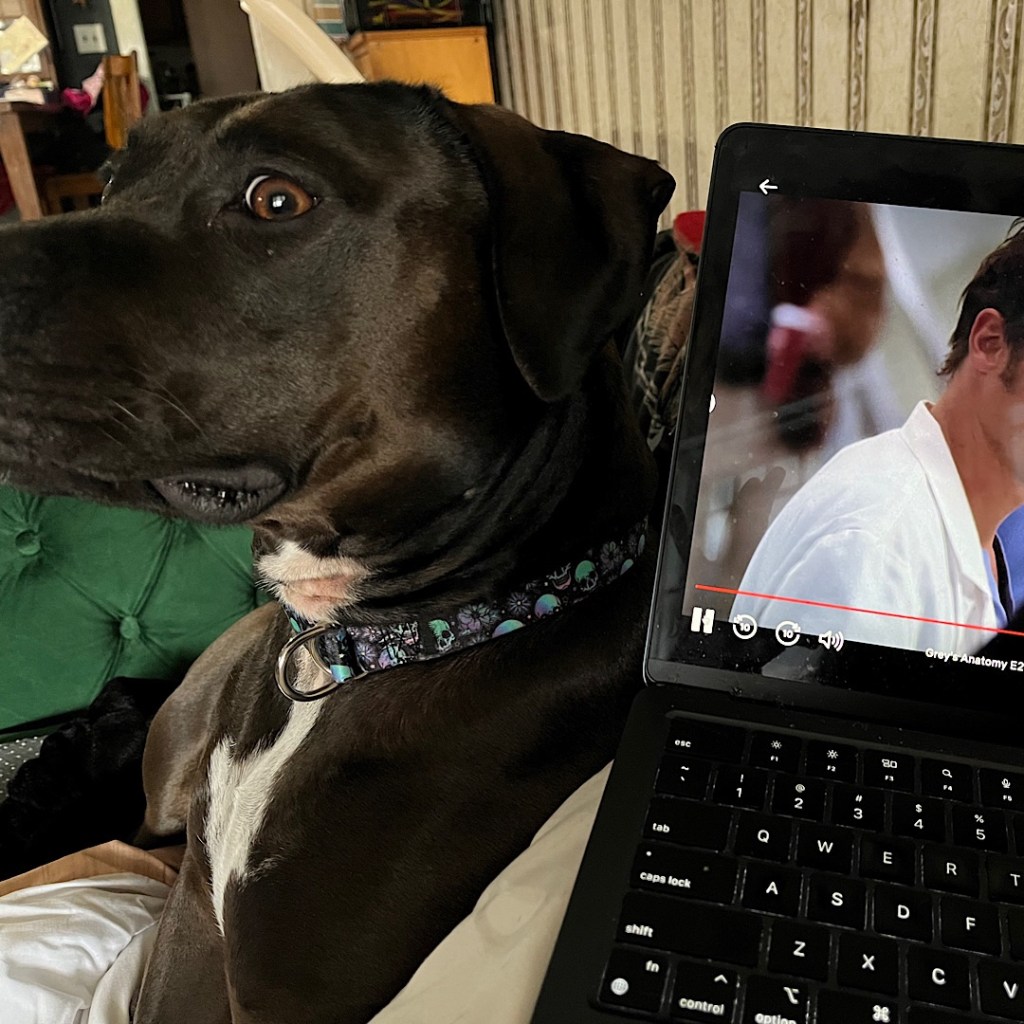
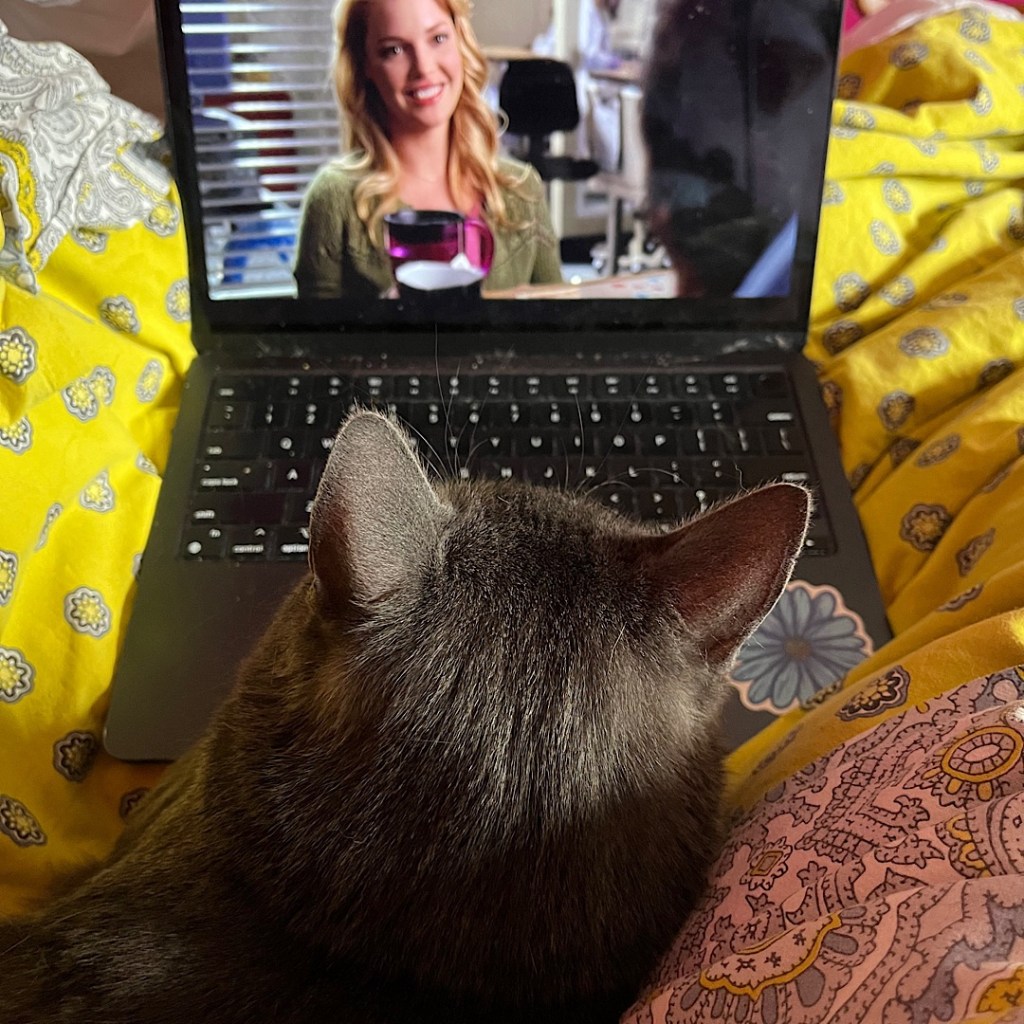
And in my case, I have explored some of Roku TV’s nostalgic offerings for Generation X (and earlier). I have watched Bewitched, I Dream of Jeannie, Diff’rent Strokes and Pink Panther recently while AppleTV offered me a free month so I am binging La Maison.
More on medical dramas: New Amsterdam

I can’t believe it’s been three weeks since I posted anything to this blog– if you’re looking for me I’m using on social media and on ParisianPhoenix.com as more and more my publishing business must support more of my life. It’s hard to believe it’s been 13 months since Stitch Fix closed our warehouse.

So, my personal life isn’t much these days because my professional life has blended so much into my personal life– and I don’t take care of myself with the attentiveness I used to because I have less resources and worse medical insurance.

But a while ago, I went on a tangent about Grey’s Anatomy. (I really cannot believe that it’s still on the air. I cannot stand Meredith herself.) All my Grey’s Anatomy’s posts can be read here.

After I finished all the season’s available of Grey’s Anatomy on streaming and watched Season 20, I turned to The Resident. I had attempted The Resident once before and abandoned it fairly quickly. I started that in early summer and finished it right after my Atlanta trip, a trip where I stayed about a mile from the museum that they used for the exterior of the hospital.

I think Dr. Bell’s transformation on that series– from the hands of death and destruction to an actual nice guy– was rather impressive. The way they handled Emily VanCamp’s (Nurse Nic Nevin) departure from the show was frankly stupid. They had an end-of-season two situation where Nic was stabbed, (one of the quintessential medical drama plots) and the staff saved not only her life but that of her unborn child, only to have her die in a car accident a few months later. As a writer, I would have much preferred to see her leave Dr. Conrad Hawkins and join some international medical NGO than simply die after swerving to avoid hitting a deer.

That show also did a troubling time jump. In the middle of one episode, they fast-forwarded three or four years as a way to get Conrad out of private practice and into the hospital again, since he is the main character. They used trick or treat night, and skipped to a bigger child and a different Halloween costume in mid-episode!

So, while The Resident has some perks, it also aggravated me as most of these shows do. You always have the maniacal surgeon who must have good outcomes at all costs, the doctor with cancer, the doctor hooked on pills. There’s always the natural disaster that threatens the hospital. The generators never work when they should. There is always a field amputation. And there is always a pregnant woman who gets in some horrible accident. And don’t forget the brilliant surgeon who has some catastrophic injury but manages to come back.

I could go on.

I was very skeptical when I started New Amsterdam, but I quickly noticed some nuances about the show. It’s far from perfect– within the first season we hit most of those typical plotlines and stereotypes. But the show grew on me. I’m troubled that they used the dangerous pregnancy plotline, with the caesarean without tools at home scenario, but killed the character off in the same episode with not complications from any of that, but in an ambulance accident.

And the storyline of psychiatrist Iggy Frome infuriates me and endears me to him. In the middle of the show’s run they have a few incidents where he must face the idea that he might be a narcissist, only to drop it without resolution (okay, technically I have about six episodes to go). But his later struggles to define himself and his role in his own relationships is stellar.

They tackle real topics with more than a perfunctory mention. The pill-popping doctor must deal with her sobriety, her addict family members, her sister’s overdose and her own controlling behavior as she realizes she replaces substances with sex and even people. The episode on the overturning of Roe vs. Wade had weight to it, as the medical professionals struggled to find solutions.

Their representation of diversity includes a trans nurse, a doctor with a dwarfism condition that starts as an extra and works his way up to chief of the department (even if that didn’t last), a conservative doctor who fathers a child in a polycule, and a deaf oncology surgeon who participated in one surgery and eventually became a main character– with a whole lot of ASL and other deaf actors/characters.

Now add to all of this that New Amsterdam is based on a 2012 book, Twelve Patients: Life and Death at Bellevue Hospital, and the author really did serve as medical director of Bellevue and survive cancer as the main character of New Amsterdam does… I, of course, had to read the book.

I’m 60 pages in, which is into the third chapter and I’m impressed at how well the book and the television program complement each other.

Life lessons according to Grey’s Anatomy

Periodically, I select a random television series and watch the whole thing, as much as I can get my hands on. Some of the shows come as recommendations from friends or family. Some are pop culture references that I feel the need to know.

With the variety of streaming services, I watch these shows when dining alone or when doing the dishes or folding wash. And I think I like seeing the various storytelling styles and the various characters built over the arcs of these long-running shows.

But no matter what– I just don’t like Meredith Grey as a person.

So with no further ado.

10 Life Lessons from Grey’s Anatomy

1. The people you love will die in car accidents at a young age. Or have catastrophic accidents and have miraculous recoveries. There are a lot of car accidents in the show, and some of them are downright crazy. Some people shouldn’t survive, and some should. Or some people get hit by a bus and die, others fly out a windshield and manage to bounce back from the most dramatic surgeries ever and don’t even have a scar. Drowning is also an issue.

2. Marriage is temporary. Just go with it. People get married quickly and divorce just as quickly. The average marriage on Grey’s lasts six months. And if it does last, people die in car accidents. People marry for love, for lust, for medical benefits.

3. 1 in 4 surgeons get brain tumors. At least. At least THREE of the main characters have specifically brain tumors and then in an unusual moment, one surgeon gets a spinal tumor in season 15. And brain. surgery, even with inoperable or cancerous tumors, is really easy to come back from in the Grey’s universerse.

4. Even if you spent a decade in school and have a lucrative career, feel free to start over in a new path on a whim. Doctors change specialties, or turn down impressive fellowships, or leave the country on a moments notice. And sometimes they become firemen.

5. You can easily change your name, leave the state and go to med school without anyone questioning it. OR if you run into immigration issues, the hospital can ship you off to Switzerland overnight so you don’t get deported.

6. Real friends cover up each other’s crimes and improprieties. I sometimes think this show should be named after the MORALLY GREY aspects of their lives. It doesn’t matter if you sabotage a clinical trial or beat the life out of someone, you can still be a doctor.

7. Most women doctors are lesbians or bisexual. A strange number of the female leads sleep with each other, but it takes until season 15 to have male characters in a gay relationship.

8. Doctors have no child care issues ever, even as a single parent with three kids. These doctors have the most convenient 24-hour day care that allows them to drop off their kids even if they are not scheduled to work.

9. Planes and helicopters crash A LOT. Not only do several characters die in a plane crash– but another character jokes about his plane crash. And those helicopters have a lot of mishaps.

10. Doctors have sex all over the hospital.

Revisit and review of Grey’s Anatomy

When Grey’s Anatomy was new, I did the old school, pre-streaming thing and bought a few seasons on DVD, probably on deep sale at FYE.

I never really liked them— only liked some of the characters. One of the ones I liked least — Meredith Grey. And the medicine portrayed didn’t interest me either.

But for some reason I started watching Grey’s on Netflix and have re-watched the first two seasons.

And for some unknown reason— I decided to go straight from season 2 to season 19. I’m about to 15 minutes in, and I already know I still hate Meredith Grey. I mean, that’s harsh, but they are imaginary people so I can say that right?

But I got to see Dr. Webber, who seems completely ancient now. And Dr. Bailey looks gorgeous but doesn’t appear to be working to the hospital.

And there’s a new Dr. Shepherd but I have no clue who she is.

But this poor Dr. Griffith with her amazing hair seems to have a lot of potential.

So it will an interesting adventure to see where these characters have gone in the last 17 years.

My new obsession: Dax Shepard

I believe I’ve mentioned (way too often) that 2022 has brought with it a lot of household-related stress. We are still trying to get the ceiling fixed with a contractor recommended by our insurance company. The project manager stopped by to try and match the material. They are literally giving me half a ceiling, just the portion destroyed by the flood.

I had my local franchise of Mr. Handyman replace some duct work under my downstairs bathroom. And The Teenager and I are trying to prioritize other household issues that come when you own a house and haven’t performed enough maintenance over 20 years: everything breaking at once.

So, as a attempt at escapism (between the house issues, my medical issues and my volunteer work and side hustle publishing company), I decided to view some of Dax Shepard’s work.

A friend had recommended his podcast, Armchair Expert, when I started listening to podcasts in the Stitch Fix Bizzy Hizzy warehouse. I immediately developed a mental picture of him that turned out to look nothing like him in real life. I imagined him as much shorter and less lean and blond.

And I wasn’t prepared for his big blue eyes.

Since I love Kristen Bell, and it saddened me to learn that she made one of her biggest splashes in Frozen as I am not a Disney fan (but I am a huge The Good Place fan), I figured it was about time I checked Dax out.

And I heard so many of Dax’s guests comment that he is such a talented comedic actor, so I wanted to see.

In my head, I still can’t reconcile how this super observant, intelligent man can portray such goofballs.

As a strong Gen Xer, I can remember sitting in my grandfather’s trailer watching ChiPs. I was hardly more than five or six, and I had a huge crush on John. My mother teased me relentlessly.

The contemporary retelling of this old television series beautifully crafted adult and sophomoric humor and tackled some larger issues in bite-sized moments. I loved it.

And now I’ve started Parenthood. I am ten episodes in. I love the family dynamics, even if the characters are very stereotypical in their basic concepts: the golden first-born son, the high-strung super competitive career woman daughter, the single mom daughter who has to move home in her mid-thirties, and the carefree jovial irresponsible son (played by Dax). But the plot lines and scripts are much richer and convey the major social and economic issues of the day.

I’m very much loving the show’s depiction of parents and teen daughters, especially since I have one of those. Dax’s character Crosby is growing with every episode, and that tickles me as well. The cinematography mimics a cross between a documentary and a sit com.

So that’s that.

My thoughts on Stranger Things

I listen to a lot of podcasts at work and one of them is “Why are people watching this?” This weekly podcast takes the top rated show on Netflix for any given week and reviews it among a group of friends.

They recently looked at Season Four of Stranger Things. Now, I first “tried” Stranger Things and couldn’t get into it. But I decided to try again, based on some comments made in that episode.

They reference how well the show captures 1980s nostalgia and comments on the good casting and talent of the young actors.

I am now starting the current season— and I’m curious where it will go because Season Three ended at a perfect point. So I think it will be hard to maintain the arc.

The series plays out like a comic book, often poignant, then funny, then over-the-top. It’s part teen drama, part horror, part sci-fi and in all honesty, the sci-fi/conspiracy horror/monster storylines don’t impress me. And the plot line of a government agency raising children with superpowers still feels like a rip-off of Dark Angel. Personally, the early episodes of Dark Angel captivate me and I love Jessica Alba in her lead role in that series. Just don’t watch the final season, it’s some of the worst television I’ve ever seen.

But anyway, the characters on Stranger Things keep me coming back. They are so interesting. And the essence of the eighties oozes out the pores. Their season three depiction of The Mall scene captured every detail— even the old branding of all the main icons of that era: Burger King, Orange Julius, the Gap.

It’s like the Buffy The Vampire Slayer of sci-fi/dark fantasy.

So I’m curious to see if Season Four will hold up.

Opinion: Representation of Aspergers in Season Two of Chicago Med

When Grey’s Anatomy first came out, I gave it a chance— but the amount of gratuitous sex made it realize very quickly it was a medical soap opera. I’ve watched a couple seasons, but the characters always seemed immature and the medical side of the show seemed superfluous to the plot.

I loved ER, but only made it through season 11 or 12. This was before the Netflix days. But still my favorite medical drama was House MD because of the quirky central character and the difficulties the rest of the ensemble cast had dealing with him.

One of these days I should make a list of the medical dramas I have watched over the years and revisit some of them to share what I like about them.

But my current show of choice is Chicago Med, but I am losing patience with it as I fear the writers are “jumping the shark” more with every season.

The first season did a great job of establishing a wide range of characters from a wide variety of backgrounds.

And in season two, the writers introduced a new heart surgeon— a Black and (Orthodox) Jewish gentleman by the name of Dr. Latham.

As soon as the regular cast began to interact with him, I suspected he had Aspergers. He portrayed a certain type of rationality and difficulty with emotions and reading others. His approach to surgery was very routine based.

I liked the character— a lot. And he discovered his Aspergers with the help of the psychiatric staff at the hospital (which as a doctor I think he would have realized it before) but to see him digest this news was very rewarding.

But then he wanted treatments. And that upset me. Aspergers made him a great surgeon and a unique character. But because he lacked empathy with distraught patients and the nurses said he “creeped out” families, he wanted to, pardon my use of the expression, see how the other half lives.

And the treatments started to work. And I hated it. I hated the notion that a doctor was perpetuating the idea that people who are non-mainstream need to be fixed.

Fuck that.

I’m not going to say anything more, because spoilers, but let’s just say by season 3 Dr. Latham’s Aspergers was forgotten and he contributes a valuable perspective to the show. And PS— in a mass casualty event, he rocks it with triage.

The show in Season 3 had a compelling storyline with Dr. Reese’s estranged father, which started as a really good dip into psychiatric issues, but then went over the top in not one but at least two ways. I hated the outcome.

And now in Season 4, I am seeing two storyline develop that feel more crime drama than medical and that’s not what I signed up to watch.

So now it’s a question of do I finish the show or abandon it?

Snowy day all around

The snow started its gentle cascade yesterday and has kept going, blanketing the world in cold and stillness.

Yesterday I cleaned the birdcages— the budgie family is doing well— and spent some time cooking and checking on friends.

Snow days are for chili, and several others on Facebook had the same idea. My chili was a vegetarian version with kidney beans, black beans, black eyed peas, carrots, spinach and corn (and a Yuengling to make it just right).

I did some more concocting today. Made some pineapple-curry quinoa patties I had in the freezer and chicken potstickers with some sautéed pineapple anticipating that the teens wouldn’t be keen on the “burgers.”

I even used the juice from the pineapple to whip up some homemade sweet and sour sauce. Somehow though I grabbed the chocolate vinegar so my sweet and sour sauce turned chocolaty which actually accented the pineapple.

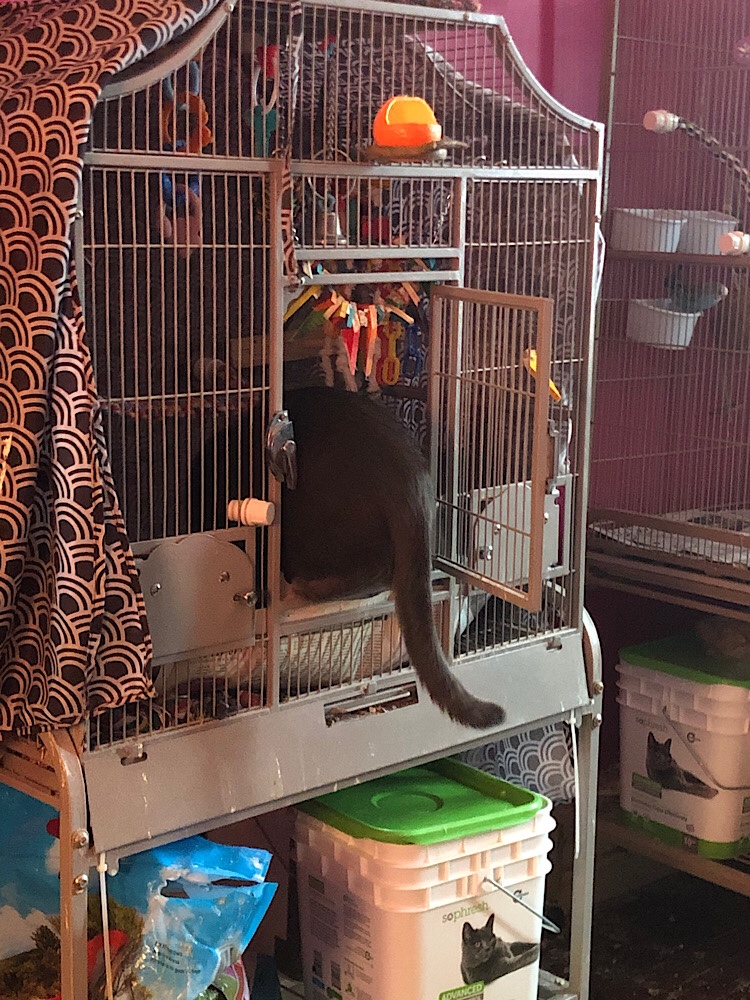
The animals meanwhile are either sleeping or in mischief. Minerva of the Roman Pride played in some red paint and Mistofelees decided he was a bird.

A video of Misty in the bird cage: Silly Misty in Bird Cage

The snow is still coming down and my shift at the Bizzy Hizzy has been canceled. I’m going to take my vitamins and watch another Brockmire.

I’m a Hank Azaria fan, in part because of his diverse and longstanding voice work on the Simpsons but also because he was hysterical in the Birdcage with greats Nathan Lane and Robin Williams.

I gave Brockmire a test run because of an interview on Fresh Air (this should link to the podcast). I’m finding a lot of humor and a lot of societal commentary and perhaps just reality. Some of Brockmire’s comments about larger issues like climate change surprise me. In general, Brockmire as a character experiences a lot of growth.

And he gets a tortoise in season three. As a former tortoise owner, the tortoise humor slays me. Even though he does keep calling it a turtle.

Clip featuring Clemenza: Clemenza, Brockmire’s tortoise

So now that my dishes are going and my coffee is done, let me head back to my Brockmire.

Streaming TV: Coming of Age stories

I tend to watch TV while doing chores or when resting between fatiguing tasks. I often watch TV on my iPad when putting Nala (my Goffin’s cockatoo) to bed.

I recently finished The Crown on Netflix which fed my love of history to my writer’s mind. When I work with historical documents in my academic work, I often imagine the lives in the text.

Though I do find it… awkward that they made a television series about living royals. Then I realized— it’s Queen Elizabeth’s coming of age story.

I recently watched Free Form’s Motherland: Fort Salem, which is an alternative history, a coming of age story and in my opinion— a political drama. There are heavy ethical questions in every episode even if the plot lines seem predictably anti-cliche.

And I find it difficult to extend my “willing suspension of disbelief” to accept that witches would call a truce with the Church and State and would serve as a conscript military.

And the magic is better than Harry Potter, and the technical aspects of it are done off screen though I don’t like that the magic is mostly vocal.

But I’m very anxious to know what happens next.

Speaking of coming of age stories, I also watched the French film Mignonnes (Cuties) that is trending on Netflix. Of course, the mainstream American discussion focuses on the objectifying and sexualisation of young girls.

The main character (Ami/Aminata) is French of Muslim descent hailing from Senegal. So her grandparents and community elders speak Wolof and she is black.

Traditionally, Muslims came to France as part of the African colonial legacy. Muslims struggle with their identity and acceptance in France— regardless of racial background.

So I immediately saw how all the kids from the French projects bonded through dance even if that dance was suggestive. The fat French girl, the Latina French girl who ironed her hair, the blonde and white French girl, the black French girl and, yes, the African Muslim French girl.

This was a story of the universality or growing up in a technology rich world as a poor female. And trying to find your place and a way “out” of difficult socio-economic places.

A very different coming of age story— offering a very different time and place— was Crip Camp on Netflix. I notice Netflix documentaries made by Netflix are often merely interviews and footage randomly strung together and as such rather boring.

Finally, I’m dying to watch a final documentary, and to some Jersey kids of the 1980s it might also be a coming of age story, Class Action Park. It’s currently on HBOMax and I am considering getting a trial so I can watch it.

Action Park was an amusement park in New Jersey with such crazy rides no one would insure them. Some of my friends used to go. I vividly remember the commercials.

TV Psychotherapy

My mind has experienced a lot of shifts recently. I have changed the way I communicate thanks to some insights of the teenager, some stress at work, and a variety of great support from friends and family.

In the midst of all this, there is the Coronavirus pandemic which allows a lot of introspection for those of us who try to be self-aware.

I’m not a big television watcher. I grew up in a rural setting in a valley by the river where we had poor television reception. We didn’t receive access to cable until I was a teenager.

When I left home, my husband and I chose not to pay for cable (and this was Netflix first started and they mailed you discs and prepaid envelopes— streaming was not a thing).

So, Hulu and Netflix on my iPad have allowed me to explore decades of pop culture. And I realize that many of these reality television programs can offer a window as to how we all face our struggles and build our relationships.

While I originally started watching Gordon Ramsay, it was because I love food and he had a reputation that I wanted to understand. I also like big, athletic guys with bad attitudes and exotic accents.

But the more I watched— whether it was Hell’s Kitchen, Kitchen Nightmares, Hotel Hell or other Ramsay programs— I saw people of all backgrounds reaching toward goals of increased knowledge and skills, wanting a better life, and working to impress not only a mentor but a larger-than-life icon, a modern God.

And Ramsay pulls talent out of people and sees something in people. It’s amazing to watch.

Inspiring.

Shows like 90-Day Fiancé show how desperately people want to be loved and the lengths they will go to— whether in hope of love or acceptance or, again, that desire for a better life or a Green card.

Now, I’m watching Hoarders. I watched the first episode because I’ve been in a hoarded house and it is mind-blowing. I wanted to understand.

I have learned how our upbringings and traumas intersect and influence how we communicate and relate. That stuff, shopping, accumulating, giving up and other verbs… it’s a manifestation of our emotional walls. I would classify My Secret Addiction (or is it My Unusual Addiction?) in the same realm—how to cope.

And then you take a show like Transitions, where people explore their gender identity, and I suddenly see how much of a struggle they have to live as the person they really are versus the person they feel forced to be by family and society. That’s strength.

And why you really want a good outlook, and to see hope, enthusiasm and change, you watch Queer Eye.