Author Angel Ackerman
Surviving Life With Baby
A humorous list of survival techniques for parents welcoming their first child.
Surviving Life with Baby
- You may think you have no idea what you’re doing. You don’t, but neither does baby. Baby is just as new at this as you are.
- The “book” may say not to put baby in the swing for more than 30 minutes at a time, twice a day. Other moms say: If it saves your sanity, do it.
- It’s normal to consider selling the baby on eBay. (As my husband says, “SIDS is just an excuse for parents who smother their infants.”)
- Rock, swing, swaddle, sing, feed, diaper. Repeat.
- Week four is easier than week three, and so on.
- For the firsts few weeks, make lists of everything. A “to do” list may include your own basic hygiene. (Hint: conveniently leave list of chores where friends or relatives, who “want to help” will see it.)
- There will be days when you don’t brush your teeth until two in the afternoon.
- Sometimes, running the dishwasher makes it a good day. Sometimes, running and emptying the dishwasher constitutes a good week.
- Make your own rules, then decide which ones to break. (I said no pacifiers, but rescinded for nap time when my mother-in-law babysat, but I insist on the No TV rule. I like putting the baby to bed at a set time every night, but sometimes my friend keeps her baby up if her husband works late so they can have family time.)
- Listen to your heart, not your neighbor’s advice. Same goes for mothers and other relatives. If it doesn’t feel right to you, don’t do it.
- You will understand Baby’s cries. Suddenly, around eight weeks, you just know what the baby wants. And you’re not sure when it happened.
- Your life will start to return to normal—in about six months.
- If breastfeeding, remember: It can be uncomfortable for the first four to six weeks. Then, it’s the easiest thing in the world. Even in public. As my friend and peer mom says, “it’s not a breast anymore, it’s like whipping out a bag of potato chips.”
- It’s not just poop. It’s a major event. After a while, it requires a Richter scale. “That’s the biggest 10 I’ve ever seen!”
- Call your friends. Have a friend or relative who you can call at any hour. Or make sure your spouse has a cell phone on. There will be days when you feel like you’re going crazy and you need someone who has had a baby and understands. These days get fewer as baby grows, but they still happen.
- Sleep when the baby is sleeping sounds good but it doesn’t always work. I recommend going to bed at night when the baby goes to bed, even if it is 6:30 or seven o’clock. You may need to do this for a couple months to prevent utter and sheer exhaustion.
- If you cook, double the recipe and freeze some. Label well.
- Prioritize. I do dishes and laundry every other day. But the toilets—I try to do them once a week. If I make every other week, that’s more realistic. Until baby moves, vacuuming is a low priority. (But a good one if visitors want to be helpful. Just leave the vacuum where friends and family will see it.)
- Pace yourself. Even if you feel great, don’t overdo it. Take it as easy as you can until that post-partum check-up. And if your guests/relatives/visitors annoy you—ask for some space or hide. You can take the baby with you or not. Hormones do go crazy. Blame them.
- If baby is inconsolable, go for a ride in the car, a walk around the block or try the swing. Motion works wonders. Sometimes, you need fresh air, too.
- MOST IMPORTANTLY: On the very worst days, the baby will do something really cute to remind you why you’re doing this. Don’t forget to watch for it.
We spent days meandering the streets of Tunis. We hopped trains to Sousse and Carthage. We celebrated with the locals on the one year anniversary of the departure of Ben Ali. Olives factored into our lives there with every meal, served in a big bowl beside the olive oil, harissa and bread. A perfect complement to the spicy tomato-based, lamb sausage soup that I can still taste today.
We found the market the day before we left. We could see it from our balcony at the hotel, but we never quite realized what sat under that massive building always boisterous from the first light. That’s where I snapped this photo of olives, in all their rich varieties.
Every time I taste a good olive, a real olive, not one that’s been industrialized and reduced to life in a can, I return to Tunisia.
Travel: Olives
News: Phillipsburg police gain K9 Tanner (2001)
Excerpt: How Haute Couture Sells Prestige
Seducing the Masses:
How Haute Couture sells Prestige for Fashion Houses
By Angel Ackerman (December 2010)
Anyone who has ever watched “Style with Elsa Klensch” on CNN, noted the dresses of
female celebrities at the Oscars or flipped through the pages of a fashion magazine like Vogue or
Harper’s Bazaar has seen the fantastical creations of modern French high fashion or haute
couture. While the industry technically caters to celebrities and the wealthy, the importance of
modern haute couture depends on it building an image of pizzazz for a fashion house. Individual
houses rely on haute couture not to sell extremely labor intensive art pieces from the runway, but
to promote mass market merchandise such as ready-to-wear, perfumes and franchise goods
(cosmetics, sunglasses, purses and ties). The glamorous image of haute couture draws everyday
consumers to cheaper more mainstream goods by offering them a small attainable piece of
luxury. In simple terms, this paper will look at why haute couture still exists and concludes that
the answer rests in the image high fashion creates and how it influences consumers to buy
perfume and ready-to-wear.
To understand this interaction, it may be beneficial to offer a definition of haute couture
today. Claire Shaeffer, not a scholar but a sewing expert, provides a relatively succinct and
precise definition of this aspect of the fashion industry. She states:
“To earn the right to call itself a couture house and use the term haute couture in its
advertising or in any other way, a member of the Chambre syndicale (1) must design
fashions that are made to order for private clients and involve one or more
fittings, have a workroom in Paris with at least 20 full-time workers, present a
collection of at least 50 designs, day and evening garments, to the press in Paris in
January and July for the spring/summer and autumn/winter seasons and show the Collection to potential clients in the respective couture houses in a determined place.” (Shaeffer 2007: 7-8)
These rules cannot even begin to explain how incredibly complex haute couture construction is,
though Shaeffer also provides a summary of the buying experience of a 21st century client in the
Dior couture house. As Dior is one of my case studies for this project, I will devote some space
to this so that the reader may see exactly how this industry remains old-fashioned, labor intensive
and as a consequence, cost-prohibitive. The mechanics of this sales and service process are
nearly identical at every house.
After the January show for the press, the fashion house will host weekly shows for clients. Each client books appointments with the head saleswoman (directrice) with their individual saleswoman (vendeuse). A client always has the same vendeuse, so that the vendeuse can understand the client’s style. Most of these saleswomen speak fluent English in addition to French. The client will try the sample garments, usually unzipped because of the small sizes, but the vendeuse is adept at working around this. Changes are discussed, items like the fabric or
length of skirt are all customized. On a client’s first visit to a house, the première (literally, “first”
or head of the sewing workshop) will take about 30 measurements of the client’s body, head to
toe, so the staff can make a dress form to replicate that client’s shape.
The première main (or “first hand,” the top-skilled seamstress in the workshop) will
create a muslin toile of the garment. The workshop staff will cut real fabric with the toile as a
pattern. The garment is sewn together loosely (basted) for the first fitting. The client tries the
garment, the staff evaluates it and marks changes before returning it to the workshop. They
remove every stitch and every piece of the garment pressed before being reconstructed for the
second fitting. Embellishments such as embroidery or beads are added. A second fitting occurs
and if everyone is satisfied the process may stop there. Significant changes mean deconstructing
everything to press every single piece again. The final step is always to add the label, which at
Dior includes the date of the collection and the fabrication number. This summary is extremely
simplified, and does not address a complex garment or a fashion show (Shaeffer 2007: 14-16).(2)
As this summary demonstrates, haute couture embodies everything old-fashioned.
Everything in haute couture is done by hand, from seams to sleeves, beads to feathers. If a
fashion house does not employ the “hands” (“mains” as called in French) for these jobs, it hires
outside contractors for it. Chanel is famous for its 2002 purchase of House of Lesage, France’s
oldest embroiderer that traces its origins to Charles Worth, the founder of haute couture. This
house provides lace and other embroidery work for three of my case studies: Chanel, Dior and
Lacroix. Imagine in today’s world of sewing machines and cheap international labor, an army of
people in France with jobs as intricate as being the “little hand” (“petite main”) that sews sequins
or, my personal favorite, the left-handed “hand” who finishes zippers (Shaeffer 2010: 96).(3)
Despite its old-fashioned methods and its roots in the mid-19th century, haute couture
always has embraced a global business model aimed at surviving in the roller coaster
environment of the early 20th century. This model depends on image. Trends in demographics
of wealth, exploitation of global media, creative franchising, incorporating international business
partners and, perhaps most importantly, connection with technology that allowed the
manufacture of ready-to-wear and mass market merchandise have allowed haute couture to
survive. This project will discuss how image and clientele intersect in haute couture to promote
ready-to-wear and other consumer goods.
To explore this, I have compiled chronological timelines of major trends at several haute
couture houses, using three legendary French houses as case studies: Chanel (founded 1909),
Dior (1946), and Yves Saint Laurent (1961). I extrapolated data on licenses for mass market
goods, sales and the performance of haute couture throughout the 20th century. I applied my
findings to two newcomers, Jean-Paul Gaultier (ventured into haute couture in 1997) and Christian Lacroix (1987). The traditional houses of the former trio developed mass market practices as a means of survival in the face of World Wars, economic crashes, globalization and the information age.
The latter two are different. Gaultier opened his ready-to-wear house in
1977, waited twenty years to delve into haute couture and earned his official designation in
2001. Lacroix opened his doors in 1987 but declared bankruptcy in 2009. Now, Lacroix is
known for scents marketed by Avon.
Business books on fashion argue whether or not fashion is a success or if it will continue
to have world influence. The End of Fashion by Teri Agins, a Wall Street Journal reporter
covering fashion, calls the modern fashion industry a failure because of declining profits (even
though mainstream brands like Levi Strauss continue to make millions, they are making less
millions than previously). Fashion Brands by Mark Tungate, a marketing specialist, studied how
fashion brands develop and use their image. I built on their observations by studying both
French and English language sources (books by people in the industry, biographies, newspapers,
magazines, interviews with designers and corporate representatives, official web sites, and
academic journals). I tried to interpret data regarding who bought haute couture, its effect on the
French economy, global profits in the luxury market and how specifically perfume and ready-to-
wear increased profits for fashion houses.
Many of these items cannot be directly compared. For instance, sales figures are
presented in the literature as French francs, Euros, dollars and even pounds. Even when they do
correspond in currency, the years are so far removed from each other that the figures cannot be
compared without adjustment for inflation.
My goal is to explore the relationships between haute couture, an industry which costs
fashion houses millions of dollars a year, and mass market fashion goods. Agins blames the lack
of haute couture profit on the industry’s indulgence in art and talks about how multinational
entities — including two big French corporations: LVMH (Louis Vuitton Moët Hennessey) and PPR (Pinault-Printemps-Redoute– purchased fashion brands in the nineties. She proclaims haute couture a failure and implies that fashion as an industry will continue to decline. Agins neglects to consider fully the impact of image and marketing these
mass market licensed items, something Lou Taylor focuses on in “The Hilfinger Factor and the Flexible Commercial World of Couture.” Similar to how the lower-end brands like Tommy Hilfinger use the specific selling of a lifestyle image, that’s exactly how haute couture incurs profit. Image leads to the sale of overpriced designer goods. Taylor calls this phenomenon “brilliance in commercial flexibility” (Taylor 2000: 129)
While Taylor addresses mainstream American fashion entities, his findings are supported in the business realm by Alain Chaffel, a French economist, also credits the success of haute couture to “brilliance” but he refers to
handicraft and creativity (2008: 46).

Haute couture often sparks a debate about whether or not high fashion sewing influences

everyday clothing trends. Fashion scholars argue about whether fashion trickles down from
haute couture or “mops up” from the street (for example, Jenkin Jones 2002 vs. Hastreiter 1993),
but a bigger lesson can be learned. On one hand, scholars like Taylor study mass market goods,
while haute couture attracts scholarly attention for its artistic value and impracticality. No one
seems to acknowledge that haute couture spawned the modern fashion industry, and it did so by
incorporating global business practices at its very origins. Its sensitivity to the global market and
its adherence to French values makes haute couture a relevant topic that combines the
preservation of culture with international economic success.
Haute couture follows strict French trademark and production rules, as an appellation
d’origine contrôlée, despite tracing its roots to Charles Worth, mentioned earlier as a founder of
House of Lesage. Worth was an expat Englishman who made Paris the center of the fashion
universe. While fashion seems quintessentially French in reputation, only two designers from
my five case studies are French. All three of my iconic French houses are led by non-French
designers. Chanel’s Karl Lagerfeld is German. Dior’s John Galliano is British. Yves Saint
Laurent’s Stefano Pilati is Italian. This offers a direct contradiction to the stereotype that the
French do not like foreigners involved in their business, another reason why haute couture is a
pertinent industry to study today.
ENDNOTES
(1) Already Shaeffer introduces a complexity into this definition. Producers of haute couture must belong to
the official French fashion union. They can only join the union if they have a “godfather” who is already a
member of the union who attests to their craftsmanship and worthiness and fulfill all the other criteria in
Shaefferʼs definition.
(2) To get a small taste of the craziness before an haute couture show I highly recommend “The Day
Before: Jean-Paul Gaultier,” part of a reality series on the Sundance Channel. The Day Before, Season
1, Episode 4, featuring Jean-Paulʼs spring 2009 collection. Valentino: The Last Emperor is a feature-
length documentary film about Valentinoʼs last collection which is available in Skillman Library.
(3) Shaeffer points out that itʼs rare to find an ambidextrous “hand” who can easily sew both sides of a
zipper, so many houses have an employee whose primary job is to be left-handed. This level of detail
and intricacy is typical of haute couture.
Photo: The Magic of Cape May
November, 2006.
My husband and I traveled to Cape May, N.J., for our first vacation that didn’t involve staying in the home of a friend or relative since the birth of our daughter.
The weather had turned cold, so we bought her the hat she’s wearing. Plus a frog raincoat. She refused to take either off for the duration of our trip. This photo summarizes the fantastic adventure.
The sun. The sand. The child’s fascination with touching and exploring. She called the Victorian where we stayed “The Fancy House.” We took her to an arcade and played Skeeball and encouraged her to play a game where she danced on the blinking lights. Her prizes? Some dinky vampire teeth and a finger trap.
A man saw us together on the beach, as the wind whipped us around. He offered to take a family portrait. I displayed it in the living room for years.
Humor: Baby, just sit in the swing!
My life is usually funny. When things go wrong, they don’t go average wrong. They go Charlie Chaplin style wrong. I did an entry on my writing blog about this tendency of my life because my friends are always pushing me to be the Erma Bombeck of my age. And I do love the classic Erma!
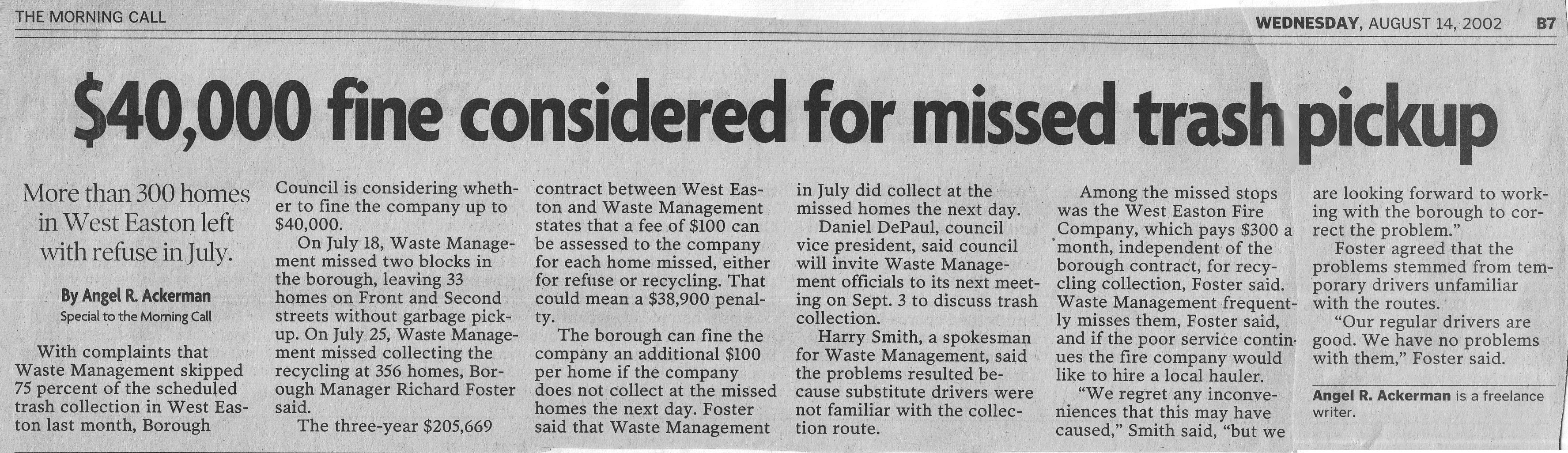
Here’s a newspaper clipping about my daughter that I think falls under humor.
Basic PR for the Amateur
If you have public relations or journalism experience, this list is not meant for you. This list is meant for the mom in charge of the PTA public relations committee or the poor guy who volunteered at the animal shelter hoping to walk a dog and got stuck behind a computer. It’s always a great list for the small business owner hoping to generate media interest in their operations without paying for it…
- A press release should be about 400 words long. It should never be longer than one page.
- A press release should end with three number signs (###) centered on the bottom of the copy. (Copy is the lingo for “the words.”)
- If writing from a business, non-profit or some other not immediately recognizable entity, the paragraph about the ### should say, in about 75 words, the history of the entity. This paragraph should be on every press release you send out and it should always say exactly the same thing. Update it yearly, or when there’s a big change.
- When you email a press release: the subject line of the email should say PRESS RELEASE: and then state the most basic facts: what’s happening, why they care, and the date. All in the subject line. This information will be similar to the headline you put on the press release and similar to the file name of your press release.
- Copy the entire press release into the body of the email, so they don’t have to download the attachment to read it to judge how important it is.
- Attach a .doc, .rtf or .txt file of the press release to the email, so if they want to copy your press release without retyping they can without having the hard returns and goofy formatting that comes with email.
- For an event, send a press release about two weeks in advance. You may send a reminder a few days before the event, and clearly state REMINDER in the subject line with the same title as the original message.
- Now, the writing. Always write your first paragraph as if it’s the only paragraph the editor will read. Keep it under 100 words. Cover who, what, when, where, why and most importantly: convey any specific info that would resonate with the readers/public.
- The second paragraph can provide more info as to why it’s an important event. Provide the details that will convince the editor to do the story.
- Paragraph three is a nice place to provide a quote from someone involved, with the quote marks and everything, just like they do in the newspapers. This will relate directly to what was said in paragraph 1 & 2.
- You can single space your press release, but provide a space between paragraphs so it’s easy to read.
- Always provide a “For more information, contact:” line. I put mine at the very top. Include the person’s name, their title, their email, business phone, and, if possible, an “after five p.m.” number so a reporter on deadline can find you.
- Use active verbs. This means avoiding as much “to be” as possible, avoid “is,” “been,” “was,” “being” etc.
- Use spell check and grammar check
- Have a friend read it before you send it out