Falling through the screen door

Monday. I slept pretty decently last night despite the oppressive heat. I had performed 105% in Freestyle on Sunday in the Stitch Fix Bizzy Hizzy warehouse, folding and shipping clothes while dreaming of new sundresses for myself.

I came home a little stiff and achy, a trend that seems to be back-sliding on the recent physical progress I made but the finger held up to its first day out of the splint at work.

I also came home early, as the Teenager planned a movie night for blind friend Nan to watch How to Train Your Dragon, a movie I have not yet seen despite the fact that I made a Toothless stuffed animal at Build-A-Bear.

Nan and I were to stop and pick up dinner at Wawa and the Teenager had made homemade ice cream (that honestly was on par with Cold Stone Creamery). And everyone got their desired dish from Wawa— except me— as I wanted a pre-made salad from the grab and go cooler and apparently the cooler was broken. The employees were removing all the food and the floor around it bore wet floor signs.

So I ate leftovers out of my fridge.

The audio-described version of the movie was intense. The poor man doing the description didn’t have time to breathe.

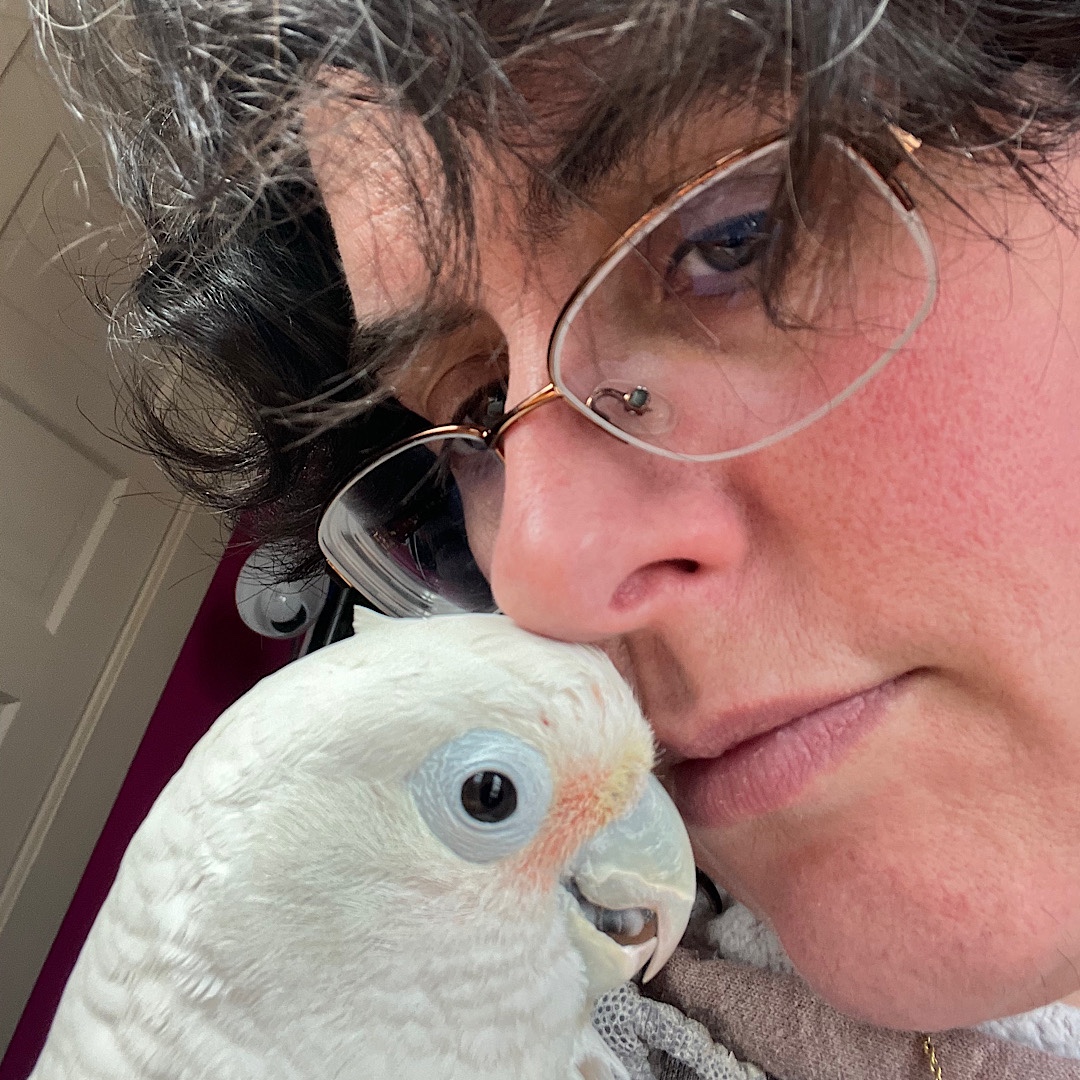
I was in bed by 8 p.m. The cockatoo had issues at 2 a.m. But all-in-all a good night.

At work today, I was tired, hot and a little bored at my regular table in QC. I did 101%.

I’m still have issues with a strange burning and tightness in my right thigh, and dealing with that is causing lower back pain.

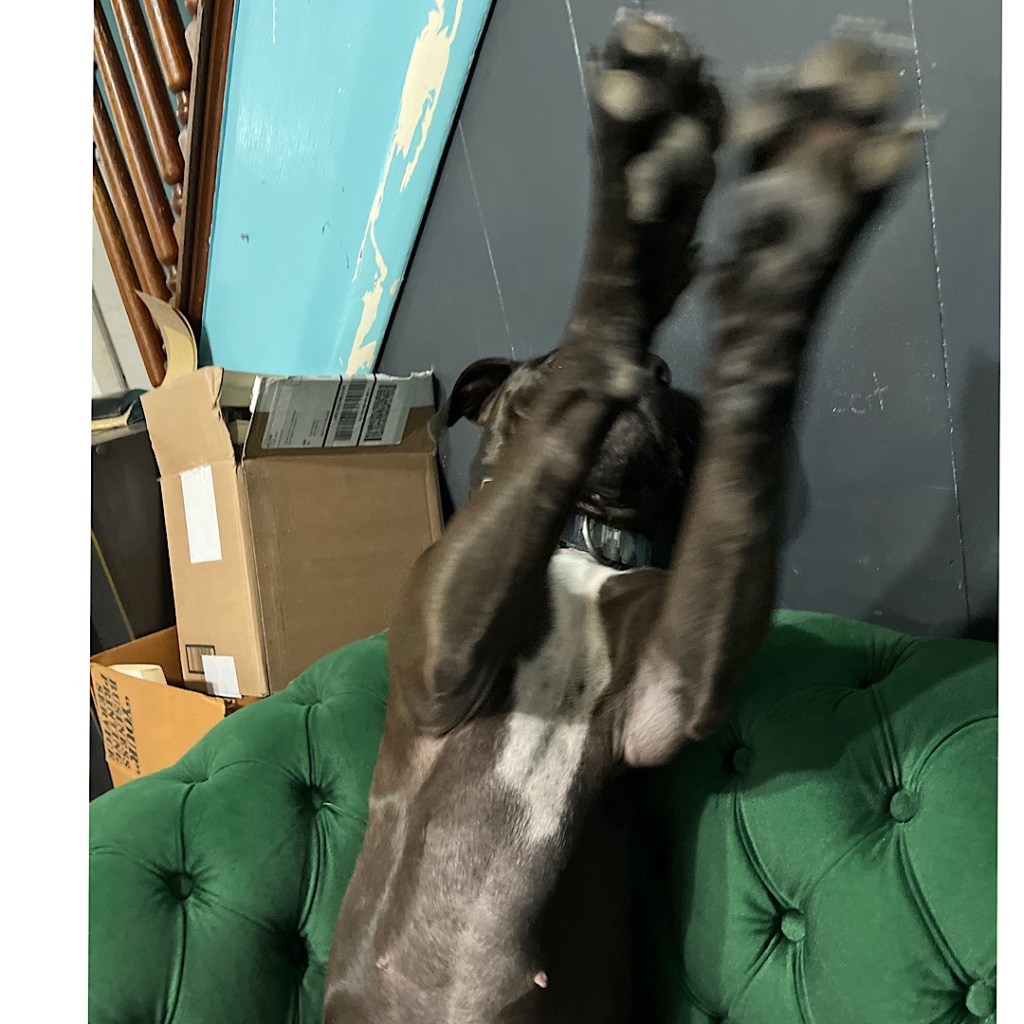
I got home from work and tentatively poked my head around the corner in the garage— checking to see if dog was in the yard. She was not.

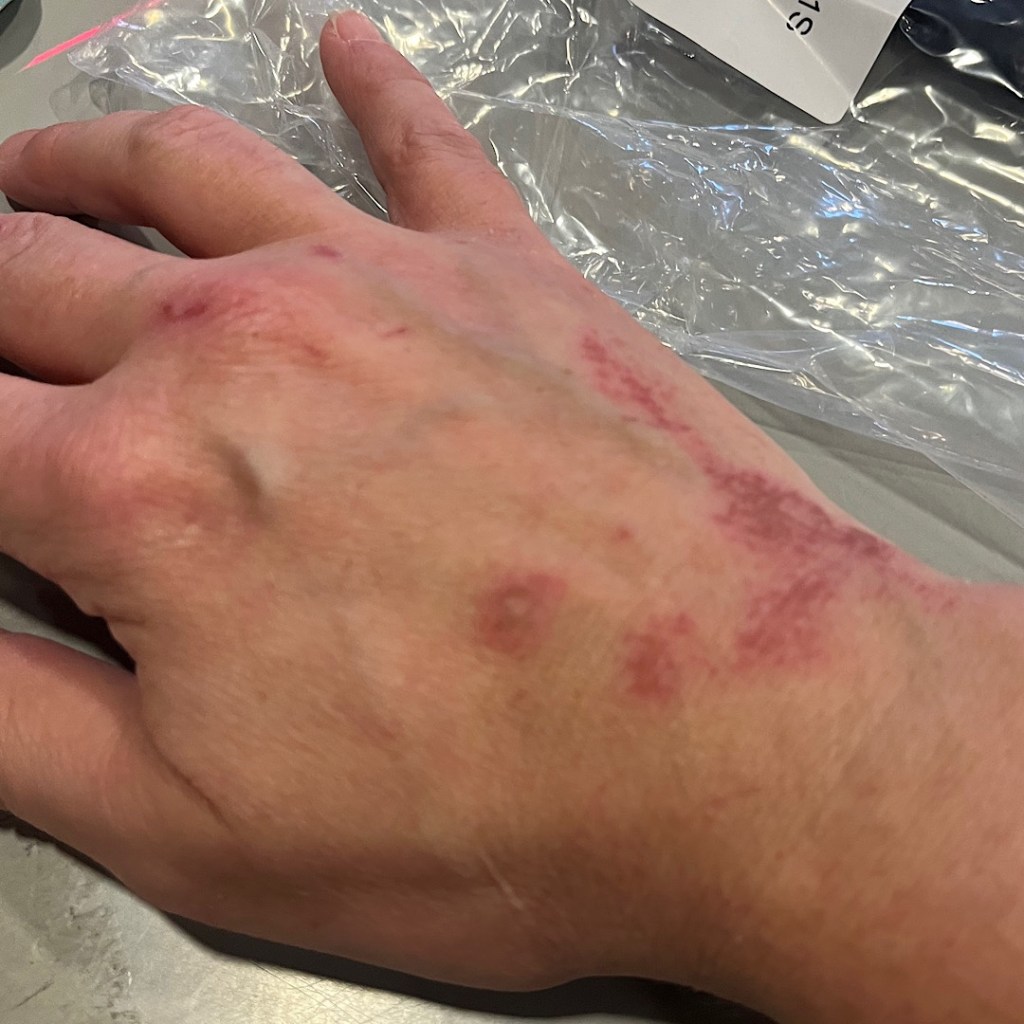
I walked up the stairs from the car bay to the main room of the garage. Walking across the big open space in my garage, I tripped over my own foot and fell. I did some sort of corkscrew dive and fell backwards through the screen door to exit the garage then skidded across the floor. I scraped my hand, my knuckles, my elbow and I think my leg and knee.

But then I still went to the gym. Under Andrew’s careful eye at Apex Training, I did my workout. I felt better than when I arrived, even if I am still a little stiff and achy, but such is life with cerebral palsy.

Some of the damage

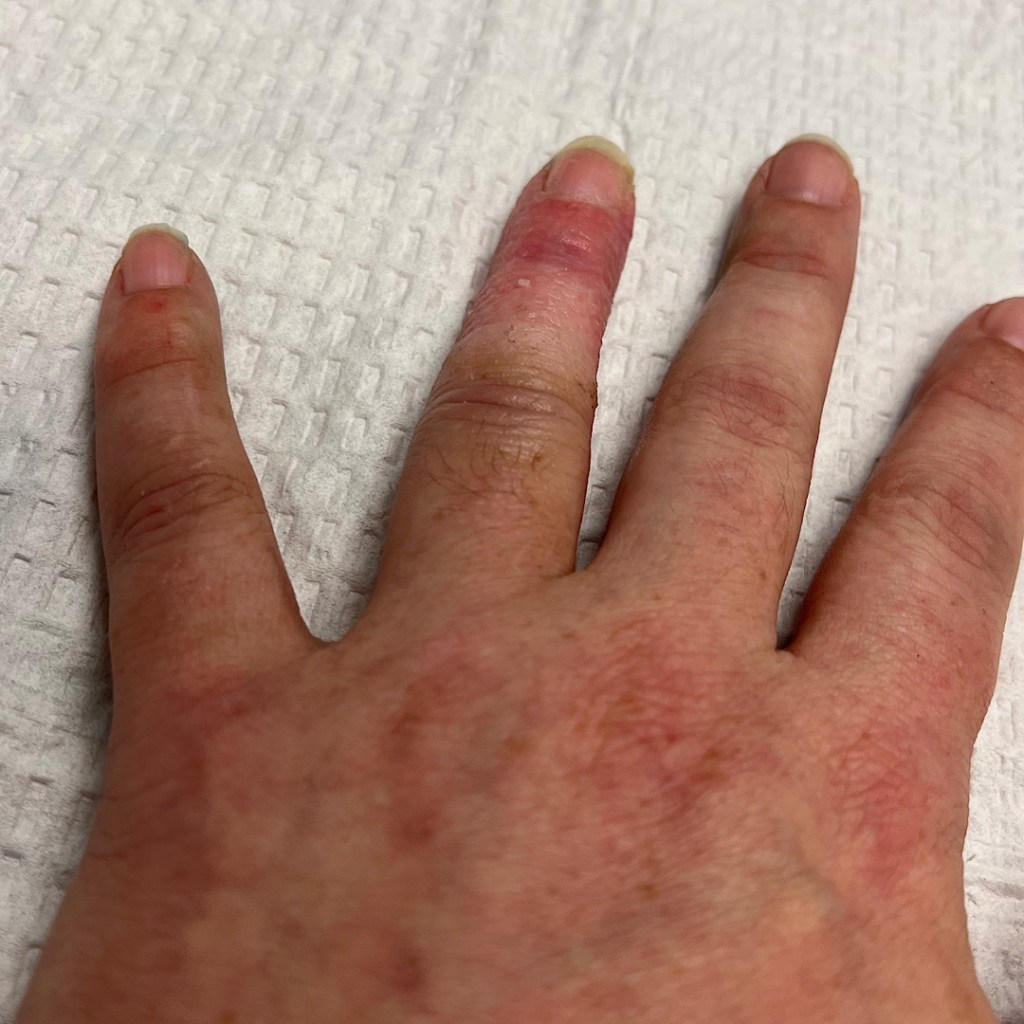
11 weeks in with mallet finger: Discharged from hand rehab

This week marked my 11th week in treatment for my mallet finger. Almost three months caring for this injury. 9 weeks in a cast. About 9 days in a splint 24/7. One week in a splint most of the day, taking it off 5X a day for an hour.

This morning was my third had rehab appointment since the cast came off. They also did the casting so I had two previous visits with them.

Typically, I go in, they make me bend my fingers and they measure everything, tell me the following week’s directions and send me on my way.

Today I went in, the had me heat my hand for 15 minutes and then I got a finger massage. The therapist measured my finger and made me a new night-time splint and told me I no longer need to wear the splint during the day.

Because I do so much work with my hands, if it starts to droop or just bothers me, I can splint it here and there for an hour.

I have another appointment with my hand surgeon July 27, so although the general guidelines say I only have to splint at night for 2 more weeks, it is recommended that I wear it until I see my specialist.

Other wisdom from my therapist as we chatted today:

  • Completely immobilizing a mallet finger for six weeks is the minimum in his opinion.
  • The finger can continue healing for an additional six months after splinting is complete. He recommends using individual judgment and awareness of the finger to decide how long to splint at night.
  • Massage the finger, especially the joints for five minutes several times a day.
  • Understand that the finger may never resume its former shape/posture/movement but that the end of the finger itself doesn’t have that big of a role in hand function.
  • Keep bending the fingers several times a day, gradually working into a fist.

Mallet finger update: I’ve had it with this splint

Today was my last official day working with a disability accommodation in the Stitch Fix Bizzy Hizzy warehouse. It’s Sunday, tomorrow is the Fourth of July, and I had a helluva time getting out of bed when the alarm went off at 4:15 a.m.

So I didn’t.

I was in the middle of an anxiety dream where I was with an old friend that cut off ties with me a decade ago… and I think a few people I’ve lost were in that dream.

I reset my alarm for 4:45 and started my day a little off and then the Keurig decided I only deserved half a cup of coffee. As. If.

Today was my first day working in my new splint. (If you didn’t know I lost the first one in my car, you can read that story here.)

I’ve suspected since Friday afternoon that my new splint was too tight, but I didn’t confirm it until I started to see marks on my finger, deep ridges, yesterday.

During work today it got pretty unbearable— so when they let us out early I came home, heated the teapot and dropped the custom splint into a bowl.

I poured the boiling water into the bowl and reshaped the plastic. It’s not nearly as perfectly molded as the professional job, but it doesn’t pinch my finger.

Mallet finger: week 10-ish

I had an 8 a.m. appointment with my occupational therapist at The Institute for Hand and Upper Extremity Rehabilitation. I cannot say enough nice things about them.

I arrived around 7:50 a.m., and ended up walking into the building with my therapist. The receptionist wasn’t there yet. My therapist grabbed my file and started my appointment before her computer fully engaged for the day.

I told her the story of losing my splint. She made me a new one and I didn’t even have to pay extra.

For more info on losing my splint, click here.

The finger is “holding up” and this week, when I take the splint off to do my exercises five times a day— which I might do seven, just based on my routine— I can leave the splint off for one hour five times a day.

It sounds like if my finger maintains its posture through this week that I am more-or-less out of the woods. It’s very exciting.

Why do I do my exercises seven times a day? For exercises like these— physical and/or occupational therapy exercises that require little bits of effort multiple times a day— I find attaching them to logical parts of my routine helps.

So in my case:

I left my appointment at 8 a.m. They are so efficient!

4:15 a.m. Wake. Remove splint. Use bathroom. Wash hands. Start coffee. Do exercises. Replace splint.

6:15 a.m. Use bathroom at work. Check hair. Remove splint to wash hands. Return to main cafeteria to chat with friends. Do exercises as warm-up for the intense folding of clothes to come. Retape splint. Head to time clock.

8:50 a.m. Remove splint. Go to bathroom and take morning break. Do exercises. Have morning yogurt. Replace splint. Fold more clothes (about 175 pieces of clothing every two hours). Yes, I fold and package clothes. I work for Stitch Fix doing Quality Control for the subscription boxes. My side hustle is my book company, Parisian Phoenix Publishing.

12:10 p.m. clock out for lunch. Remove splint. Use the restroom. wash hands. Do exercises while heating lunch. Eat. Replace splint.

3:10 p.m. Final 15. Remove splint at work station. Go to wash hands. Do exercises while enjoying a cup of coffee or snack in the main cafeteria.

5 p.m. Clock out of work, remove splint, wash hands, stretch fingers, replace splint.

5:30 p.m. Get home from work. Fight off very excited large dog. Remove splint. Wash hands. Do exercises. Replace splint.

7:30 p.m. Remove splint. Shower. Gently use fingers to wash hair. Do exercises in shower. Dry off. Replace splint with fresh tape.

And this way if I miss one, it’s okay. Or if my hand isn’t doing as much in one session we make it up in the next.

For more about my injury, click here.

Apex 100, the strawberry Frosty and a makeshift splint

I wept tonight. I nearly wept myself into a panic attack. My guts are still fluttering. And I flung things down the stairs.

But that’s the end of the story. Let’s start at the beginning.

On Monday night, after the teenager’s car accident, I went to Apex Training for my 100th session at the gym since I started about ten months ago.

Because it was my 100th session, the my trainer picked out 6 exercises for me to do 100 times, at my own pace, breaking them into sets as I saw fit.

I was a little stiff the next day, which was yesterday, but I still managed to do 100% according to the metrics at work. But my the end of the day my right leg was unsteady.

Today I woke up very stiff, with my muscles in my lower body so tight I struggled to bend and I had even less control and stability in my right leg.

I only made about 90% today.

By the end of the day, my right quad had this dull burn to it, but it didn’t really hurt. But it was getting more and more difficult to control as my stiffness dissipated.

But the teenager and I still made it to my 101st session at Apex and celebrated by trying the new strawberry Frosty at Wendy’s. Which, by the way, is much tastier with a Wendy’s sugar cookie.

I took my custom splint off— today marks one week of wearing it and taking it off every 3 hours for occupational therapy exercises and when needed “for hygiene.” And the finger is looking steady!

I removed the splint to wipe down my hand with a wet nap before eating. I set it down carefully in my lap. And then it just disappeared. I checked the take-out bag. I checked my bra, the car compartments, the seat.

The teenager told me to stop wiggling around that it had to be in the car and we’d look at home.

We didn’t find it at home.

So I went to the kitchen and started to cry. my finger had looked so good wrapped around that Frosty cup as I smeared the Frosty on my portion of the cookie the teenager and I shared.

I checked my local CVS’s website: no splint in stock. So I checked my local Walgreen’s: no splint in stock. And so it went.

Still upset, I found a piece of wood my cockatoo had stripped from her toy and taped it to my finger.

My splint. Hopefully I’ll find a better solution in the morning.

Freedom was nice while it lasted

So, as directed by my doctor, I went to see my friends — the occupational therapists at the Institute for Hand and Upper Extremity Rehabilitation.

They fitted me with a custom splint molded to my finger (for $50) that despite my doctor’s recommendation that I wear the splint at night only, they want me to wear the splint 24-hours a day for the next week, which for me will be nine days because that’s the day I can get there again.

I am to remove this splint when I bathe, when I wash my hands, and five times a day to do physical therapy exercises.

The exercises are 10 reps of basic hand gestures: straightening the hand, lightly bending the top of the hand, and making a loose fist.

If the hand loses progress instead of gains it, then the cast will be reapplied.

In pondering this, I realize several opinions of mine that may be greater truths:

  • Had I accepted my doctor’s solution of “cheaping out” and reusing my stinky cast as a splint, my recovery from this mallet finger would be more direct versus gradual. I believe gradual, supervised steps toward healing are better and I wonder if there are statistics about patients and the long-term success rates with these injuries with various treatments. How many patients would hear that insurance won’t cover it and end the conversation there without considering that the $50 might provide more than just a splint, but also guidance and expertise.
  • Are my occupational therapists just over-cautious or it is a case (as I think it is) that the therapists see more of this injury and in the same manner than nurses often know more than doctors, do occupational therapists understand more about function than fancy specialized surgeons?

Free the Finger! Cast-free after 9 weeks

I was very apprehensive and so excited to see my doctor at OAA today to get my damn cast off for an evaluation of my mallet finger.

The teenager texted me as I sat in the exam room.

“Free the finger!”

They had a devil of a time cutting it off— apparently after even five weeks in the same cast it was firmly on.

Both the hand/orthopedic specialist and the hand rehab office it’s unusual for patients to maintain a finger cast for so long. That doesn’t make sense to me, because why wouldn’t you do everything in your power to maintain agility and strength in your finger?

Free the Finger!

the Teenager

And don’t give me that “it’s too hard” or “I need my hand to do stuff.”

I work in the Stitch Fix Bizzy Hizzy warehouse folding clothes. And after my brief stint on short term disability to deal with my balance and hip issues stemming from cerebral palsy (and made more complicated by now not being able to rely on the left side of my body with this temporary injury), I went back to work and performed at 100% and higher with my finger in a cast and restricted hand movement.

That finger had so much caked dead skin and here’s the really fascinating part— my knuckle no longer has wrinkles because it has not bent.

In the beginning of my treatment, I found my doctor cold and impersonal but as he gets to know me I like him more and I get more personable interactions from him.

He told me I should gradually increase my finger flexibility with care not to hyperextend it (otherwise known as don’t bend it backwards) and splint it at night. For the splint, I could take my cast back. And tape it in at night.

“It’s cheap, but it’s dirty,” the doctor said.

Yeah, no thanks. I lived with that grimy thing long enough.

“The other option is to return to the Hand Institute and they’ll make you a splint.”

(Which, coincidentally Cigna, my insurance, does not cover. But as I do not cheap out on my medical care, I will pay for. Because right now my HSA is empty because having a disability and doing everything you can to keep yourself ahead of that disability is expensive. So please, consider this and how lucky I am that I can support myself because if I had to really on family and government benefits to subsidize my care, I’d be crippled.)

I imagine there’s a third option— buy an over-the-counter splint. And I was going to consider that. But to me, the cost of the custom splint comes with the knowledge and enthusiasm of the people at the Institute for Hand and Upper Extremity Rehabilitation. These people love and know hands.

And if I can only teach others one concept about your health, it is this: invest in yourself, meaning, find the right medical providers for your team that understand your needs and share your personal philosophy and concerns. This requires being vulnerable in a way that might be uncomfortable and it might mean having difficult conversations with people you don’t like. But it may also lead you to better understanding of yourself and of those people who seemed like callous know-it-alls disinterested in you.

I peppered my hand specialist with questions today— rapid fire as he typed my splint referral into the computer. And he respected them. The questions.

How much movement is okay? What should I watch for? I pack boxes and fold clothes and put things on conveyer belts. Should I splint the finger at work if it starts to feel weird? Is there certain motion I should avoid?

“There are no rules,” he said. “Just be careful and the occasional splinting wouldn’t be bad. I’ll see you in a month.

He made eye contact with me as if to say, “you know your body. Follow your gut.”

But he also knows I’m the patient who kept a finger cast on longer than the average Joe. So maybe, just maybe, he trusts me.

For previous installments on my finger injury: click here.

Also: a YouTube video

Babbling to Andrew Gurza

One of the very first things I did when I opened my bank account for my business, Parisian Phoenix Publishing, was to buy my art director Gayle a pastry at my favorite pie shop. But the next thing I did was head to Patreon and support Andrew Gurza, a queer man with cerebral palsy who records the podcast “Disability After Dark.”

I requested to join him on the podcast, thinking it would be a great way to promote my business and share my experiences. I wanted Andrew to know how much his honesty means to me and how much I leaned on his support– even though he didn’t know me– in my journey to accept my identity as a person with a disability, in this case spastic diplegic cerebral palsy.

I had to reschedule once due to a doctor’s appointment with my current hand injury, and he had to reschedule once due to his IBS flares. He even started a podcast to talk about various GI issues and he called it, “This Shit is Real.” And I admire him for that openness. A recent and very occasional complication with my CP has been incontinence. Sometimes I can’t feel when I have to pee until it’s the very last second. And that is scary.

We finally had our chat today, and we barely scratched the surface of what both of us could say, and I know by the end I was talking too fast. Nala even behaved, but then my parakeet Yo-yo starting singing.

I hope he can salvage the audio.

I was so excited to have that chat with him as I have listened to the podcast for more than a year now. And he asked if he could contact me again so we can talk about book publishing.

Andrew can contact me anytime! The world needs more people that force discussions that we all need to have. We need to release ourselves from sensations of shame, anxiety and insecurity and accept each other and the perspectives we bring to the table.

I had a notebook because I wanted to write down the brilliant insights I knew we would have together and we had a great, great talk. But I babbled. And now I don’t have much to share with you.

So I guess we’ll have to wait for Andrew to release the episode.

Rebuilding

No fancy title. No big announcements . Just some subtle realness.

Though I do have a little good news. Misty came home today. He’s wobbly, but he’s his sweet-natured self. Video here.

Touch of Grey is still in the hospital.

If you missed that harrowing tale, you can read it here.

The world often seems twisted in an eternal loop of one step forward, two steps back. It makes me miss my dad.

But I noticed today amid the cat drama and everyday life— I worked with my blind friend Nan this morning— that I still have trouble with my right leg, mostly stiffness and lack of control, but no pain.

So when I headed to Apex Training for my session with Andrew, I felt anxious and emotionally exhausted but physically ready to go.

Every session Andrew challenges me more today— and I did a mixed grip barbell deadlift at 100 lbs. And for the first time, I felt like I nailed the form.

As if that weren’t enough, he had me do something I never heard of: a plank up. He wanted me to do 5, but I only did 4 1/2. Well, Greg was willing to give me credit for 4 3/4. And as the teenager says, Greg doesn’t hand out credit easily. Speaking of improvements, in Saturday’s session, I surpassed 60 seconds in a plank.

My strength, at least the physical kind, is coming back.

Dinner was a flat bread pizza — a vegetarian delight of random cheese I found in the fridge, a radish sliced thinly, and some honey with red pepper flakes.

Final step in my medical journey?

Tuesday, May 31, 2020.

It’s been about a year. It’s the end of my birth month. In some ways, I started this journey in December 2020 when I contracted Covid-19.

I remember standing in the Bizzy Hizzy warehouse, at 11:45 p.m., placing the last extra small clothing item in my pick-cart. I leaned against a nearby pole, my joints all screaming.

And I thought to myself, “I’m one month into my job at Stitch Fix. Maybe I can’t do this. Maybe I’m too old and my body can’t take it. Maybe I can’t do anything anymore.

I was chilly that night, and it was December in the warehouse, so I didn’t think anything of it. Until that moment. Leaning against that pole almost too weak to stand.

I was sweaty. My hands were clammy.

I had a fever. The system at work — the nurse, the temperature checks— had missed it because I normally run low. My fevers don’t numerically look like fevers until they are very high.

And in that moment, I released a breath of relief.

I was probably the only person in America grateful to suspect that I had Covid-19. (And I did.)

Because Covid-19 was easier to deal with than the prospect that I might be too disabled to provide for myself.

I would have to read these blog entries, check my medical portal and review my podcast history to tell you the exact journey of the last year and a half, and if that interests you— I’m considering writing a memoir (Upright! Gravity is a Harsh Mistress). My husband thought of the title.

I listened to disability podcasts (such as A is for Abled, Disability After Dark, Stompers in Love and various titles from the BBC) while working at the Bizzy Hizzy as I grappled with my own identity. Am I disabled? Do I pass as normal? Do I make my body do more than it can? Or should?

These questions, and recovering from Covid, and comorbidities like anemia and weight gain, as my spine and hip problems started to bother me more and more, led me on a journey to recommit to fitness and to gain more knowledge and collect doctors that would be an asset to my medical team as I age.

I have blogged about that entire journey— from my first session at Apex Training to finally finding a local doctor that understands cerebral palsy.

She expanded on my previous diagnosis of spastic cerebral palsy and added the term diplegia, which means it only impacts my legs. She frequently told me that I self-correct very well and added that while my gait was inefficient, it was functional and it was mine… so that makes it beautiful.

My new doctor is a neurological physiatrist— with her initial training in spinal bifida which she then expanded into seeing cerebral palsy patients.

She listened to me, reviewed my x-rays with me, gave me an exam, watched me walk, and studied my shoes as if she were reading my fortune with tea leaves. She described my walk as her fingers traced the wear on my shoes.

She also complimented my “taco Tuesday” days of the week socks.

My recent disability leave from work has improved my fitness and my health greatly, so I had no pain to report. But I told her I was looking to educate myself and to know what doctors to call and when.

And she told me a lot of things I already knew— not to let myself get too tired, for one. And that I need to continue strength training and improve the mobility in my ankles (and today at Back in Line Chiropractic, Dr. Jensen gave those puppies a work out).

I also knew and understood the domino theory of my own health, that injuries like what happened to my ringer finger impact all of me, but she explained why. I’m not sure I have this 100% correct (just like I previously misused hemiplegia, which refers to right or left side of body vs. upper and lower body), but she said my brain tells my lower half not to do anything until given a signal, but as a person, I start walking (for example) and now my legs and my brain aren’t working together.

Because of this, if anything goes wrong in my body— even something as minor as constipation or an ingrown toenails— my entire system can go haywire. So, if I’m having issues, I need to examine my whole self. And if I don’t find the problem, I need to call her.

Cerebral palsy is a static condition, meaning it doesn’t get worse, but as I reasoned earlier, the decades of wear-and-tear on a body not used in the mechanically proper way can create new issues.

So what are my options if I find myself in decline?

  1. First step would be to use muscle relaxers. I currently have a prescription for flexeril, which doesn’t seem to do anything. She would try Baclofen or Tizanidine next.
  2. If that doesn’t help, she would inject Botox into my muscles.
  3. And if I still had issues, she would move to bracing.

But as of right now, I have good muscle tone and self-correct so she doesn’t want to mess with things.

I feel like I found the final link on my medical team.

I am so relieved.