I started my day with some blogging before starting the morning round of doctors and my final day with the Zioheart monitor. I left at 8:30 for my chiropractor appointment, which also involves some physical therapy stretching and some balance assessment. With Nicole’s background, she serves an important cog in the wheel to know what she’s seeing and feeling as my body goes through it’s day to day.
But I’ve been feeling physically great, even if the beta blockers leave me prone to crashing and sometimes my blood pressure falling too low, but hey– that’s part of what the heart monitor is all about.
I went to the chiropractor and tried to demonstrate my impressive “trying to walk like a normal person” skills. And Nicole was encouraging. It’s exhausting and requires ridiculous amounts of focus, so I’m hoping it makes a difference to my hip issues and my femoral anteversion.
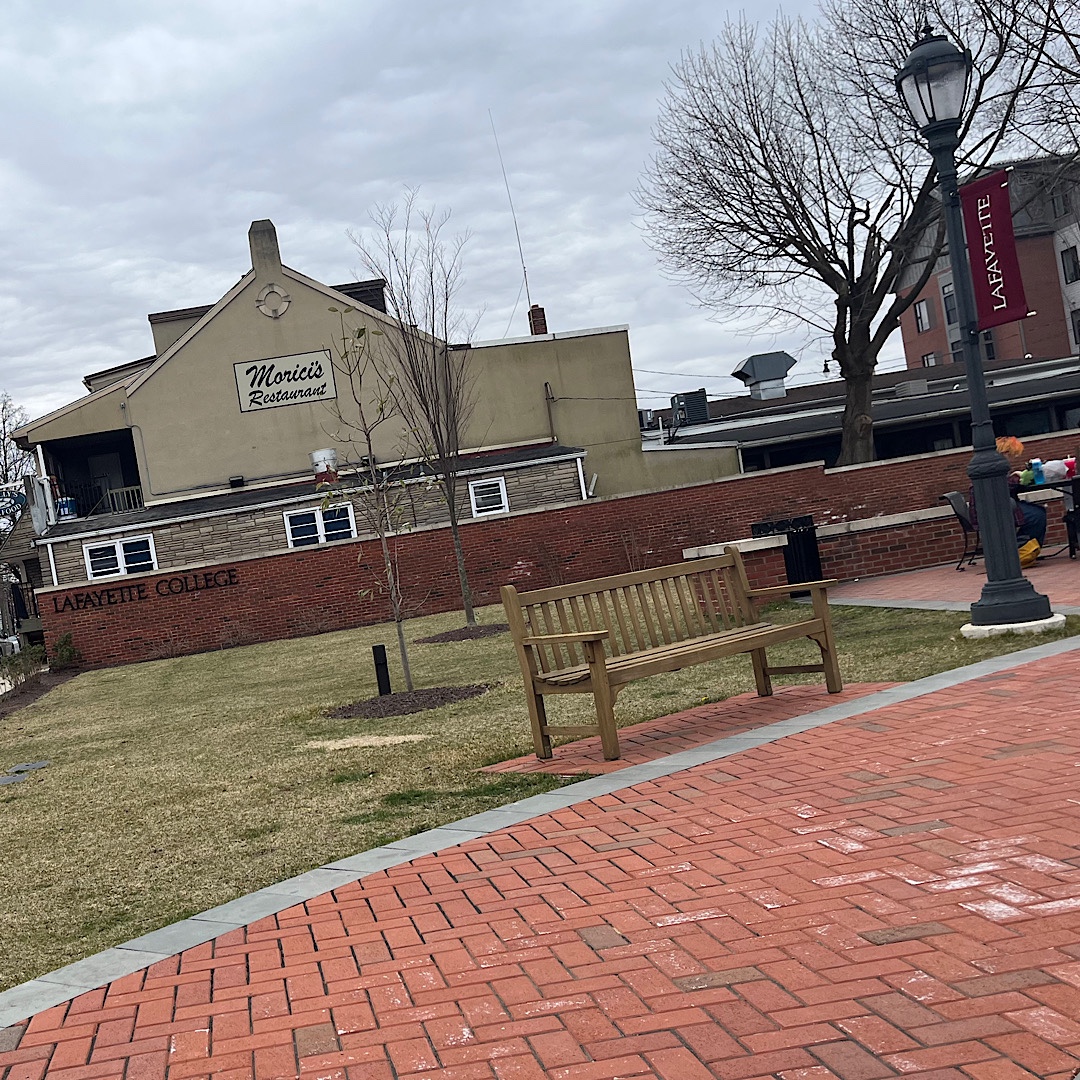
My chiropractor is just-about next door to the Lafayette College Store, where I needed to pick up some copies of our Not an Able-Bodied White Man with Money anthology that we provided for last night’s Jean Corrie Poetry Reading and Ice Cream Social. You can read about that on the Parisian Phoenix Publishing web site here.
They were having a store meeting when I arrived, so I excused myself to a couch by the store manager’s office to wait for Gayle who wanted one of Maryann Riker’s unique handmade journals. I’m in the middle of Suzanne Mattaboni’s Pencraft award winning novel, Once in a Lifetime so I can safely amuse myself.
They also have some fascinating tile in the bathroom.
When she arrived, we went for a walk around College Hill, which Gayle had not visited since she left her job at Lafayette College circa 2015.
We walked about 4,000 steps and I stumbled three times and caught myself every one. It’s the longest walk I’ve taken since my hospitalization.
And I asked The Teen to evaluate my walking and she immediately said, “Nope. Your left foot is still messed up.”
And I was trying so hard.
Gayle and I then met up with Joan and the guys from Echo City Capers, where we discussed our upcoming events and book launches.
Then I came home and ripped off the Zio monitor, only to realize quite quickly why it itched so badly.
Our long-term foster Minerva is off to a habitat at the Phillipsburg Petco tonight.
**author’s note: I’m sorry, not sorry, that this piece has become rather long and a tad historical. I will divide the piece with subheadings so that readers seeking particular topics can scan quickly. But for those who love historical context and rambling storytelling combined with my unique chaos, have at it.
It’s a quiet October morning, before the sun rises, and I am sharing my thoughts with you regarding our experience last night at the 4th Annual Easton Book Festival (2022). I’m posting in my personal blog, as I don’t know if I have fully formed thoughts (other than I had my concerns that the grassroots chaos of the festival, part of its charm, might drive my organized self to lose my mind and LO! and BEHOLD! I had a great time. Perhaps the cusp Taurus in me is mellowing into a new calmer self, my Gemini side).
I appeared briefly in the original Easton Book Festival “trailer,” look for me on YouTube with my salmon dress which looks rather orange and my trademark scarf. I join a lot of local celebrities so that tickles me.
The pandemic appeared in the festival’s youth and the city has decided to renovate (and in my humble opinion destroy) Centre Square, where the Book & Puppet Company bookstore is located. They have reduced the circle from two lanes of traffic to one and eliminated all the parking in front of businesses. They have also been toying with the traffic patterns, often closing main streets and making the traditional heart of the downtown one way. As someone who has lived in this community for more than a quarter of a century, I’m annoyed.
My history with downtown Easton
The city has two main parking decks currently in the same basic vicinity, which is good, but they have destroyed one convenient central parking lot and pocket park to build a new deck, which is not open yet. The oldest of the parking structures will soon be eliminated, as are on-street parking permits for residents. As more upscale apartments and multi-story structures join the historic downtown, the footprint of the city is changing. Or perhaps gentrifying.
My first apartment, with poet Darrell Parry, who is on the board of the festival, was an absolute dump but so much fun. We were two recently out of college, engaged kids with a pile of student loan debt and cars that barely ran. I worked at Lafayette College in the Public Information Office and Darrell worked at Caldor, a department store that, like many, no longer exists. It started his career as a shipper/receiver and honed his skill as the master of packing boxes.
Our rent for our strange one-bedroom started at $450 a month, with off-street parking and basic utilities included. We couldn’t afford cable and dial-up internet so we chose internet as we had television our entire lives and the World Wide Web was new. We would often scrape our change together and walk to Coffee and Tea Time Café, which also no longer exists, and I believe the structure is now part of the freshly-reconstructed Hearst Magazine offices that have moved to Easton from New York City. And on spaghetti nights we would order garlic bread from Colonial Pizza, which does still exist, since the restaurant was practically across the street. When we would call to order, they would often say, “Is this the neighbor?”
And then after spaghetti and garlic bread, we would go down to The Purple Cow Creamery, which later had to change it’s name to Bank Street Creamery, but you can still go there for ice cream. It’s not the same owners as it was in my day, but it has remained a hot spot of the downtown.
And since I’m already aging myself, I might as well add that Book & Puppet stands pretty much next to a place called The Crayola Factory. When I was an intern at Binney & Smith (now rebranded as Crayola since that’s the name everyone knows), I was tasked with writing and pitching a then under-construction, exciting new attraction in the former Orr’s building, another defunct local department store, called Two Rivers Landing. It would contain The Crayola Factory and the National Canal Museum.
(And I happen to be a Crayola junkie and a canal aficionado.)
You see, in my day, you could actually walk through the real Crayola factory in Forks Township and follow this blue line through all the stages of crayon and marker production. When you arrived at corporate offices in the morning, if they were making crayons, the air would carry that trademark warm aroma of wax, and if they were making markers, it smelled like burnt plastic.
I can remember sitting in my cubicle in corporate communications pitching my press release about this new family attraction to national magazines. My small, unattributed contribution to history. I did a lot of fun things at Crayola. Including dressing professional dancers in phallic crayon costumes at New York City’s Rainbow Room.
Okay, so now you see why I did not start this in the Parisian Phoenix Publishing professional blog. Because I’ve transformed into an old woman telling you the way it was in my day. And if I want to throw it back another generation, whenever I get off topic, I like to reference Arlo Guthrie‘s “Alice’s Restaurant.” If you don’t know the song, you’re young enough to find it on YouTube, Spotify or Apple Music. “This is a song about Alice. Remember Alice?” the lyrics say, even though the song seems to have nothing to do with Alice for most of the 18-or-so minutes the song goes on.
This is a song about the Easton Book Festival and “Sex in the Text.” Remember the Easton Book Festival?
This is a song about Alice. Remember Alice?
Arlo Guthrie
Darrell hates that song.
Opening Act: Poetry galore
I will not make a James Bond reference off of that title to relate it back to “Sex in the Text.”
Darrell ParryNancy Scott and Eva Parry (“the Teenager”)Reading BrailleJoan Zachary
Lynn Alexander opened the poetry segment reading from her collection, Find Me in the Iris. Followed by our own Nancy Scott, then Darrell and Rebecca Reynolds. Nancy read from newer work, including a poem about her recent move. Darrell read from his book, Twists: Gathered Ephemera, with a rather stunning introduction delivered by Lafayette English professor and festival board president, Chris Phillips. Rebecca read from each of her books (Daughter of the Hangnail and The Bovine Two-Step) and her work in progress.
And if you ever wanted to watch someone read Braille, here’s your chance.
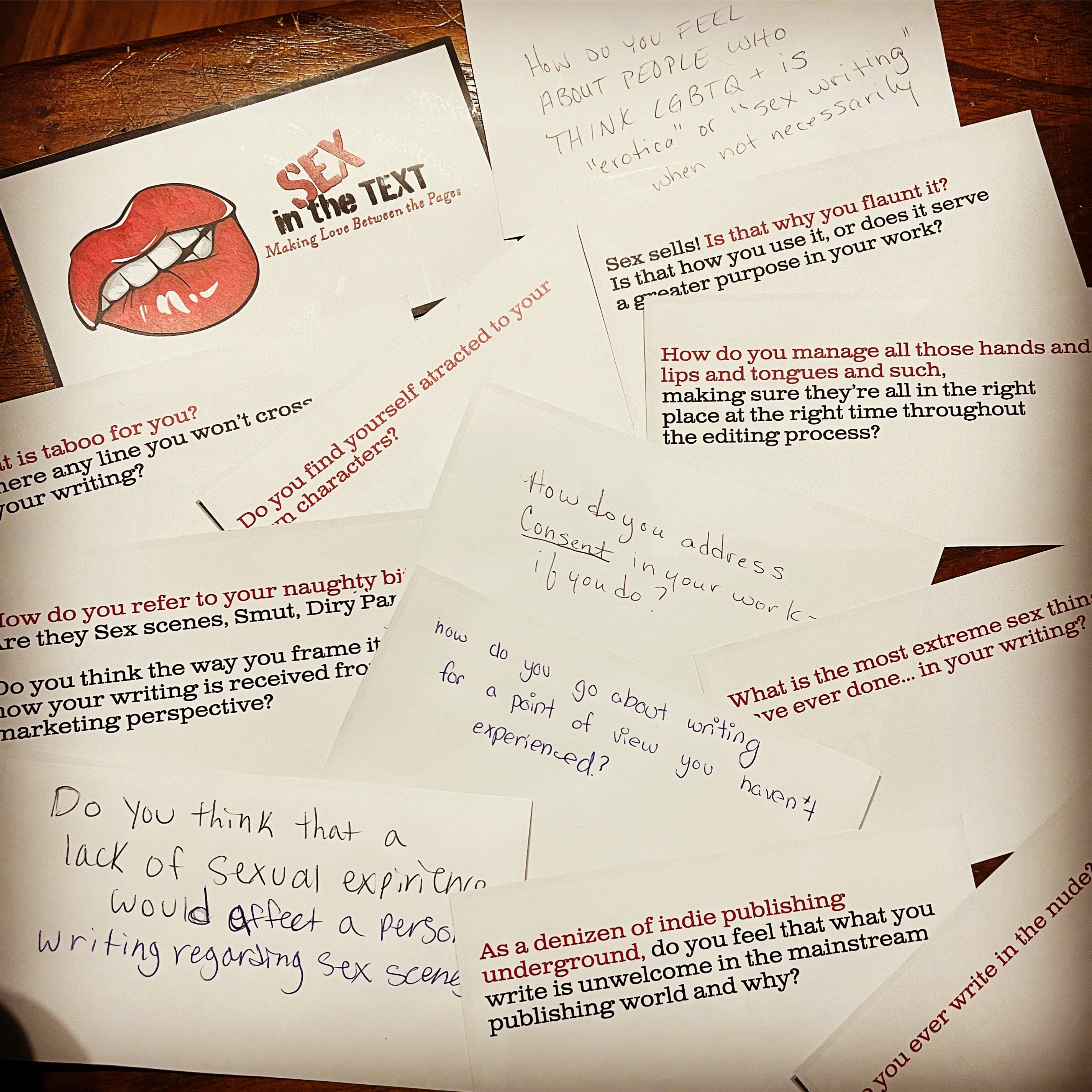
Sex in the Text: Making Love Between the Pages
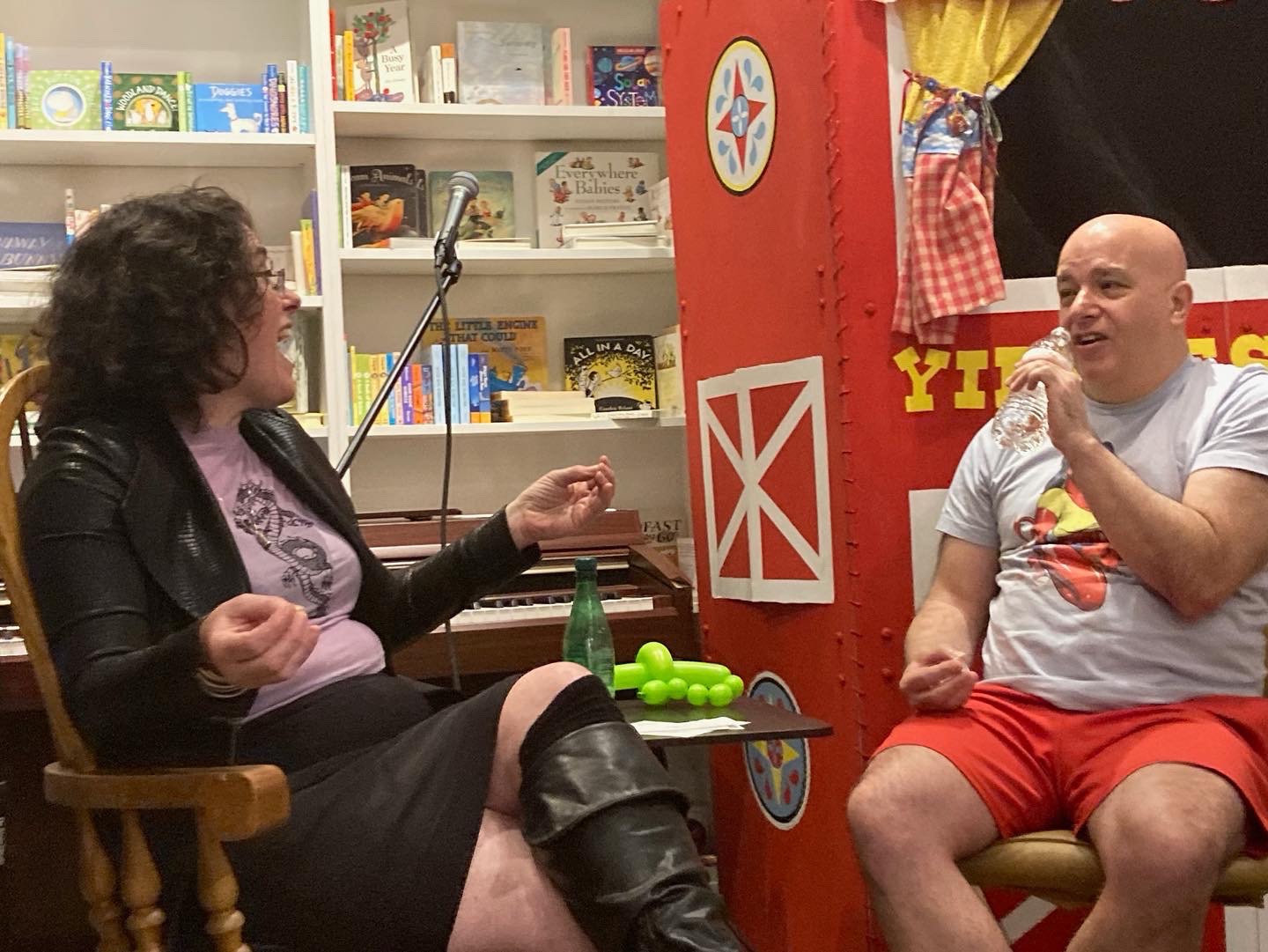
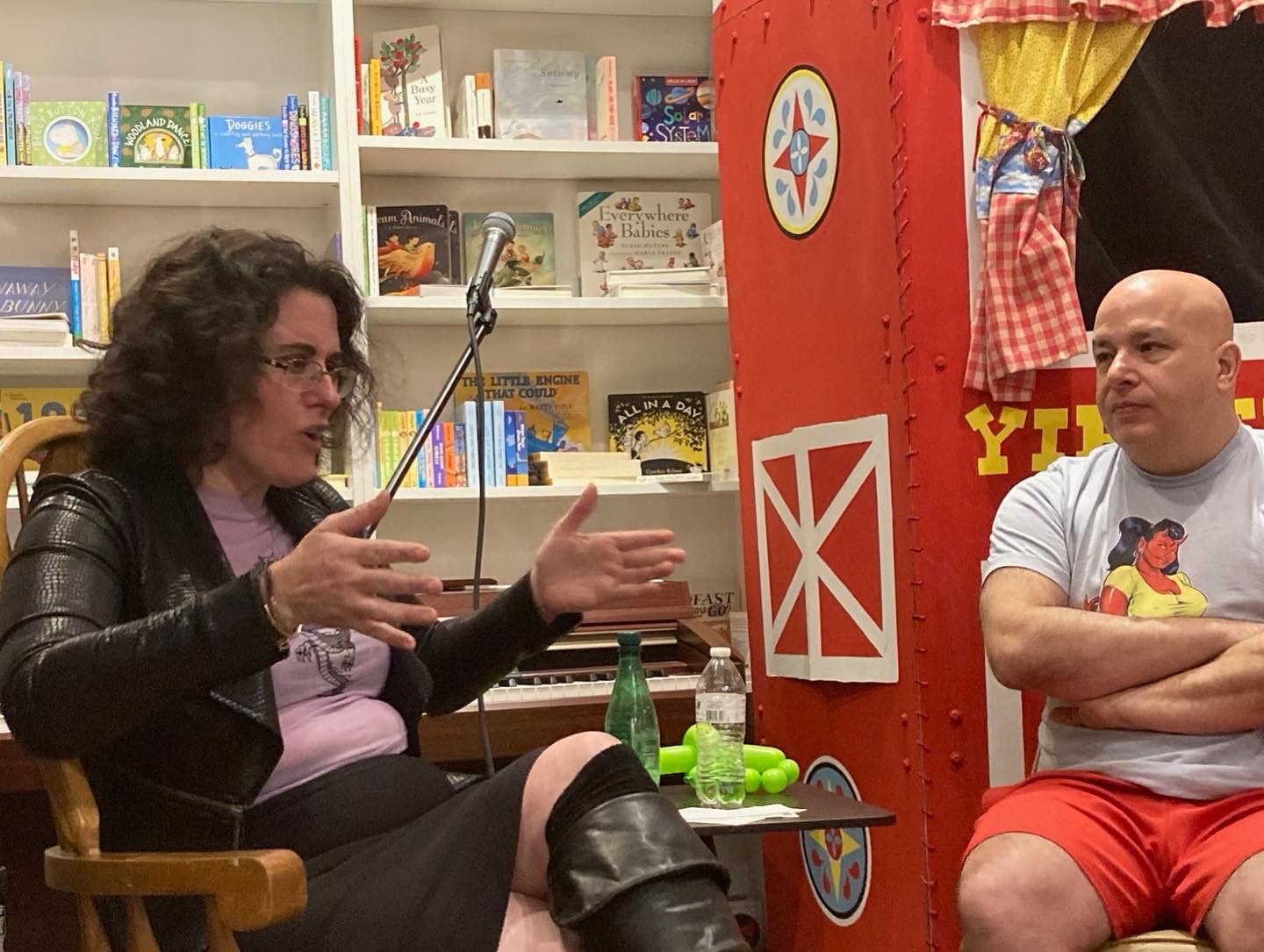
So, for some reason GLVWG (Greater Lehigh Valley Writers Group) and our (Darrell, the festival board, myself and Book & Puppet) connections did not yield more panelists for this discussion. So, Darrell and I talked about making the panel into a talk show type format where questions could be placed on index cards and William Prystauk, author of the Kink Noir series, and I could ask the questions of each other Oprah-style and discuss.
We had a fantastic time and the questions were thoughtful not only from a literary perspective but also from a societal values perspective.
It was a refreshing night, and I hope the spectators enjoyed it as much as Bill and I did.
I was scrolling LinkedIn a few days ago and one of the alumni career development personnel at Lafayette College (Margie Cherry) shared a post about older workers leaving jobs in the pandemic.
Last night, at the Bizzy Hizzy warehouse, my phone started buzzing with notifications that people liked my comment.
So I thought Lafayette College alumni were seeing it. I thought “wow! That’s 250 people.”
This morning I get a message from Margie— “your comment was featured on LinkedIn News.”
What?
Sure enough…
I suppose I’ve just typecast myself as an “older worker.”
But it’s so nice to read the comments and replies. Lots of people are reconsidering the value of work-life balance and lower stress jobs.
So as I have mentioned—the teenager and I have made consignment shopping a pandemic sport. The Attic, a consignment shop in Bethlehem, has hosted live events and posted pictures of merchandise for sale on Facebook and Instagram.
My teen and I love to peruse the Instagram offerings and direct message each other from various parts of the house about items we think the other will like.
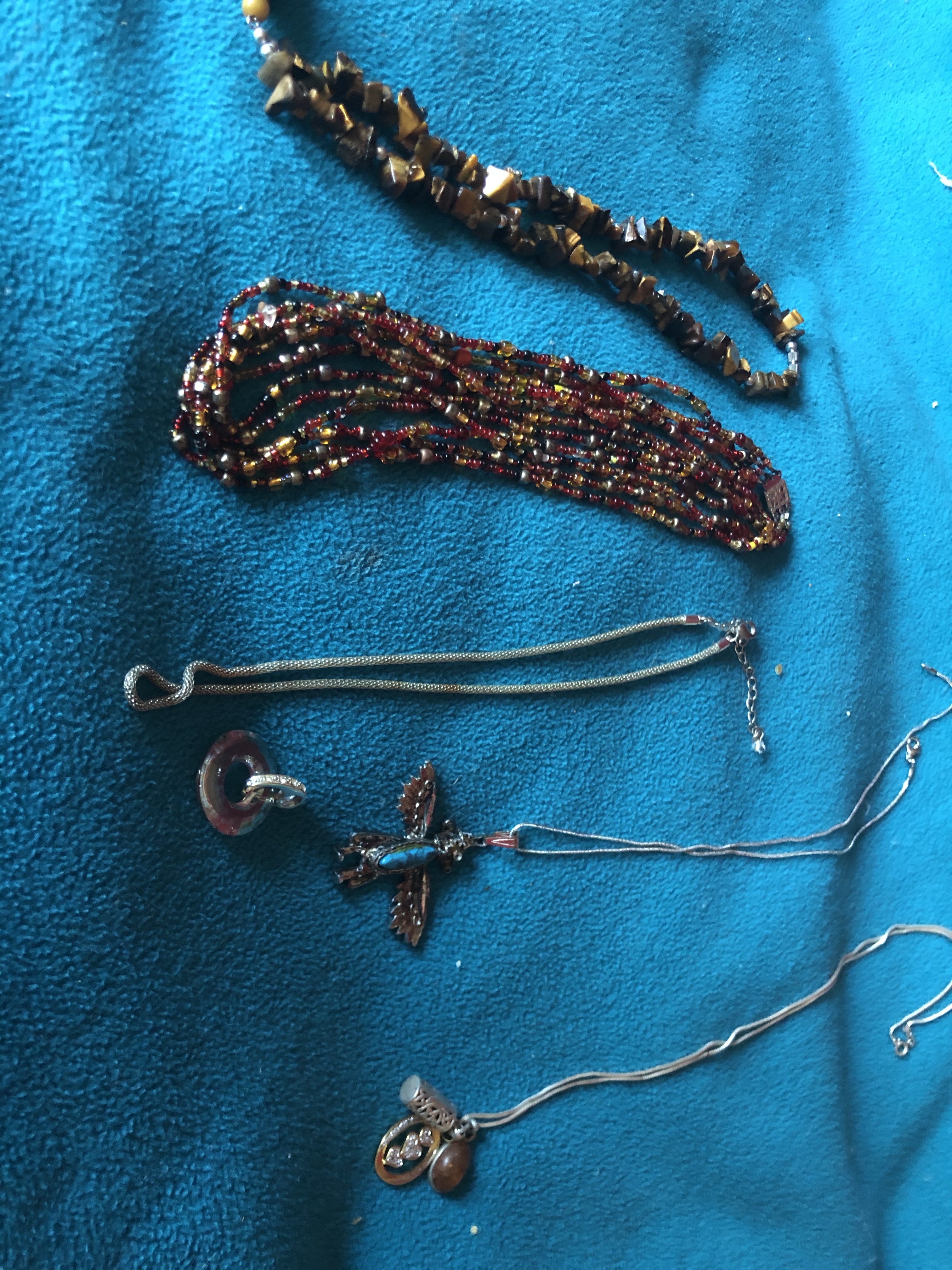
I ordered a bunch of necklaces. I used to wear a necklace every day and my necklaces were always symbolic. The amber I bought to purify energy around me. The emerald that reminded me who I wanted to be. The Celtic knot pentacle pendant that reminded me of my heritage and my spirituality.
I stopped wearing necklaces because Nala, my Goffin’s cockatoo, thinks it’s a game to bite the chains in half. And I didn’t know what necklace fit anymore.
So I bought used jewelry.
Now the necklace on the bottom of the photo is my standard one with my pentacle, my amber and a charm my father gave me recently to remind me that he loves me.
But the others are from my Attic buying spree.
And I don’t know what made me buy Horus. I think I started with the red strands of tiny beads. Then that sparkly circle. And Horus was an impulse. (I had already paid my invoice when the Attic posted the Tiger’s Eye necklace.)
And the Tiger’s Eye I bought very intentionally for the stone’s properties as, to borrow from one random website, “A stone of protection,Tiger Eyemay also bring good luck to the wearer. It has the power to focus the mind, promoting mental clarity, assisting us to resolve problems objectively and unclouded by emotions. Particularly useful for healing psychosomatic illnesses, dispelling fear and anxiety.” (Charms of Light)
I can use some focus and good luck.
But why Horus?
I saw the bird with the stone in his belly and thought he’d be homage to my flock. And I thought he looked Egyptian, so as a pagan and a former scholar of Africa, the attraction made sense.
But today as I got ready for work, I was overcome with the urge to know who my bird pendant was and the magical properties of turquoise.
So, turquoise: (from the same web site) “Turquoiseis a purification stone. …Turquoise balances and aligns all the chakras, stabilising mood swings and instilling inner calm. It is excellent for depression and exhaustion, it also has the power to prevent panic attacks.Turquoisepromotes self-realization and assists creative problem solving.“
Are you noticing a theme? Albeit a coincidental one. This is what I mean about the universe sending tools and magical objects. (I posted about this concept in my witchcraft series: My previous witchcraft series)
So I googled Egyptian bird gods and found my falcon-man Horus. And this is what encyclopedia Brittanica told me:
“Horus, EgyptianHor,Har,Her,orHeru, in ancientEgyptian religion, a god in the form of afalconwhose right eye was the sun or morning star, representing power andquintessence, and whose left eye was the moon or evening star, representing healing. Falcon cults, which were in evidence from late predynastic times, were widespread in Egypt.“
Tonight I went to see Heddatron at Lafayette College.
It’s the third weekend in a row the teenager and I went to the theater and this was by far the teen’s favorite.
Last weekend we went to see a high school production of Once Upon a Mattress, discussed here: I blame the Freddies and the weekend before that we partook in Tartuffe at DeSales University, reviewed here: Tartuffe at DeSales.
Our finance manager at the office invited us to the show since her husband is technical director of the college theatre. He pitched this show to the head of the theatre program (who, when I worked at the college more than 20 years ago was the entire theatre department, my how times have changed). And my colleague’s husband also co-taught a theatre/mechanical engineering class last fall that built the robots for this show.
Yes, Robots.
First, let me say, before getting into some of the eclectic contemporary joy of this show, that Buck Hall has a charming array of theaters to work in.
I love the challenges and the flexibility of a Black Box Theater. Most of my days in college theater happened in a black box, and the difference between performing on a traditional proscenium stage and a black box is an extreme shift in perspective and intimacy.
Performers on a proscenium stage remain above, untouched and superior to the audience; whereas in a black box, the actors and the audience engage and entwine in unspoken ways that change the performance and its meaning.
So my heart always races when I enter a black box. It’s a test of strength for the entire theatre company.
Loosely summarized, this play presents us with a pregnant housewife who is kidnapped by robots, transported to the rainforest and forced to perform Ibsen’s Hedda Gabler.
The acting was solid, though in some sections in became difficult to hear the actors overhead.
The set design and use of props proved vivid and entertaining. Perhaps what impressed me most was the fluidity of scene changes and prop switches that happened right under the audience’s nose.
The robots were sci-fi rich yet silly, one made from a mannequin (and he of course talked about the size of his penile shaft), another made of a garbage can and a Rubbermaid cooler with salad tongs for arms. Three others appeared, one loosely comprised of an ironing board, another a broom.
The director’s notes refer to the multimedia and STEM nature of this piece. And indeed, the show made use of video, music and robotics. Futuristic yet in the past and present all in the same time.
And for pure comic relief, the cast performed Bonnie Tyler’s Total Eclipse of the Heart.
I know a show is good when my brain stops analyzing and just has a good time. That happened to me in this show, right around the Bonnie Tyler sing-along.
But, being me, I must keep dwelling on themes. Even though the video clips ask us to consider if we’ve sexually assaulted our toasters over the years (inserting our bread into its cavities for years for nothing but our own pleasure) and if the robots will wake up to our abuses, the actors seem to be asking us to examine the place of women and also to examine our commitments and relationships— has humanity evolved at all in the last 150 years? Or will the robots do it first?
After the show, the teenager and I took photos outside Buck Hall.
Last night, I attended the audio-described performance of Tartuffe at DeSales University last night. The teenager and my blind friend, Nancy, accompanied me.
Act I Productions always does a fantastic job and at this point, I know the staff almost as well as Nancy. (I wrote more about this yesterday, Tartuffe tonight.)
I was technically an English Literature and Language major in college for my first bachelors degree, but probably three-quarters of my degree was actually theatre classes as “Doc” Jack Ramsey was my favorite professor and I was active in the theatre company. I was also technically a French minor, but I was only one class shy of a double major. About a decade after I graduated, I did take an additional French class at my alma mater (Moravian College) and several more at Lafayette College when I earned my second bachelors in International Affairs.
That’s a long-winded way to say I’m a huge nerd who has studied Moliere.
DeSales University has a great theatre department offering majors in various forms of performing arts, so their shows are always top notch.
They offer one performance of every major production as an audio described show for the visually impaired. As I mentioned in yesterday’s post, this is a great way to include everyone in theatre.
I also provided my companions with a mini-lesson in farce versus comedy, where farce is quicker paced, has more characters entering and exit, and includes more physical humor than mere comedy.
Additionally we discussed Moliere and 17th Century Drama in general. This particular play is almost 400-years-old. It tackles heavy themes, philosophizing about religion and God (or perhaps religion versus pure spiritual intentions), gullibility, and how to change someone’s mind when they can’t see the truth.
Moliere is only slightly more modern than Shakespeare and, and this is totally my opinion, I find the French drama more accessible, funnier and more sexually-charged than Shakespeare’s canon.
The basic premise, and one that angered the Roman Catholic Church, is that a wealthy man invites a beggar into his home. The beggar, Tartuffe, has demonstrated piety that has impressed the master of the house. Tartuffe then tries to win over the master’s goods and family, and almost succeeds. The family would have been left in ruins, if not for a convenient intervention of the king, which of course, was Moliere’s way of keeping in the good graces of the crown.
The production at DeSales included a brilliant set, the paint hues of the set walls shifted colors based at the lighting. They created the illusion of a huge estate house on a small stage with an amazing display of perspective. They designed a set with six doors, about twelve stairs and three levels in a comparatively small space.
I only noticed maybe two line mix-ups. Acting was solid. I’m starting to recognize some of the actors. I think the daughter and the stepmother might have been my favorite.
I thoroughly liked the translation. It maintained much of the original rhyme without sounding forced in English. And some of the word choice was very rich. I very much enjoyed the vocabulary.
The costumes deliberately code the characters. The daughter and her suitor, as young and naive lovers, wear pink and pale blue. The stepmother wears an elaborate gown of pale blue and a light turquoise. The father wears various shades of blue and purple, but the hot-headed son wears vivid orange.
The religious themes, and the theme of being suckered in and acting stupid, still hold true today. I feel like the American political climate also seems like a “Tartuffe” story.
This is the final week to see Lalla Essaydi’s photographs at the Williams Center for the Arts gallery at Lafayette College.
This seven photograph exhibit takes a journey into contemporary Muslim women’s space while exploring traditional Orientalist beliefs, otherwise known as Western stereotypes of the Muslim/Arab experience.
Immediately, I recognized these themes in Essaydi’s photography. My previous exposure both academically (my interest in post colonial Francophone Africa, how it intersects with the Muslim world, and the impact these topics have on contemporary international politics) and via travel in Africa and the Middle East came rushing into my head like a lost dream you fight to remember upon waking.
This exhibit features five photographs that use white/beige colors, Arabic writing, henna and women in various levels of religious covering and two photographs more steeped in color.
The seven photographs come from three different series: Converging Territories, Harem and Bullets. Just reading those titles should leave a certain taste in the mouth. I have with me an exhibit guide but I haven’t referred to it yet as I prefer to digest the works on my own first.
The first piece one encounters in the exhibit is 2004’s Converging Territories #24, featuring a woman’s face, only eyes showing, with writing on her face and the cloth covering her. The chromogenic print mounted on aluminum divides the woman’s face into four panels, each an almost even display of skin, lettering, and beige fabric.
This one did not attract or impress me. That is not to say it does not present a strong harmonious image. It is certainly a lovely piece of artwork, but artwork often speaks to the viewer in unique ways and this one seemed what one would expect from an exhibit like this.
Next came Harem #2 (2009). Instantly, I noticed the use of the term harem and the mimicry of traditional Orientalist images prevalent in I believe it was 19th century Western paintings capturing a fantasy of what Western/European artists expected the Muslim/Arab lifestyle to be.
The Harem series uses more color, more texture, and repeats the Orientalist themes of a reclining woman in exotic dress. The repetition of these stereotypical themes used by a Muslim female photography made me bristle. But this woman is propped on one arm and seated rather proudly so I sense the challenge to the age-old idea of the Middle Eastern harem.
Next, I found Bullets #3 (2003).The woman in this photograph has a sassy shoulder turned to the camera. She is covered, but showing more flesh than normally proper throughout the arm. The backdrop is all bullets as if they were tiles on the wall, bullets also adorn her clothes. Another stunning photograph, but frankly I grow tired of the constant obsession of the Muslim identity automatically connecting with terrorism. I’m sure that’s Essaydi’s point, too.
I’m going to skip my favorite piece and turn instead to Harem Revisited #34 (2012). Perhaps this is the most colorful piece presented at Lafayette. It is three years newer than the other, and the woman’s pose in this one is not only more docile and reclined but divided into three panels, an immediate detraction from her humanity. She is reduced to pieces.
But the focal point of the exhibit (and my favorite), if I can proclaim that based on not only the fact that it was in my opinion very prominently displayed, is Converging Territories #30 (2004). [Featured image for this post.] It depicts, with the same beige clothing on beige background covered with writing and people decorated with henna, four females standing side by side in various levels of garb.
The largest woman, whom appears to be the only adult in the group, is completely covered head to toe. I can’t even refer to it as burqa as she doesn’t even have a slit or a screen for her eyes. I see them as a family, and the next one is in more traditional burqa and appears to be an adolescent. The next girl, a sweet looking pre-teen, has her scarf tied under her chin, exposing her whole face but not her hair. The last little girl has no head covering.
What I adore about this photograph is the vivid use of the progression of covering as it follows a woman through various stages of life and suggests not only the typical message of how a woman’s identity is limited by strict forms of covering, but also attaches this idea to the act of mothering and potentially makes it more universal. To me, the suggestion is that all women lose a part of their identity as they transition into a maternal role. This has nothing to do with religion.
If you miss the exhibit at Lafayette, a similar exhibit runs through May at the Trout Gallery of Dickinson College.
About Lalla Essaydi: According to the exhibit guide, she grew up in Morocco, raised her family in Saudi Arabia, and lived in both France and the United States. She received her arts education from prestigious art programs in both France and the United States.
I had an opportunity at the end of January to explore a position in the fine arts field, using my words to promote their art. That gave me the opportunity to spend some quality time with my scanner. I reconnected with several pieces from Lafayette College magazine.
I wrote this piece on senior art projects and even had a photo featured. (Bottom photo on the second page.)
Then there was this feature on Gregory Gillespie working with Lafayette College students.
This is an excerpt/introduction from a paper written for a seminar at Lafayette College, taught by Joshua Sanborn, inspired by a class taken at Moravian College, taught by Jean-Pierre Lalande.
EXAMINING FRENCH MASCULINITY & THE GREAT WAR:
DID LES PETITS POUSSINS OF THE INTERWAR PERIOD BECOME
LES COQS GAULOIS?
Angel Ackerman
History 353 Gender and Sexuality in Modern Europe
May 12, 2009
When researching French masculinity, it quickly becomes apparent that on some level every stereotype—the seducer, the adulterer, the drinker, the connoisseur, the philosopher, the artist, the swordsman, the braggart—bears truth. (1) In fact, various scholars have agreed that Cyrano de Bergerac, “…swashbuckler, poet, unsophisticated lover and universal character; the most accomplished expression of gallantry for Frenchwomen,” serves as an icon of nineteenth century
French maleness on the cusp of modern martial masculinity. (2)
But manhood, and many social institutions, would undergo great change throughout Europe as science—beacon of hope at the end of the 1800s, a great force to improve the quality of life— created weapons that would decimate many parts of France and inflict upon all European nations a brutal loss of life previously unimaginable. The devastation permanently altered the social, political and economic landscape in Europe. The battles of World War I slaughtered nine million
men, with one-third of them leaving a widow and average of two children. In France, the Great War robbed 700,000 children of their fathers and more than a million “wards of the state,” a term that could mean either orphan, child without father or child of a permanently disabled man. With about 1.5 million men dead, an entire generation in France grew up without a father (3)(which would make them orphans as the French orphelin means simply “child without father” unlike its
English equivalent).
In the midst of this fatherless phenomenon, French masculinity shifted shying farther from traditional martial masculinity even as the country sought to restore its former paternalistic glory. Literary themes of the early twentieth century and interwar era discuss the societal struggles caused by absent father figures, floundering government and the threat posed by neighboring Germany, but how does the generation of fatherless boys contribute to France’s changing expectations for men? Did French war orphans fit the traditional male gender roles or did they become “a pampered bunch of wimps” from single-parent households led by women? (4)
With this in mind, one potential answer to whether or not single mothers reared a generation of wimps is this: It was neither the absence of paternal role models nor the actions of French mothers that created a generation of men who would not subscribe to martial masculinity of the previous age. A societal backlash against the sufferings of the Great War caused this shift, potentially exaggerated in war orphans because of their familial loss. The orphan’s experience
served as an allegory for France as a whole as it dealt with altered masculine roles; fatherless orphans did not cause the change.
To examine this idea, one must establish a selection of men who lost their fathers in World War I. This seems simple enough. Search some prominent historical figures and politicians, seeking those born between 1905 to 1910. I skimmed hundreds of biographies in encyclopedias, academic databases and even, in quasi-desperation, Wikipédia (French Wikipedia). Articles in French yielded the best results, as could be expected, especially when searching terms like
“pupilles de la nation” (wards of the state) and “mères de deuil” (mothers in mourning). But, with a limited time frame for this particular project, I could only locate two orphans to use as my case studies: author Albert Camus and playwright/ actor Jean-Louis Barrault.
For Camus and Barrault, their status as orphans altered their interior attitudes regarding masculinity, not the behaviors that would define them. War orphans cannot be blamed for the wimpish state of French manhood after the Great War, because the war had changed French maleness for the entire nation. War orphans were one voice among many reacting to the loss of traditional masculine honor codes. Barrault and Camus, like their artistic peers, lamented this
lack of masculine definition.
Of course, the experiences of two men do not lead to firm conclusions. But these two men, thanks to their creative sensibilities, have contemplated these questions of what it means to have a father and what makes someone a man. Raised in different family environments on different continents, these two men came to many of the same conclusions. If coupled with the observations of significant playwrights of the Interwar era, the experiences of Camus and Barrault verify the cultural context of the 1920s and 1930s. Orphans articulated the dilemma of shifting masculinity which continued into World War II with the French surrender.
ENDNOTES
(1) My title plays tribute to one of the World War I postcards featured in Marie-Monique Huss’ book, Histoires de Famille 1914-1918. (Paris: Noesis, 2000) Le petit poussin is the little chick on one postcard expressing his hope that he will one day become a great rooster of Gaul. (213) Why the rooster? According to the French president’s official web site (www.elysee.fr) The rooster is one of the symbols of the French republic because of its appearance on the coins of the Gauls. It is often used by foreigners today to represent the French in sporting events. “Le coq apparaît dès l’Antiquité sur des monnaies gauloises…Il est surtout utilisé à l’étranger pour évoquer la France, notamment comme emblème sportif.”
(2) The quotes comes from Edmond Rostand, Cyrano de Bergerac (Paris: Bookking International, 1993). This quote comes from the back cover of an edition purchased in Paris in 1995: “Cyrano de Bergerac, héros au grand nez et coeur d’enfant, bretteur et poète, amoureux ingénu, est un personnage universel; c’est l’expression la plus accomplie du panache à la française.” Scholars who have cited him include Robert A. Nye, Masculinity and Male Codes of Honor in Modern France (Oxford: Oxford University Press, 1993) labeling Cyrano de Bergerac as an example of French panache, modesty, and swordsmanship (226) and Huss in Histoires de Famille calls him moral, elegant and displaying the appropriate war scars to be a proper French male (117).
(3) Olivier Faron, Les enfants du deuil: orphelins et pupilles de la nation de la Première Guerre mondiale, 1914-1941 (Paris: Éditions la Découverte, 2001), 13.
(4) The idea for this paper came from Jean-Pierre Lalande’s Twentieth Century French Theatre class at Moravian College in fall 2008. From my notes on Jean Anouilh’s Antigone, 22 October 2008: “Hémon- represente les hommes pragmatiques… ‘je ne vive pas sans elle [sic]’ ‘that’s totally stupid.’ stereotype of a spoiled young man. a né [sic] après la première guerre. 1920- pampered bunch of wimps- Hémon. No 45-year-olds in 1942. lost generation, les jeunes ne sont pas capable.”
At the Chronicle, I occasionally wrote long features. I loved what these high school students were doing, so my editor gave me free reign to profile them. I took the photos, and the front page photo of Randy remains one of my favorites. June 2003. Ten years ago. I should find out what happened to these youth.













 Angel Ackerman