Cardiology meds

Last spring, I experienced two falls down the stairs in a two-week period that led to bodily injury. That led to a period of A-fib and 24-hours in the hospital.

The cardiologist on call at the hospital put me on beta blockers, metoprolol, and the dosage wiped me out and gave me orthostatic hypotension. I learned through working with a dietician that I am sensitive to salt and I drink enough water that I wash the sodium from my system.

My primary care physician dropped my medication dosage in half, but the orthostatic hypotension and occasional weird bouts of high heart rate did not go away.

I found a new cardiologist and got a second opinion. The new doctor thought the Apple Watch was enough protection against Afib and that I could stop taking the medication. Since I was losing my job a month later, I thought discontinuing a beta blocker would lead to an increase in blood pressure due to stress.

But now it’s a year later– and I’m not sure the pills do anything.

The physician assistant and I had a discussion about eliminating the med, and she wants the doctor’s opinion first. The question remains of what should this medication be doing. If it’s supposed to be helping my heart remain a steady pattern, then I need something extended release or a different class of medications. If it is really just an insurance policy against Afib, I suppose it is enough.

The physician assistant asked if I would be willing to wear a Zio heart monitor to make sure this was a smart move. Last time I wore a Zio, it showed some stuff, but not Afib. That cost me $600, and that was when I had “good” insurance and Medicaid. I have a high deductible plan right now with high coinsurance and no HSA, so I mentioned that I was saving my budget for more important tests– like the MRI I am paying for out of pocket. That bill was more than $2,000.

I haven’t heard back yet, but my point in mentioning this is that the pertinent question of the day was to ask what my medication is supposed to do, and if it is doing its job. It’s easy for a doctor to tell us that we should or need to take something without question its exact function.

Day 5 of Omada: Wondering if it’s a scam

I feel like I have said a lot of this a lot of times so bear with me as I say it again.

The background

About 10 years ago, I decided to try to lose five-to-ten pounds. Approaching my 40th birthday, I needed to shed some weight before my annual physical. I worked at Target at the time where I walked 14,000 to 17,000 steps a day. I started weight training again, primarily because I had broken my right hand at work and could not untwist the soda fountain nozzles at night. No hand strength left. I worked primarily closing shift and I would get up, do my weights and walk 2-4 miles around my neighborhood. Every day. I counted calories and perfected my macronutrients and I felt invincible.

I lost 30 pounds in less than six weeks– while weight training. I dropped too much too fast and I had to buy a fitbit to make sure I was eating enough.

I worked really hard to regain weight and muscle.

But now, I’m approaching fifty. I have reached an all-time high with my weight– weighing the same thing I did on the day my daughter was induced 20 years ago. I have gained a little more than 30 pounds in the four years since the pandemic and a lot of other personal events.

And as someone with a mobility disability, that weight impacts everything even more than it does for the average person. I went to the gym religiously for three years, but I didn’t have the willpower or the finances to stick with good habits. Because it’s cheaper to eat the $1 McChicken and $1 diet Coke than it is to make your own chicken sandwiches.

The present decision: Omada

I know what to do. I understand nutrition and everything I do wrong. But I need someone to hold me accountable because my personal discipline is gone. Today is my sixth day participating in Omada– a free-to-me program through my medical insurance company– and I went on a small binge last night.

Perhaps my opinions will change, but I think Omada is a scam. And I think the bulk of the program is driven by AI.

But let me summarize the philosophy of the program.

There is no calorie counting. No exercise tracking but steps. So if you want your weight-training to count you have to convert it to steps, which makes no sense. I understand the idea behind tracking meal choices and not calories or macros. The program wants you to study your choices and habits to make meaningful change.

I’m using the Omada app AND MyFitnessPal and I’m still not making good choices or creating positive change. I’ve participated in my group’s discussions. And I’ve sent a long introductory message to my coach. And I reported a tech issue regarding my scale the day I received it.

I remedied the problem with the scale, so I thought they saw that I was using it and that’s why they didn’t get in touch. Turns out, it just took a week.

So I told my coach my history, and after the first day of tracking she mentioned she saw evidence of stress eating in my day’s choices. I thought to myself, “Really?”

Now to me, stress eating is eating a family size bag of Cool Ranch Doritos. I reviewed my first day’s food. For lunch I had one leftover slice of pizza because I came home from a meeting extremely hungry, and in the evening I had a small individual bag of vegan gummy bears. My calorie count for the day ended around 1400.

Did she think I ate a whole pizza?

I replied, “It was just a busy day. I had a lot of meetings, but I think I made good choices.”

She asked, “Would you like some strategies for eating on the go?”

And I responded, “I have my strategies, but many of them include food I can’t afford right now like my KIND oatmeal breakfast bars that have 8 grams of protein perfect to tide me, and I don’t eat out because my grocery budget is around $100/month.”

Which if you ever read my posts on grocery shopping, you’ll know that’s true.

She responded with tips like eating slower and putting my utensils down (which my message to her pointed out that I did not eat before the meeting, came home very hungry and then took the easy way out, which has nothing to do with eating too much at meals) and how to be smarter about eating out (when I said I don’t have the money to eat out). I believe this list of suggestions came from a chat bot who recognized the phrase “meetings” “busy” and “on the go.”)

No mention of the fact that my grocery budget is below poverty level. A person might want to address that first.

The research

My reporter’s instincts kicked in at this point.

I was already perturbed that it gave me a step goal of 7500 a day without any consideration of my health, my current activity level or my goals.

As a person who works at home at my desk for nine to twelve hours a day I get about 4000 steps on an average day. If I walk to do my errands or take a leisurely stroll around the mall, I get 6500 steps. The last time I hit 10,000 steps I spent the next day in painful muscle spasms. My point is– you need to gradually increase your activity level, especially if you have preexisting conditions.

To qualify for Omada, you need to have a weight problem, a heart condition or diabetes (or prediabetes). I am overweight, ended up in the hospital with Afib last year and had gestational diabetes which puts me at risk for prediabetes. AND I have cerebral palsy.

For people with heart conditions or obesity, is it safe to suddenly walk 7500 steps a day?

I looked online. How does Omada get paid?

Insurance companies pay Omada based on how much patients interact with their devices.

So, Omada gets paid every time I step on the scale.

This is bullshit.

And last night, after a day of decent eating, I added on an extra 500 calories of a peanut chew-style candy, gin and juice and freeze-dried fruit that I didn’t put on the app.

Everything Wrong with America

I miss my more carefree days– which didn’t seem carefree, until now, when I have several appointments after each 8-hour workday in the warehouse, health issues to sort, a job hunt and debt to pay. Life is never simple or easy for most of us, but 2023 has, for me, felt like eternal optimism and hope while being bludgeoned. I get my proverbial sh*t together, and something outside of my control decides to parachute into my life.

When Stitch Fix announced closing the Bizzy Hizzy, they scheduled all sorts of guests and workshops for us as displaced employees. My separation date is September 15, so I have four more weeks, or two more paychecks, depending how you look at it. One of the workshops Stitch Fix hosted, and paid us to attend, was a visit from the state “Rapid Response” team to explain how unemployment and career services from the state work. They handed us a booklet that told us how to survive our layoff. (Surviving a Layoff: Your Guide to a Soft Landing and a Smooth Re-entry by Harry Dahlstrom. Mr. Dahlstrom, I’m sure you’re a very intelligent and likable person, but your advice is written for middle class Americans with two cars and their own house.)

“Remember that emergency fund with three-months pay stashed away…” Oh, Mr. Dahlstrom. Do you not have a child going to college this fall? Or medical debt? Or a used car that needs constant repairs? Or a teenager whose car insurance costs $500/month because of an accident? That’s just me. Others might have a disabled or unemployed spouse, student loans, bad credit that led to predatory loans for everyday items… or maybe they just recently got this job and had been using their credit cards to survive.

“Reduce your thermostat to 68 degrees.” Oh, Mr. Dahlstrom, mine has been at 64 for two decades.

“Trim your entertainment.” I don’t have cable. I don’t have any streaming services (though the Teenager has Spotify, which she pays for, and she also bought HBO Max and made for the year upfront.) I don’t even have home internet, relying on my phone’s hotspot and public connections. I think the last time I went to a movie was two years ago.

“Prepare a weekly menu” and “put back 10 percent of the things in your [grocery] basket.” Oh, Mr. Dahlstrom. I spend $250 on groceries for myself each month, that does not include the Teenager as she buys her own groceries. And I do get coffee or a donut out, which adds up to about $25 a month, which I consider reasonable as, as you mention, I search for discounts.

Other advice includes: “collect old debts,” “turn unwanted things into cash,” “change your lifestyle,” and “bring in the paying customers” using a talent or skill. Because my half-a-double home that I pay about $900/month for is full of useful items? I haven’t even had a vacation in about five years. And my talent? It brings in about $150/month on a good month.

“Unload the family jewels.” Mr. Dahlstrom, I’m so frugal I wouldn’t even let my husband buy me a diamond for my engagement ring. When we got married, we used Irish claddaghs so all I had to do was switch it to the other hand. I don’t own a single piece of jewelry or any item worth anything. My car is a 2015, my computer is a mid-range model, even my Brooks Brothers suit is 15 years old at this point.

But this is what’s wrong with our country. As a society, we assume everyone “poor” or experiencing financial trouble or unemployment is in that situation because they are irresponsible, stupid or did something wrong. And sometimes that poverty or situational bad luck is due to society’s expectations.

For example, starting with my generation (the GenXers) we insisted that our kids go to college and saddled them with loans to do it. Then, we flooded the market with bachelor’s degrees, which rendered them meaningless, and started pumping up the value of master’s degrees. For those of us associated with the arts or wishing to pursue an academic trajectory, a Ph.D. is now required and some perfectly talented individuals with MFAs are now trapped in a life of eternal adjunct status.

And the poor Millennials also fell victim to this higher education fiasco except the cost has skyrocketed and these poor kids are starting their lives with student loan payments that rival my mortgage and they can’t land a job with a living wage so they work in warehouses with the same people who skipped the education in the first place.

Now, add to that the way the medical system works. In my opinion, and this is just my opinion, more people than ever need some sort of medical support in their life. Whether it be disability, illness, mental health struggles or maintenance medication, it seems like more people than ever spend a ridiculous amount of their income on healthcare.

I have been extremely fortunate that my mathematical brain allowed me to calculate costs and I determined that the free to me high deductible health plan, when you included the employer contribution to my health savings account and a $50 contribution from me to that same HSA each paycheck, paid for most of my medical costs this year (except for my mental health therapist, who for some reason, the medical insurance company likes to pretend doesn’t exist. They just won’t communicate with him or pay him).

Now, before I continue on this rant, I don’t understand why healthcare in this country is primarily connected to employers and employment. Why is it an employer’s responsibility to provide access to healthcare? Eliminating this ridiculous practice might be a good first step to getting healthcare under control. If you meet certain criteria, you can qualify for government-sponsored insurance, which also dictates the level of care you receive, and the open marketplace for healthcare is expensive.

I just don’t understand why everyone isn’t pushed to the open marketplace OR why everyone can’t qualify for government insurance. If everyone went to the open marketplace and insurance companies had to compete for individuals instead of corporations perhaps the access to care would change. In other words– even a company like Stitch Fix– has thousands of employees. If insurance company had to court those individuals and families, they would have to work a lot harder to court them versus convincing one corporation to allow them to insure a large group of individuals.

I missed a month of wages after my hospitalization, which due to the one week waiting period, even with my employer-sponsored short term disability insurance, only provided three weeks of wages at less than 67% of my normal wage, and on top of that the company administering those payments misplaced my paperwork which meant I had to repeating submit paperwork and did not get the last week of those wages until one full month after I returned to work. And my doctor had to submit three sets of paperwork. Which, technically, costs $25 a form for the doctor to submit.

And because I have a congenital and permanent mobility disability, I always need physical therapy. But physical therapy sessions cost hundreds of dollars and insurance companies limit access to them. So I hired a personal trainer and pay him $25 a session (which bless him, he has now reduced his rate to contribute toward my fund to pay for my service dog which is another $5,000) and I bet Mr. Dahlstrom would say I should eliminate that from my budget as an extraneous expense.

But Mr. Dahlstrom, I imagine, does not live with a disability and has probably never experience what it’s like to have a leg that just suddenly stops working or a hip that feels like it’s waving to people from my butt. And since my muscles and my brain literally cannot communicate, I have to physically show them what to do so that movement is reduced to muscle memory and does not have to include the brain.

In closing, I’m going to end this long and winding blog post with a celebration that also highlights everything wrong with America. My friend Southern Candy from Stitch Fix turned 65 yesterday and she asked to go to Shady Maple Smorgasbord. That place was SO BIG, I think my whole d*mn town could have dined together. They had so much food and so many cooking stations I think we could have fed a village from a developing nation for a week.

The staff was amazing. The food was quite good. The gift shop was enormous. And in general, it looked like people were only taking what they could eat. But we all ate too much. I had three dinners and two desserts and spend several hours thinking I might vomit. The cajun catfish and the carrot souffle were my favorite. And I really wanted to punch an old man in the face because as I was reaching for the last piece of coconut custard pie, he snatched it away from me.

And the reality of how much food, how many steaks, how many excess calories we were all consuming filled me with such guilt and shame. Our culture, and you can disagree with me, is so centered on gluttony and selfishness. So while I was happy to spend time with my friend, and take a road trip with her, and laugh with her– I have to ask: how can such a place exist? I’m sure the intent, because Shady Maple started decades ago, was to provide a place where people could dine and have a wide variety of choice and not have to chose, or for families to dine together while pleasing difficult eaters. But this was insane.

Free the Finger! Cast-free after 9 weeks

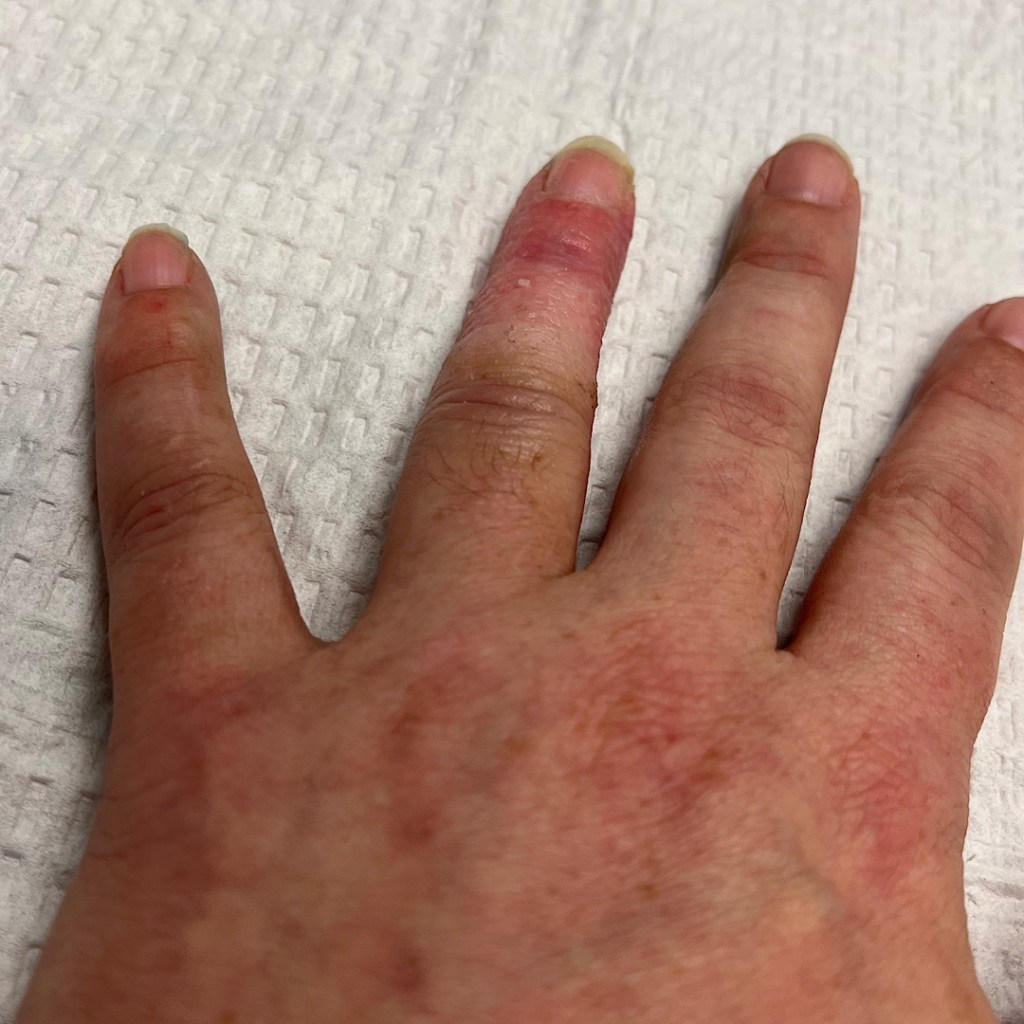
I was very apprehensive and so excited to see my doctor at OAA today to get my damn cast off for an evaluation of my mallet finger.

The teenager texted me as I sat in the exam room.

“Free the finger!”

They had a devil of a time cutting it off— apparently after even five weeks in the same cast it was firmly on.

Both the hand/orthopedic specialist and the hand rehab office it’s unusual for patients to maintain a finger cast for so long. That doesn’t make sense to me, because why wouldn’t you do everything in your power to maintain agility and strength in your finger?

Free the Finger!

the Teenager

And don’t give me that “it’s too hard” or “I need my hand to do stuff.”

I work in the Stitch Fix Bizzy Hizzy warehouse folding clothes. And after my brief stint on short term disability to deal with my balance and hip issues stemming from cerebral palsy (and made more complicated by now not being able to rely on the left side of my body with this temporary injury), I went back to work and performed at 100% and higher with my finger in a cast and restricted hand movement.

That finger had so much caked dead skin and here’s the really fascinating part— my knuckle no longer has wrinkles because it has not bent.

In the beginning of my treatment, I found my doctor cold and impersonal but as he gets to know me I like him more and I get more personable interactions from him.

He told me I should gradually increase my finger flexibility with care not to hyperextend it (otherwise known as don’t bend it backwards) and splint it at night. For the splint, I could take my cast back. And tape it in at night.

“It’s cheap, but it’s dirty,” the doctor said.

Yeah, no thanks. I lived with that grimy thing long enough.

“The other option is to return to the Hand Institute and they’ll make you a splint.”

(Which, coincidentally Cigna, my insurance, does not cover. But as I do not cheap out on my medical care, I will pay for. Because right now my HSA is empty because having a disability and doing everything you can to keep yourself ahead of that disability is expensive. So please, consider this and how lucky I am that I can support myself because if I had to really on family and government benefits to subsidize my care, I’d be crippled.)

I imagine there’s a third option— buy an over-the-counter splint. And I was going to consider that. But to me, the cost of the custom splint comes with the knowledge and enthusiasm of the people at the Institute for Hand and Upper Extremity Rehabilitation. These people love and know hands.

And if I can only teach others one concept about your health, it is this: invest in yourself, meaning, find the right medical providers for your team that understand your needs and share your personal philosophy and concerns. This requires being vulnerable in a way that might be uncomfortable and it might mean having difficult conversations with people you don’t like. But it may also lead you to better understanding of yourself and of those people who seemed like callous know-it-alls disinterested in you.

I peppered my hand specialist with questions today— rapid fire as he typed my splint referral into the computer. And he respected them. The questions.

How much movement is okay? What should I watch for? I pack boxes and fold clothes and put things on conveyer belts. Should I splint the finger at work if it starts to feel weird? Is there certain motion I should avoid?

“There are no rules,” he said. “Just be careful and the occasional splinting wouldn’t be bad. I’ll see you in a month.

He made eye contact with me as if to say, “you know your body. Follow your gut.”

But he also knows I’m the patient who kept a finger cast on longer than the average Joe. So maybe, just maybe, he trusts me.

For previous installments on my finger injury: click here.

Also: a YouTube video

Do as I say not as I do, or fun with medical billing practices

I don’t think anyone will disagree with me when I say that medical insurance and medical billing in the United States makes no sense. It’s unfair to patients, unfair to doctors and makes the lives of medical office staff ridiculously complicated.

Let me just give a disclaimer that anything I say in this post is not a reflection of the skill of my physicians or the caliber of my care as both have been excellent.

But basing medical care on the decisions of private insurance companies attached to employment is reminiscent of the “company town” days when employees lived & worked in the same place and businesses profited on and controlled the life experience of their employees. Check out the old coal mines. I am from Pennsylvania after all.

I have spent much of the last year bouncing from specialist to specialist trying to learn how my body works as a 40-something with cerebral palsy and now, almost three weeks ago, I ruptured a tendon taking off my socks.

Last night, when I was already slipping into a fragile emotional state feeling lonely and physically broken (hey, it happens. We’re all human and have moments. Mine happen after dark while binge-watching medical dramas.), the teenager brought me the mail.

It was 9 p.m., I was curled in bed with an episode of The Good Doctor cuddling Louise, the tripod foster cat who deserves a permanent home because she’s such a doll.

I open my EOBs from my insurance company. Now, I know my recent misadventures will be expensive. I also know my therapist has recently sent me a $600 bill and apologized but said he can’t deal with my insurer anymore. But that’s another story and after almost 15 years with the same mental health professional… I will take care of it.

But this particular EOB charged me $200+ to see a specialist (fair) and a $2,000+ fee for surgery. Surgery? I walked into the office, an assistant removed my splint, he looked at me, he looked at the imaging done by Patient First, told me to get a cast and go back to work, and told me to make a follow-up for May 18 and left.

The assistant helped me put my splint back on, I left his office, went to another medical office (unaffiliated with him), filled out new patient paperwork, paid a $50 deposit, and received a cast.

Does any of that sound like surgery to you?

Being an anxious woman of a certain age with a hand injury, I did what seemed best at the time: I poured a whiskey and diet cola and grabbed the bag of sriracha pita chips and binged.

I ate all these chips, but no hummus or tea.

In the morning, I discovered I put my underwear on backward. I had two cups of coffee and a glass of water (I won’t eat until I get hungry) and called my insurance company.

“I’m not aware of having surgery so I’m confused.”

They arranged a three-way call to the doctor’s office.

The woman, who was polite and professional said, “so you’re not being treated?”

I said, “well yes I am.”

And she explained that’s a blanket term for tendon repair.

I replied, “Okay, so this was not explained to me. Let me just get some clarification. I paid the office fee, so the doctor could evaluate me, and he also gets an additional fee? Even though he sent me to a different doctor for the cast?

“Oh, she explained. “It covers any additional treatment in the next 90 days.”

Well then I hope that covers the office visits for all my check-ups and follow-up care.

I thanked them both— the representative of the insurance company and the billing clerk at my specialist’s office. But this is just another example of how the American medical industrial complex complicates and threatens patient care and a patient’s concern for if that care will financially destroy their stability.

** the title of this piece is a reference to me using binge eating as a coping mechanism

Neurology Update

So, I just received a phone call at work from my neurologist’s office. They want me to come in at 8 a.m. Wednesday, because “my” insurance company denied my CT scan.

I use the quotation marks because this letter comes from the insurance company that provided my Medicaid. I received Medicaid four months into my unemployment in November 2020, and I accepted my position at Stitch Fix one week later.

Stitch Fix provides medical insurance as of day one of employment.

To the best of my knowledge, I used Medicaid for one visit to my primary care physician that happened to be scheduled during that week.

I filled out the required paperwork to alert the county assistance office that I had a job, and insurance. I received some paperwork that implied my Medicaid would expire at the end of the year.

But as of January 1, 2021, it still seemed to be hanging around as a secondary insurance policy. Even though I never saw them pay for anything, and my primary insurance was a high deductible plan.

In Spring of 2021, I received a notice that I need to reapply for my medical assistance or it would be canceled as of 8/31/2021. I threw the paperwork away— because I don’t need Medicaid.

But the hospital and the network of doctors associated with it still insisted I had it.

So I thought maybe it would disappear December 31, 2021.

And December 28, 2021 they write the letter denying my CT scan that I photographed and posted above. I receive it around January 5, 2022.

To refresh anyone’s memory or for new readers— I have cerebral palsy but I didn’t really receive medical treatments or interventions as a child, which leaves me now trying to understand my body as it ages. I am approaching my 47th birthday.

My neurologist appointment was December 23 — you can read about that here (and more here) as it was my first ever. I now have an official diagnosis on file with my doctors.

The neurologist’s office scheduled me for a CT scan of my brain on Dec. 30. I was really excited for several reasons: I have never had any CT scan; I am very curious to see what brain damage will be revealed; and my deductible was paid for 2021.

But the office canceled it two hours before the procedure because the insurance company neither approved nor denied the claim.

I find out today that Cigna has approved the scan but Medicaid did not and the neurologist’s office didn’t want me getting a surprise bill.

They canceled a procedure that would have cost me a 10% copay, and now I will pay for it out-of-pocket as my deductible is $1,750. And my HSA will be empty as the teenager is getting hearing aids Friday.

In other physical related items:

  • Yesterday I experienced a lot of steady pain at work. By the end of the day, I couldn’t even reduce my symptoms and sleep was uncomfortable. I blame the fact that they changed our break schedule and we had our last break at 1:50 — leaving us to work three hours without a break, the last three hours of our ten hour shift.
  • I finished yesterday at about 80% of the daily metric.
  • Today, I had a high point at 3 pm of about 95% — and finished the day at 90%.
  • My back today felt better, pain at let’s say 4 instead of 8. But my toes on my right foot burn about 10 minutes out of every 90.
  • Interesting side note, I think the intense back pain involves some nerve activity as when my pain increases I can’t feel my need to urinate. Not at all. So that’s fun.
  • And the Mirena is doing it’s job. But for the first two months, I spotted most of the time. I think I had two days each month where I wasn’t spotting or bleeding. I think that has finally ended. My body seems to act like my body.
  • But today, for some reason, my right breast aches. Kind of like milk let down.
One of my orders today was 8 pounds of jeans