Why the Disability Struggle Impacts All Humans

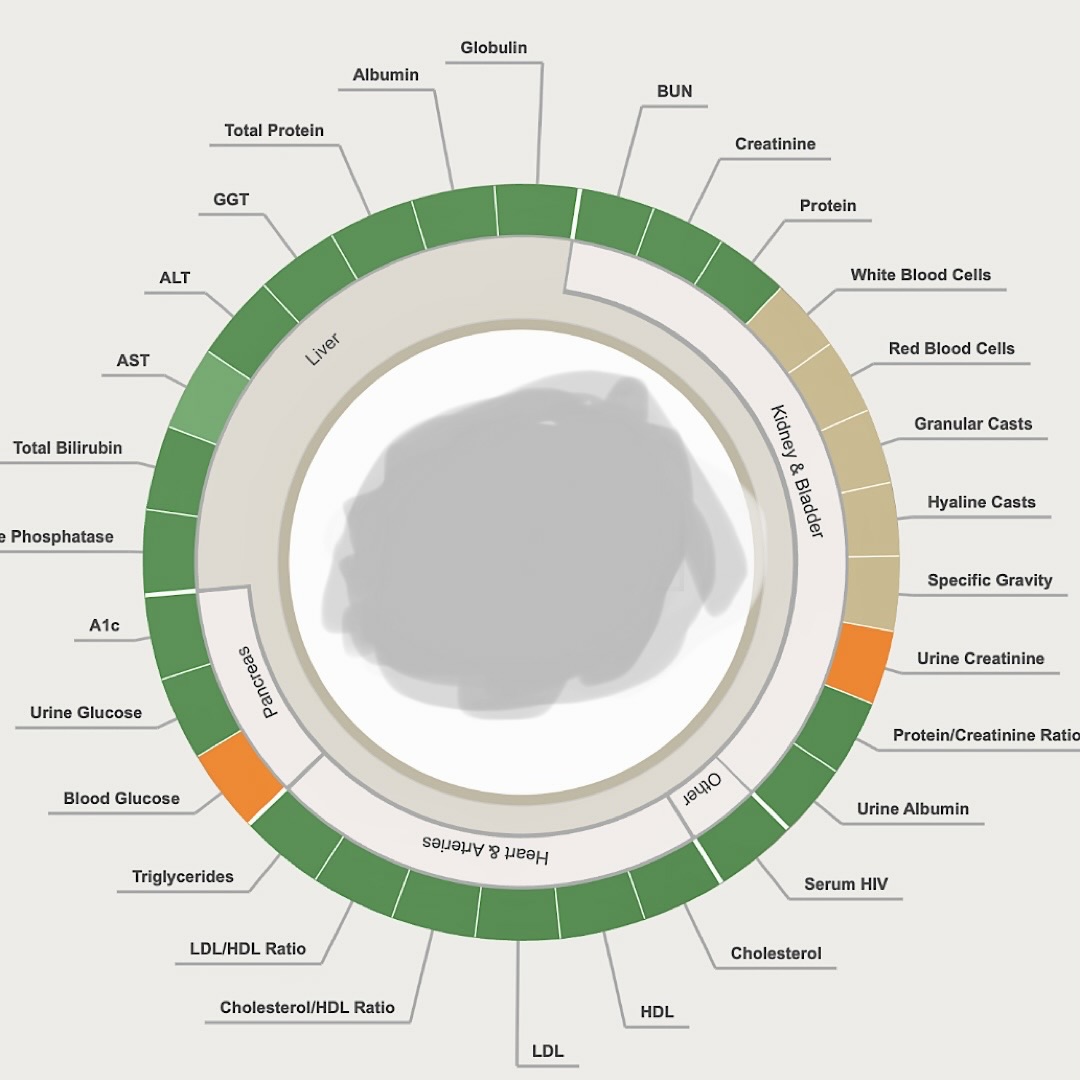
It’s Monday morning, and while my red blood count maintains there is nothing wrong, my body shows the signs of anemia, which feel better when I follow a strict regimen of healthy eating, vitamin D and iron supplements… but that is something my primary care physician and I will discuss at my annual physical in September. And he will probably express disappointment that I have regained the ten pounds I lost last year.

It’s true for all of us– when we’re sick or weak or broken, we take care of ourselves (or we try to, I hope) and when we feel better, the routines that help us maintain that wellness fall to the wayside and lean toward repeating the same problems. I know I have a 20-year history of struggling with low ferritin reserves, why don’t I do better to always keep a routine of quasi-regular supplements?

Many disabilities are permanent but not progressive. And most people experience disability at some point in their lifetime– either congenital, temporary or permanent. Any person with a disability or aging person can explain the weight of co-morbidity, that while their various issues alone may not be progressive, when combined with our temporary or new ailments can make life exponentially harder.

My mother struggles to understand how I could be so easygoing and mobile as a kid while experiencing more falls and discomfort now. As my mother, she is no stranger to the aches and pains and limitations of aging, but she didn’t connect that the running and playing and constant activity I had as a child kept my muscles looser and healthy in a way that I can’t match as a fairly sedentary adult. That’s part of the reason why I’ve usually had a part-time job that requires movement and pursued strength training as a hobby.

I know that I need to lose 30 to 40 pounds. As a person aging with cerebral palsy, this would help my cardiovascular system and help take so much stress off my musculoskeletal system. But I have learned, through years of strength training and nutritional counseling that my body reacts strongly to salt and sugar, which means if I wish to lose weight I need to not only increase my activity level, but also cook whole foods, every time. The vicious circle of “I don’t exercise enough because my body hurts/I can’t breath/I’m tired” perpetuates itself because the only way to get past the discomfort is to do it… and survive and persist. (And then there’s the ironic reality that you can overdo it, and hurt yourself trying to do what’s right.)

This is not a disability struggle. It’s a human one.

All people experience a disappointment in and/or failure of their body. It’s a point Johanna Hevda and Julia Watts Belser both point out in their work. They claim that everyone experiences disability within their lifetime, but I extend that same idea to say that all people at some point experience some sort of body dysmorphia. Even if your body works, and is completely normal, people will experience dissatisfaction with it at some point. Maybe you hate your hair, struggle with your weight, identify as trans, wish you were a better athlete. All of these experiences have nothing to do with disability, but stem from the body.

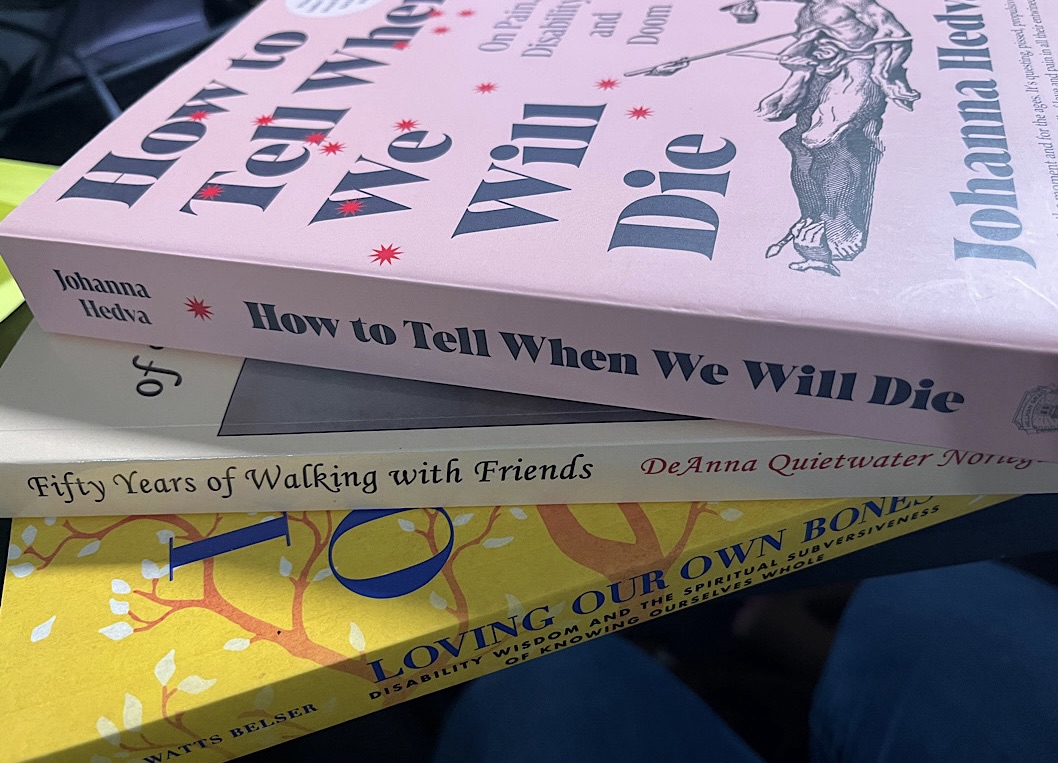
A pile of three disabilty-themed books. The top one, How to Tell When We Will Die: On Pain, Disability and Doom by Johanna Hedva, is pink with red stars. The next on the pile is a beige memoir, FIfty Years of Walking with Friends, by DeAnna Quietwater Noriega. The one on the bottom is vivid yellow, Loving Our Own Bones, by Julia Watts Belser.

Disability Pride Month is celebrated in July because that’s the month when the Americans with Disabilities Act was passed. I didn’t put that together until today, so if you needed that tidbit of knowledge, there you go. I happened to order a whole bunch of disability-themed books in late June because my good friend Nancy Scott told me I should be doing more writing in that space, and she’s right, and she’s tired of hearing me say, “when I write my medical advocacy memoir.”

The four books from the disability space that I read this Disability Pride Month:

  1. How to Tell When We Will Die: On Pain, Disability, and Doom by Johanna Hedva
  2. A Disability History of The United States by Kim E. Nielsen
  3. Fifty Years of Walking with Friends by DeAnna Quietwater Noriega
  4. Loving Our Own Bones: Disability Wisdom and the Spiritual Subversiveness of Knowing Ourselves Whole by Julia Watts Belser

I have been working to expand my collection of books by writers with disabilities. I currently have read books that range from poetry to books with characters on the autism spectrum, though none of these books include my fascination with medical fiction, a realm where Michael Crichton and Frieda McFadden spend some time, and one of my favorite memoirs (An Exact Replica of a Figment of My Imagination) which covers pregnancy and pregnancy loss simultaneously. My Goodreads shelf of “disability” books is visible here.

Poets with disabilities on my read list include Jennifer Bartlett, Larry Eigner, Susan Glass and Nancy Scott. Twentieth-century memoirists on my shelf who explore cerebral palsy include Christy Brown and Marie Killilea, and then there are the people I know, like Tylia Flores (we connected via the Internet) and Peter Altschul (who like DeAnna above is a member of the Behind Our Eyes writing group).

Here’s a very brief review for each of these four books:

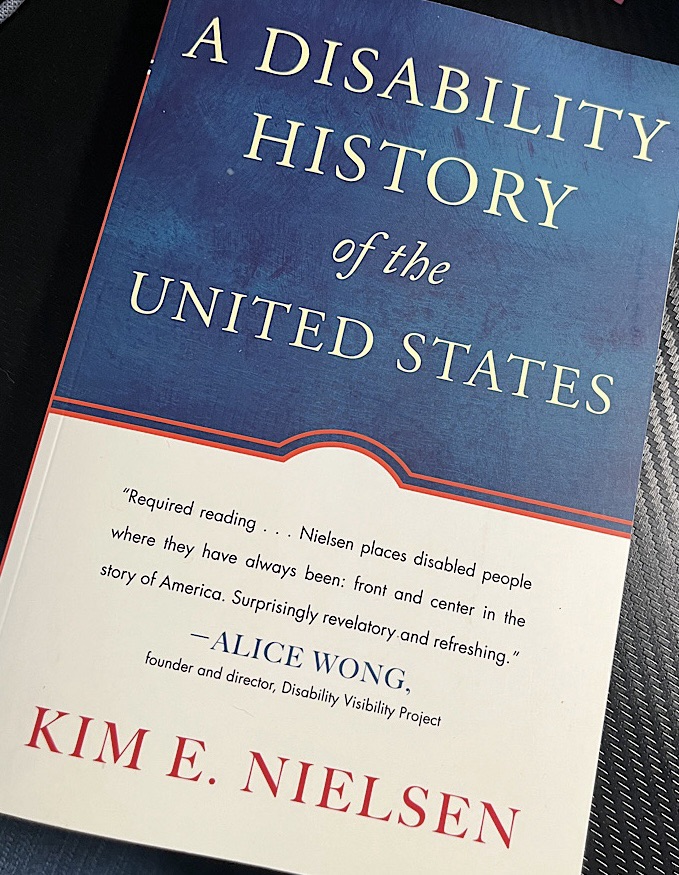
A copy of A Disability History of the United States
  1. On Hedva: I already wrote a long piece about this one, primarily to keep my own notes accessible for future use. You can read that here. Hedva is a queer writer who uses they/them pronouns and has issues with chronic pain and bipolar depression. Their essays are not a cohesive unit, but based on an essay that gained them a publishing contract when it went viral. Their greater thoughts about disability are steeped in personal experience, and often tied to their sexual experiences. But this author challenges us to view the difference between capacity and capability, just because we are capable of something does not mean we have the capacity to do it.
  2. On Neilson: Nielson ended up researching disability as an accident (or serendipity?) as she worked on her history dissertation. Hedva writes philosophically about the capitalist resistance to disabled bodies (as we are worthless if we are not productive to society) and Nielson uses her history background to explore how the capitalist framework has disenfranchised all bodies that are not able-bodied white men, which I found hysterical because one of my publishing company’s initial projects was an anthology, Not an Able-Bodied White Man with Money. See that book here. She weaves together the plights of women, people of color, and people with disabilities into the same historical framework– all of them had bodies deemed inadequate and incapable and inferior by white men.
  3. On Noreiga: This was my first time reading one of Noriega’s books. She’s a self-published author of indigenous heritage who lost her sight as a child. As someone on the waiting list for a service dog, I thought it would be fun to start with her experiences with her (I believe) eight seeing-eye guide dogs. The memoir covered the first decade-ish of Noreiga’s life in autobiography format. The final chapters each provided a summary of her later-in-life seeing-eye guide dogs. While the book did offer insight as to how these dogs perform their complex duties and build relationships with their handlers, the primary focus of the book is Noreiga’s college years and first few years of marriage.
  4. On Watts: Nancy Scott ordered a Braille copy of this from the library at the same time that I ordered the print copy, and that was sheer coincidence. Some of Watts’ ideas are beautiful, like her interpretation of observing the weekly Sabbath as a tribute to not only spirituality but also to her body as an opportunity for rest. Like Heva and Nielson, she laments the push for capitalist societies for valuing bodies only on their capacity to do work– but I think all of these writers need to consider the role of industrialization in all of this. We are no longer in agrarian societies where families live and work together communally and therefore can cater the work to individual strengths and weaknesses. Watts treads a strange line. As a queer rabbi with cerebral palsy and a wheelchair user, she tends to tell us minimal information about herself, yet connect her spiritual journey to her physical one without giving us all the details. In many passages, her affluence shows through, that her financial resources and life situation have provided her with more opportunity that the average disabled person. And she seems to have a fascination with the potential amount of times blindness appears in the Old Testament. As said before, her ideas and themes overlap with Hedva and Nielson, and she focuses on building a relationship with God where you are whole and representative of God in your broken/disabled state. She applies this to beaity standards as well.

I will be revisiting some of these thoughts in my Substack this week,

Thoughts raised by Johanna Hedva

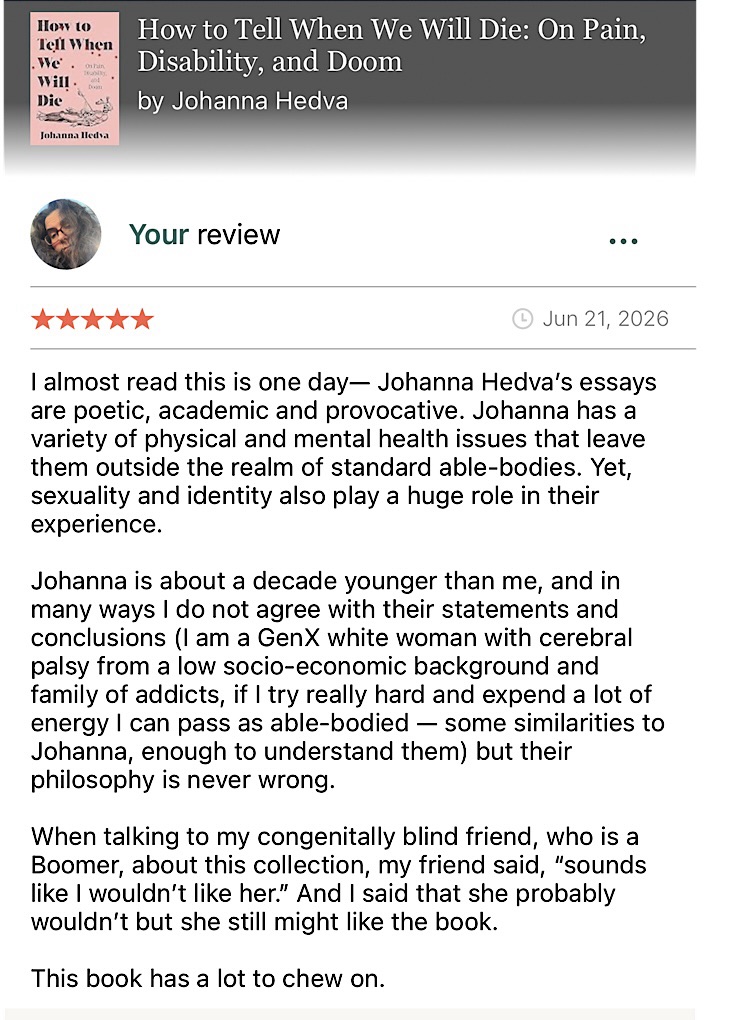
Screenshot of the Goodreads review that is also quoted in the blog piece

I put Johanna Hedva’s How to Tell When We Will Die: On Pain, Disability and Doom on my wish list probably when it was a new release.

The cover design is lovely and the bio of the author is enough to draw interest:

Johanna Hedva (they/them) is a Korean American writer, artist and musician who was raised in Los Angeles by a family of witches and now lives in LA and Berlin…

I guess the first step of my thoughts on the book would be to share my Goodreads review with you.

I gave the book five stars even though the most Generation X parts of my soul wanted to give it four, because despite how much I disagree with some of her points– I can’t stop thinking about them.

My Goodreads Review

I almost read this in one day– Johanna Hedva’s essays are poetic, academic, and provocative. Johanna has a variety of physical and mental health issues that them outside the realm of standard able-bodies. Yet, sexually and identity also play a huge role in their experience.

Johanna is about a decade younger than me, and in many ways I do not agree with their statements and conclusions, (I am a GenX white woman with cerebral palsy from a low socio-economic background and family of addicts, and if I try really hard and expend a lot of energy I can pass as able-bodied– some similarities to Johanna, enough to understand them) but their philosophy is never wrong.

When talking to my congenitally blind friend, who is a Boomer, about this collection, my friend said, “sounds like I wouldn’t like her.” And I said that she probably wouldn’t, but she still might like the book.

This book has a lot to chew on.”

So what are some of their thoughts and my thoughts on their thoughts?

Random comments first.

  1. The title is a shout-out to astrology.
  2. Their book deal for this collection stemmed from the essay Sick Woman Theory which went viral. The attention it garnered made them more of a figurehead and/or activist than they ever intended to be. The essay Sick Woman Theory is not nearly as interesting as her response to that essay, Why It’s Taking So Long.
  3. As a member of GenX, I have some discomfort with how the queer community throws around labels. Johanna identifies as a queer, and not as a woman, which is fine, but I guess I remember the days when people didn’t need to define their identity as concisely as we do now. You didn’t need to label every aspect in which you are weird. It’s okay to just be different.

So let’s look closer at some of their points.

Essay One: “How to Tell When We Will Die”

Opening paragraph:

“Heroes die on the battlefield, never from chronic pain. Diarrhea never makes its way into myth. Tragedies are devoid of menstrual cramps.” Johanna has my full attention. On the second page of the essay, they talk about the representation of disability in early and twentieth century film, and how disabled people become “flattened by some insidious super-cripple myth.” Throughout this first essay, Johanna is tossing around some serious academic critical theory before suddenly turning into memoir…

They speak about not receiving a diagnosis for their ailments until in graduate school (despite later saying that the conditions were inherited from their mother and grandmother, so I think the statement should have been that they could not get a label on the diagnosis– she does state that doctors were “baffled” by her symptoms and “dismissive of their validity.”). And they mention that they stayed on for a second master’s degree to keep their student medical benefits to the tune of $250,000, that led to a career in the arts where they refused any job that did not meet their aesthetic. They chose poverty. They chose art.

I’m wondering why– even if they didn’t want a standard job with employee-sponsored health insurance– they didn’t just buy health insurance or take on medical debt instead of a quarter of a million dollars in student loans.

But then there are gems like “You do not have to be disabled to experience ableism” and “no matter how it arrives, disability will arrive for everyone, sooner or later” (which they repeat in the last essay.) And Johanna points out that the biggest ableist fantasy is that we control our bodies, and we will always be able to control our bodies.

Johanna talks a lot about her mother’s addictions, and the abuse they suffered at their mother’s hands, and of their own mental health issues. Her first suicide attempt happened at age nine, when she took a bottle of sleeping pills, and when she did not die, she carried on with her life.

We are more than 25 pages into the book when we learn that mental health plays a significant role in her disability, which we later (not in this essay) learn includes endometriosis and chronic shingles. I understand that people with disabilities do not owe any sort of explanation of their ailments to anyone, but if you are writing a book about disability, I believe that information should be front and center.

And in this essay she mentions her love of death and doom metal. You can hear some of her music here on YouTube.

Essay Two: “Sick Woman Theory

The essay that started it all. I think it’s really important to understand that they called it “sick woman theory” because regardless of how they identify, the medical establishment and the world consider them a “sick woman” and they are seen as a “sick woman.” They frame their theory that our capitalist world is designed for the existence of “white, straight, healthy, neurotypical, upper- and middle-class, cis- and able-bodied man who makes his home in a wealthy country, has never not had health insurance, and whose importance to society is everywhere recognized and maybe explicit by their society, at the expense of everyone else.” To a certain extent, I want to call out a “Yes, bitch,” (as they toss around this phrase) but at the same token– would the experience be the same in the developping world/Global south.

Essay Three: “The Blast Radius of Disability”

I have to say that I love this concept, “The Blast Radius of Disability.” Disability doesn’t effect one person, one episode, or one place or time. Instead, it impacts everything around it, everyhing that it touches. Johanna speaks of time dvided into before and after sickmess, but I can’t help but wonder how they can divide time in such a way when mental illness entered their life so early they can’t really remember a before, can they?

It is in this essay that Johanna mentions that individuals with disabilities must operate according to “crip time” not clock time, doing things as the body deems itself capable not as the world says we have to do them. On one hand, I understand the point, but that’s not how the world works. I have to believe that there has to be a balance, of not overdoing things in order to conform to the mainstream standard and hurt oneself in the process. And there’s an inference that the entire world runs on the same precision, which isn’t true. There is “island time,” “Latin time,” and “African time.” Each culture has its own realtionship with time, so maybe they need to find a place and a rhythm that works for them.

Essay Four: “In Defense of De-Persons”

A discussion of capitalism and mental illness.

Essay Five: “Get Well Soon”

“Are these my limits, or are these the limits of the world?” Johanna reminds us that disability is part of a dichotomy– the ill being inactive while the healthy take action, the disabled remain still while the rest of the world creates revolutions.

Essay Six: “Notes on Activism (aka Notes on Failure)”

Organizing is exhausting, Johanna begins. Activism, they write, “reminds us how the world actually is, not now how we would like it to be.” Activism often comes off with hypocrisy– like buying your anti-racism books off Amazon.com. Their other question: How can you balance the need as an activism to care for others, yet also take care of yourself?

Essay Seven: “Letter to A Young Doctor”

I didn’t like this one. It seemed to repeat some of other concepts. Johanna tells this doctor all the other things they have already told us and will tell us differently in future essays. The doctor approached Johanna asking for advice.

Essay Eight: “Soft Blues”

Or “The Summer of the 12-inch cock.” The first several essays that are reflections on Johanna’s sexuality. And an in-depth exploration of her experience in a mental hospital for depression that led to her experiencing an entire summer of bipolar mania.

Essay Nine: “Can I Hit You?”

The BDSM essay. Which has the most amazing line: “Pain is the price I must pay to be awake to life.”

Essay Ten: “The Freak”

Another relationship essay. The only highlight I have in the whole essay is when Johanna discusses capability and capacity. They remind us that just because we are capable of something does not mean we have the capacity for it at this time.

Essay Eleven: “Notes on Trash Talk (aka Notes on Community)”

Interesting essay where Johanna gives a view of their obsession with fighting, boxing, wrestling and MMA, and how the way a coach talks to a losing athlete is the type of trash talk we could use more of as disabled people.

The next few essays are all Johanna’s entertainment criticism. I will skip those, even though they do circle around to disability as it all does.

Essay Fifteen: “Notes on Ambition (aka Notes on Survival)

This is a complex one– looking at what we all need, versus what we want, and how many of our ambitions are actually motivating us toward ideals that might not be our own.

Essay Sixteen: “Hedva’s Disability Rider.”

They explore this rider more in a later essay, the one I mention that speaks back to the original “Sick Woman Theory” and presents the repercussions. But here, Hedva gives us the document they send to institutions that invite her to perform. I feel like some of the items on the rider should not be listed as conditions for employment, but instead factors of how much they should charge for their fee. If you know you need a business class airline seat on the aisle, you make sure you only say yes if the organizers give you enough money. Some of the informational items are valid: like allergies. But Johanna also uses the rider as a way to advocate for everyone with disabilities and call attention to how excluded people with disabilities are. They ask for sign language interpreters, live captioning, all-gender restrooms, wheelchair accessibility and audio description.

They say they know they won’t get all of it, but they like to have the conversation and point out how unaccessible and exclusionary the world is.

And this is why hardcore advocacy is exhausting, friends.

While we would like to invite all the people with disabilities to everything, why provide the services if the people aren’t there? I know Nan and I have attended shows at DeSales University where they have one performance with audio description and live captions. These shows are made accessible with grants. Start there.

Essay Seventeen: “Room Day”

Johanna’s partner is Johannes, a German citizen, which is why they now live in Berlin most of the year so they can get better medical care. She does not mention her partner until essay seventeen. The partner to whom the book is dedicated.

Essay Eighteen: “Soft Until It Gets Hard”

How can you not love this title? Another relationship essay.

Essay Nineteen: “Why It’s Taking So Long”

In this essay, Johanna discusses the rider and how when they send the rider to an individual, they would prefer not to see that individual in the context of the institution but as a person with whom they can have a conversation. Teaching moments? Which is exactly what they say later on the page when they discuss they are now part of a “learning experience” that they did not want to be. And here’s another great observation– if an invitation comes in for any event that involves the concept of care in any way and is being organized by solely white women, Johanna won’t do it.

The essay falters between the idea that Johanna never wanted to be an advocate but now that they have the power, they feel a requirement to advocate for everyone.

Here are some great points:

  • Capitalism is so demanding, it makes us all more disabled
  • Even when we are told we “have to,” humans can’t truly do anything alone
  • It’s a fallacy that all you need is will, and the proper manifestation of it
  • Care is often framed as debt
  • You might be winning, but maybe there’s no prize

Essay Twenty: “The Hag in Charge”

A lovely adventure through Greece that offers some recollection of Johanna’s poverty and her spiritual beliefs.

A line that reminded me of Nan, who says this often: some disabled people (Nan and I like to say it’s normally able-bodied people who become disabled) have a fantasy of healing, “and then hate themselves when it fails to arrive for them.”

Disability Lit Review, part one

Let me offer a bit of an author’s note on this one, or perhaps a caveat, that I only got five hours of sleep last night, and my body hurts today. This is the third night this week I got six hours or less of sleep, due to some fairly intense routine change that is kicking my ass. And the pain I am experiencing today is not my standard everyday pain, but similar pain in a more twitchy and unnerving form.

And this may lead to some of my more strident tones. Or perhaps I always feel my opinions with a certain sharpness, but ordinarily I present them after the application of a filter.

I will try to keep my aggressive aggravation to myself, but no promises.

Earlier this month, I drafted a “bird piece” for the Behind Our Eyes anthology, a collection in the works to highlight the members of the Behind Our Eyes email-based writers group for writers with disabilities. I joined the group a couple years ago after participating on the fringes through Nancy Scott, who, in cheap amusement and most things disability, is my partner in crime. I normally lurk in the group, but recently heard they were actively looking for bird stories. The anthology features a variety of sections and one themed block focuses on animals.

I wrote a creative non-ficiton piece about my Goffin’s cockatoo and I navigating disability together, with a present-day, present tense story of Nala plucking her feathers due to her anxiety and me trying to figure out why. The plucking led to her not being able to fly, which gave her a temporary mobility disability. So I used this present-day situation to frame flashbacks exploring why Nala was anxious, but also looking at my mobility disability and the similarities and conditions that made us good for one another. The anthology committee wanted just a bird story, so they’ll be publishing the present-day section of my interactions with Nala.

This was the first of two pieces I wished to submit to disability-associated anthologies. I have drafted the second, but that one is specifically for disabled voices to share what we wished the outside world understood. I revisited my first draft, and tightened it somewhat, and thought the piece sounded like an introductory chapter to my upcoming medical advocacy memoir. That piece has two themes– the beginning talks about how my family had too many problems for me to realize I was “disabled” which seques into the second half, about me finding out my body and assembling an adequate medical team.

Nan has been encouraging me to write more in the disability space, her paraphrased quote being that I could have a real impact there. And in my experience, there are two main types of voices in the world of disability literature. The most mainstream voice is the voice of the writer-first– commonly a writer who experienced illness or disability not from birth, with either some sort of privilege or talent. The second is the disability activist who is not a writer, but congenitally-disabled and fighting for their right and the resources to exist. (And I guess the third would be the hobby disabled memoirist.)

I find myself crossing all these categories. I have the natural writing talent, my background as a professional journalist, my credentials as an academic and historian, and the experience of a congenital disability. Yet, I have the privilege of being a white woman, and if I can borrow the term, I can “pass” as an able-bodied person if I focus really hard and am having a good day. I have the type of cerebral palsy that you might not notice or that might make you stare at my feet and knees.

This morning on social media, I saw a post from a disabled Iraqi/Afghan War veteran stating that he needed to retire his service dog as she had had a seizure. The man said that his career involved much travel and public speaking as an influencer and motivational speaker. I searched the internet for him and found a very basic web site, some YouTube videos and an Instagram, but no information about him or the experiences that lead him to be a motivational speaker.

Now, in everyday life, people with disabilities do not owe information or an explanation to anyone regarding details about their private lives or medical conditions. But if you build a career on your experience coming back from a disability, I think some of that information is owed to prove the validity of that expertise. (And if you are an influencer, a Google search should turn up some information about you.)

What I am about to say next is going to make me sound like an ass, and I mention to not to invalidate the experience of people with disabilities who fit the categories as I am about to describe– but the lived experience of a Cis white heterosexual male in the United States of America who develops a disability after voluntary service with the military is very different from the experience of a person who has never been able to walk, has a limb difference, total blindness or any of the multitude of disabilities that occur at birth.

(Add in family resources, and there’s another layer of complexity.)

Some people have more choices. Some people have more privilege.

ALL people living with ANY TYPE of chronic illness or disability deserve the same respect, but one must understand that they all come from different places. As all humans do.

This has led me into a brief literature review of the disability space, one I have only explored via finding books written by ordinary people on their experience with disability. My list included the third anthology from Behind Our Eyes and a service dog memoir by one of its members, Peter Altschul. I have a collection of books with connections to cerebral palsy: several modern memoirs by Tylia Flores, a pre mid-20th century memoir by Dubliner Christy Brown, and Karen, a parent’s cerebral palsy memoir that takes place about 10 years after Christy Brown, and then poetry and academic work by Jennifer Bartlett. And a highly academic poetry book by blind poet Susan Glass.

A copy of A Disability History of the United States

I recognized my need to diversify… especially as I start more work on my medical advocacy memoir and consider making more deliberate strides into this space.

Here’s what I ordered:

  • A Disability History of the United States by Kim E. Nielsen. I believe this was Nielsen’s Ph.D. thesis in history. In her introduction, she mentions that she is a white woman of certain privilege, and she ended up in this space by accident, with no connection to disability. Then, shortly after receiving a publishing contract for this book, her teen daughter contracted an illness that made her a wheelchair user and gave her a more personal glimpse of the issues she had talked about.

I finished this book yesterday, and it’s definitely an important work, exploring hundreds of years of attitudes and events about disabled bodies. Nielsen aligns disability rights with other civil rights, for women, for Blacks, for gays. She presents the idea that any body that is not strong, healthy, heterosexual, white and male faces the same discrimination and lack of belonging in the American social structure. And ALL of these bodies are disabled and deemed as unsatisfactory as part of the capitalistic labor machine.

It’s an important work that shows how ideas about disability evolved and how legal status/rights have changed.

Today I started:

  • How to Tell When We Will Die: On Pain, Disability and Doom by Johanna Hedva. This is Johanna’s fourth book, and the bio on the back lists them as a Korean American writer, artist and musician raised in Los Angeles raised by a family of witches.
A pile of three disabilty-themed books. The top one, How to Tell When We Will Die: On Pain, Disability and Doom by Johanna Hedva, is pink with red stars. The next on the pile is a beige memoir, FIfty Years of Walking with Friends, by DeAnna Quietwater Noriega. The one on the bottom is vivid yellow, Loving Our Own Bones, by Julia Watts Belser.

Their introduction mirrors a lot of the same concepts about the issues disabled people create for American capitalism. Their experience though is one of disability after chronic illness. I have only reached page 28, and Johanna mentions a decade of chasing a diagnosis, but states that they inherited chronic illness from their mother and grandmother– which leads me to wonder why a diagnosis was such a mystery?

I suspect the reality is that Johanna had trouble finding a doctor to label the diagnosis officially, which is the “doctors are idiots” and the “American healthcare is broken” problem not that Johanna didn’t know what was wrong.

I hope Johanna eventually shares their disability with the reader, but as of yet it has not happened, and again– I know no one is entitled to know the private details of another person’s medical situation, but it is important when one is standing in a public space claiming authority regarding such issues.

The other two books on my new acquisitions are:

  • Fifty Years of Walking with Friends, another guide dog memoir by BOE member DeAnna Quietwater Noriega. I added this one to the list because of Noriega’s Native American heritage.
  • Loving Our Own Bones: Disability Wisdom and the Spiritual Subversiveness of Knowing Ourselves Whole by Julia Bessler Watts. Julia is a queer rabbi. This book was recommended and you had me at queer rabbi.

Seasonal summary and hoping for new beginnings

My daughter is in the garage doing yoga right now– an old set of yoga DVDs I found on a discount pile somewhere 20 years ago. I used to used those DVDs once or twice a day, each routine a mere 20 minutes, and its impact huge on my body. I should be out there with her right now, but although it is 8:30 in the morning on a Sunday, I am already knee-deep in work. So maybe after my 9 a.m. meeting I will give it a go on my own.

I’ve had some successes in life lately, but health and fitness is not one of them. I’ve been struggling with my mobility since before my trip to Ireland in March. Some of that is due to lack of movement in my routine. Some is due to lack of chiropractic care and not enough stretching. Some is weight.

But now I’m experiencing more and more symptoms of anemia. What started as mistyping words– not misspelling but using completely different words: “basket” coming out of my fingers instead of “basic” and “winter” instead of “window”– has nos (and I just typed “not” instead of “now”) escalated to incidents of brain fog (driving past the bank instead of to the bank) and drinking too many caffeinated beverages without feeling their impact and literally not being able to keep my eyes open at 2 or 3 p.m. despite having healthy sleep hygiene and getting to bed on time. And all of these symptoms get worse with the heat and the sun. Which is also classic anemia.

I scheduled my annual blood work for tomorrow morning at 6:45 a.m. It’s not due until September so the insurance company will probably love that. I also left a message for my chiropractor, Nicole Jensen at Back in Line, because even though it puts a strain on my finances, I need the care.

My right leg is definitely leaning into its femoral anteversion, and the best way I can describe it is like I have a tree trunk instead of a leg that I’m dragging around. And then once it’s a little straighter and not locked into a weird position, any yoga I do will help keep things limber.

I started taking my vitamins last week: vitamin D/calcium with breakfast, iron with lunch, and vitamin C with dinner if I remember).

I’ve also cleaned up my diet and I think I can say that except for breakfast with Laurel at Panera on Tuesday, all food has been prepared at home. I have tried to make sure I get more fresh fruits and vegetables and include a protein with every meal. With this routine, I have lost five pounds this week. And I know that is all the sodium/water weight leaving my system. But if I with another 7 pounds off this summer, I could be at the weight I was last fall when I saw my primary care physician last fall.

Both Eva and I have struggled with motivation to eat so far this spring/summer season… We’ve both been busy, stressed and exhausted. Eva’s taking an online American Sign Language class through Purdue University and her midterm is tomorrow. It’s really cool to watch her learn. And to help her study.

We’ve both taken to finding items that are easier to eat. Often these are easy-to-grab meat products and snacks for her, and meal-prepped items like overnight oats for me. Last night we both needed something for dinner so I made tuna fish sandwiches which also helped us use some of the aging iceberg lettuce in the fridge. I’ve been adding kale to everything I can, especially pasta and eggs. My other coup was a make-your-own quesadilla bar– I had flour tortillas, corn tortillas and refried beans from the dollar store, all items I keep on hand (in addition to beans I cooked from dry and froze, in seven different varieties); we had lettuce, tomato, and onion left over from burger night; and on a whim, I had just purchased sour cream and a huge block of cheddar. We even had fresh limes to give everything a citrus kick.

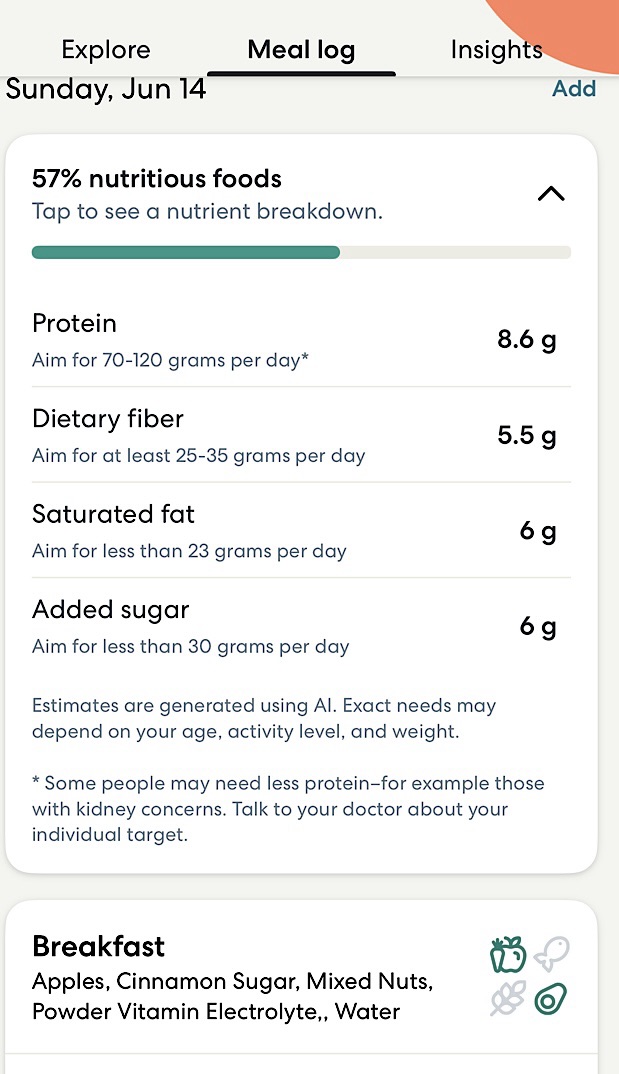
Speaking of food, I’ve been tracking my food in the Omada app again. I still believe the Omada program is a waste. If you have issues with food and weight and health and don’t have a previous understanding of nutrition I can’t see it helping. It only helps me because it reminds me what I’ve eaten, how I’m trending and gives me some basic nutritional summaries. But the fact that my insurance company gets charged $30/month just because I stepped on a scale is nuts. My coach is really good, but for the most part she can’t tell me anything I don’t already know.

So much of health is making the hard and responsible choices.

And doing what you need to do.

It’s also the only app/system that gets worse over time. Their AI-driven logging system can’t identify basic foods, and when you try to edit the listings with information from the actual label, it just ignores you. Omada does not believe in tracking calories. It encourages instead you make better, educated decisions based on your hunger and how you feel. I understand that calorie-counting can lead to some psychological issues, but in the end, weight loss is math. They do track fiber, added sugar, protein and saturated fat. But not sodium. If you have a chronic weight or heart problem, you need to understand sodium.

And they encourage you to aim for 50% nutritous. I average 50% on any given day. Today I’m at 57% so far, but I’m due for lunch. That may change. Now, if you know me, you know– I try to make my meal choices as close to vegan and minimally processed as possible. I had gestational diabetes when I was pregnant with Eva, and trying to eat 2800 calories in six meals a day with no sugar on a vegetarian diet got me very bored. Thank God I decided to incorporate tuna into my routine. I can still remember some of those routines. My ten-thirty a.m. snack was large curd cottage cheese and usually strawberries or raspberries and my 8 p.m. snack was decaf coffee and unsweetened soy milk. (I had to do something to make the “milk” drinkable.) I still can’t look at a plate of food without seeing its protein and carbohydrate estimates in my head.

screenshot of the Omada app showing the list of protein, fiber, fat and sugar stats

Most people don’t have my experiences. And I know myself. For instance, if I eat a meal out, even if I make the good choices, I will gain 3 pounds the next day.

Most people don’t stay invested in their choices like I do– so if I only eat 50% nutritious, how does a standard American diet rank? I wouldn’t want to know.

So far today, I have had:

  • about 16 ounces iced coffee with a healthy pour of half and half. (That comes in at 50% because the coffee is considered a healthy drink, even if I drink it at every meal. The half and half on the other hand is not nutritious, because of its saturated fat content, but it has calcium, vitamin D and protein and isn’t sweetened or processed like other creamers.)
  • For breakfast, a little more than half an apple with skin on, with cinnamon sugar and mixed nuts. Water, 30 ounces, and one scoop of my Powdervitamin electrolyte powder which has no calories, is the most dense with minerals and salt, and sweetened with stevia. But because of the sugar on my apples and the powder, that again ranks my meal as only 50% nutritious. I could have used a processed caramel fruit dip or an icing and Omada would have ranked my choice as just as it did when I added just a touch of sugar. And the electrolyte powder gets treated like a sugary Gatorade even though I need that supplement to prevent orthostatic hypotension because I don’t eat many sodium-rich foods and I drink so much water. How many other people drink 50+ ounces of fluid before 9 a.m.????

My plan remains simple… More movement, more yoga, eating at home, and not eating due to stress. And in a few months or maybe a year I will write a blog post like this. Again. Which I do so frequently. As I struggle and fail and disappoint myself. But permanent change is a long game and it’s hard when the only person who holds the power and the motivation is yourself.

The Medical Refund I Didn’t Ask For

I keep promising myself that I won’t let this blog anguish and fade into nothing, and then I fail. If you miss me, check out Parisian Phoenix Publishing on the web or social media or sign up for my weekly-ish Substack newsletter. (Which you can do here.)

While I keep intending to do more jovial hometown adventures and life updates about the cats, the bird or the dog, it doesn’t happen. (We have TWO dogs this week as we have a jovial mutt with us as a boarding client. He’s a joy to be around, and he’s such a confident and stereotypical dog compared to our depression-prone backyard-bred pit mix.)

Eva’s dog has received a custom muzzle as a safeguard against her fear-based reactivity. And the difference it makes in our ability to trust her with new dogs and people and her comfort while wearing it is amazing. If you have a dog with issues, a custom muzzle is a game-changer.

But today I want to talk about what happened when I returned from Ireland regarding my emergency room visit two months prior. And I might sound like a conspiracy theorist, but it is what it is.

I have a high-deductible, employer-sponspored health plan through my husband, but as we are separated, I do not ask him to use his HSA. The HSA absorbs a lot of those out-of-pocket expenses. And my husband’s employer gives him money for the HSA as an incentive to take the high-deductible plan.

I have done the math. As a family, we have had the high-deductible PPO plan for 20 years. It sounds scary at first, but the monthly premiums are way cheaper than the other plans and the PPO allows us to see any doctor we want when we want, and when you have chronic issues, that’s important. I briefly had an HMO in the late 1990s when I had never had any health insurance before and no real medical treatment post age five, and my primary care doctor sent me to a podiatrist who specialized in ankles for my gait issues because he was pretty much the only provider in network. He told me there was nothing anyone could do without finding a provider in a major city.

And by the way, he was wrong.

If you don’t know, a high-deductible plan means that the insurance company pays nothing of any of your expenses until the deductible is met. In my case, that’s $3,500. BUT, my out-of-pocket maximum is $5,000 a year.

The ER Bills

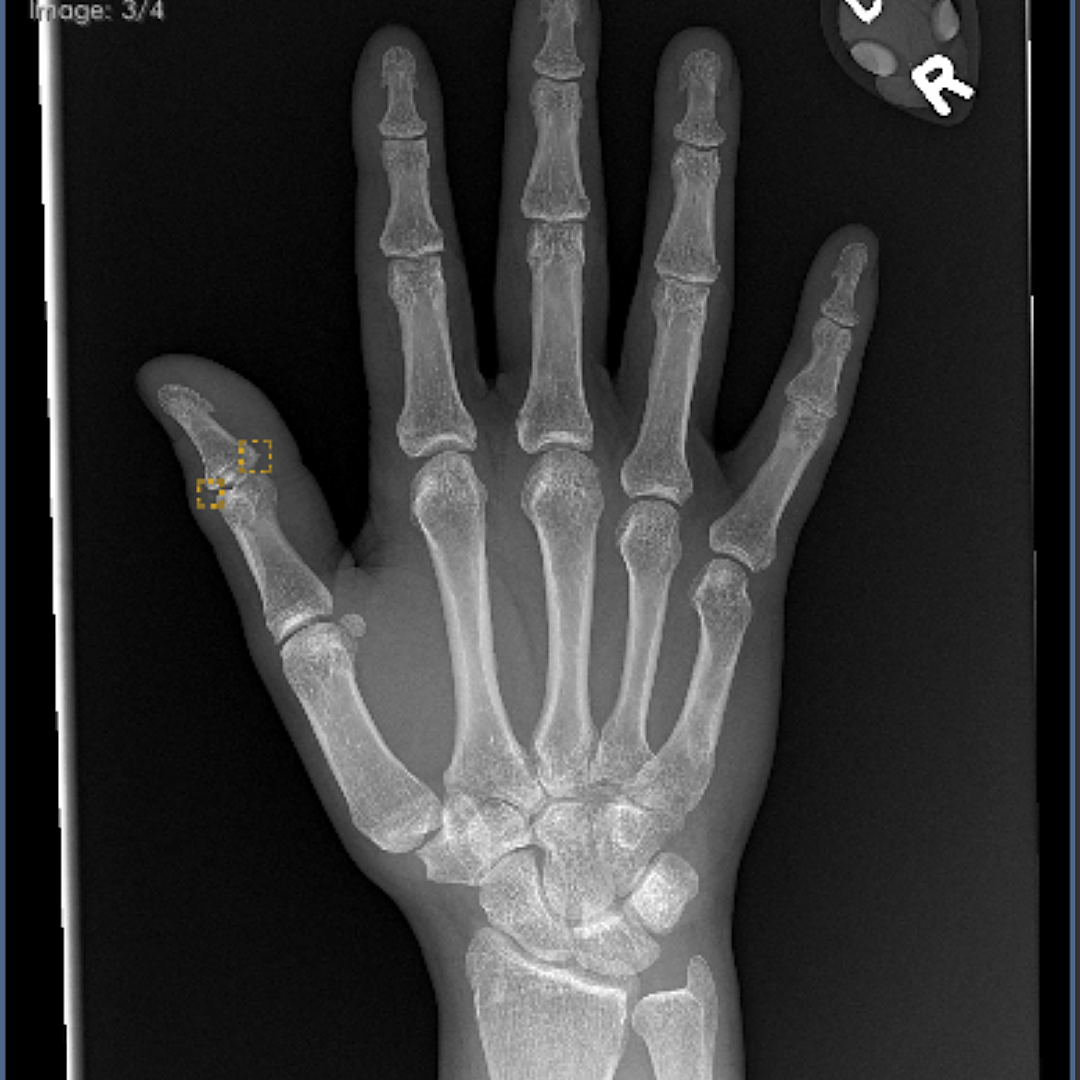
As you may recall, (if not here it is: the original post and the ortho follow-up) in early January I had a fall and I debated between going to the ER or the urgent care because of my history with afib after bodily trauma… I was not in afib, but I did break my thumb, which has not fully recovered.

That fall led to about $800 in out-of-pocket orthopedic specialist bills and about $3,000 for the emergency room. Now, I use AblePay which allowed me to schedule payments for these services and gain a cash discount. For the ER bill, I opted to pay more than $2,000 in one lump sum of my American Express because it allowed me the largest discount. I then used the AmEx PlanIt feature to schedule that into monthly payments for a fee instead of accruing interest. In the end, I didn’t save money but it allowed me to space the payments.

But then… randomly, a full month after I paid 100% of the ER bill in a lump sum of on my credit card, my insurance company (Capital Blue Cross) decided to renegotiate the bill– which remember, they did not pay. I did.

I did not know this was happening. I was less than $200 away from my out-of-pocket maximum for the year so I scheduled regular chiropractor appointments and a mental health check-in with my therapist. The chiropractor appointments help me not twist my body into weird contortions that further cause complications from my irregular gait, and since my chiropractor Nicole was originally a physical therapist, she helps me stretch and monitors my gait to make sure my feet “do feet things.”

So, while I have debt from the ER visit, I can now have chiropractor appointments every other week for a small coinsurance amount ($40). And that is a huge help to my mobility.

On a Friday afternoon, I get an email from AblePay and a notification from AmEx that I had a $1700 refund on my recent medical bill. Which sounds great, right?

I logged onto Capital Blue to see what was going on, and indeed they had renegotiated my bill, which rolled back my previously met deductible and out-of-pocket maximum. And I had two chiropractor appointments and two therapist appointments that I was now responsible for. That’s about $700.

And I know what you are thinking, that still leaves me $1,000 ahead. But oh no it does not. Because remember, I had only paid one payment of my planned credit card charge. So the whole refund went to the charge, and I still needed to pay the remaining several hundred.

I negotiated a payment plan with my therapist and canceled all my upcoming chiropractor appointments.

I wish I could tell you that was where the story ends.

Present Day Repercussions

When I was in Ireland, I walked a lot more than usual. A lot more. As it was a relatively last-minute trip, I didn’t have a chance to try and get myself in shape. So I attributed the discomfort to my out-of-shape-ed-ness and called it a day.

But I am experiencing problems again. For the last week, I have been experiencing increased muscle pain in both my legs. My left leg usually does not hurt. My right leg always hurts. Like every day, I experience at least a pain level one but typically two or three. It’s like there is a braid of muscle that splits the back of my thigh muscle and presents with a constant pulsing, ache. But increasingly, my calves are experiencing extreme, painful muscle stiffness, in both legs, and my knees hurt.

My flexibility is better than usual, and I have no problems with my back, but if I touch the floor, it kills me to straighten my legs.

And this morning, after a week or so of this, and several days of feeling like my legs aren’t attached to my body when I walk, I started to cry. I caught myself, but I still started to cry. I took an extra dose of my baclofen– at double strength, and that made the calf pain go away. But I’m struggling to use my legs. And I’m getting damn tired of it.

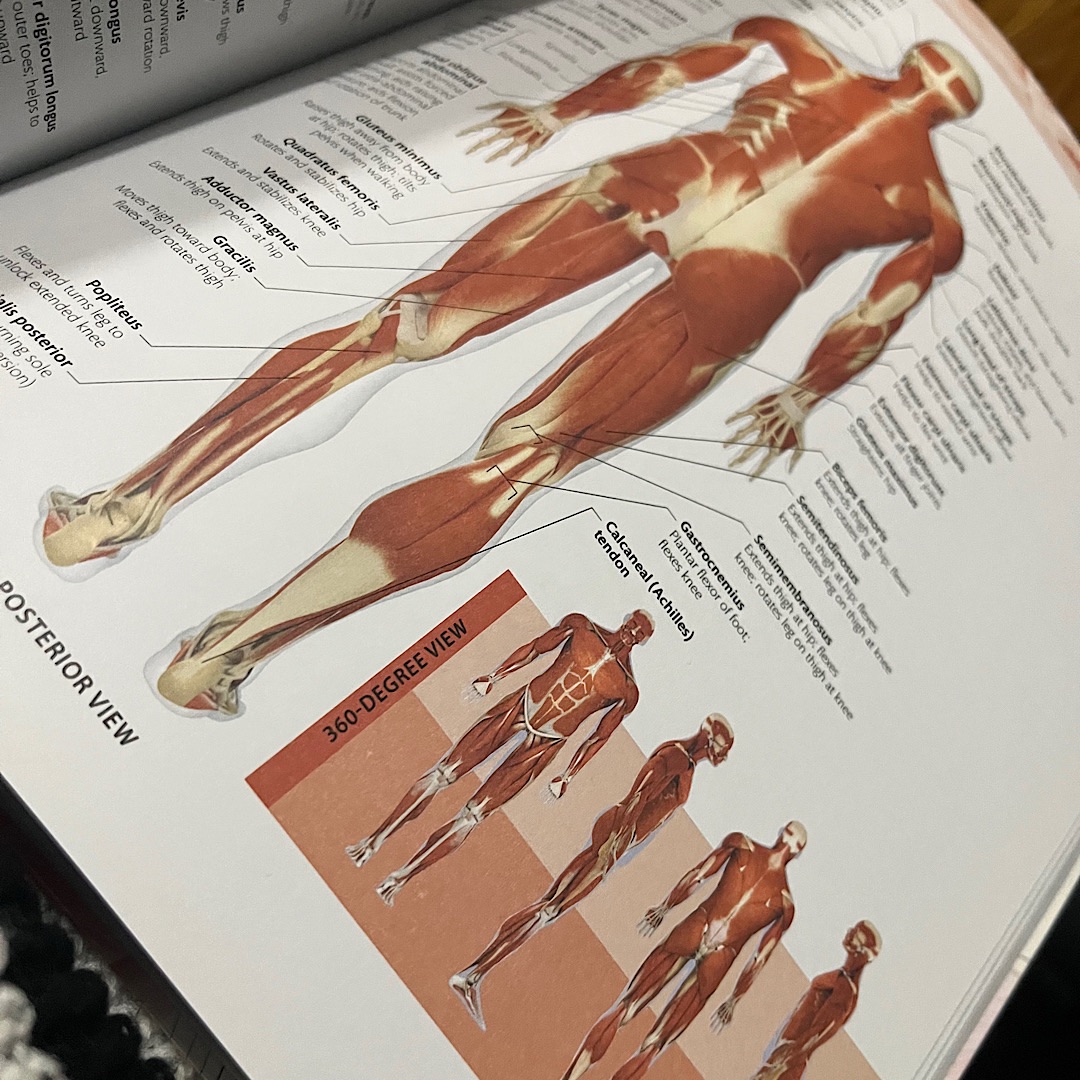
I have tried to find and label what muscle hurts, but I can’t.

I suspect I need physical therapy. I have tried to take short but regular walks, making sure that I hit at least 5,000 steps daily, but I think it’s too little too late, and my muscles have forgotten how motion works. This winter was hard, long and cold; and with my part-time fast food job laying me off, I don’t stand and walk as much as I have during the last year.

But that leg pain I refer to as a braid? That started shortly after Stitch Fix closed. I think because I went from a job where I stood eight hours a day to a sedentary job. That’s almost three years of the same pain. That has now intensified.

So, why don’t I call the neurologist?

Because she costs $220.

And if she wants tests, I can’t afford those.

And If she agrees that I need physical therapy to stretch out and retrain muscles, that’s thousands of dollars. It sounds ridiculous. That a six-week physical therapy session would rack of thousands of dollars, but when I broke my ankle, which was TEN years ago, that cost me $5,500. That deductible and co-insurance adds up.

This is when I miss my Medicaid.

Becuase I work hard, everyday, and I just can’t afford the treatment and maintenance that would improve my quality of life.

And it sucks.

To make a choice everyday to deny yourself care you need.

Because of money.

And I believe– and maybe I’m wrong– that Capital One renegotiated my ER bill because I hit that out-of-pocket maximum and they didn’t want to pay my upcoming bills.

Our health care system, specifically for-profit, employer-sponsored health insurance, sucks.

It’s broken.

Broken Thumb

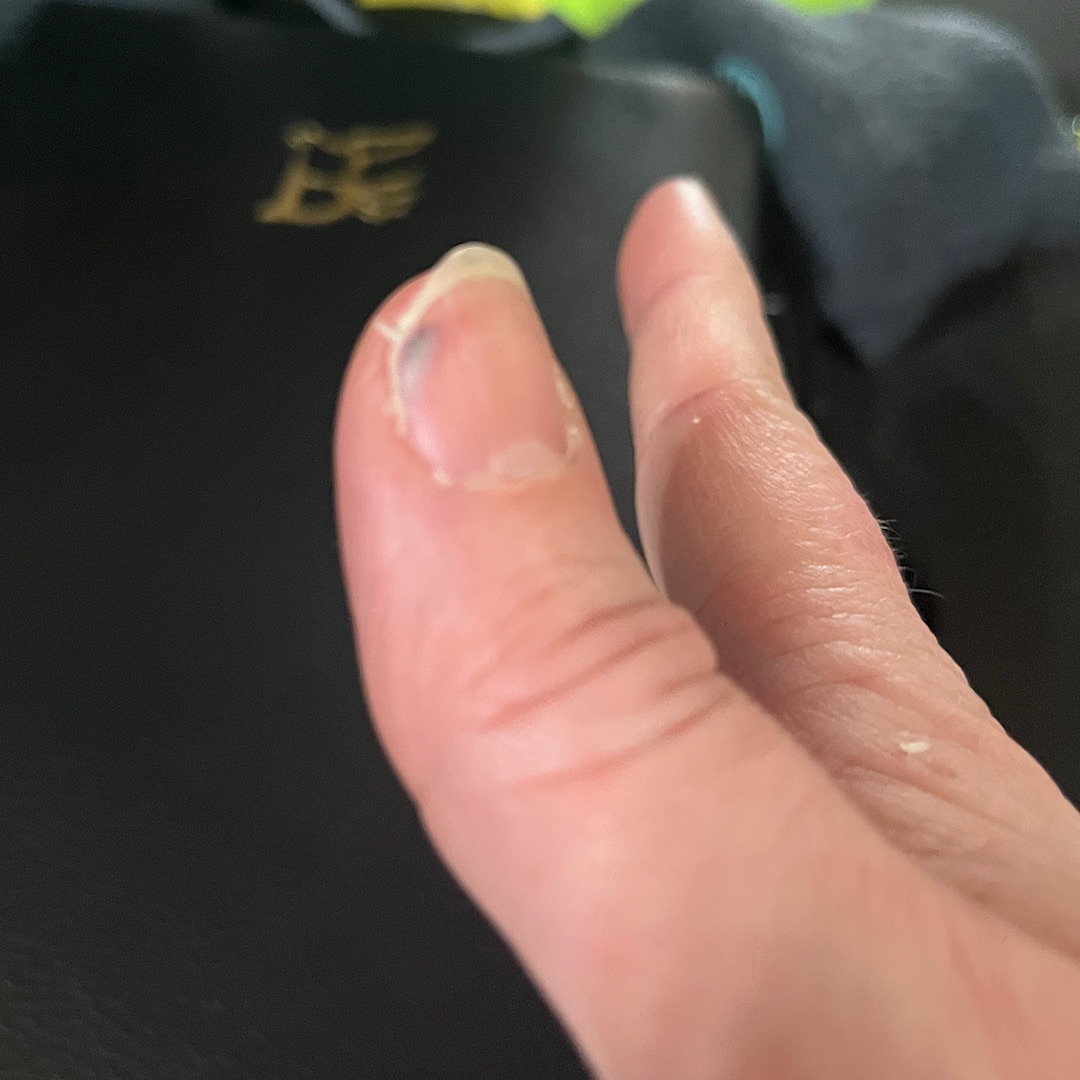
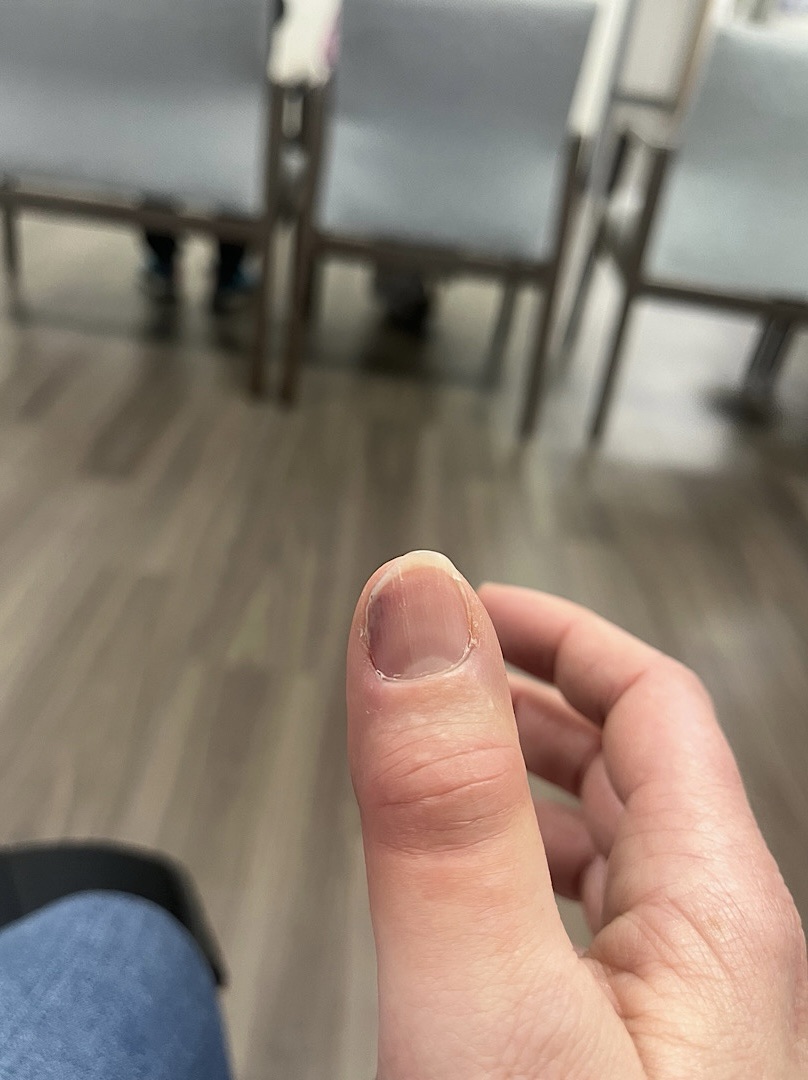
In 2023, I had two falls close together (two bouts tumbling down the stairs in two weeks) and in general, I tend to fall more in winter (and not even outoor falls due to weather and ice). These two factors and my hospitalization with AFib after my falls in 2023 led me to go to the emergency room yesterday because of my fall at lunch time on Wednesday.

(For more info on my hospitalization in 2023, click here.)

I just wanted to make sure that this fall didn’t lead to a sequence of falls.

In similar cautiousness, today I visited my old ortho practice from when I broke my ankle in 2016. That’s the infamous “I broke my ankle and went to the Chinese buffet before heading to urgent care for an x-ray” incident. Read more about that here.

I felt silly, because my injury is pretty minor compared to other orthopedic cases. The ER told me that if it didn’t feel better in two weeks to follow up with ortho.

But I know from past breaks that the first two weeks is when the healing really solidifies and if it heals wrong, I would have more problems. And I wanted better direction on how to splint it, a better splint, and confirmation it was broken.

It is. In two places in the knuckle.

This is my right hand. At this point only one finger of my right hand has not been screwed up in some capacity.

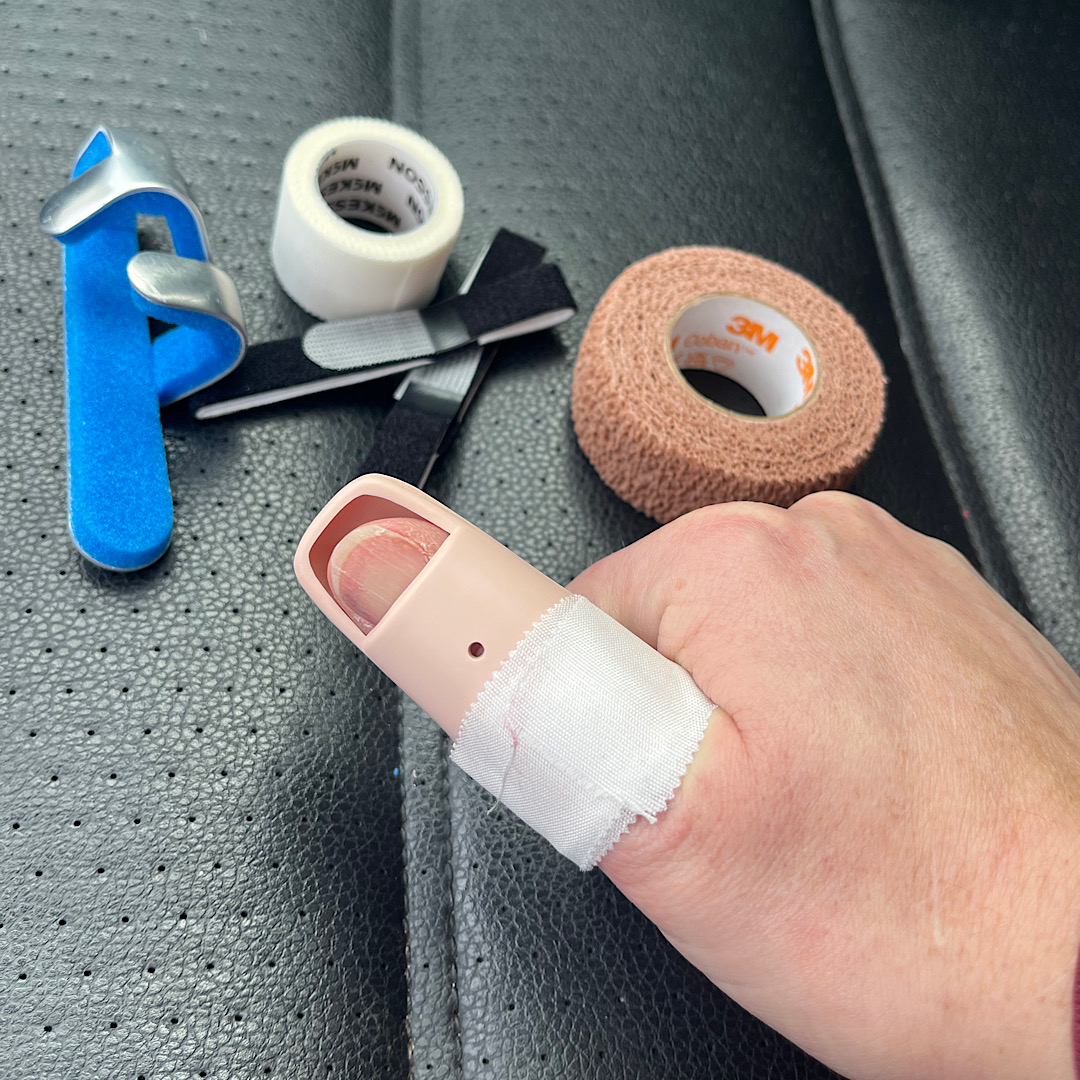
And the doctor seemed to agree with my fastidiousness. He gave me a better splint and some first aid tape and told me to come back in four weeks for a follow up and new x-rays. His assistant gave me some Coban tape and some buddy strips for the splint.

I have a high-deductible insurance plan and I do not have an HSA, so I know I will pay more than I want to for this, but it’s my dominant hand and I need it to work.

Playing my favorite game: ER or urgent care?

Yesterday, in a strange turn of events, I had a fall. More of a trip.

But let’s back up. Remember that tire incident from my last post? The day after that post (which was not the same day as the incident) I came down with an ailment that still has me congested and softly coughing.

I have to wonder if I had COVID.

It’s only been the last few days that I’ve felt myself. And that might contribute to the perfect storm that put me in this position.

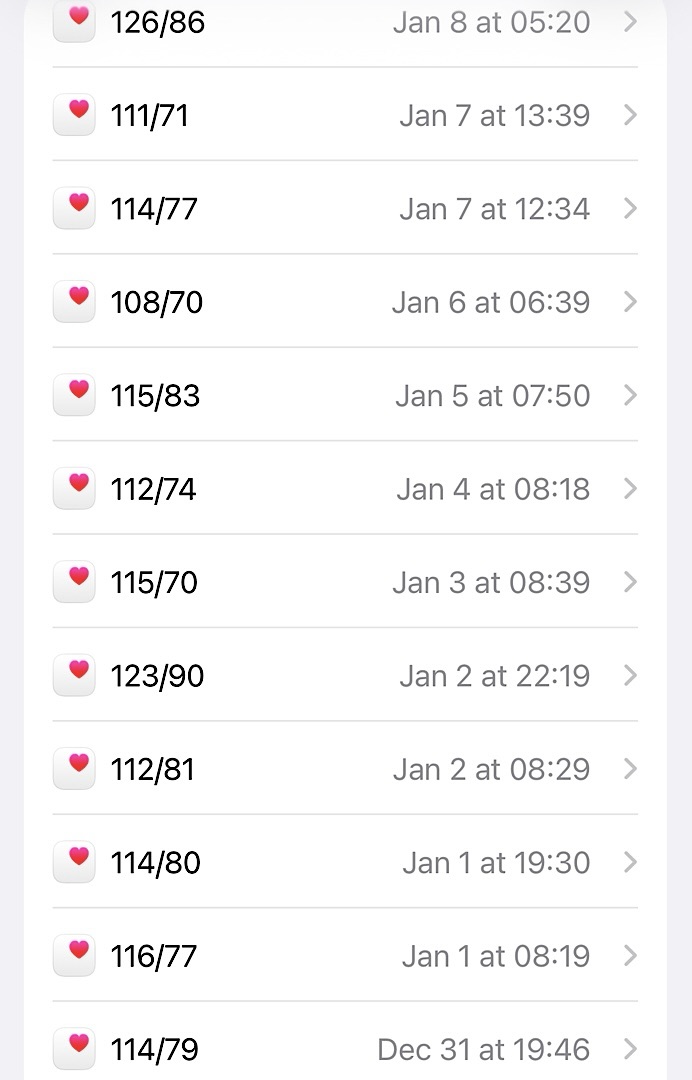
I forgot to take my baclofen yesterday and all I had before I went to pick up Nan for our errands was coffee and a couple Munchkins. (With Eva on vacation, those of us left behind had to take the dog to the Dunkin Drive Thru window.) I even forgot to take my blood pressure.

When I got home, it was probably 11:40. I had coffee from Panera and groceries in the car, as well as some plastic bins from the dollar store to organize the deep freezer.

I brought the coffee in first and got the dog out of the crate. The backyard had a lot of dog poo, and I wasn’t sure she peed.

So I put on her collar and her prong, leashed her up and checked for dogs and people. We went across the yard.., and the mailman popped off a porch four houses down.

I had not put on my hands-free, waist, back-up leash. So I dropped to my knees to better control the dog lunging at the mail carrier. I got her settled (the dog, not the mail lady) and put her back in the house.

I went to the store to get the items from the dollar store. The mail lady approached me to give me the mail. I accepted it, placing it in the large-ish plastic basin containing all the items from the dollar store.

I turned, got my foot caught on the dog’s outdoor place stay, and fell. I fell with a bit of a twist, landing both on my stuff and on my right thumb.

Assymmetry percentage

I landed on the sidewalk and along the steps.

I smashed the basin. It never even made it into the house.

The fall probably happened around 12:20. My watch didn’t register it as a hard fall, probably because the basin broke my fall and prevented more serious injury.

The thumb hurt but it moved well, so I took my Baclofen, had some lunch and sat down for a while. My phone suggested my gait had been awful that day.

Thumb directly after accident

At 5 p.m., I did a shift as the front counter bagger at Chick-Fil-A. 4 hours.

Had dinner. Came home. Went to bed.

Woke suddenly in the middle of the night. My thumb hurt and it was bending less than it was earlier. I went back to sleep, planning to go to urgent care in the morning. The recycling truck came around at a bit after 4 a.m., woke me, and I couldn’t get back to sleep. I decided that even though I got less than five hours sleep I would just get up.

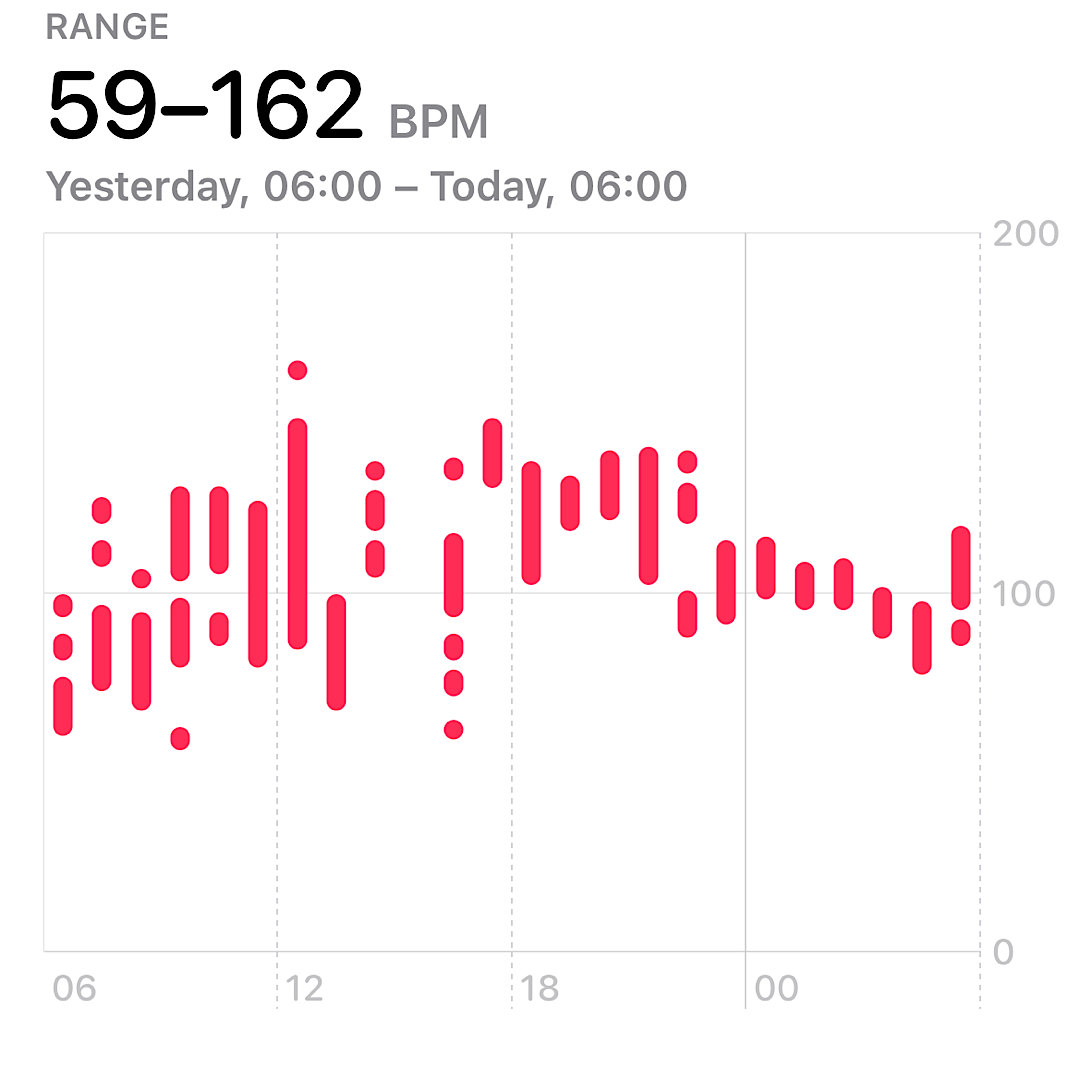
When I looked at my phone, I noticed a series of notifications. Apparently, my heart rate had been high while I was sleeping. Since I had that afib incident after my falls in 2023, I did an ecg on my phone. It was fine.

I headed for the bathroom. And as soon as I opened my bedroom door, I had to fight not to urinate on myself. With no warning. As I got closer to the bathroom, it was harder not to lose control– and in the end I didn’t really make it.

Thumb in the ER

Now my thumb would not bend at all.

I began to wonder: Do I have too many complexities for Urgent Care? With my disability and my heart history…

At 5:30 a.m., I decided to bite the bullet and walk to the ER.

A ten-lead echocardiogram was normal. Thumb shows a possible chip fracture.

I came home and called my neurologist, who is also a physiatrist, leaving a message in case she wanted to see me since I had a weird combination of symptoms. The person who assisted me asked me all sorts of questions.

While on hold with their office, I looked up the number for the Institute for Hand and Upper Extremity Rehabilitaton. I have worked with their therapists for two of my previous finger injuries on my right hand. They are now closed.

The person on the line with me from the neurologist’s office suggested I call the orthopedic specialist, especially since it’s the same doctor whom I consulted with when I broke my ankle ten years ago. The ER advised I call them if it got worse or did not improve.

But I would like to confirm whether or not it is broken and get a better treatment plan than this huge, cheap splint the ER gave me.

The person on the phone at the ortho’s office assured me that it was smart to be seen, right away, versus waiting for time to pass. She even had a cancellation for tomorrow morning.

So I guess we’ll have more updates tomorrow.

The finger and the feast

Maybe the title is a misnomer.

There is no feast, but I like alliteration.

I went to the hospital yesterday for a specialty diagnostic ultrasound of the middle finger of my right hand. I’ve been having issues with it for six months. There were about four instances, about once a month where when I reached for something, it felt like the finger exploded and I screamed out. The pain only lasted 20-30 seconds, but the whole experience reminded me of when I had a mallet finger on the neighboring ring finger. And I keep expecting to see that finger drooping.

[If you would like to learn more about mallet finger: here is the blog entry about my um… accident… where I sustained an injury removing my socks. This is the entry about meeting with the orthopedic specialist.]

And every time I move the top of my finger independently of my other fingers, it clicks. Not painfully, but it’s noticeable. It’s just weird.

Today I had to go to St Lukes Bethlehem, which is the main urban campus of the hospital network because if the specialty nature of the ultrasound. I did not know that the parking deck was under construction. And for the first time in my life, I had to use valet parking. I technically had enough time to look for parking in the neighborhoods near the hospital but… I thought that stress would be higher than just using the valet service.

I checked in at the kiosk, and thinking about it now I never had the chance to check if my Able Pay was on my file because I will be paying for this test out of pocket. I have a high deductible medical plan and I have about $1,200 left of my $3,500 annual individual deductible. Able Pay gets me a discount on procedures and offers me interest-free payment plans.

Of course they asked if I might have had a fall and I had to tell them, “Of course I might have had a fall, but not one I can connect to this problem.”

The test itself involved the doctor and the radiologist– and the doctor could feel my clicking finger. BUT because of the nature of the click, remember it only happens if the finger is acting independently, he couldn’t get an image of it. The way he held my finger to get the image prevented the click. OR he couldn’t get the ultrasound into the proper place at the right time.

He found fluid around the joint, but he couldn’t say whether or not it caused or was related to the click. And he couldn’t see anything wrong.

He said he could “grill me” longer and keep trying weird things to take the image, but we both decided it wasn’t necessary. If he didn’t see anything structurally worrying AND I no longer have the pain– then I’m satisfied.

My neurologist asked if I wanted to see a hand specialist as a next step to examine the inflammation. I said no, unless the pain returns.

In the meantime, influenced by my experience at the Hindu temple and my recent overeating/ weight gain, I have done an impressive (in my opinion) job removing animal products and artificial sweeteners from my diet. I am working to reduce caffeine consumption but that has not been as successful.

So far this week, I have had no meat, milk only in my coffee, two servings of cheese, and I may have consumed eggs in baked goods that I did not make. But the main baked good in question is packaged gingerbread cookies that came from Grocery Outlet. They are GMO-free and I have eaten four small cookies (which comes out to one per day).

The scale is three pounds down, which might be because I moved the scale and this is an old house. I am also surprised that my protein levels have still been hitting 60-80 grams a day.

Eliminating animal products and artificial sweeteners is a great way to be mindful about eating. Sure, I want to promote preserving resources and eliminate animal suffering, but there is less food noise to contend with if you start with the vegan options and ask “will one of these work?” and the bonus is that I end up getting more fiber and meeting my fruit and vegetable goals because plant-based non-manufactured foods are often the most nutrient dense.

Today I visit the ENT to set up an old lady hearing test.

We now have a deep freezer

We recently got an old, hand-me-down deep freezer.

And at the same time, the federal government shutdown and Pennsylvania state budget impasse have complicated SNAP benefits for families who have them.

I heard on the news that 1-in-8 Americans have SNAP (Supplemental Nutrition or “food stamps”). I heard one story this morning about an unemployed widow with a 15-year-old son whose soundbite suggested she sent him to school so he could eat breakfast and lunch.

I hope she’s sending him to school for an education, first and foremost.

I consider myself a fiscally-conservative Democrat who believes that education and healthcare should be attainable and fair. I would love to have a Ph.D., but I can’t afford to finish my masters and I refuse to go into debt for it. I also have a disability, and even when I am well-employed I often have to make choices about my medical care.

Right now, I have my own small business. I work a part-time job in the food service industry to provide some reliable income on a steady timeline. I am an adjunct instructor at my local community college, and if you break it down to an hourly rate, I probably make a similar wage at my fast food job (because of the fact that I did not have the money to finish my degrees). And I have freelance writing and editing jobs and a mini author’s assistant job.

And I’m always on the look out for more. Applied for another this morning.

I started my career in public relations, and ended up in print journalism, which led to a long career of lay-offs as newspapers died. I worked in non-profit communications and development, where I learned a massive amount of useful skills like grant writing but also experienced a ridiculous amount of toxic managerial behavior. Some people work in the non-profit sector because they want to make the world a better place, but at the same time, many of those people have either childhood trauma and/or personal insecurities that create some challenging environments in an already difficult field.

I mention all of this because I have experience with unemployment. I have experience with being the single mom with maybe enough resources to survive a month. I was a single mom raising a teenager who lost her job during the pandemic and did not find out if she qualified for unemployment until the weekend after she accepted a new job. I was unemployed for four months and had opened my home to one of my daughter’s friends who didn’t feel safe in her own home.

I applied for public assistance because I was volunteering at a non-profit that provides services for people exiting human trafficking situations and my “boss” suggested it. Because I had no income and I had an official dependent, I received more than $700/month in food stamps. And Medicaid. Which was a great help. Even though I only received food stamps for four months, I rationed them so they lasted almost a year.

I had accepted a job in the warehouse at Stitch Fix. I loved that job, and the company, but after three years they decided to close our warehouse. After three years at a wage where my take-home pay was the same as what I had made as the development manager for a small non-profit with a two-million-dollar annual budget (thanks to the fact that Stitch Fix offered their employees free medical benefits), I found myself laid off again.

And when my unemployment ran out, I once again applied for food stamps. I had gone on multiple interviews, built up my small business, but still struggled with the cost of my medical care– my estranged husband put me on his benefits but my medicine was $50-$100 a month and all my doctor’s appointments I had to pay out of pocket because of the high deductible. So I really hoped I would qualify for Medicaid again. And I did.

I also qualified for $525 in food stamps.

Around this same time, Trump got re-elected and the cheap refrigerator I bought started freezing the food in the refrigerator and not freezing the food in the freezer. But I couldn’t afford a new fridge– and I still can’t– so we started buying only what we could eat in a few days, or foods that could safely thaw and refreeze.

Lettuce is not one of them, if you were curious.

The point of all this is to ask: Regardless of how you feel about who uses food stamps or how the government distributes them or whether or not people try hard enough or work hard enough, why is no one asking why we have a system where 1-in-eight Americans qualifies for food stamps?

I have seen and heard so many things about the system, and I have known people who work in the branches of government that distribute these types of assistance and they are all people who want to help. I have met people afraid to work because they might lose assistance, and I have seen people who need the help lose it because they made too much money. (And, like me, it’s usually people who need medical care.)

I have about $2,300 left on my deductible this year, and I have spent almost an equal amount if you read my EOBs from the insurance company. I’m losing my hearing in one ear and I need a hearing test and a visit with the audiologist. The muscles in my one leg have been spasming 24-hours-a-day for almost a year now and I just blamed it on my cerebral palsy but my neurologist has concerns that previously noted damage to my spine (from all these years of walking crooked) may have caused nerve damage in my lower back. And my one finger has been doing crazy things for about a year.

That’s probably at least $6,000 worth of tests. Do I just try to schedule it all before the end of the year and finance the $2,000+ remaining of the deductible on a credit card? Or Able Pay? or do I wait until I am better off financially?

Back to the deep freezer. A friend of the family was hoping to get a decade-plus year old freezer out of his house. We took it. We took all the stuff from our cheap refrigerator that needed better freezer conditions and piled it in. And I thought– when Trump was elected an I was worried about the future of food stamps, I didn’t have a freezer to fill. I did however invest in every non-perishable food item I could tolerate.

Dried Beans. Plain-old Rice. Canned Fruit. Canned Vegs. Nutritional Yeast. Some condiments. Canned Tuna. Spam. Canned Chicken.

My childhood traumas leave me to ruminate frequently about food scarcity, financial security and general stability. I will probably always behave as if every trip to the grocery store is the last one I can afford. And I have done my grocery shopping at the Dollar Tree and the Grocery Outlet because I only had $20 left to feed us for the week.

The Office of Vocational Rehab considers me the most severely tier of worker, whereas the federal government says I do not qualify for disability because I work so much and at so many jobs. But the federal government doesn’t take into consideration that I have to work that hard to make ends meet. And I don’t always succeed and I often hurt myself doing it. And I just work past it.

But how do you determine an equitable way to decide who deserves help? And I ask a third time: Why does 1-in-eight Americans receive food stamps? What is wrong with our society if 1-in-eight people cannot afford to feed themselves according to the criteria the government sets forth?

Food for thought.

We went for a Real ID and ended up with doughuts

Today, my friend Nancy and I embarked on getting her Real ID here in Pennsylvania.

We have prepared for this for weeks. We went online– at least twice– and checked the document requirements. We checked that the federal shut down wouldn’t impact state services. We reviewed the documents ourselves, provided extra ones where we could, and organized them.

Nancy has never had a Real ID, but she has had state-issued photo identification. It expires at the end of the year, and with the nature of life recently and the talk of needing certain forms of identification to enter federal buildings, Nancy thought a Real ID was smart. Nancy is blind, and should she ever have to turn up at the Social Security Office to straighten out any messes, she might need it.

With the rules in general on travel and proving one’s identity, it seems smart indeed.

I went through all the documents. We had an original birth certificate with raised seal, social security card, tax documents, marriage certificate with raised seal, utility bills for proof of address, and who knows what else we had in that envelope.

We could have gone to the local driver’s license center and had them verify our documents. If we passed their inspection, the next step would have been to apply online for the ID. Then, the state would mail a camera card for us to get the photo taken and the final product issued.

I talked Nan into going to the larger center in Whitehall because theoretically they could do everything all at once.

I was optimistic but also pragmatic.

We got there when it opened. There was three regular spaces and two handicapped spaces left open in the parking lot. I chastised Nan for not bringing her parking pass. The center had at least 10 counters open in a space that resembled a small airport terminal. The line extended out the door. We got inside within three minutes, chuckling at the guy behind us who had to answer the guy behind him about what documents he needed to renew his driver’s license.

And then that person loudly proclaimed, “I can’t stand here in line; I have to get to work.”

Then, why did you even show up if you don’t have the documents you need and you don’t have time. I literally cleared my whole day, just in case the wait was long. I had snacks, too.

We progress toward the end of the rug that lines the floor in front of the door. The man in front of us steps off the rug. A security card tersely tells him to get back on the rug.

The first stop is what might be reception desk where you are issued a number based on what you need to do. Nan states her purpose.

The gatekeeper, like a troll guarding a bridge, asked for her state-issued ID.

Boom.

He follows up with a request for her birth certificate.

Boom.

He then asks for social security card.

Boom.

Next, marriage license. Now, if we ace this, we only have proof of address left. I am nervous about the marriage license because all the married and especially divorced women I know have had problems with this step. Nan is nervous about address because she has moved since her state identification was issued.

The gatekeeper unfolds the paper. The one I studied so carefully because it had a raised seal.

“This is just a church certificate,” he said.

“What else would it be?” Nan asked.

As my heart fell, he said what I expected. “It needs to be the marriage license from the county courthouse. You should be able to walk in and pick it up.”

So we didn’t get to proof of address.

And I felt terrible because I knew they were picky, but I don’t know what the county-issued document looks like. I don’t believe they hand those out. I think the officiant files them and you have to request a copy in order to get one.

On the way home, Nan was apologetic and annoyed. I was upset with myself because I knew better.

But then we both got pissed.

Nan got pissed because this feels like another attempt to further impoverish people. If you have a disability or if you have a certain background that makes paper record-keeping difficult, or if you can’t drive or don’t have a car or reliable public transportation, how do you collect these documents and transport them to a formal government office like this? Especially when such places are typically crowded and require patience and waiting; and they are typically open at hours like 8 a.m. to 4:15 p.m. Monday through Thursday when normal people are also working.

I got pissed because look what document tripped us up–

The Marriage License.

Have you ever heard of a man being denied something because of a “discrepancy” with his name? (Actually, yes, I have. Men are much more prone to carry the name of a father or grandfather which can cause problems.)

In this case, Nan was denied a Real ID because we don’t have a county marriage license proving she married and changed her name.

But… Nancy has paid her taxes for 30 years with that name.

She has bank accounts in that name, and you can’t open a bank account without proving you are who you say you are.

Nancy receives her social security disability payments in the name of Nancy Scott.

And you know another thing that ALL THOSE OFFICIAL items have in common? The use her social security number as the factor that connects her to everything.

So what does her marital history have to do with anything? This does NOT have to be part of the process. At first I thought it made sense, because obviously you have to explain the name change. But if you have a track record of DECADES of use of the same name in association with your social security number, I don’t see its necessity.

We went back to her house and she did not have a county-issued document recording her marriage. And trust me, if someone had given Nan such a paper, she would have it.

We could have stopped by the courthouse but we opted to call first and went for a doughnut instead– trying the new shop Bill & Siobhan’s No BS Doughnut Shop.