A Walk Through Ali Sabieh

Ali Sabieh is a train town in Djibouti. The railroad to Addis Ababa, Ethiopia, opened in the late 1880s, I believe. Ethiopia is landlocked and depends on neighbors for imports. 

We visited the old train and train station and walked through town. 


Next we visited the purple mountain in the background.

  
As the town shrinks…


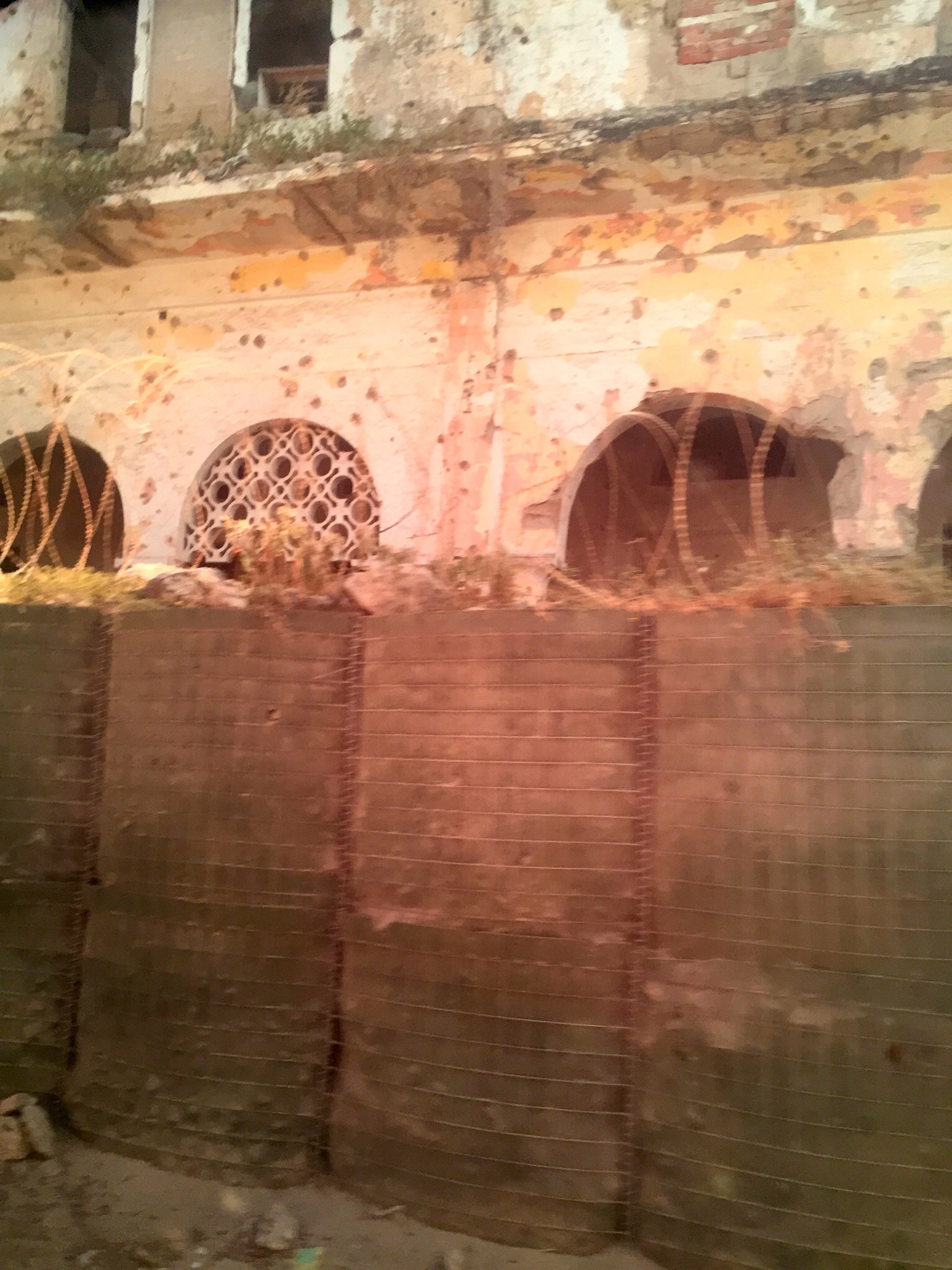
At the bottom before lunch I saw strange things:


Lunch was chicken and many, many flies.

  
Our driver packed some French fries and fed them to these baboons on the roadside:


When we continued on our trip, where the standard highway meets the African desert road, our guide pointed out that Ali Sabieh has no petrol stations. We stopped at what appeared to be someone’s house and he filled our car with gas from jugs. They used a water bottle cut into a funnel and wrapped it with a scarf.


our guide, Momo, talking to the girl who found my tattoo

 
Meanwhile, I made a friend with a little girl in a green dress. She offered me a candy. I refused. She showed me the candy on her tongue as if I didn’t understand it was candy. Then she poked my arm.

I looked down. She had noticed my bat tattoo. She scurried away and returned with every kid in the neighborhood. I peeled up my sleeve and this horde of children poked and prodded my arm. The girl talked with Momo, our guide, but I don’t know what all the children said when they were chattering like crazy.

White lady. Head uncovered. Short hair. Strange bat on arm. I am indeed an oddity.

And then they left.

Road Trip, Djibouti style 

When we returned to Djibouti City from Mogadishu (last weekend), we booked a trip with Bambu Service Touristik to visit Lac Abbé on the Ethiopian border.

African road trips are precarious. You have the crazy drivers, lack of petrol stations, dessert roads and rocky roads and a general lack of, say, signs. 

A straight drive from Djibouti, Lac Abbé is probably a three or four hour drive depending on conditions. We had several stops booked into our day.

I was extremely excited about this trip, because Lac Abbé is traditionally Afar nomad territory. Djibouti, as a country and former colony of France (granted independence in June 1977), has two traditional ethnic groups (among a host of others): the Issa Somali, with connections to Somalia and Somaliland, and the Afar, who hail from/migrate to Ethiopia (and I believe Eritrea).

I had just returned from a three day visit to Mogadishu. Mogadishu had opened my eyes to the influence of Somali culture in Djibouti. As soon as I returned to the streets, I recognized the food for sale. And now I could go see the Afar region.

As a student historian, I was thrilled.

  
As you drive into the countryside, you need more improvised structures. Often small huts made from the volcanic rock, sticks, corrugated metal and other recycled objects. Tires are the fence of choice.

  
Homes often have tires fencing in little yards…

Along the route we saw a lot of cylinders and it turns out there’s a big water infrastructure project underway to bring water from Ethiopia to Djibouti. 


Again, big news for a small country with no natural resources. 

  
Our guide built a coffee stop into our trip and M and I do love coffee. I had forgotten how much I love tea in this area of the world. I think their secret is boiling the sugar into the water before adding the tea. Though I’m not sure. I don’t like sweetened tea other places.


making our coffee


  She poured our coffee from her thermos bottles and when people paid her, she tossed the coins in a basket under her little table.

coffee and tea


other patrons having coffee


Our next stop was the town of Ali Sabieh. That will be my next topic. 

Lido Beach thoughts 

I heard about the attack at Lido Beach while at work today. I visited Lido Beach last week. Last week.

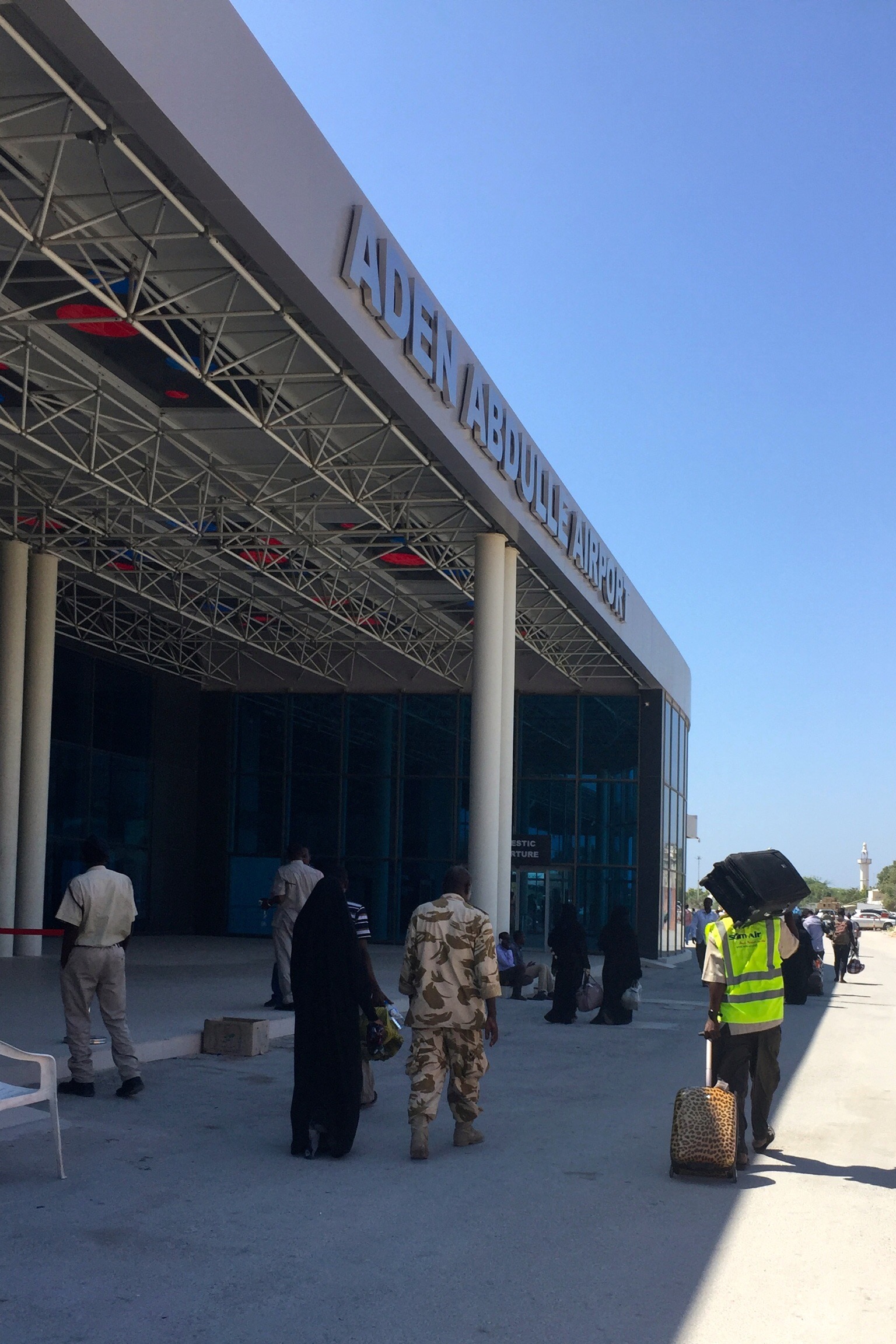
I flew to Mogadishu on a flight from Djibouti, a stopover on a flight from Jeddah, Saudi Arabia. I and my travel companion, M, stepped onto a plane full of black African men and women in black niqab.

The flight was originally a Jubba flight, but it turned into a code share with Daallo, the Djibouti national airline that had once gone defunct.

I noticed immediately that the staff appeared to be Eastern European and not very happy about their current assignment. Part of the problem was apparently the baby that a preschooler had on her lap. A preschooler was holding a baby on her lap before take-off! 

I think, perhaps, the enthusiastic flight attendants were bickering over who needed to deal with that. The woman crew member finally gave the baby to the man who might have been the father and moved the girl to next to the potential mother.

The flight attendant went for the baby lap belt extender and somehow, the baby ended up on the child’s lap again. This flight attendant, receiving no help from the male staff member (I swear he folded his arms, huffed and went and sat in his fold-down seat), seemed on the verge on losing her mind.

She finally forcefully grabbed the baby, realized how gruff she seemed, and made some sort of Russian-esque “coochie coochie coo” noise. She passed the baby to the mother and buckled everyone in before they could move.

And we didn’t see flight attendants again until landing.

  
I don’t want to digress too much with the beginning adventures, but now that I’m safely home I can tell you we stayed at Hotel Sahafi and I found it amazing.

  
There staff did a wonderful job feeding us and protecting us.

  
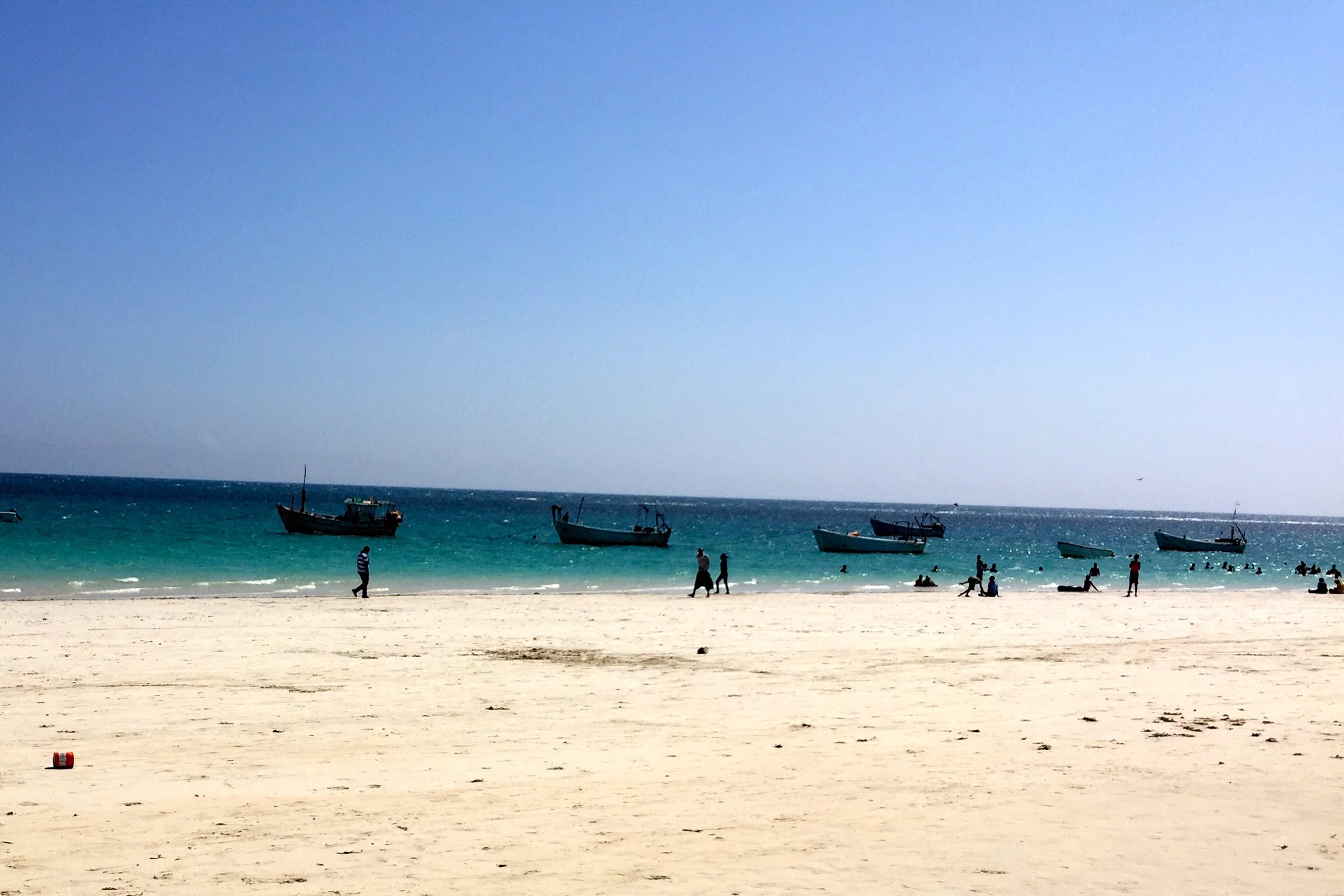
The first place we visited was Lido Beach, the most recent site of a terrorist event. Last week I was there. Last week I was frisked (in that special intimate kind of way that only happens in Muslim countries) and passed through a metal detector to go the beach.


And I did think it odd to have such tight security for the beach, but I had just arrived and it hadn’t really sunk in where I was.

Mogadishu.

And we had four armed guards with us as the local population frolicked on the beach.

  
The woman swam in their long dresses and headscarves. Boys and young men played a game of soccer in the sand and joked that we were scouts from FIFA.

But Mogadishu suffered a nearly 25 year civil war, a tribal war that only ended in 2012. Hopefully someday this gorgeous city and delightful population will be a place safe enough to visit without security.

But today it is Mogadishu.

  
Of “Black Hawk Down” fame.


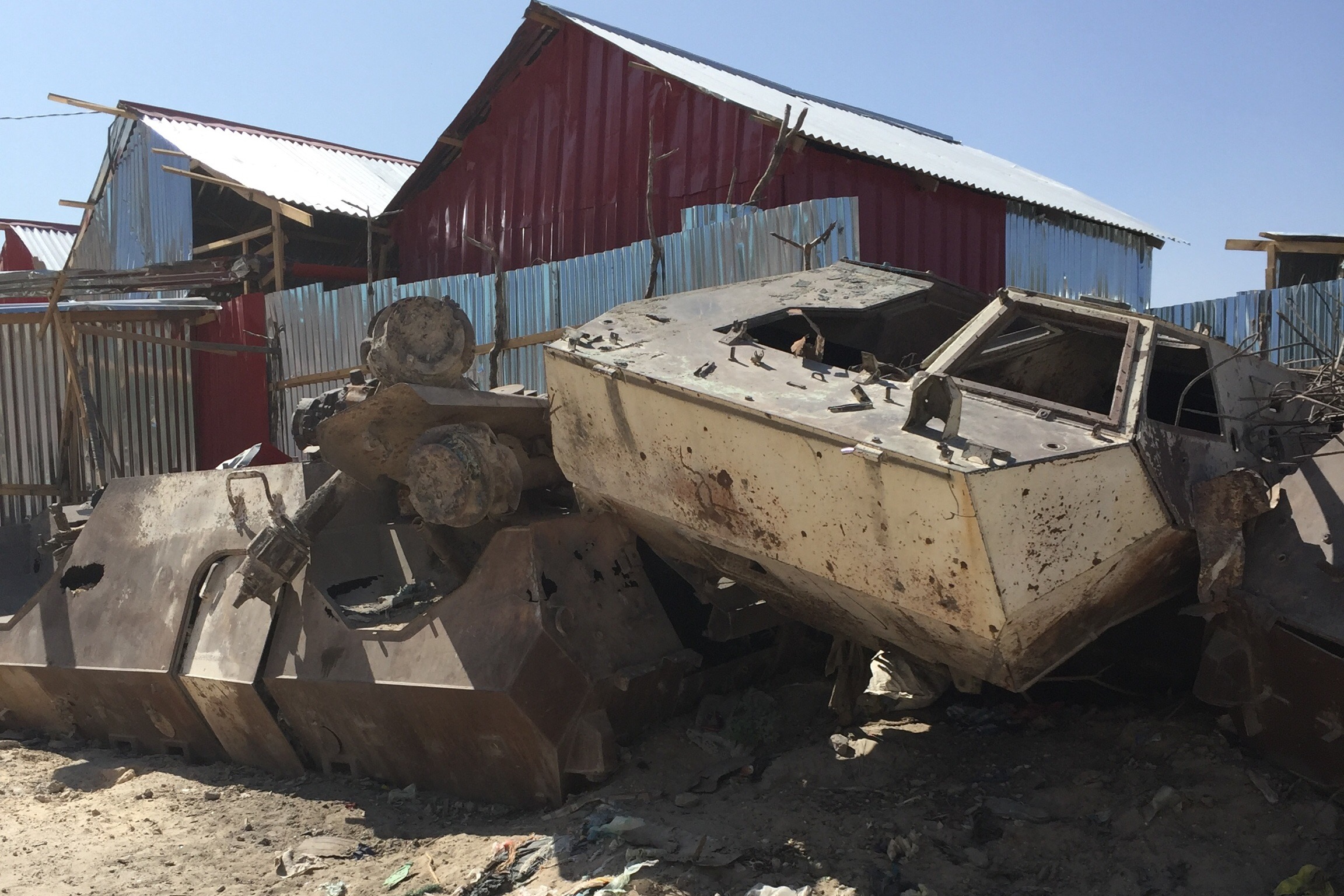
Where Pakistani tanks line the streets in addition to American military carcasses.


A land of barricades.  
 
And passive defense systems to protect against suicide bombers.


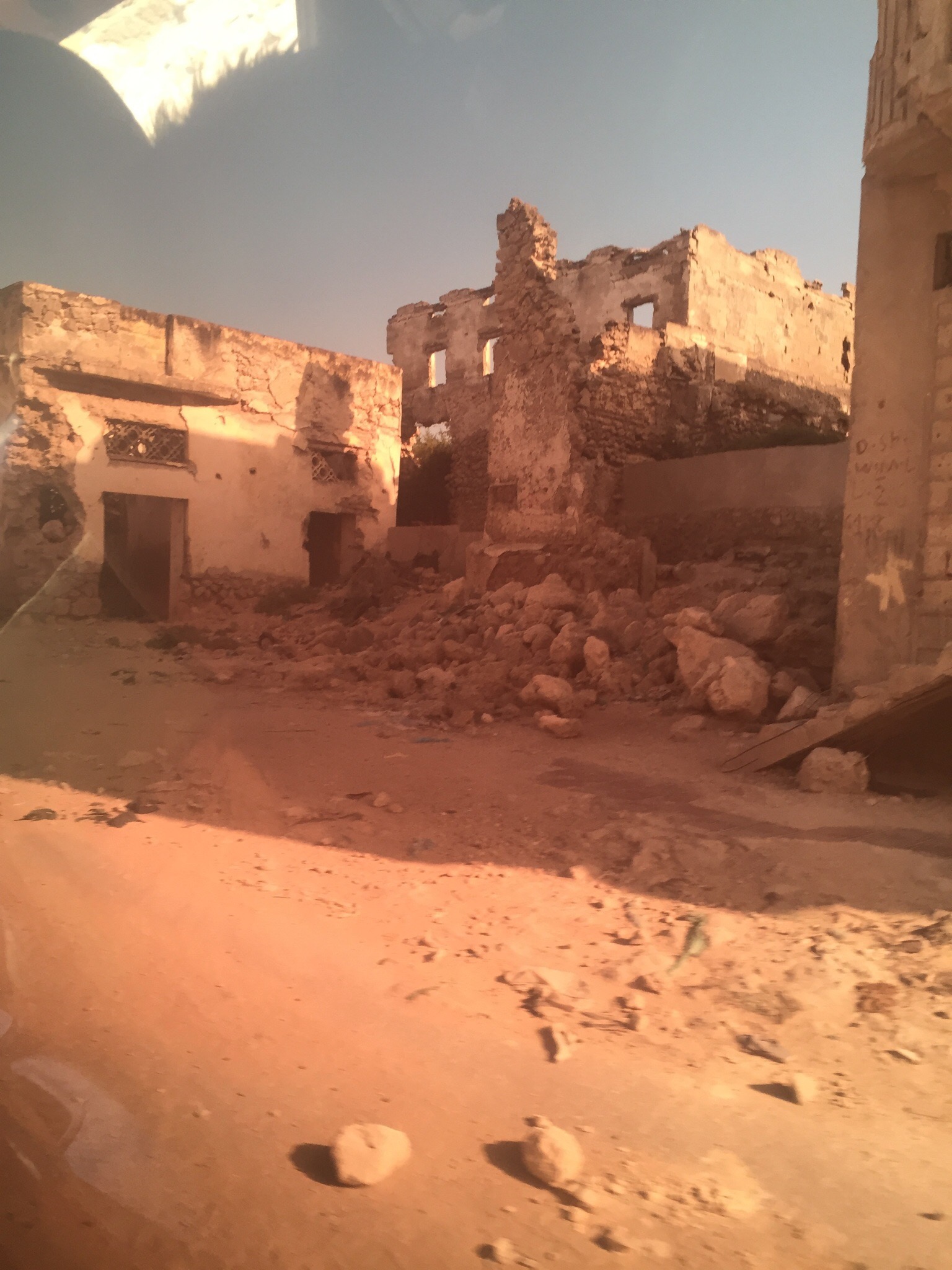
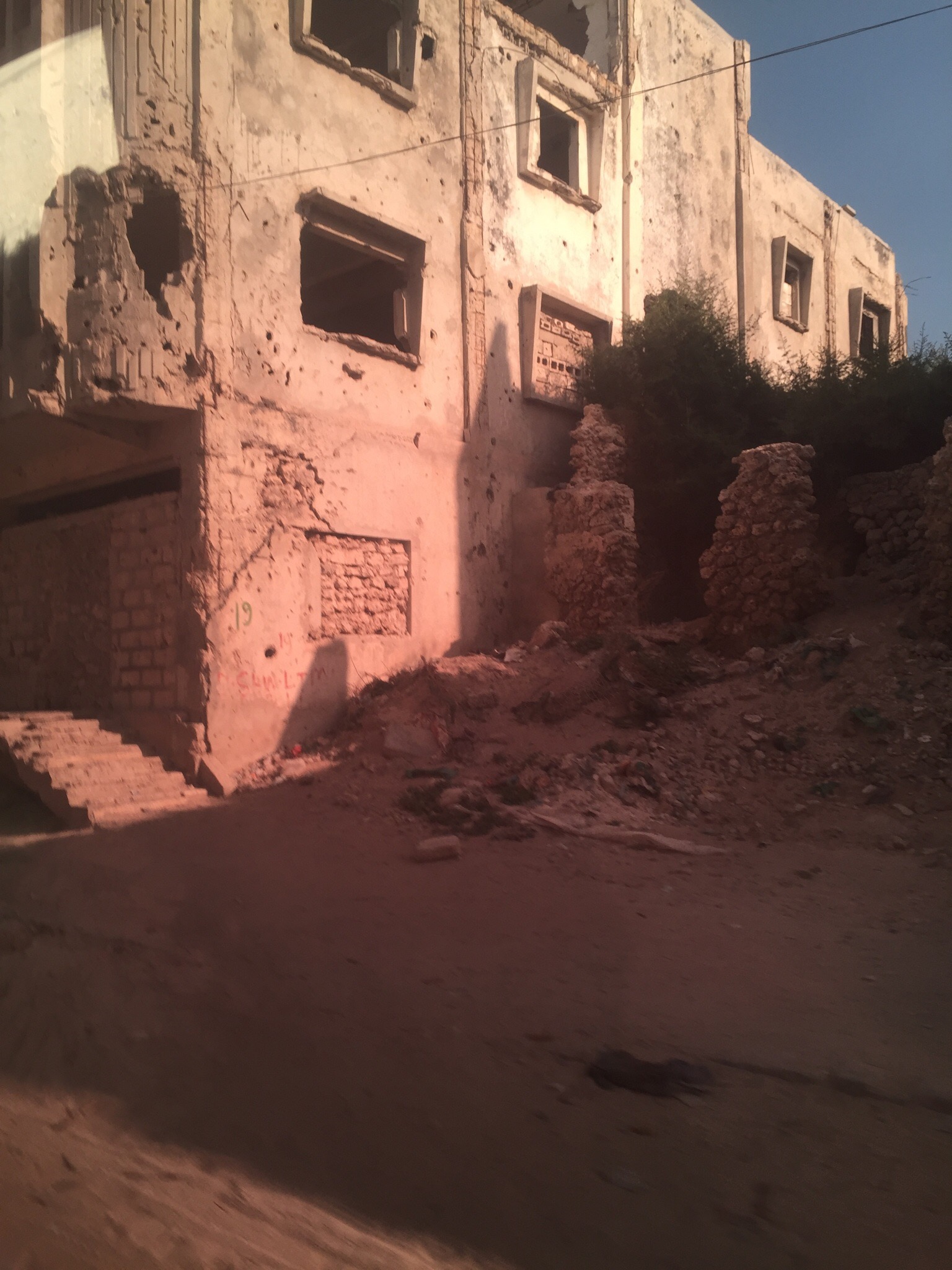
And battered buildings, many “destroyed” but occupied.

  
Even what used to be embassy row… Now protected by barbed wire and suicide bomber walls because peacekeeper soldiers sleep in the wreckage of what used to be the embassies.


But in the end, I went back to a cozy hotel room.

The Amazing Lives of Camels

Our second day in Somalia featured some excursions outside of Mogadishu. We visited… for lack of better terms… a camel dairy farm.

Apparently we arrived at just the right moment as two of the camels were mating. We were told that camels mate for four hours, and we had arrived in time to see the camels finish. (I posted a video on my Instagram account: angelackerman.) A baby camel gestates for 13 months and will have an average life span of 25 years.

Camel milk is touted for its medicinal properties against cancer, HIV and other diseases. We tried some fresh out of the camel (from a communal African bowl) and it was sweet and had an almost vanilla-like taste. I kept comparing it to almond milk in my mind.

They gave us some in a plastic sandwich bag, tied at the top in a knot, to take home. The armed guards in our contingent and our other staff also took some, but they bit the corner off their bag and drank it right away. We put ours in the hotel fridge. After dinner, M bit the corner off the bag (not as eloquently as our Somali hosts) and we poured it into our water glasses.

I mixed up the glasses and M corrected me. At this point I reminded him that we had shared a communal bowl with a bunch of random Somalis and he was concerned about switching our glasses…

We both decided that cold it tasted like milk. We were disappointed as neither one of us likes milk. Maybe you have to drink it warm.


The Coffee Lady in Mogadishu

On our first day in Mogadishu, we were driving back to our hotel, Hotel Sahafi, when the traffic slowed and a gendarme told us that the white car a few car lengths ahead of us contained a bomb. Apparently, a suicide bomber had made it this far (about two miles from our hotel) when authorities noticed the bomb and the bomber-to-be deserted the car and ran.

As a result, the road was closed and we were rerouted until the car bomb could be diffused. We were returned to the hotel and locked in for the night. While our driver and guide were getting information from the gendarme, I noticed this woman making coffee and started taking photos. Since I don’t speak Somali more than “Yes,” “No,” “My name is…” and “Move,” I didn’t realize at the time that we were so close to a live bomb.

Of course I used the time to snap street photography from inside our vehicle. These photos were taken on the outskirts of a makeshift village of refugees who left their homes in flight of the rebel group Al Shabaab.


Departure from Mogadishu

I know it’s a tad in-contiguous to write about leaving Mogadishu before I chronicle our activities in Somalia, but I jotted notes on my phone and wanted to share my impressions while they were fresh.
This was written in the airport and on the plane using the notes feature of my iPhone.

Today was probably the most challenging of our time in Somalia. I’ve become more aware of our guide/”fixer” having more interest in his business affairs and his personal life than our comfort. As isn’t uncommon in more rustic destinations, if we don’t have exact change we can forget seeing our remaining money, despite promises otherwise.

But he delivered on showing us what we came to see and our security detail did their job. 

This morning, we got up and had breakfast intending to leave for the airport at 9 a.m. Our fixer arrives late, provides our souvenirs (and no change). Then he announces our 1:30 flight has been moved to 11 am (and yesterday he implied the flights are overbooked and we may be turned away at the gate).

So in the equivalent of a Third World hurry we hop in the truck and bring with us a Somali fellow also headed to the airport. It is our last time leaving via the hotel’s security measures and we zig zag up the route to the airport.

The airport is 10 minutes away, very close to the UN compound. We approach, walls beside us to protect from suicide bombs, barricades and barbed wire. Traffic chaos as everyone tries to reach the chute that leads to the airport.

It takes 30 minutes to get to the first checkpoint. Ugandan peacekeepers and local security ask for our passports, gaze at our white faces, greet “good morning,” scan the car for bombs.

One official wants our bags removed from our possession. I believe our staff protests that we don’t have time for that and they want to get the Americans to their flight. The bags are returned to the truck.

Two of our hotel security detail have left the truck and watch cars around us, passersby and the scene in general. I’m starting to know them: the skinny one with the full goatee, the badass looking one with his big shiny sunglasses. 

Heavy military vehicles roll by one after another.

It’s 10 a.m. and we weave to the final checkpoint, a boom arm that blocks the road in front of the actual airport. The Ugandan peacekeeper in his camo and sleek pink sunglasses waves us toward the end of terminal. A local gendarme without firearm directs us to the parking lot. After ten minutes of banter in Somali, we leave the car and walk to the terminal.

We arrive at the airport. One of my souvenirs from Djibouti raises an eyebrow at security. I knew exactly why they wanted me to open my suitcase. It’s a gift I bought for my husband.

We have to go to the ticket counter for a stamp on our e-ticket. We go to check in. We go to another desk where they match our names and passports to what looks like the flight manifest. We go to immigration, probably the quickest part of the process. Ladies in robes and head coverings check our passports and tickets again. A second round of security. Finally the gate.

Keep in mind, the international departure area of the airport is probably the size of a small elementary school gym. And all of this has happened before the departure gates.
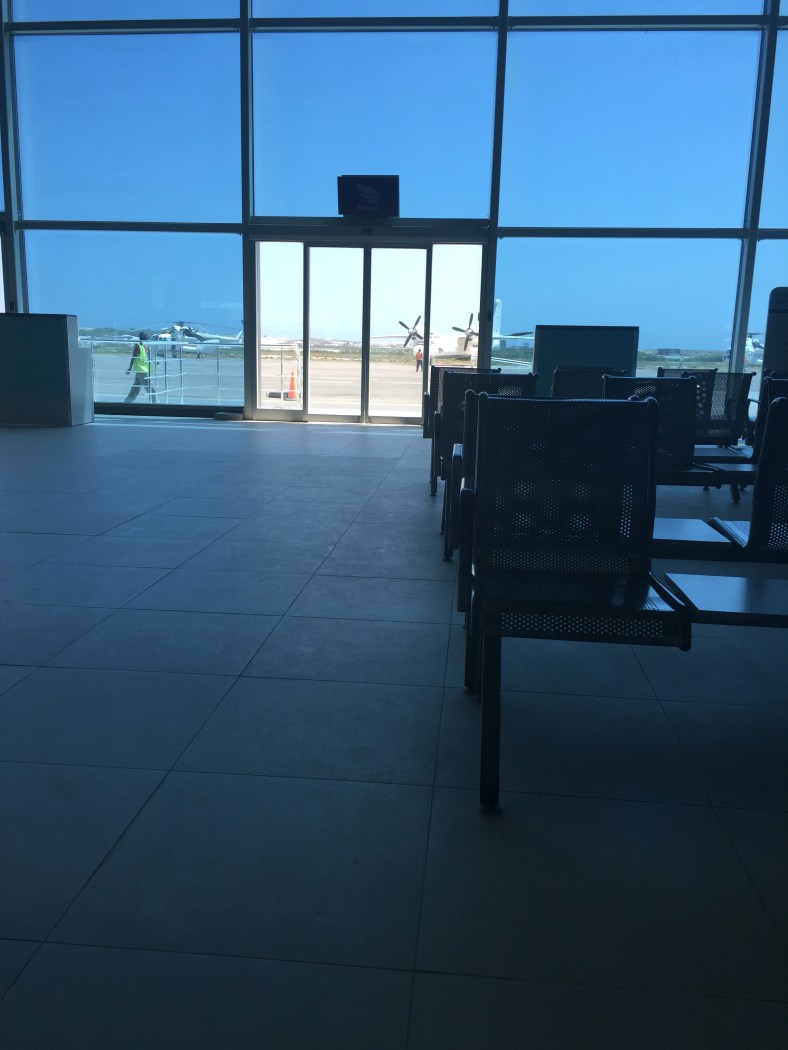
  
At the gate, the bathroom has no water, no soap and at least a functional toilet but no paper, spray or other creative method to cleanse oneself.

M asked about smoking, and one of the staff brought him outside to smoke and back in. 

Plus, the flight to Nairobi scheduled for 2:05 left before we got here, so perhaps there is something to the panic. But the board says our flight is checking in and still listed as 1:30

At the gate, surrounded by windows, one watches the planes arrive. Then the staff comes through screaming airline names & destination cities. They give everybody about five minutes.

  
The plane arrived, a British jet or something with flight attendants that might be Ukranian or Russian. Unlike the ones on the flight down that acted like they were being punished doing a routine between Jedah, Djibouti and Mogadishu. The aircraft smelled like someone had been smoking– we’re guessing the pilots.  
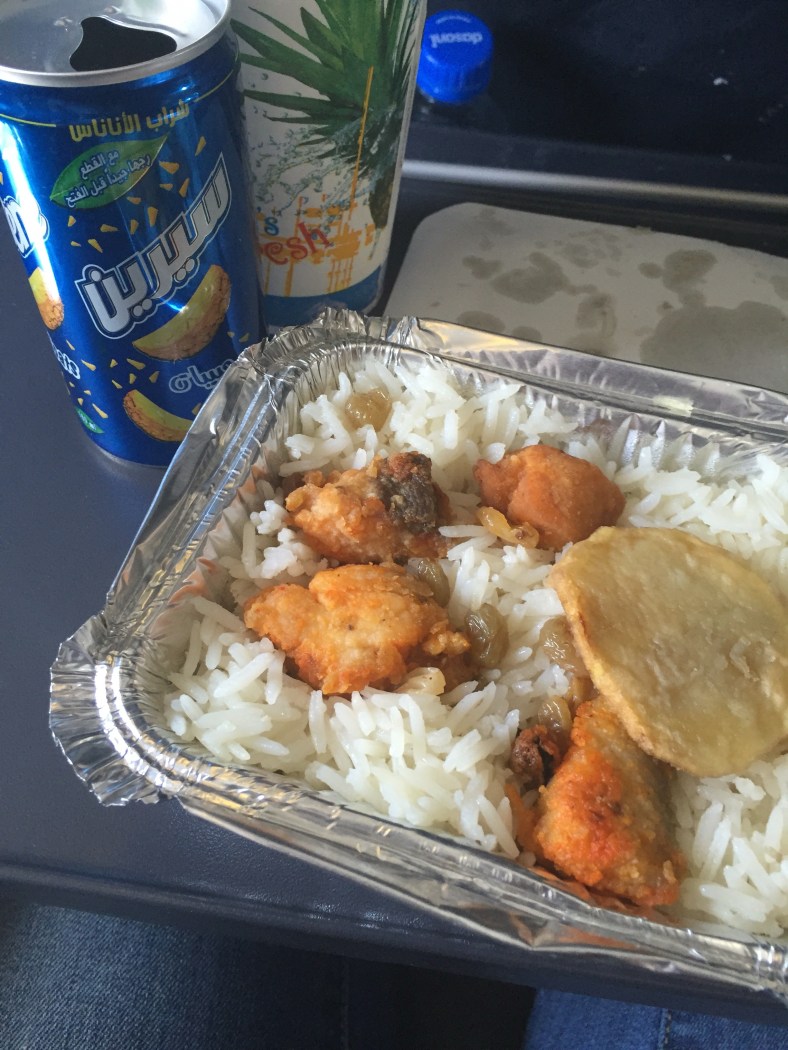
  
This is a direct flight, flight time 1 hour 40 minutes. Meal service was water or pineapple juice and fish with Somali style rice. The flight attendants keep running in and out of the cockpit.

The flight attendant is spraying air freshener neurotically because someone is indeed smoking in the cockpit.

Addicted to Somali Cuisine

I have fallen in love with the food in our hotel in Mogadishu. My amorous affair began with goat, moved to the Somali version of fried chicken, devoured the rice and perhaps might have peaked over the quality of the fruit. And that was just lunch.

I adore eating. I live to eat and enjoy every morsel that enters my mouth.

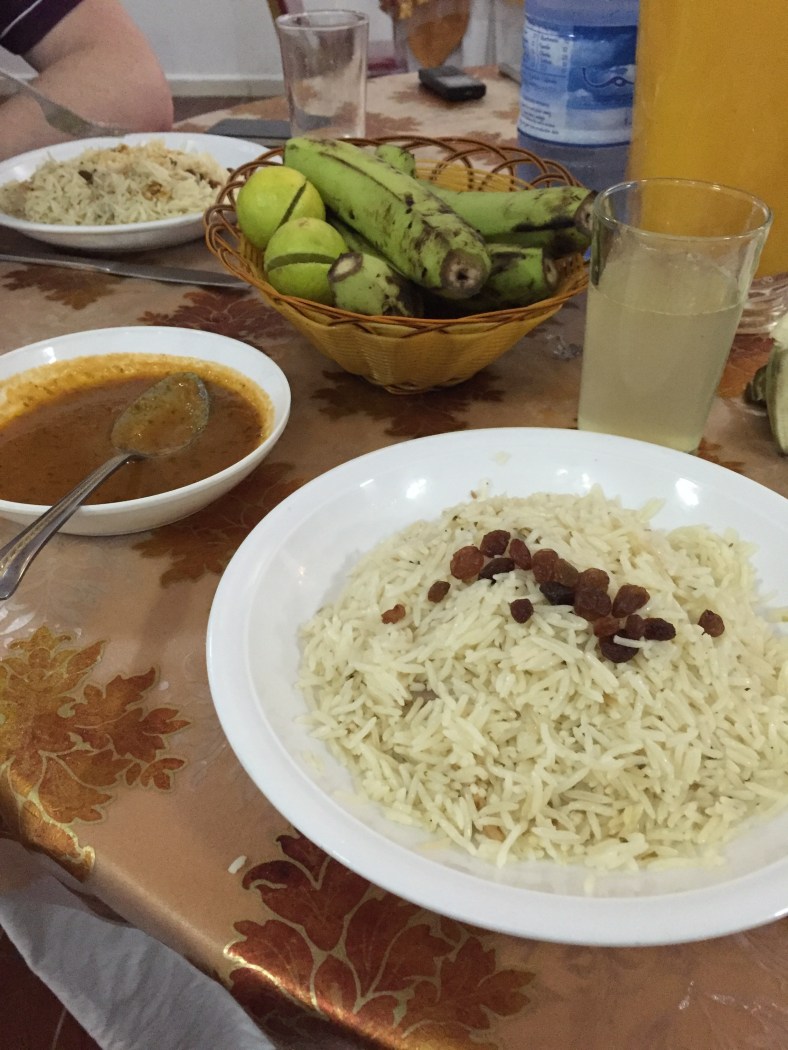
In Somalia, this was the first taste:

IMG_7781

Rice, with “Somali sauce” in the upper right and banana

Have you ever seen rice so beautiful? I added some of what the servers are calling “Somali sauce,” a hot sauce that seems like a blend of harissa and ketchup.

For a main dish I selected goat. M chose chicken. The other option was camel. Hopefully that will be an option again today. I would like to try camel.
IMG_7782

Goat

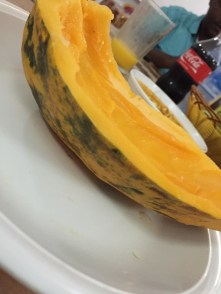
Dessert at lunch and dinner is fresh fruit. Appetizer is the best bananas I have ever had and limes. I am not a fuit eater. At home I occasionally eat a banana and I adore raspberries. I can eat watermelon or strawberries but won’t go out of my way to do so. Well, they bring out this melon after lunch, carefully draping a napkin over it to keep the flies off. I liked it. Was a tad indifferent to it, but it cleaned the palate and had a mild, fresh taste.

IMG_7783

Papaya?

When we returned to the hotel early (due to a failed suicide bomb attempt and a still live bomb strapped to a car two blocks away), we enjoyed a coffee, some sort of donut and samosa.


On the second day, our tour guide/”fixer” told us to wrap the samosa in the donut. I liked them better eaten separately.

Dinner the first night was chicken steak, spaghetti and a vegetable mix of what appeared to be potatoes, onions, peppers and carrots. It tickled my tongue so much I ate enough for at least two people.

IMG_7911

The spaghetti had an unusual spice to it and a little bit of meat, a tad on the dry side but in a good way. M insists the stray herb is cilantro. I wish I would have taken an after photo of this platter. The staff brought this for the two of it and I demolished most of it.

IMG_7912And then came the fruit course, lovingly and carefully covered with a napkin. I do not eat fruit. My daughter on the other hand eats fruit as if she were part monkey. I ate the papaya (? on the bottom) first. I liked it. Then switched between the mango and the watermelon. In comparison to the mango, which had a texture that melted in your mouth and a potent flavor as if someone had condensed it, the watermelon (though juicy and the most flavorful watermelon I have eaten) seemed bland.
I had noticed earlier in the day, a man in a fouta that squeezed the limes into his water. I had also seen the lime squeezed over the rice. Definitely an “a-ha” moment. M added lime to the Coke he was drinking to combat a caffeine headache. And the staff constantly offers us Coke and bottled water. And the occasional Sprite.

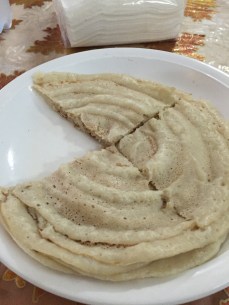
Our guide suggested we try Somali injera for breakfast to compare to the Ethiopian version. Our server offered us “omelette,” liver or porridge for breakfast and seemed a tad surprised we wanted injera. We ordered omelette and then he asked how we liked our omelette. His first offer was “scrambled” so I accepted that and assumed omelette was his term for eggs. He brought a giant portion of eggs, injera and, of course, we asked for Somali sauce. I really believe they make it for us fresh when we request it.

IMG_7924

Somali injera for breakfast with “omelette”

The injera has a crisper texture and is less spongy than the Ethiopian.

Meanwhile, at a nearby table, I watch the same man who revealed the uses for lime. He was having raw egg and honey for breakfast.

When we returned to the hotel for lunch, we dined in the fancier dining room and had no choice of goat or camel. Merely fish, chicken leg or chicken steak. But we started with a lovely cream of vegetable soup, with fresh juices: mango, watermelon and limeade. I drank them all and all delighted me.

Our dinner last night repeated the dinner the night before, and breakfast was also the same today. I must come back and try the camel some day.

Called a Chinese tourist 

My friends mock me for taking so many photos, and truth be told most of them get deleted by the end of the day.

This morning the idea that I might need an intervention hit home when a Djiboutian man pushing a wheelbarrow saw me taking photos in the street and greeted me with a hello in Chinese.

M’s main mission for today was to buy a simm card for his phone so we’d have a local number. After coffee, croissant and bread (yes, we got up before they ran out), we headed to Djibouti Telecomm.

The day started out at 79 degrees and 50% humidity. It honestly gave me a bit of a chill. Quickly, the humidity built. The sun came out and we began to bake and sweat.

M went into the telephone office and I opted to wait outside and watch people. I noticed that I can now distinguish some basic words in Somali, which with my abysmal ear for languages is impressive.

Only one man talked to me and our conversation, in French, went something like this:

Man: How’s it going?

Me: it goes

Man: You live in France
Me: No 

Him: You live here 

Me: No

Him: But you are French

Me: No 

Him: But then…

Me: I am American

At which point he departed. Abruptly, scratching his head.

We walked town a bit and stopped for coffee and juice at Bunna House. We freshened up at the hotel and went to the rotisserie stand in front of City Burger to buy a herbed, spiced roasted chicken.

  
We ripped that chicken apart with our hands, using tissues as our napkins, picking through skin, bones and the paste remaining of chicken guts. It was amazing.

We then went for a walk, knowing full well we were approaching the 1 pm shutdown of town. Let me say that if we attracted attention in the market at other times of day, today we learned that at 1 pm, we’re the only people out there and the locals descend upon us like vultures.

  
We took brief naps and then made our daily visit to Nougaprix where today we bought two “coconut brownies.” Very dry but tasty. The two of them cost, together, about 75 cents.


Dress Quest in Djibouti

There’s a dress I want, but every time I step into the women’s shop, surrounded by women, a man from the street dives toward me to help me with the purchase. He will then receive a commission from the shopkeeper and it aggravates me because I only receive this treatment because I am white.

I bought two dresses, from two different shops today, with a unwanted helper, but paid 2500 Dj Francs. That’s about $13.50. It’s also what I paid for my dinner last night at the sit-down restaurant of high quality.
  
The dress I want comes with the headscarf and my first helper wanted me to pay 5,000 Djiboutian Francs. 

I returned later, hadn’t even expressed interest in the dress when a different man swooped in upon me while a woman insisted on trying to sell us incense.

Today M and I started out early and wove through the side streets and alleys of the market to sneak into my shop from behind.

We did it. Walked up to the counter and asked for my dress. An older Djiboutian woman in a mountain of colorful textiles leaned over and pinched the fabric as I held it. She nodded her approval.

And so I bought it. For 1800 Dj Fr. About $10. With the scarf. And to think I paid 2500 yesterday.